


By Ryan Jordan and Andrew Marshall
Introduction
This gear guide features trekking poles of various designs that weigh less than about a pound per pair. We screened 109 models from more than a dozen manufacturers and culled the final list down to 14 models for a more detailed analysis and review.
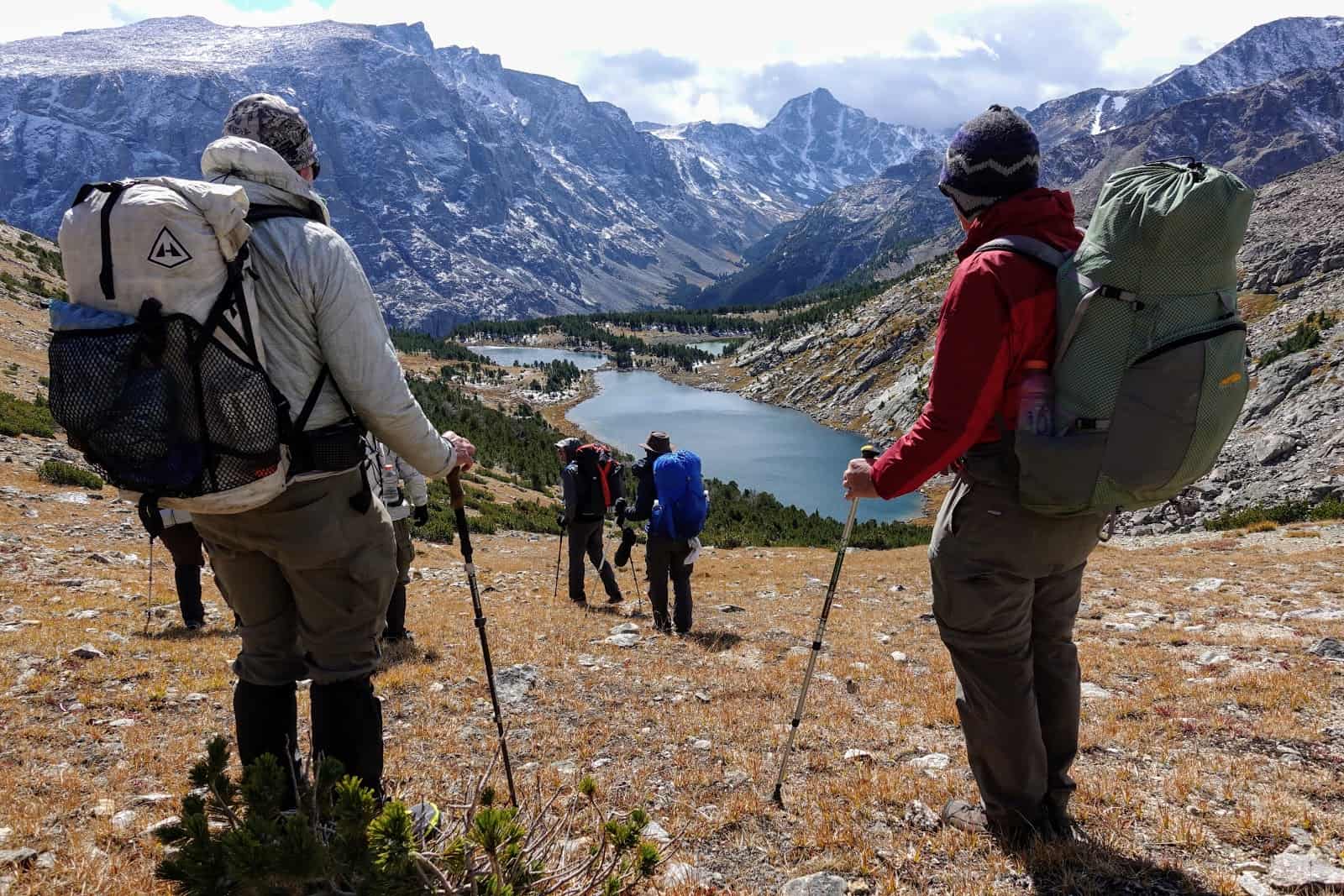
In addition, you’ll find numerous trekking pole skills videos in this gear guide that will aid you in making informed buying decisions and help you use trekking poles properly to get a reasonable amount of performance out of them.
This gear guide will include:
- A discussion of design considerations for trekking poles.
- A list and explanation of performance criteria.
- An overview of the trekking pole market.
- Reviews of each of the 14 trekking poles included in the article.
- Recommendations from the authors.
What about trail running, ski, nordic walking, staffs, and walking poles?
Trail running poles are typically minimalist in nature; they are compact (usually via a folding mechanism), and have minimalist grips, straps, and tip housings. Some are suitable for hiking. Likewise, some hiking poles (as included here) are also suitable for trail running. This gear guide does not include poles marketed exclusively to trail runners.
Ski poles usually have plastic or rubber grips for better friction with ski gloves, a fixed length, and include snow baskets (sometimes not removable) as a matter of routine. A variety of ski poles known as slalom poles have bent shafts. Ski poles are not included in this gear guide.
Nordic walking poles are longer than trekking poles, have different tip styles (most often, rubber), and narrow-diameter grips without much ergonomic shape to them because Nordic walking technique doesn’t favor a tight grip. Nordic walking poles are built for speed and exaggerated arm motion and are not generally considered to be appropriate for trekking. This gear guide does not include Nordic walking poles.
Staffs are usually taller and thicker poles, often made of wood, decorated with little metal trophy badges, and are most often carried by Scoutmasters and other people who enjoy going slow, carrying a lot of gear weight, and feeling nostalgic. We don’t review them here.
Walking poles are poles marketed specifically to a consumer market of fitness-minded people who don’t care so much about gear performance but want to feel good about using gear that looks cool – like the trekking poles carried by ultralight backpackers. Walking poles aren’t reviewed here.
What are the benefits of trekking poles?
Well, that depends. Do you wear a lab coat, are you a YouTuber/blogger, or someone who wants to get the most practical performance out of their hiking gear?
People who wear lab coats (the science guys) have performed a wide range of studies that tout the benefits of trekking poles. Some of these benefits include:
- Using trekking poles reduces the force of impact of your feet on the ground.
- Using trekking poles increases caloric expenditure, giving you a better cardio workout.
- Using trekking poles decreases effort, thus saving energy.
Manufacturers of trekking poles love these studies although a seemingly equal number of people who wear lab coats have performed studies that refute these same claims. Science enthusiasts who like to criticize scientists claim that the results are inconclusive because of poor experimental design, too few subjects, unrepeatable experiments, and more.
That leaves us with YouTubers and bloggers who make money by convincing their viewers/readers that they must purchase trekking poles because they offer enormous benefits for every person on the planet. It’s hard to blame them. They have to pay their camper van payment, after all. We’re not immune to this bias, but we do our best to resist it. Be sure to review our affiliate disclosure at the end of this report.
So let’s stick to the concrete benefits of trekking poles without trying to convince you that truth can be pulled out of nowhere:
- Trekking poles are a multi-use item that can be used to pitch shelters like tarps, tarp-tents, and pyramids.
- Trekking poles aid balance and stability if you’re moving fast downhill with a big pack. The bigger the pack, and the faster you’re moving, the greater the benefit.
- Trekking poles can aid balance and stability on very rough terrain where your feet are constantly off-kilter. Examples include the Pennsylvania AT, High Uinta shale, Alaskan tussocks, and the JMT during a high snow year.
- Trekking poles give you something to do with your hands on a thru-hike, which can be really boring at times.
- Trekking poles are useful for hiking with an injury such as a sprained ankle or knee.
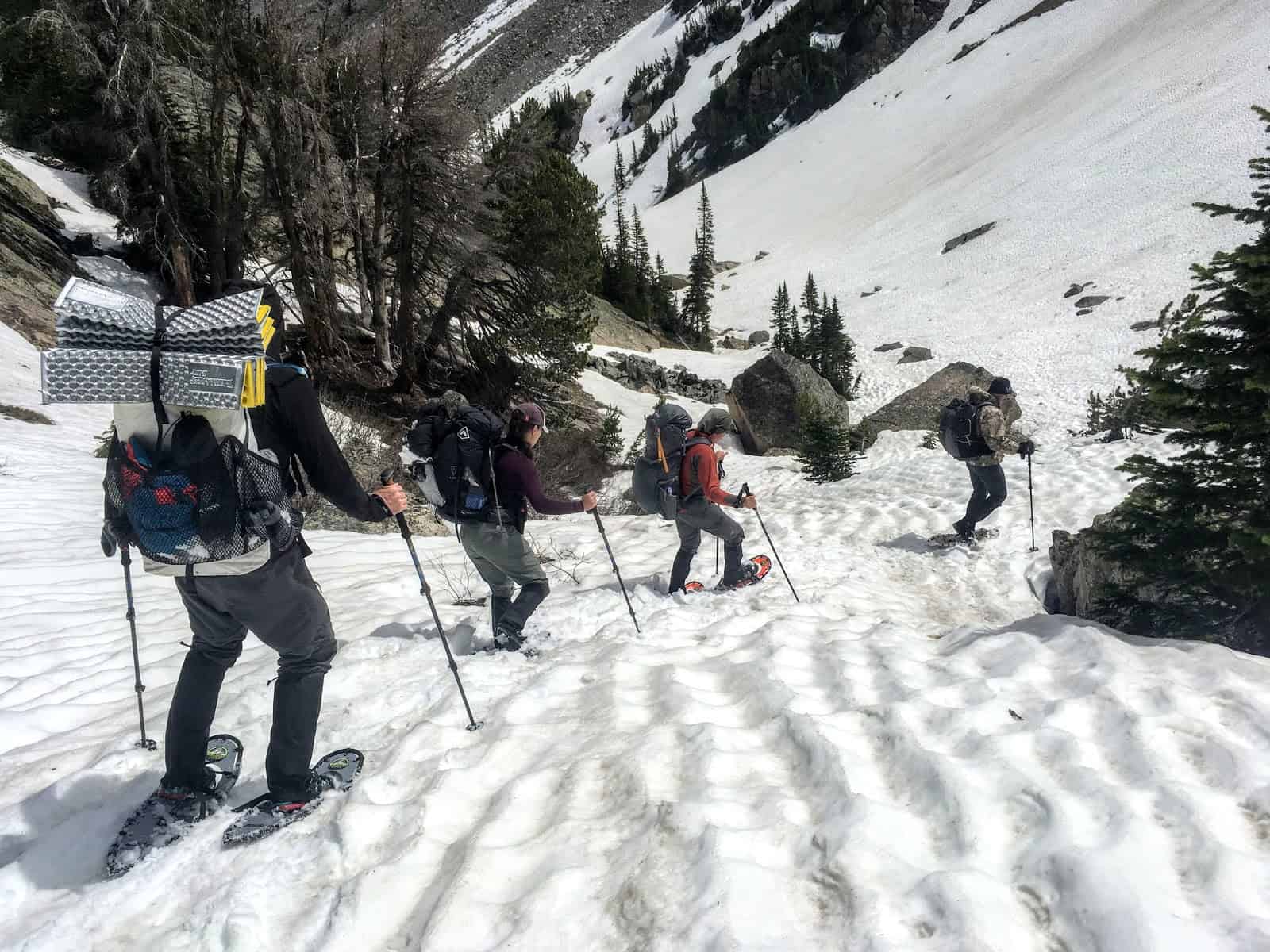
Are trekking poles useful for maximizing your physiological performance on a trail with little elevation change? Probably not. The data doesn’t support it. For example, here’s a study that suggests that hiking pole use increases energy expenditure while hiking uphill. Ouch! How do we expect to promote trekking pole sales with science like this?!
Are trekking poles going to “save” your knees, wrists, elbows, hips, back, neck, or feet? Probably not. The data doesn’t support it.
Can trekking poles be used as a weapon against wild animals? Possibly, but we don’t review that performance criterion in this gear guide.
Do trekking poles make you look like a more experienced hiker? Maybe, maybe not. Just be sure you learn how to use them.
Design Considerations
Shaft Material
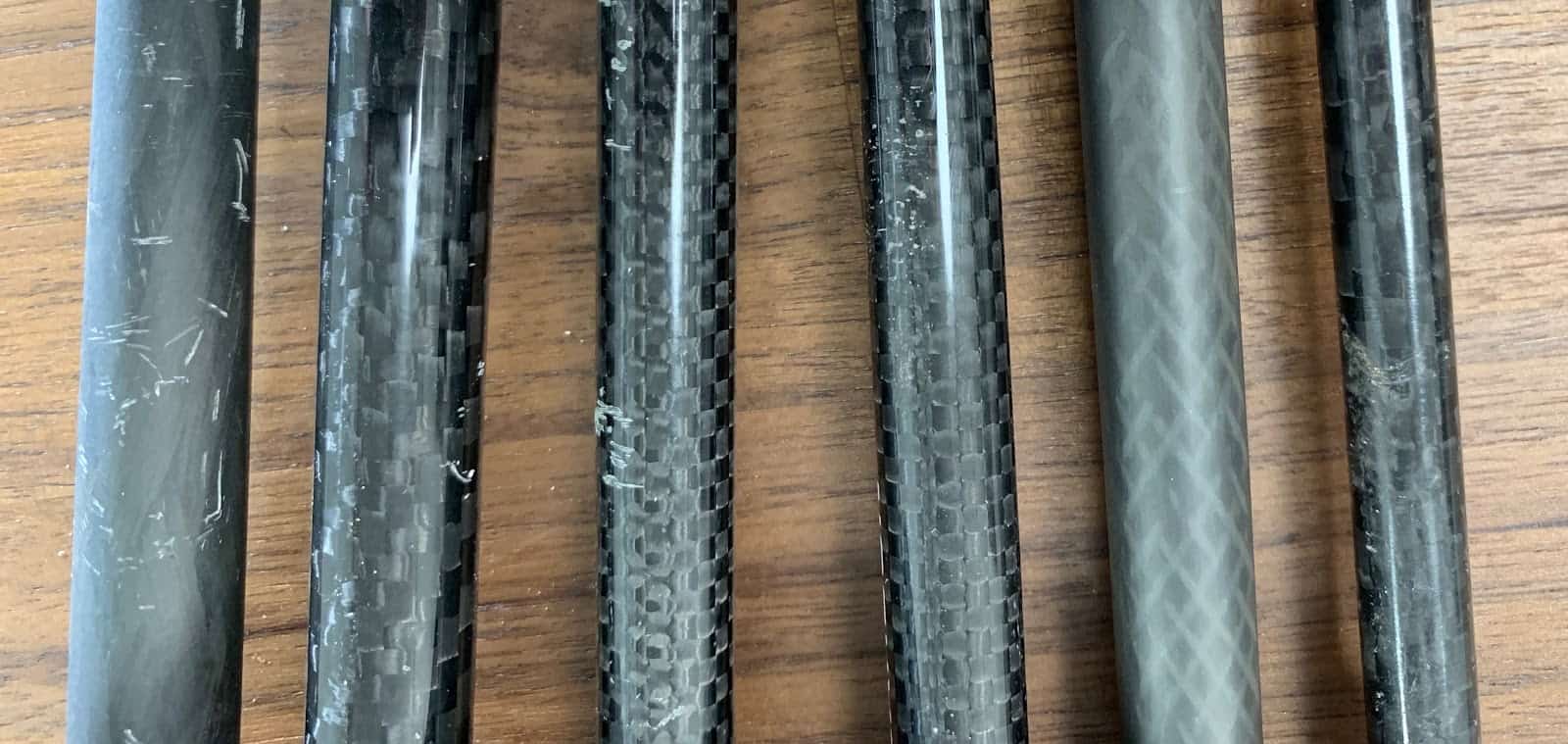
Trekking pole shafts are made of either aluminum or carbon fiber tubing. Although carbon fiber is known for its high strength-to-weight ratio relative to other materials, one can’t really make the conclusion that carbon trekking poles are lighter than aluminum ones. Instead, the best we can do is compare two hypothetical pole shafts that have the same diameter and wall thickness.
For these two hypothetical pole shafts:
- The carbon fiber pole would be much lighter (30-40%) than the aluminum pole.
- The aluminum pole would be less brittle than the carbon pole, which means that it would be able to absorb more deflection from bending and thus, be more resistant to breakage.
- The carbon fiber pole would be much stiffer than the aluminum pole. In theory, this should make the carbon fiber pole more energy efficient when used for ascents (i.e., less energy loss due to deflection).
The lightest available trekking poles are made of carbon, but they’re also poorly durable and are prone to breakage near the pole tip when the tips get stuck in mud, vegetation, snow, or talus.
Straight vs. Bent Shaft
Bent pole shafts are used primarily in slalom ski racing poles, where they offer some efficiency when tucking them behind you as you clip gates. They offer no utility for slow-motion sports like hiking, backpacking, snowshoeing, and Nordic skiing.
Locking Mechanisms
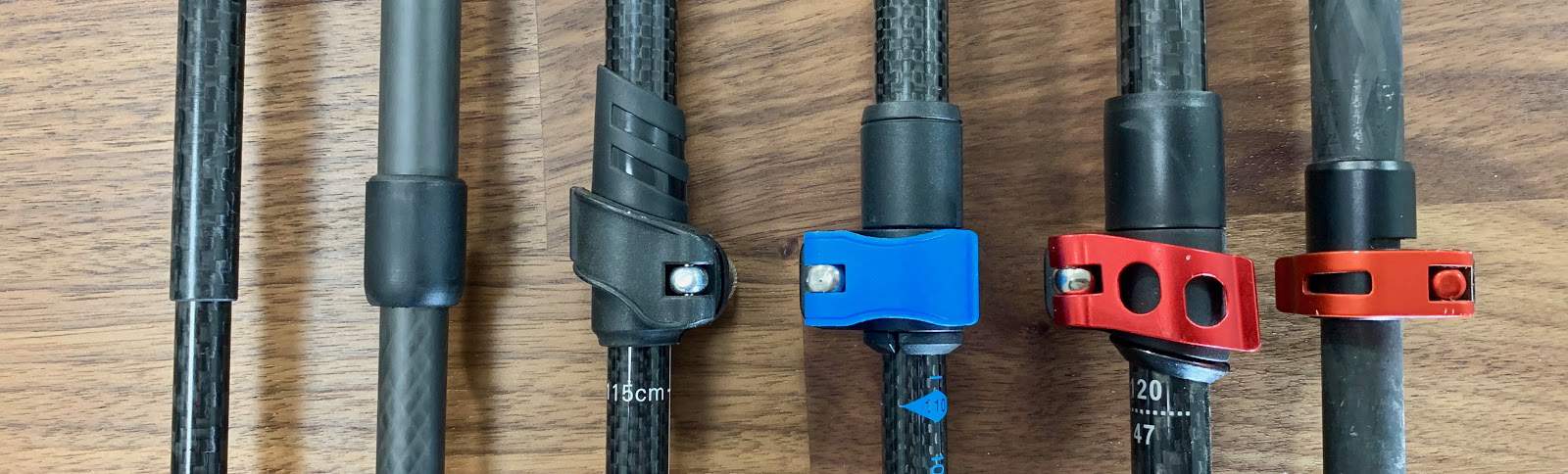
There are three major types of pole locking mechanisms: Twist-lock, lever clamp, and push button. Less common mechanisms also exist: foldable and hybrid.
This video illustrates the different types:

- Twist-lock: In a twist lock mechanism the user rotates pole sections in opposite directions, causing a screw-activated expander (“expansion nut”) inside one of the shafts to tighten against the inner wall, creating an action similar to a compression fitting. This closure type is prone to mechanical failure due to dirt or grime fouling the expander mechanism. It can also be difficult to adjust in wet or cold situations, or while wearing gloves because of the need to maintain a tight grip while rotating the pole shafts.
- Lever Clamp: The lever clamp works by tightening a band around the trekking pole sections to lock them into place. Most lever clamp mechanisms have a tightening system to adjust the tension on the lever. This system is easier to operate while wearing gloves.
- Push Button: This system works like a pop-up picnic tent pole: it uses a spring-loaded button and a series of pre-drilled holes to lock into place. The downside is that the lengths are pre-determined and the button can jam. Blood blisters are common when depressing these buttons in cold weather, when finger skin gets caught between the button shaft and hole!
- Foldable: A relatively new type of collapsing trekking pole is the foldable pole. Foldable pole sections collapse similar to a shock-corded tent pole, and when assembled, are secured in tension with a push button mechanism. Foldable poles are not typically adjustable.
- Hybrid: More than one pole locking mechanism can be used on a single trekking pole. For example, foldable poles may also have a lever clamp fitting on their topmost section to allow for a minor amount of adjustability.
Shock Absorption
Trekking poles with so-called shock absorption mechanisms in them (springs) are supposed to “reduce impact.” That sounds like a neat benefit, doesn’t it? Impact reduction must translate into preventing a catastrophic ligament tear while hiking, right?
However, the science that arrives at this conclusion is sparse and dubious. Research from the Department of Biomechanics and Kinesiology at Germany’s Tübingen University suggests that anti-shock mechanisms can reduce peak impact forces by as much as 40%. However, the link between “reduction of peak impact forces” and “protection of muscles, ligaments, and joints” (as Leki claims) is a very weak one. Worth noting is that while Leki supports this claim by referring to the aforementioned “study”, no source in a peer-reviewed journal is provided, so it wasn’t possible to verify whether the study was independent, or funded by a pro-trekking pole actor (e.g., trekking pole manufacturer).
In another study, researchers did not discover any meaningful difference in load transfer forces between the foot and ground among hikers carrying weighted packs on level terrain, whether the hiker was using shock-absorption poles, non shock-absorption poles, or no poles at all.
A review of anecdotal experiences from other hikers posted to our forums indicates a mixed preference for anti-shock trekking poles:
- “…they work well for my knees, wrists, and elbows.”
- “I vote for shock… I like them on the down hill.”
- “I have [poles] with antishock, and I actually like it. The spring is very rigid, so it doesn’t flop around or make noise. I have to put considerable pressure on the pole for it to depress the spring all the way. For me, it does reduce the shock without any stupidness (over-hyped gizmo factor).”
However, the anecdotal evidence against anti-shock poles was not only more prevalent, but based more on direct observation of instability, noise, mechanical failure, increased weight, and higher cost:
- “. . . I never liked the antishock ones. It felt like I was putting the stick in some mud every time i planted. Even on hard ground.”
- “I tried poles with shocks … and the repetitive little sproinky noises the poles made just really bugged me [. . . and] the shocks added nothing to the experience for me…”
- “I found them noisy, had a ‘rattle’ feel to them and pretty much pointless. I can’t see the advantage of a shock. . . Save yourself the weight, distraction and complications…”
- “The shocks [. . .] wear out eventually, and get loose and sloppy.”
- “Scared the hell out of me when I took a stumble and thought the poles were going to give way. I mostly use my poles for balance when crossing creeks so something solid is preferable for me.”
- “I use my poles for balance, I don’t want any give in the suspension to disguise the feel.”
- “On an AT section hike I left a pair of anti-shock Lekis at a shelter one morning and didn’t realize it until 2 miles later. It must have been the peace and quiet that distracted me. I actually considered if the poles were worth the 4 mile round trip to get them back. To be truthful they weren’t. Gimmick!”
- “I’ve owned both shock and no-shock and I greatly prefer regular lightweight poles without springs. It’s like a tight little sportscar, you can feel the road better with a tighter suspension.”
- “I personally hate them. Too loud, no feel and I’ve never seen a pair that didn’t break.”
- “I have two pair of trekking poles, one [. . .] with the antishock gizmo, and one [. . .] without. I would never get poles with the antishock device again! [. . .] The anti-shock device is noisy (click, click, click at every step) and adds to the weight. I haven’t found that it did anything for my wrists (I was worried about my carpal tunnel syndrome), either! I haven’t had any hint of a wrist problem with either pole.”
- “I fell several times when I slipped and planted the pole hard on rock, and the ^$% anti-shock *bounced* off the rock instead of digging in, and down I went.”
- “Antishock poles are noisier and more expensive, while adding no real value.”
- “I used anti-shock poles once…and promptly gave them away. I couldn’t help but feel like I was never planting them firmly or they were flexing.”
- “Less cushion + no toy sound = wonderful.”
It’s worth noting here that Leki has introduced a new type of shock absorption mechanism that is based on the elasticity of stiff rubber introduced as a bulbous gasket above the tip of the pole. Having used poles with these new shock absorption mechanisms, I (Ryan) do find that they are quieter and stiffer than traditional spring-loaded shock absorption assemblies. However, I’m not convinced that they are worth the added weight or swing effort.
That said, it is the opinion of the authors of this review, based on a lack of authoritative scientific evidence, anecdotal user reports, and common sense, that anti-shock poles probably offer no utility for backpackers who are interested in maximize the performance-to-weight ratio of their trekking poles. In addition, we are in favor of simplification over unnecessary complication in order to minimize mechanical failure points.
Therefore, anti-shock poles will not be included in this gear guide.
One user who posted on the same forum perhaps summed it up best: “Maybe I’m not getting it, but I never understood the point of the shock. I just figured it was a marketing thing.”
Yep, us too. Buyer beware.
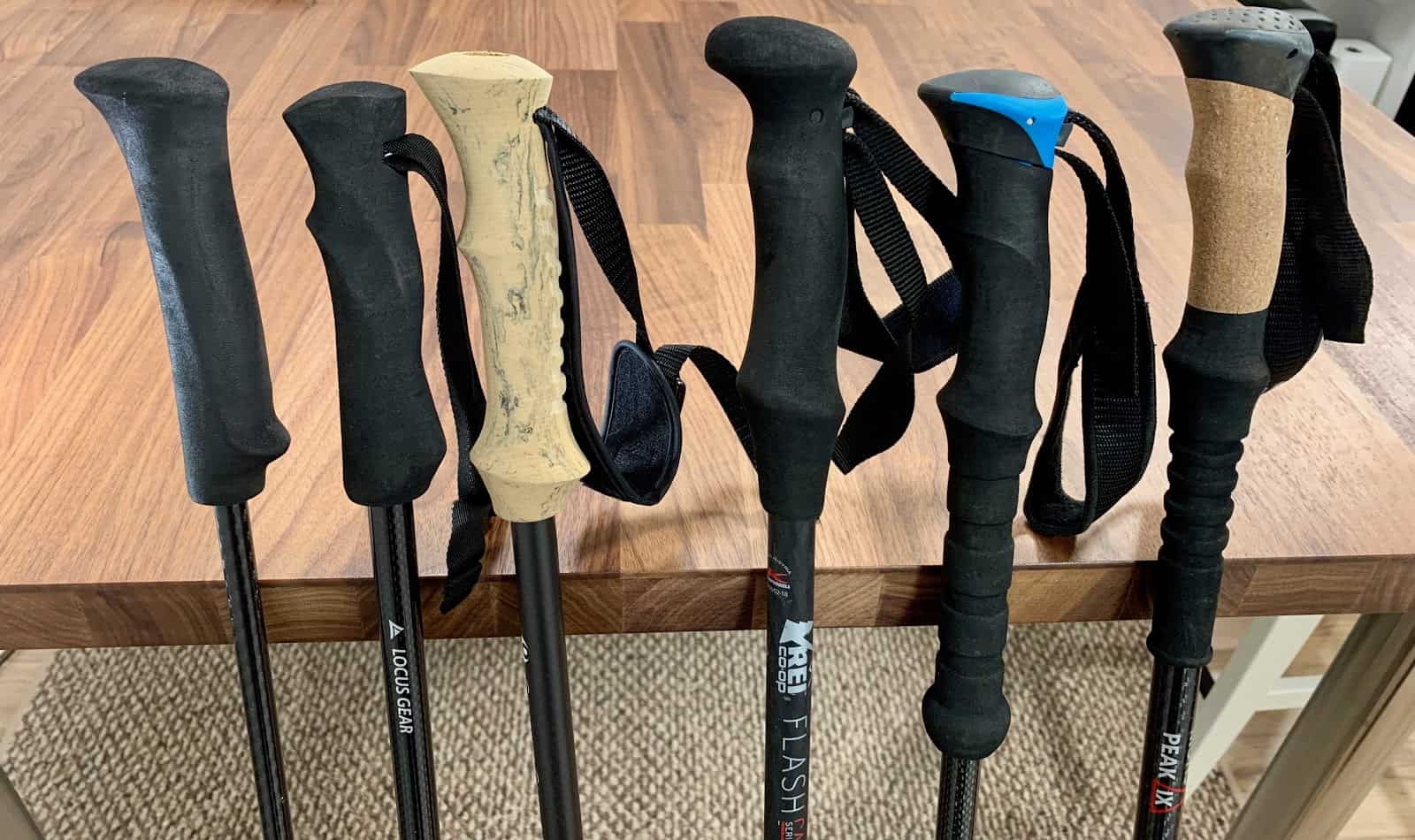
Grip Ergonomics and Materials
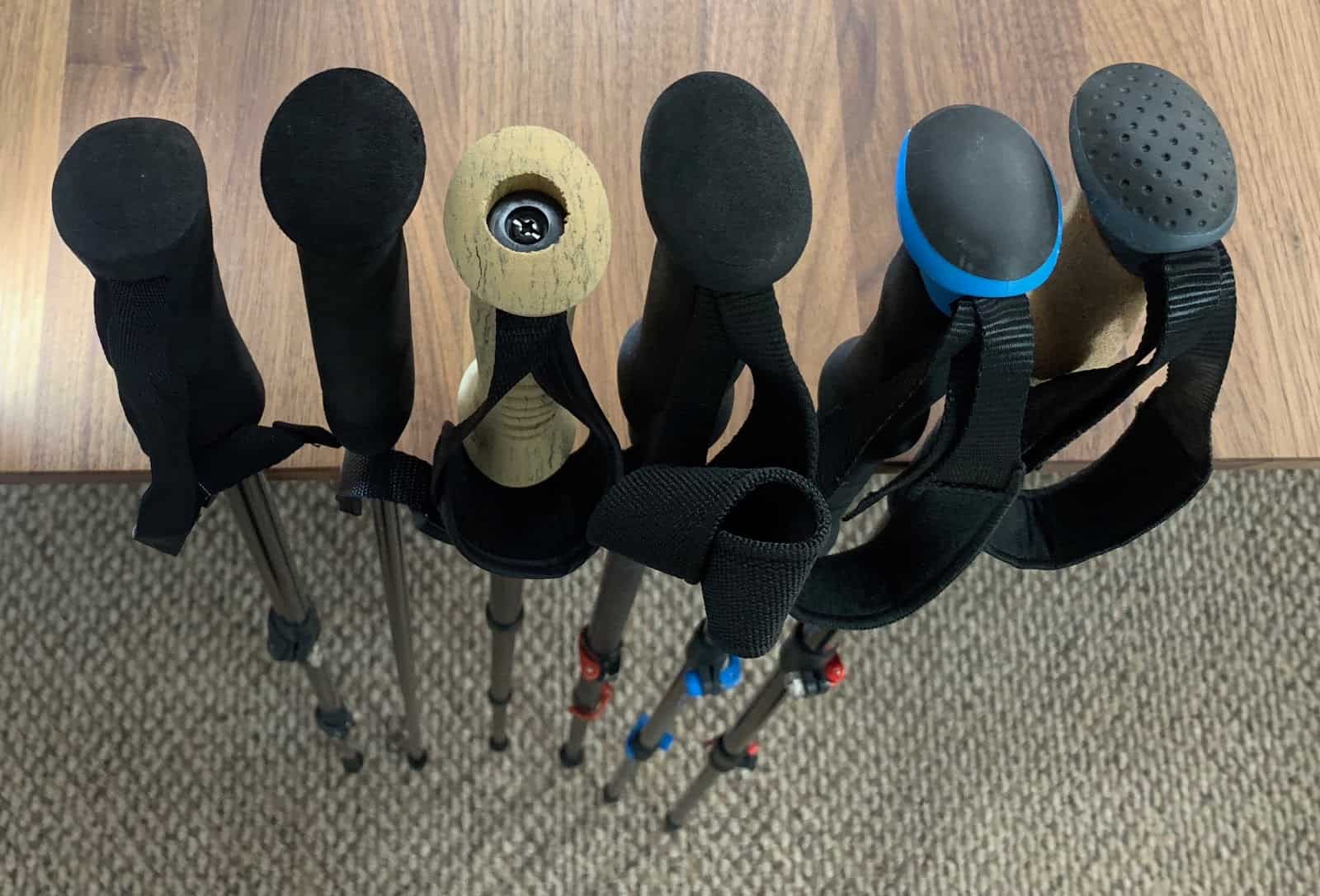
The ergonomics of trekking pole grips are defined by the grip material, knob/cap size and material (grippier is better, larger is better), trigger finger rest, palm rest, extended grip, extended grip friction (channels or ribs), and extended grip palm rest.

The grip material is the part of the pole most often in contact with your body, so choose wisely.
- Rubber: A rubber grip absorbs a great deal of shock and vibration. It has the potential to chafe or blister sweaty hands due to friction, while also be insulative on cold days.
- Foam: A foam grip is soft and cushy, but absorbs sweat, body oils, and dirt (making it difficult to clean) and breaks down quickly, causing it to lose some of its original ergonomic shape.
- Cork: A cork grip is a good blend of cushion and moisture resistance. While easier on sweaty hands than rubber, it can feel a little colder in frigid temperatures.
Foam grips are the lightest and most comfortable (when new, at least). Rubber and cork grips are heavier and more expensive but easier to clean.
Grip Angle
Some companies market “ergonomic grip angle” as a trekking pole feature. Such grips are angled about 15 degrees “forward” and are proposed to keep the arm and wrist in a more naturally-aligned position.
Once again, no scientific evidence exists that supports this claim, and at least amongst the hiking community, anecdotal evidence is conflicting. Most people who identify as lightweight backpackers tend to prefer non-angled grips because of cost savings, experience that suggests that they don’t offer any benefit, and perhaps their intrinsic bias against marketing BS.
Ergonomically (theoretically) a forward grip angle would only benefit faster hikers who plant their poles ahead of their stride, and use poles that are typically shorter in length than what manufacturers advise. The extreme (and probably the only appropriate) manifestation of this are the 45-degree angled and very short Pacer Poles, which customers seem to rave about.
Extended Grips
On some models, you’ll find a foam tube surrounding the shaft below the main handle. This allows you to “choke up” on steep climbs rather than taking the time to adjust the poles to a shorter length.

Foam is essential for an extended grip because you’re wrapping your hand around the shaft instead of contouring it around an ergonomically-shaped hand grip. Foam is sticky and helps you maintain that grip. Some extended grips are ribbed for additional friction.
Strap Design
Straps or no straps?
Manufacturers use three strategies for straps: no straps, wide straps lined with wicking fabric, or something in between.
Straps offer three key benefits:
- Poles sometimes get stuck in mud or snow or rocks, and upon forward propulsion, your hand leaves the pole grip. Straps keep the pole in your possession so you don’t have to go back to retrieve it.
- A properly adjusted strap allows you to exert downward pressure on your wrist that can provide more stability. To this end, an adjustable strap properly fitted is essential.
- When bushwhacking or rock scrambling, straps allow you to release your poles so you can use your hands to grab handholds on rock or deal with dense brush.

Wide straps with wicking fabrics are comfortable for long ascents but add weight.
Think twice before purchasing strapless poles, or removing straps from your poles. I (Ryan) used to be a passionate advocate for strapless poles due to their aesthetic simplicity, but I’ve since reversed my position about straps. For off-trail travel in steep and mountainous terrain, poles with at least rudimentary straps on them are essential for me.
I (Andrew) agree wholeheartedly. I’ve lost strapless trekking poles on complicated river fords. Additionally, straps allow you to loosen your grip on the pole over easy terrain, giving your hands a break on long (thru-hike) expeditions.

Tips
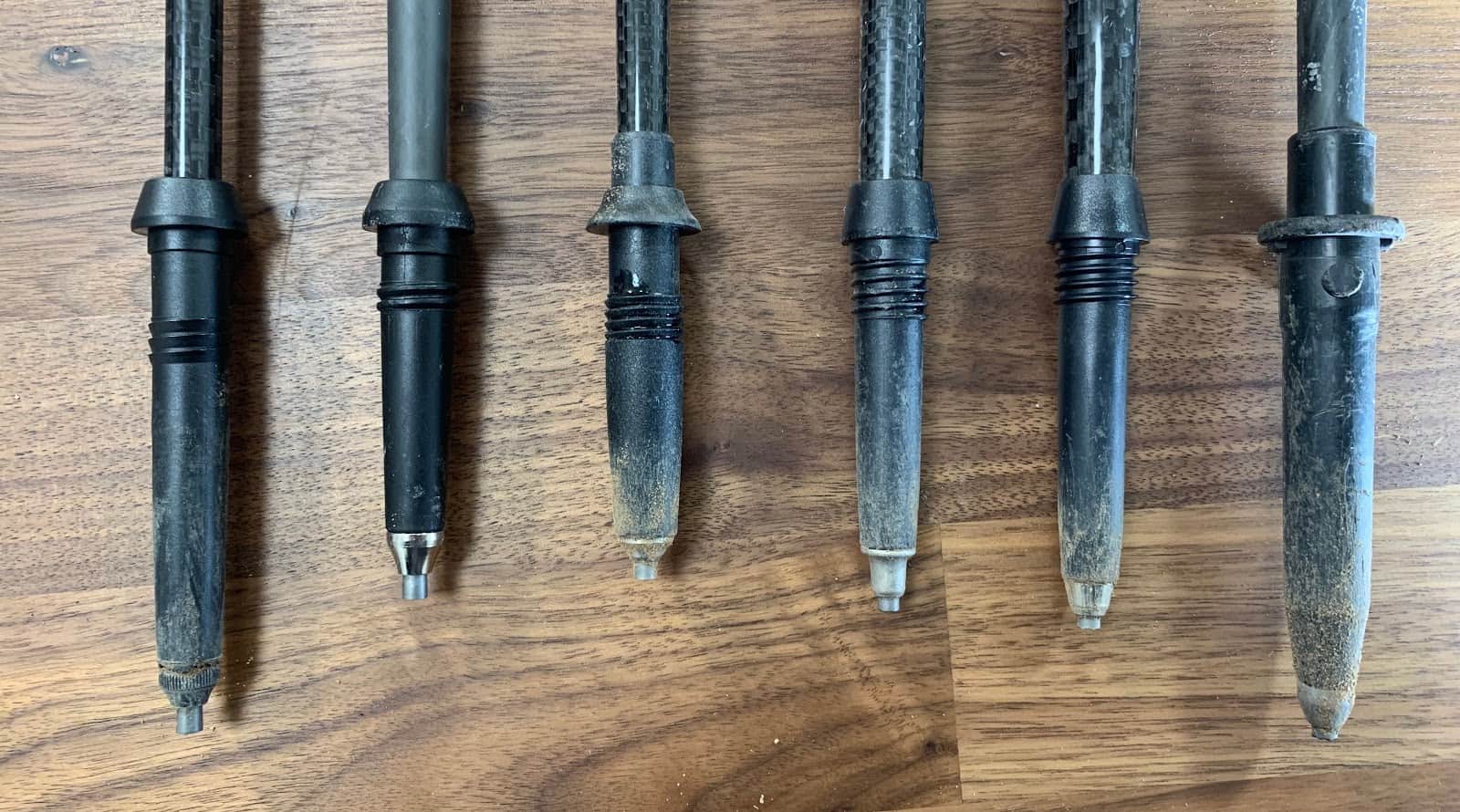
Most trekking poles ship with carbide-tipped plastic end caps. Carbide is durable and provides a precise grip on rocky terrain.
You can purchase aftermarket rubber tip caps that slip over the carbide tips. The advantages to rubber tip caps is that they don’t leave holes on the side of the trail (some feel that this is an important leave-no-trace consideration on heavily-used trails), dampen the “click-click-click” noise of the tips coming into contact with the ground on every pole plant, and provide better traction on some types of rock (but only when dry, and only if the poles are planted nearly perpendicular to the ground surface). Some thru-hikers carry them for long road walk sections.
Rubber tips add weight, and we’ve found so many on the trail that have fallen off that they are a meaningful source of trail litter in high-use areas.
Baskets
Poles without tip baskets are lighter, swing easier, and can be placed more precisely when navigating steep and rocky terrain because the tip isn’t hidden by the basket.
Baskets come in two primary sizes: small baskets are about 1-2 inches in diameter and larger baskets are about 3-4 inches in diameter. Smaller baskets are designed to keep the pole from penetrating in deep mud, spongy tundra, talus, and hard snow, while larger baskets are for winter travel in powdery snow.
Small baskets are useful for mud, tundra, talus and snow because if your pole penetrates too deeply, your forward momentum may break the pole shaft.
Performance Criteria
The following criteria are used to evaluate trekking pole performance in this gear guide:
- Straps and extended grips – straps and extended grips add versatility but also weight and cost.
- Adjustability – adjustable poles are more versatile – they are beneficial for terrain of varying steepness and use with straight-pole-supported shelters. However, adjustability adds weight.
- Collapsibility – a short collapsed length is beneficial for storage on the pack and for travel. However, collapsibility adds weight.
- Weight – lighter is better, whether the pole is being carried on your pack, or in your hand.
- Durability – more durable is better, but comes with a weight penalty.
- Cost – cheaper is better, but you often get what you pay for, and the cost of a “breakable cheap pole subscription” isn’t actually beneficial.
Straps and Extended Grips
Straps add versatility and function for travel off-trail on terrain that is soft (e.g., snow, mud, tundra) or terrain with holes (e.g., talus, tussocks).
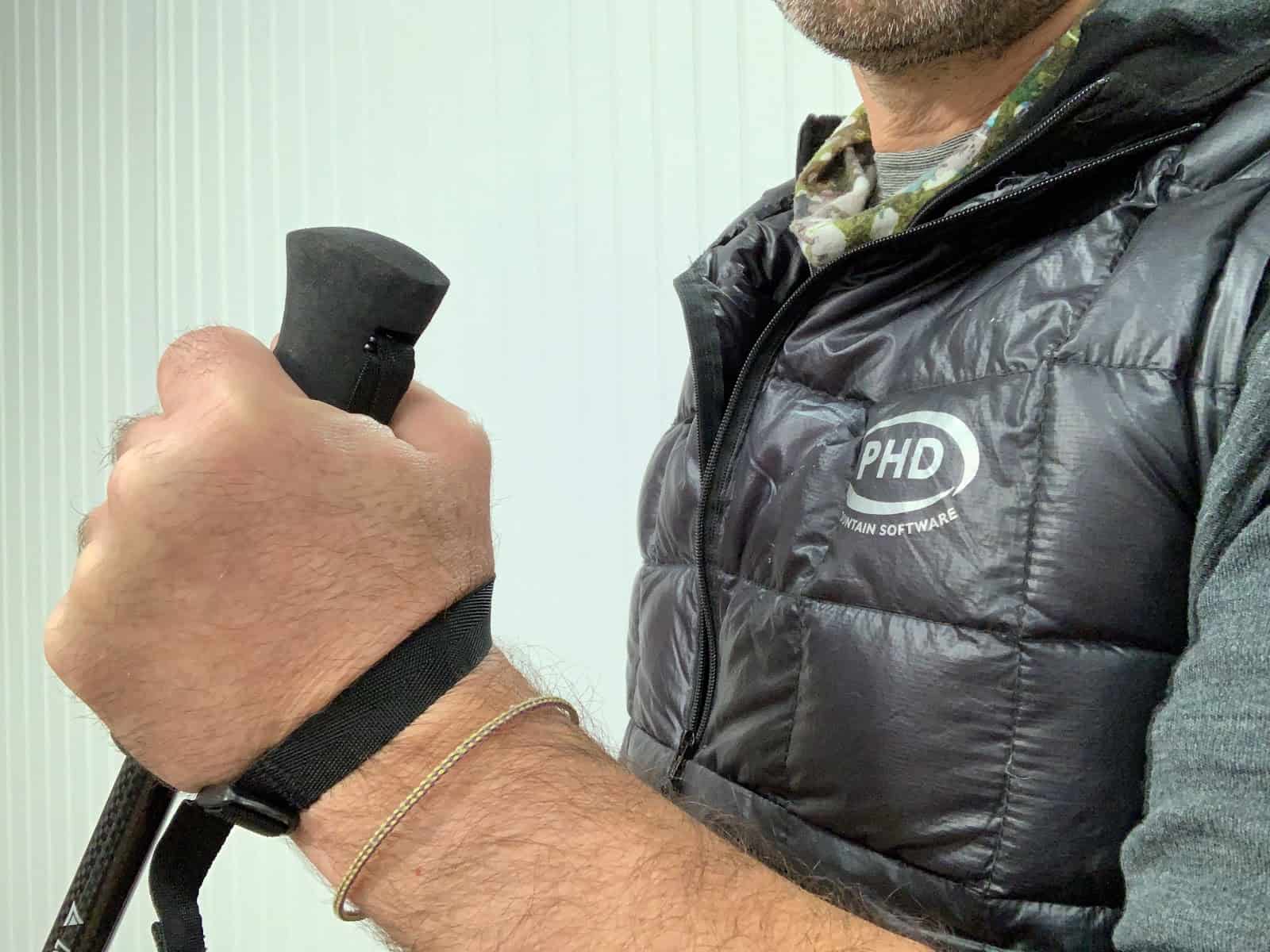
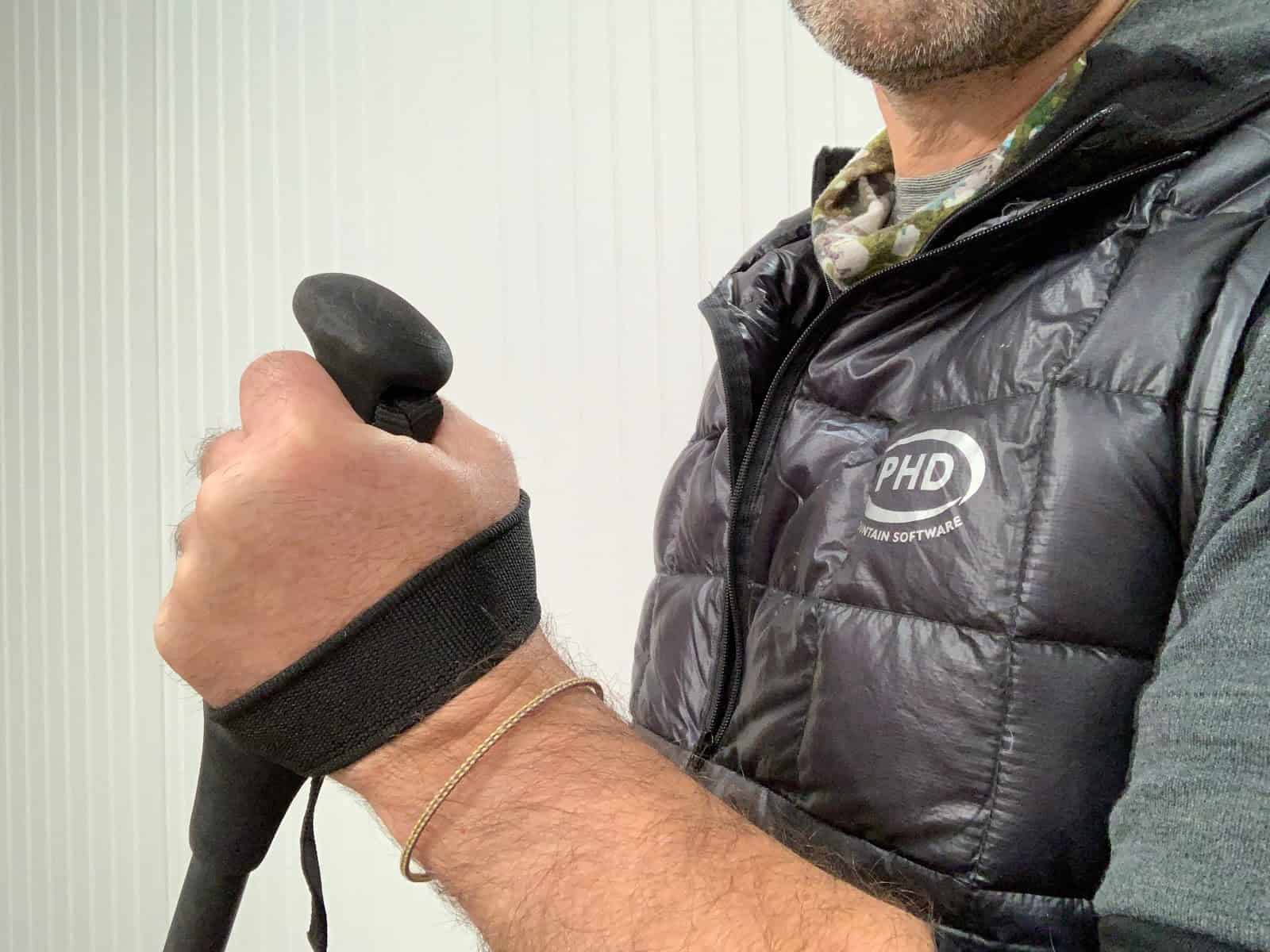
And, extended grips allow for a pole to be used more optimally on short steep ascents without taking the time to adjust them.
Adjustability
Although preferences vary, it’s generally recommended to use a pole length that allows your elbow to maintain a 90-degree angle (or perhaps slightly less). This gives you the most stability and comfort over long periods of time.

That also means that on steep climbs or descents, the pole length will need to change in order to maintain this optimum angle.
When hiking downhill, you can adjust the pole to be slightly longer to add stability and keep your body more level.
When hiking uphill, shorten the poles to add upward power to your movement.
On slanted ground or traverses, you can adjust individual pole length accordingly.
Of course, this all assumes you are using an adjustable pole. Some ultralight hikers do not consider the advantages of adjustability to be greater than the weight saving advantages of a fixed length pole, and instead, adjust the angle at which they use the pole accordingly (reference the video for how this is done).
Also, the locking mechanisms of adjustable poles are occasionally prone to failure or compromise (e.g., they get stuck or don’t engage as a result of dirt intrusion). Some poles can be difficult to adjust when wet or cold, especially when wearing mittens.
Adjustability also comes into account when considering use with a shelter, but we’ll treat that separately. See below.
Collapsibility
Collapsibility of poles is a factor to consider under two circumstances: when traveling and when storing in or on a pack.
- Travel: Trekking poles are not allowed as a carry-on item on airplanes. This means they have to be stored in checked baggage or left at home. For this reason poles that collapse to a very short length are more useful for trips that involve air travel.
- Pack Storage: As useful as trekking poles can be, they are not ideal for all situations.
- Many hikers prefer to stow trekking poles on or in their packs when scrambling, bushwacking, or boulder hopping. In these cases, the size to which a pole collapses should be taken into account.
- Additionally, the ease and speed with which a pole collapses and extends should be considered, especially if you are planning on stowing and re-deploying your poles on a regular basis.
Fixed length poles complicate all of the above factors. Another consideration, especially for thru-hikers or others who need to re-supply on long trips, is that many restaurants and places of business prefer that your poles be well stowed and tucked away so as not to accidentally knock over merchandise or your fellow shoppers.
Use With a Shelter
Utilizing a shelter that sets up with trekking poles is a great way to turn a single use item into a multi-use item – thereby saving weight. Most shelters that set up with trekking poles require, at least technically, an adjustable trekking pole. This allows for flexibility in pitch and location (depending on shelter design).
If you choose to use a fixed length pole you might find yourself with fewer options. You can always do some research and buy a pole length that best suits your shelter or vice versa. A solution for fixed lengths poles that are too long is to angle the pole off center from the shelter. If your pole is too short, several cottage industry brands sell pole jacks to raise the height.
Finally, there is the MYOG solution. Many enterprising hikers simply build a fixed length pole that matches the needs of their shelter and hiking style.
Pole material is not usually considered to be a factor under most conditions when the pole is used for shelter support. However, I (Ryan) have snapped carbon fiber poles in high winds when two poles were lashed together for a large (four-person) pyramid shelter, and I’ve snapped carbon fiber trekking poles and bent aluminum trekking poles under extreme snow loads during winter conditions.
Weight and Swing Effort
The poles in our Gear Guide range from 2.7 oz to 11 oz (individual pole weight). It’s hard to notice the difference between poles that weigh 8 vs. 9 oz. However, we found the difference is more noticeable and dramatic once the difference becomes about 30% or more. And the difference in weight while hiking between a 3 oz pole and an 11 oz pole is almost mind-boggling.
A trekking pole is carried in the hand, meaning its weight must be considered differently than weight carried in a pack.
The “swing effort” (force, e.g., in ft-lb) required to use a trekking pole is proportional to the product of its weight (e.g., in lb) and the position of its center of mass measured by its distance from the grip end of the pole (e.g., in ft).
For example, let’s compare two poles each having a length of 120 cm (3.9 ft). Pole A accurately represents the lighter poles in this gear guide, while Pole B accurately represents the heavier poles in this gear guide.
Pole A has a total weight of 100 g (0.22 lb). It has a foam grip, a lighter tip housing, and a single-piece carbon fiber shaft. Its center of mass is measured at 36 cm (1.2 ft) from its grip end. Its swing effort is thus calculated as 1.2 ft x 0.22 lb = 0.26 ft-lb.
Pole B has a total weight of 350 g (0.77 lb). It has a rubber grip, heavier tip housing, a tip basket, and a three-piece adjustable aluminum shaft. Its center of mass is measured at 42 cm (1.4 ft) from its grip end. Its swing effort is thus calculated as 1.4 ft x 0.77 lb = 1.1 ft-lb.
Thus, it wouldn’t be a far stretch to assume that Pole B requires more than 4 times the amount of effort to swing while hiking. Other assumptions go into this model, of course (which includes the angular and cartesian displacements of the hiker’s swing and the effects of gravity during the swing), but you get the idea. In other words, swinging a heavy pole gets real old, real quick.
This video illustrates another example – where a heavier pole actually has a swing effort that is lower than a lighter pole!

In this example, consider the following stats:
| Pole ID | Pole Weight (oz) | Distance from Center of Mass to Grip End (in) | Swing Effort (ft-lb) |
| C | 14.5 | 17.0 | 1.28 |
| D | 18.0 | 12.0 | 1.13 |
Remember, the weight of a piece of gear doesn’t always tell the whole story about its performance!
But here’s the caveat.
Scientific evidence suggests that caloric expenditure of heavy vs. light vs. no poles makes a difference only during exaggerated swing motions (picture those super-cool fitness walkers on beach boardwalks in California!), and that it doesn’t make a huge difference for people walking or hiking with a natural swing gait.
However, backpackers will certainly appreciate lighter swing weights over the course of a long, all-day hike or a long distance hike (e.g., thru-hike), because it will make pole placement easier and relieve some arm strain caused by swinging poles thousands of times per day.
Durability
Alternatively, there is the question of durability vs. weight to consider. A heavy weight does not necessarily always indicate a stronger pole: there are factors of design and construction quality to consider. That being said, many poles at the light end of the spectrum are built from carbon fiber, which is more prone to breaking under lateral strain than the aluminum poles.
Cost
A hiker moving at a moderate pace might initiate contact between his trekking pole and the ground anywhere between 20 to 40 times a minute. That adds up over miles, days, and years of use. For this reason, the difference in lifespan between a well constructed trekking pole and a shoddy one might be more readily apparent than in other pieces of gear.
The poles in this gear guide range from $30.00 to over $150.00. Cost varies with construction, design, material, and point of origin. Some hikers buy cheap poles knowing that the poles might not last long. In some cases, it’s just as easy to break an expensive carbon fiber pole as it is to snap an inexpensive one!
Category Overview
We surveyed 109 models of trekking poles from Gossamer Gear, Ruta Locura, Komperdell, Black Diamond, Helinox, Locus Gear, ZPacks, Mons Peak IX, REI, Leki, Montem, Hiker Hunger, Kelty, and Mountainsmith having weights ranging from 2.7 oz per pole to 11.0 oz per pole.
Here’s a chart showing their weight distribution:

The average weight of the trekking poles surveyed was 16.1 oz/pair. The standard deviation of these weights was 4.1 oz/pair. Using those delimiters, we thus define three categories of poles we arbitrarily call “heavy” (all poles heavier than average), “light” (all poles lighter than average), and “ultralight” (all poles lighter than the average minus one standard deviation).
In this gear guide, we are only considering poles that fall into either the ultralight or light category during our preliminary survey.
Of the 45 models that met the “light” or “ultralight” criteria, we hand-picked a selection that we felt provided a representative overview of various designs from both mass-market and cottage-branded manufacturers.
Excluded from the gear guide, notably, are poles manufactured by OEM Chinese factories that sell branded products to end-point suppliers. These are the typical poles you find at large online shopping sites like Amazon under a variety of brand names. Most of these poles are inexpensive, manufactured by one of only a handful of large Chinese manufacturers, and are of dubious quality.
Product Reviews
The following table highlights the products featured in this Gear Guide. When multiple sizes of a given model were offered, we selected and tested models that spanned a 115-125 cm range as much as possible. When there was an option for a model with or without straps, we selected the model with straps.
In addition, we included two models in the table – the Gossamer Gear LT3C and LT4/4S – that have been discontinued. However, these poles are so iconic amongst those of us in the ultralight backpacking community that we couldn’t help but include them for comparison purposes.
| Model | Length | Weight Per Pair | MSRP |
|---|---|---|---|
| Gossamer Gear LT3C* | 120 cm | 5.6 oz | discontinued |
| Ruta Locura Yana | 78 cm - 135 cm | 7.5 oz | $155 |
| Gossamer Gear LT4S* | 90 cm - 140 cm | 9.2 oz | discontinued |
| Komperdell Carbon Trail Ultralight | 120 cm | 9.4 oz | $150 |
| Gossamer Gear LT5 | 60 cm - 130 cm | 10.0 oz | $195 |
| Helinox Passport Featherlite Twist Lock | 53 cm - 120 cm | 10.4 oz | $140 |
| Black Diamond Distance Carbon Z | 120 cm | 10.5 oz | $170 |
| Locus Gear CP3 | 65 cm - 135 cm | 10.6 oz | ¥13,800 (approx. $130) |
| Helinox Passport Tension Lock | 115 cm | 11.0 oz | $150 |
| Black Diamond Distance Carbon FLZ | 105 cm - 125 cm | 12.7 oz | $190 |
| ZPacks Ultralight Carbon Fiber | 62 cm - 142 cm | 13.4 oz | $100 |
| Mons Peak IX Tiger Paw Carbon | 62 cm - 135 cm | 13.9 oz | $150 |
| Komperdell C3 Carbon Pro Compact | 90 cm - 120 cm | 14.5 oz | $160 |
| REI Flash Carbon | 105 cm - 140 cm | 14.8 oz | $140 |
| Leki Carbon Ti | 100 cm - 135 cm | 15.2 oz | $180 |
Let’s review the key design features and performance benefits for each of these models.
Ruta Locura Yana

With the discontinuation of Gossamer Gear’s lightest pole model (the LT3C) The Ruta Locura Yana is now one of the lightest (if not the lightest) trekking pole on the market that includes a strap (at less than 4 oz/pole).
Advantages:
- Lightweight
- Foam grips
- High quality and strong (stiff) carbon shafts
- Wide range of adjustability
- Minimalist straps
- Low rattle/vibration
Disadvantages:
- Collapsible only to 31 inches (28 inches if two-section shaft is separated)
- Grip shape isn’t aggressively ergonomic
- Pole adjustment is based on compression / twist-lock mechanism that requires a lot of tightening to resist collapse under high forces and/or in cold conditions
- More durable carbon used in the lower shaft makes the swing effort higher than slightly heavier poles
Komperdell Carbon Trail Ultralight
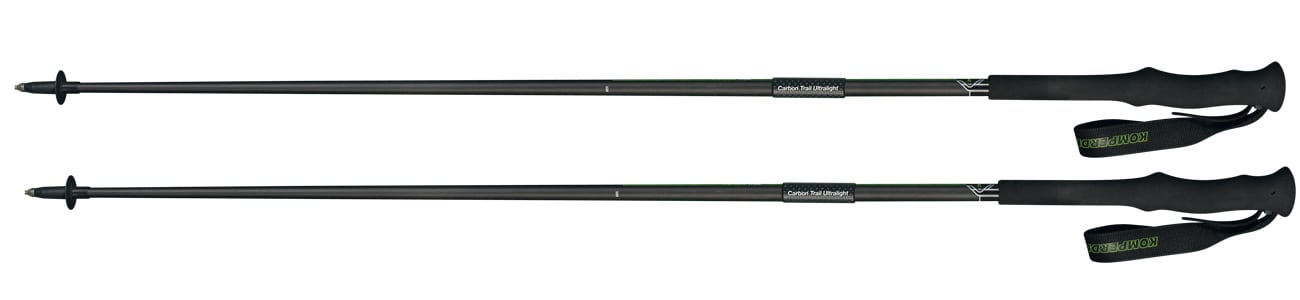
Lightweight foam handles with extended grips and comfortable straps are great, but lack of a palm rest or extended grip ribbing/channeling compromised the function of the Komperdell Carbon Trail Ultralights. Photo: Komperdell.
The Komperdell Carbon Trail Ultralight is an extremely stiff, fixed length pole with extended foam grips and a wide, comfortable strap. In terms of pure trekking performance – using the pole while hiking – its performance-to-weight ratio is unmatched. This pole uses the same shaft as the old Stix poles we built and marketed under the Backpacking Light brand several years ago.
Advantages:
- Lightweight
- Extended foam grips, comfortable grip shape
- Very stiff carbon shafts
- Lightweight straps, but still with padding and wicking surface
- Zero rattle/vibration
Disadvantages:
- One piece, non-adjustable pole limits versatility, adjustability, and collapsibility
- Poor execution of extended grip – it needs a palm rest and some ribbing/channeling for better grip.
Gossamer Gear LT5

One of our favorite grips! Very comfortable, ergo foam grip – but alas, no grip extension. A grip extension and lever clamp adjustability mechanisms would elevate the LT5 into “best-of-the-best” in lightweight trekking poles (caveat: for trail use)! Photo: Gossamer Gear.
The Gossamer Gear LT5 is a three-section carbon, adjustable pole with minimalist straps. With a collapsed length of only 60 cm (24 in) it’s the most collapsible telescoping pole featured in this gear guide – a notable achievement for a pole that weighs only 5.0 oz.
Advantages:
- Most collapsible telescoping pole in this weight range
- Very comfortable ergonomic foam grips
- Wide, padded, soft straps offer a lot of comfort
- Low rattle/vibration
Disadvantages:
- Twist-lock adjustability mechanism is one of the least secure and reliable among the poles we tested
- Carbon shafts are thin-walled and quite fragile, especially lower section – prone to breakage
- No grip extension
- Most expensive pole in this gear guide
Helinox Passport Featherlite Twist Lock
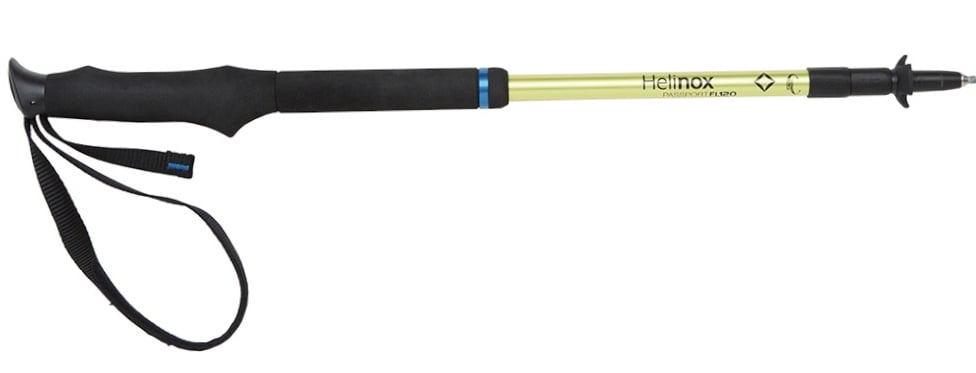
The lightest aluminum pole in this review, the Helinox Passport Featherlite Twist Lock are compact (collapsing to 21 in) and light (5.2 oz/pole). The high-quality DAC aluminum shaft is strong for its weight, but the pole suffers from quite a bit of flex and the twist-lock mechanisms are the most difficult to use of any pole in this gear guide in cold and wet conditions. It’s available (if you can find them!) in max lengths of either 120 cm or 135 cm.
Advantages:
- Lightest aluminum pole
- Collapses to a short length
- Extended foam grips
Disadvantages:
- Foam grip is not aggressively ergonomic
- Extended grip is smooth, requires more grip strength to use
- Twist lock mechanism gets stuck in cold and wet conditions
- Suffers from a lot of flex
- Poor US distribution
Black Diamond Distance Carbon Z
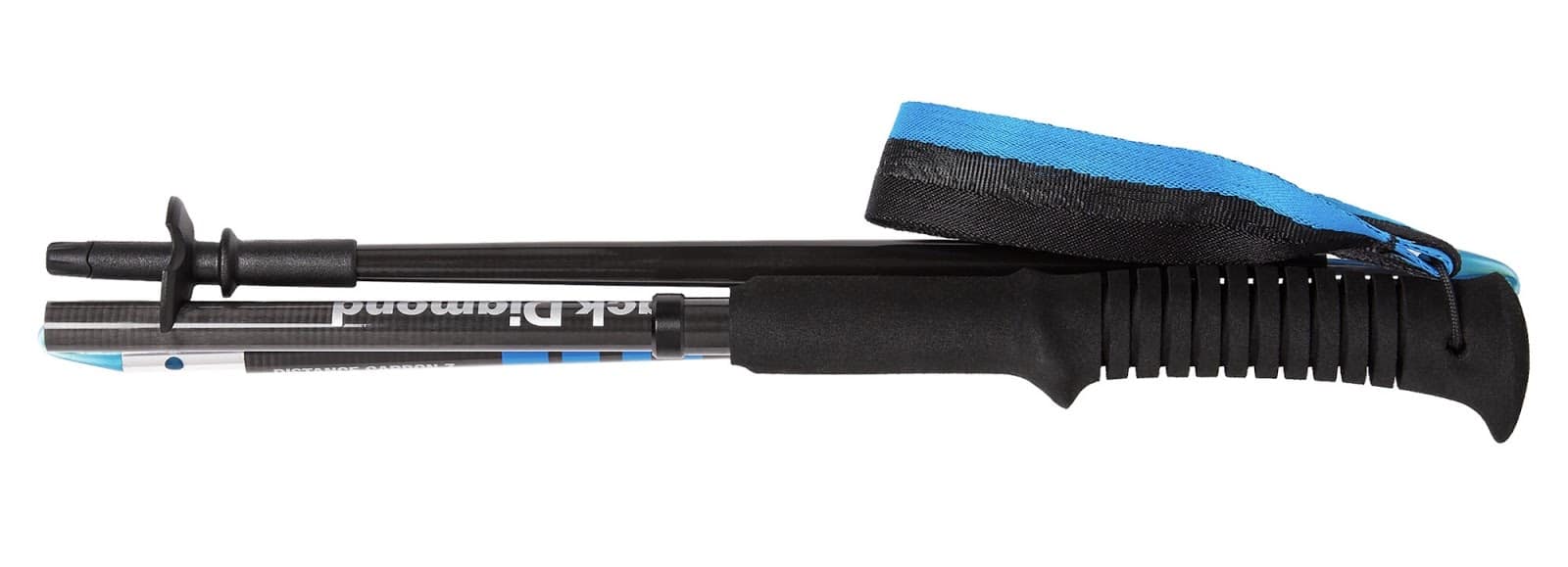
A channel-cut foam grip makes the Black Diamond Distance Carbon Z a very comfortable pole to hold, but lack of a palm rest at the bottom of the grip extension limits its potential. Photo: Black Diamond.
The lightest folding pole in this review, and thus, the lightest “tiny-when-collapsed” pole in this review (5.3 oz each and 16 in long when collapsed), the Black Diamond Distance Carbon Z is a solid choice when light weight and collapsibility are your most important criteria.
Advantages:
- Very short collapsed length (16 in)
- Light weight (5.3 oz each)
- Comfortable channel-cut foam grip
- Extended grip
Disadvantages:
- Length is not adjustable
- Extended grip lacks a palm rest
- Stiffness is not as much as Ruta Locura Yana or Komperdell Carbon Trail Ultralight
- Unpadded nylon strap lacks some of the comfort niceties found in other poles, but is wide enough to prevent it from digging into your skin
Locus Gear CP3
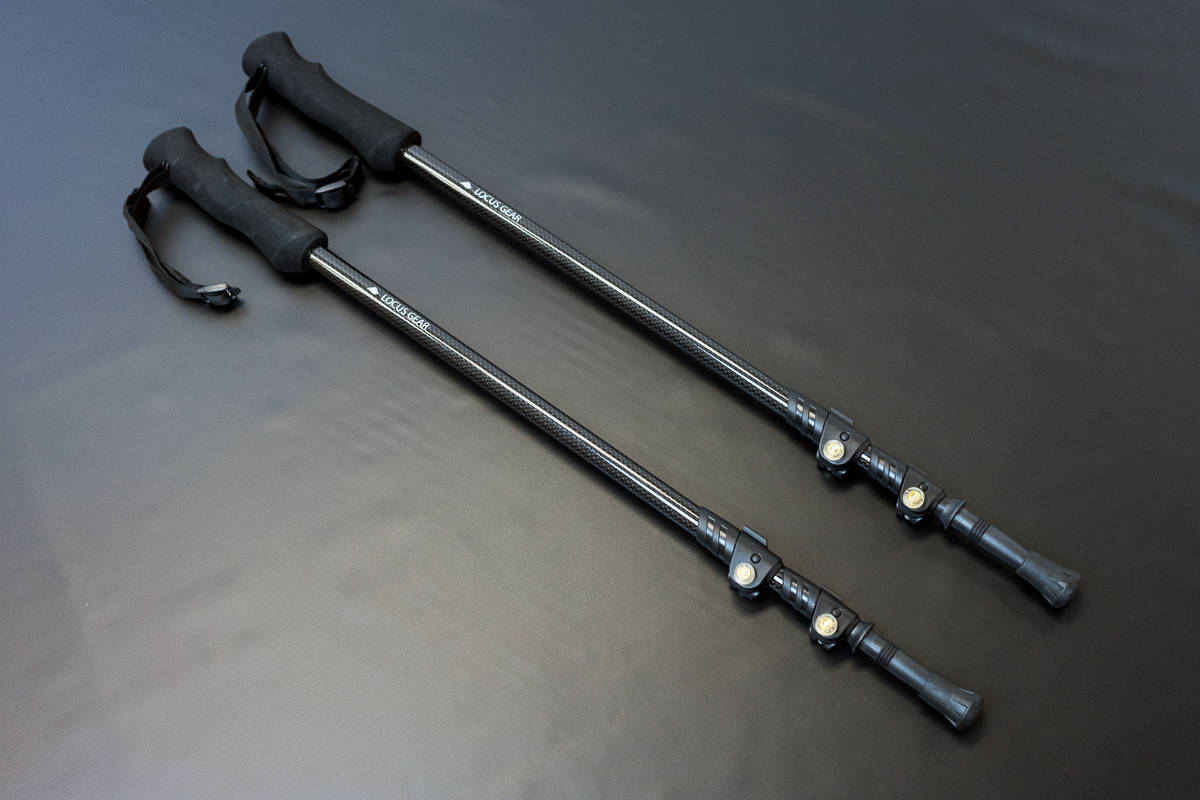
Minimalist grips and straps are the defining features of the Locus Gear CP3 trekking poles. Photo: Locus Gear.
The Locus Gear CP3 is a carbon, three-piece, telescoping pole that collapses to a length of 26 in and weighs only 5.3 oz per pole. Its key design characteristics are its lever lock mechanisms for adjustability and its minimalist grip and strap.
Advantages:
- Light and compact for a 3-piece collapsible pole
- Minimalist strap and foam grip for weight savings
Disadvantages:
- Foam grip is not aggressively ergonomic
- Lever hardware is plastic – durability concern over the long term
- Minimalist strap may be too much so – thin strap digs into wrist when used aggressively for weight-bearing
- High rattle/vibration in the joints when using on hard-packed terrain
Helinox Passport Tension Lock
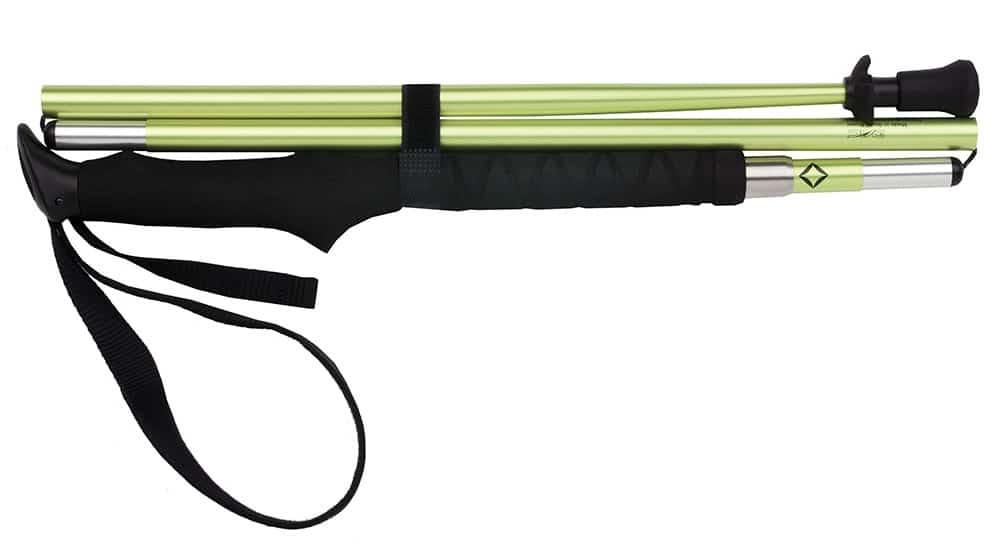
The Helinox Passport Tension Lock folds to a tiny size, making it a terrific option for travelers, day-hikers, and trail runners. Photo: Helinox.
Similar to the Twist-Lock model of the same name, the Helinox Passport Tension Lock is a non-adjustable folding pole that collapses to a length of only 14 inches – the shortest of any pole in this review. Otherwise the Tension Lock model enjoys the same advantages and suffers from the same disadvantages as its lighter Twist-Lock cousin.
Advantages:
- Most collapsible pole reviewed in this gear guide
- Extended foam grips
Disadvantages:
- No adjustability
- Foam grip is not aggressively ergonomic
- Extended grip is smooth, requires more grip strength to use
- Suffers from a lot of flex
- Poor US distribution
Black Diamond Distance Carbon FLZ
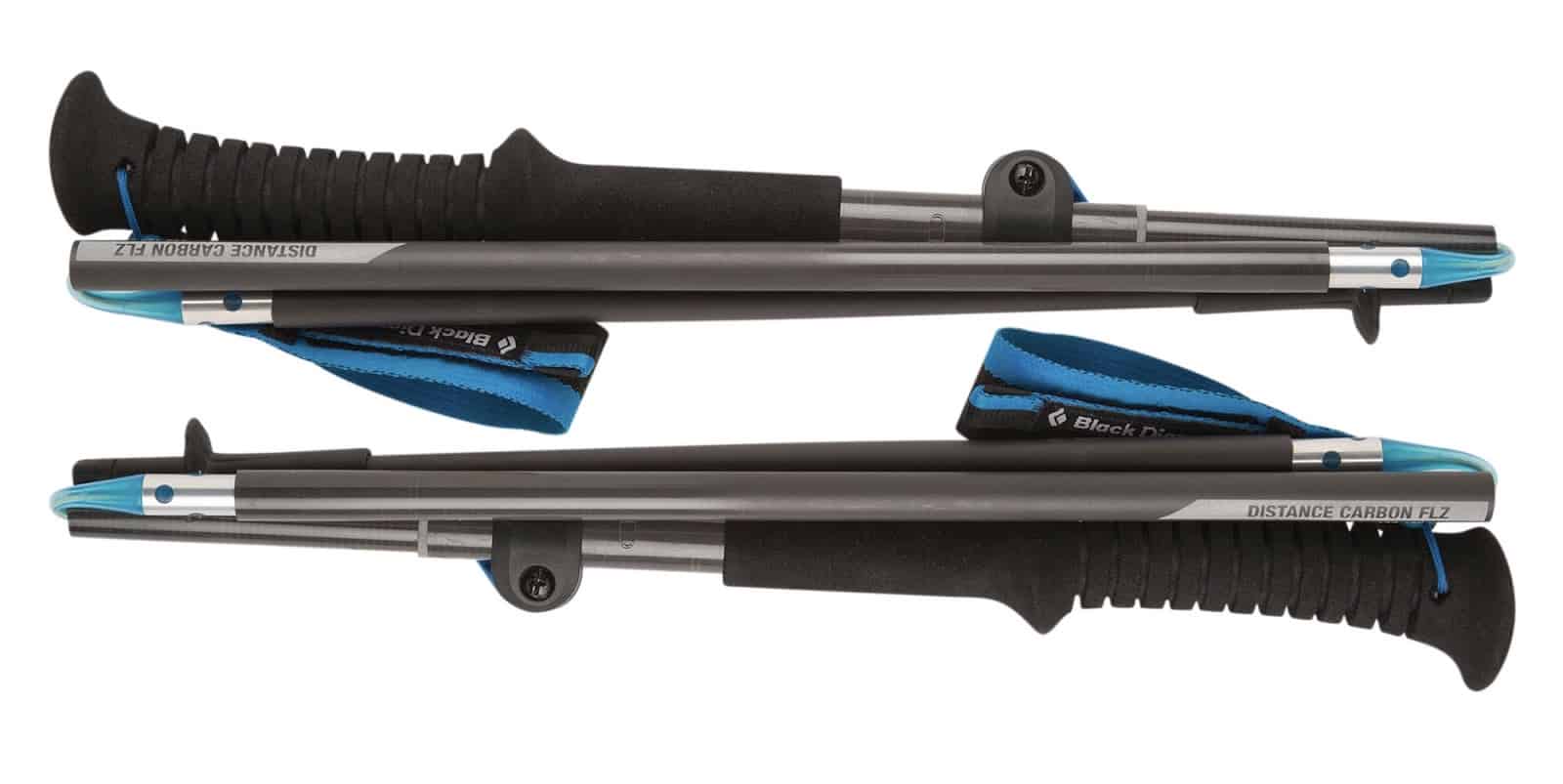
Only slightly heavier and less compact than the Helinox Passport Tension Lock, the Black Diamond Distance Carbon FLZ offers a more comfortable grip and strap, with some adjustability provided by a single upper lever clamp mechanism. That makes it a more versatile choice for ultralight backpackers. Photo: Black Diamond.
A very short collapsed length (14.6 in), light weight (6.4 oz/pole), and a terrific extended grip/strap combo, the Black Diamond Distance Carbon FLZ is one of the best all-round lightweight poles on the market, whether folding or otherwise. The FLZ model adds some adjustability!
Advantages:
- Short collapsed length due to its folding design
- Enough adjustability for some shelter pitching and changing terrain
- One of the better foam grip, extended grip, and strap combos available in terms of comfort
- Stiff, rattle-free, and strong
Disadvantages:
- Limited adjustability for tall shelters
- Extended grip could benefit from a palm rest
ZPacks Ultralight Carbon Fiber
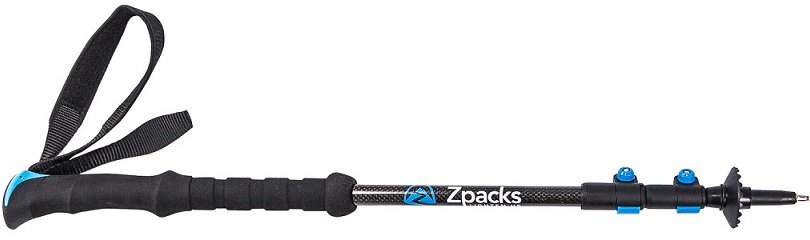
ZPacks Ultralight Carbon Fiber poles offer the best extended grip palm rest of any pole in this review, making it a complete grip package. No small feat for a $100 set of adjustable poles that still weigh less than 14 oz/pair. Photo: ZPacks.
Surprisingly inexpensive telescoping carbon fiber poles, the $100 ZPacks Ultralight Carbon Fiber poles are not as light as what we’d expect from a cutting-edge cottage manufacturer (6.8 oz per pole). Plastic hardware but higher quality manufacturing quality make them rattle less than the slightly lighter Locus Gear CP3 poles, but the grip/extended grip/strap combo make these more versatile and comfortable than the Locus Gear model.
Advantages:
- Very good (comfortable) strap, foam extended grip, and foam grip (ergonomic) combo
- Lever lock mechanism prone to some slippage in cold temperatures unless tightened very tightly (more so than the Locus Gear poles)
- Inexpensive
Disadvantages:
- Plastic hardware in adjustability mechanisms brings long term durability into question
- Moderate rattle/vibration
Mons Peak IX Tiger Paw Carbon

A thoughtful grip-strap-extended grip package, metal hardware, and stiff shafts make the Mons Peak IX Tiger Paw carbon a compelling option if you’re looking for a full-featured pole. Photo: Mons Peak IX.
Mons Peak is new to the backpacking gear game, but don’t discount their first entry into the trekking pole market. The Mons Peak IX Tiger Paw Carbon is one of the highest-quality poles in this review. The carbon shafts are stiff, thick, and strong, and the metal lever adjustability mechanisms are high quality and perform very well in cold and wet conditions – the best of any trekking pole in this gear guide. As the lightest pole in this review with a cork grip, it also includes a very useful extended grip and comfortable pole strap.
Advantages:
- Stiff, strong pole shafts
- Wise blend of cork and foam in a comfortable grip and extended grip
- Comfortably wide, padded and wicking wrist strap built with an eye on weight savings without sacrificing comfort
- High quality metal lever-style adjustability mechanisms perform well in cold and wet conditions
Disadvantages:
- Comfort and quality comes with increasing weight: these poles are 6.9 oz apiece.
- High rattle/vibration
- Extended grip could benefit from a palm rest
Komperdell C3 Carbon Pro Compact
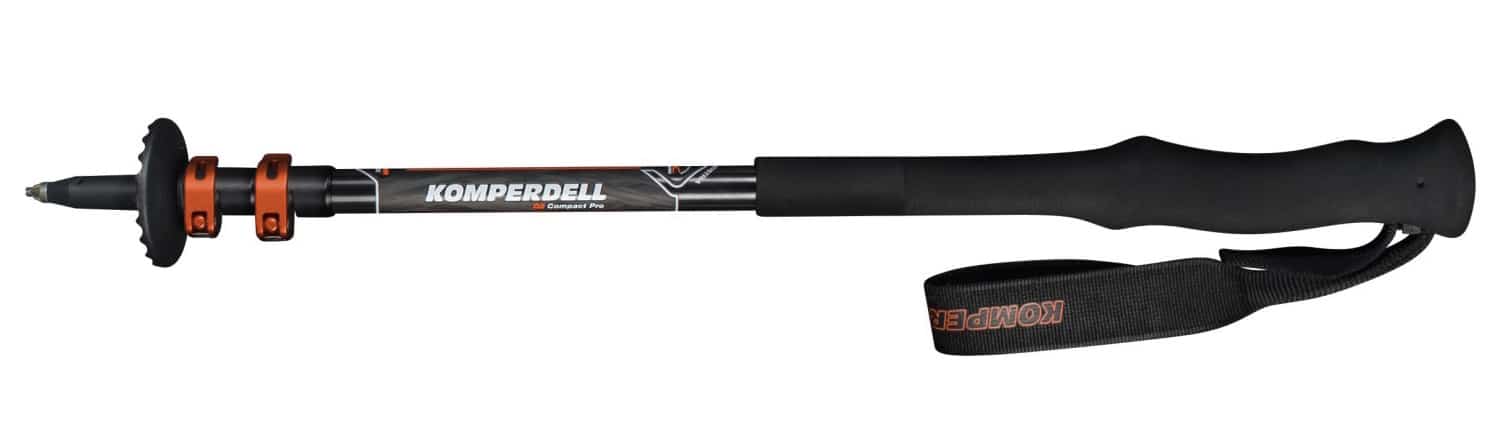
An aesthetically beautiful design, the Komperdell C3 Carbon Pro Compact sure looks good. Add some channeling and a palm rest to the extended grip and it could be close to perfect. Photo: Komperdell.
Once beloved by ultralight backpackers, Komperdell C2 and C3 Carbon Pro poles (including the Komperdell C3 Carbon Pro Compact) have undergone solid design improvements through the years. However, for the weight, there are other as-good-or-better options for telescoping carbon trekking poles, including the Mons Peak IX Tiger Paw Carbon and the REI Flash. Nevertheless, the C3’s remain a viable contender even though they are among the more expensive poles in this gear guide.
Advantages:
- Metal lever-style adjustability mechanisms that are secure in cold and wet conditions
- Extended foam grip with good strap comfort
- Strong, stiff carbon shafts
Disadvantages:
- Foam grip lacks the ergonomics and comfort of the Tiger Paw or Black Diamond Distance Carbon Z
- Extended foam grip isn’t ribbed or channeled, which limits its comfort when choking down
REI Flash Carbon
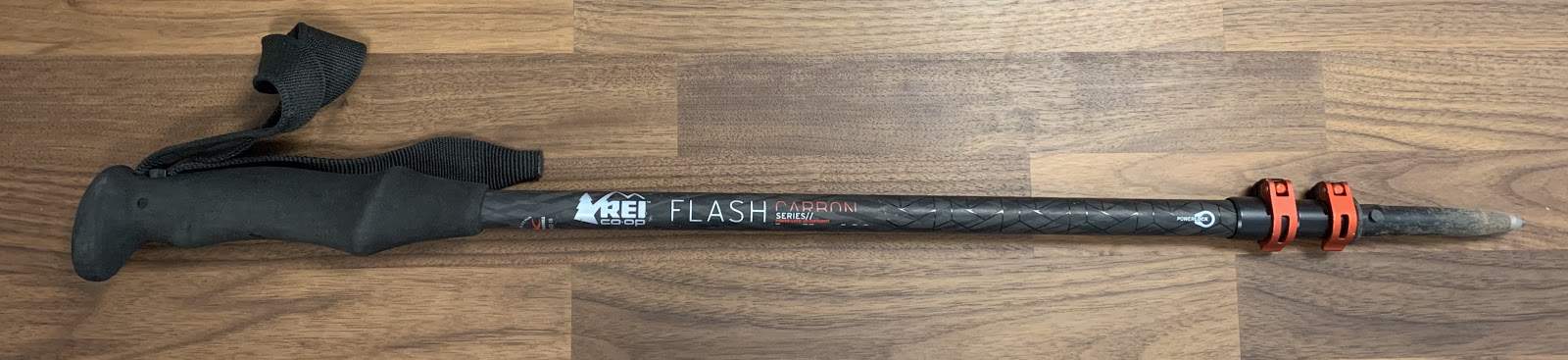
The REI Flash Carbon is a well-built pole with virtually no vibration or rattle, and has the stoutest tip of any pole in this review, which protects the lower carbon shaft.
Finally, a pole that extends to 140 cm – the REI Flash Carbon. This will be a benefit for taller hikers or those that appreciate the flexibility (as we do) of being able to pitch one end of our shelter (such as a tarp or TrailStar), or the center of our pyramids, higher in good weather for added ventilation.
Advantages:
- Metal lever-style adjustability mechanisms that are secure in cold and wet conditions
- Foam grip offers excellent comfort
- Strong, stiff carbon shafts
- Very comfortable and wide wrist strap
- Excellent value for this feature set ($140)
- Low rattle/vibration
Disadvantages:
- No extended grip
Leki Carbon Ti
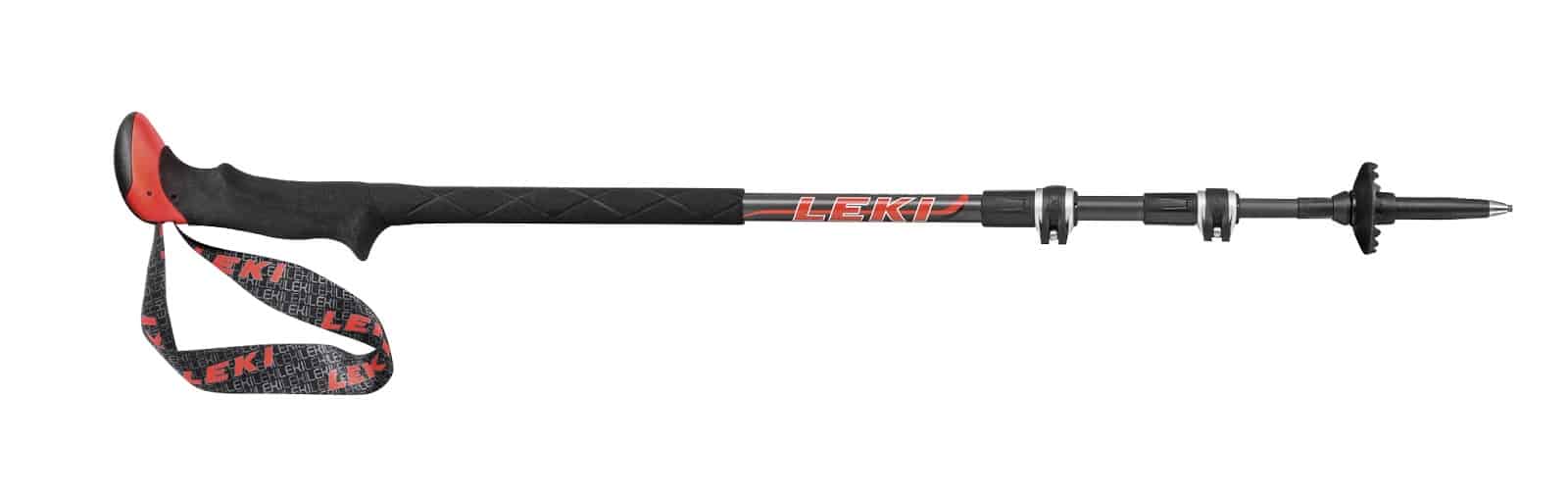
The Leki Carbon Ti is Leki’s lightest pole. An outstandingly comfortable foam grip is hampered by an uncomfortable strap and a smooth extension grip without a palm rest. However, the pole is solid, vibration-free, durable, and well-built. Photo: Leki.
As the second most expensive set of poles in this review ($190), and the heaviest (7.6 oz/pole), the Leki Carbon Ti has a bit of convincing to do before it can win the hearts of backpackers with an eye towards weight savings. Nevertheless, as Leki’s lightest pole, it’s worth including here for those of you who have been drinking the Leki kool-aid for the past few decades. It’s the highest-quality, most vibration-free pole in this review, and it offers the most comfortable hand grip.
Advantages:
- Foam grips are very comfortable to hold, extended grip offers some channeling for additional friction
- Lever action adjustability mechanisms secure well in wet and cold conditions, but less so in very cold temperatures and transmit no vibration or rattle
- Leki name may come with cachet for some – you know, like driving a BMW
Disadvantages:
- Expensive – price-to-performance ratio is no longer competitive when compared to the other poles in this review
- Extended foam grip doesn’t include a palm rest
- Strap isn’t padded – just a piece of webbing
Recommendations
Lightest Weight
If your poles spend a lot of time on your pack, or you use them primarily for shelter-pitching and the occasional downhill, we recommend the Ruta Locura Yana.
Easiest Swing Effort
If you’re in the mood for thousands of miles of trail hiking, and don’t feel a compelling need to have a collapsible pole for travel or bushwhacking, check out the Komperdell Carbon Trail Ultralight. These poles are for the AT thru-hiker. Pair it with a carbon pole jack from ZPacks or Ruta Locura if needed for shelter pitching.
Most Compact
Foldable poles will always be the most compact – they are ideal for runners carrying tiny day packs, or travelers (just tuck them away in a small suitcase). Our pick blends collapsibility with a very comfortable extended grip and strap combo: the Black Diamond Distance Carbon Z.
Most Durable
Durability and weight do go hand in hand here. Don’t ignore the Ruta Locura Yana. They offer a limited feature set but they are the most durable poles we’ve ever seen in this weight class (i.e., poles than weigh less than 5 oz apiece). For absolute durability (if you spend a fair bit of time off-trail or in rough terrain), consider the Mons Peak IX Tiger Paw Carbon,the REI Flash Carbon, and the Leki Carbon Ti.
Best Value
The cheapest poles in this review – the ZPacks Ultralight Carbon Fiber – aren’t just inexpensive, but they are also among the most versatile. Good grip, good strap, extended grip, wide range of adjustability, and good stiffness for stability on descents.
Best All-Around
The most versatile among the “ultralight” poles are the Ruta Locura Yana (adjustable, light, and strong) and the Black Diamond Distance Carbon Z (terrific grip/strap, collapsibility).
The most versatile among the “light” poles are the Black Diamond Distance Carbon FLZ (same benefits at the Carbon Z model, but with some adjustability) and the Mons Peak IX Tiger Paw Carbon (best grip/extended grip/strap combo of any pole in this review, plus a wide range of adjustability).
DIY for Cheapskates
Not sure about trekking poles for you? Consider a cheap and easy DIY option to test the waters:
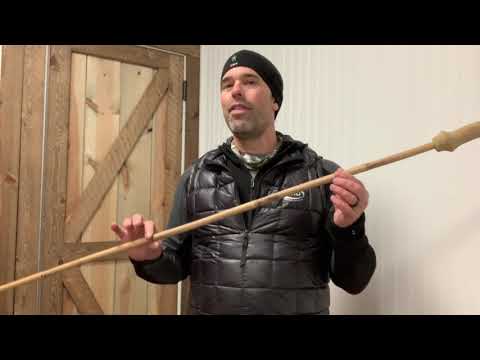
Materials:
- Bamboo shafts
- Foam Grips
- Rubber Tips
- The best glue for grip-to-shaft and tip-to-shaft adhesion
Product Review Disclosure
Updated September 15, 2018
- How we acquired these products: Product(s) discussed in this review were either acquired by the author from a retailer or otherwise provided by the manufacturer at a discount/donation with no obligation to provide media coverage or a product review to the manufacturer(s).
- We do not accept money or in-kind compensation for guaranteed media coverage: Backpacking Light does not accept compensation or donated product in exchange for guaranteed media placement or product review coverage.
- Affiliate links: Some (but not all) of the links in this review may be “affiliate” links, which means if you click on a link to one of our affiliate partners (usually a retailer site), and subsequently make a purchase with that retailer, we receive a small commission. This helps us fund our editorial projects, podcasts, instructional webinars, and more, and we appreciate it a lot! Thank you for supporting Backpacking Light!


Discussion
Become a member to post in the forums.
Not really my idea, though I tried something similar a couple times. I think this was from the old Yahoo Backpackinglight email list about 15 years ago.
OK, I have an older staff in my storeroom. I got a couple of the strap top/bottom. This has been through the mill, maybe 1500-2000mi on it. As I remember, I replaced the strap with a shorter version while making another staff (parts are interchangeable.)

The tip was replaced last spring. (I usually only use one staff, the trails through the majority of the ADK’s are too narrow/scrubbed-in to use two.) The original bumper was worn out.

You have a technical error in this review – Force is NOT measured in lb-ft. lb-ft is a unit of torque NOT force.
If the expectation of the article is to inform and dispel misinformation and erroneous science – having technical errors in the review poses question/concerns which you have expressed critical of other reports/claims.
Additionally, Gossamer Gear LT4/LT4S Trekking Poles are NOT discontinued – Gossamer Gear still list LT4/LT4S Trekking Poles within their product line and provides support and replacement parts for the LT4/LT4S Trekking Poles.
From my experience, trekking poles add more to my trekking enjoyment than take away.
James, a good system you developed. Try using a prussic knot for your cord strap. Slides up and down easily and locks instantly in place under load.
As Greg hinted…. a calorie is a unit of energy. A rewording of a those 2 statements might be worthwhile ;-)
Bruce, I tried a Prussik loop, but that didn’t work too well. 1) it tended to shorten up the staff a couple inches and 2) because the shaft was slick carbon, the knot really didn’t stay put, well. But that was an earlier version. Maybe I’ll try it again with the longer 12′, 3piece poles or find a piece about 50″ long. Thanks!
Not quite true – I’ve got a set made of titanium tubing. Neener, neener.
I would be interested in knowing what brand and what model.
FYI: titanium poles could weigh almost double aluminium ones and cost up to 10x as much. It is a much more expensive material.
My experience with poles labeled ‘titanium’ has been that they really an aluminium alloy containing maybe 1% titanium. I am not sure, but the effect of adding Ti may be similar to that of adding Scandium. A classic example is the old Leki Makalu Ultralight Titanium poles. (Did they in fact contain ANY titanium? I don’t know.) In many ways quite a fraudulent bit of advertising.
Cheers
James,
That’s a clever idea i can see working well. I wouldn’t mind not having adjustable length, or using strap length as an alternative means of shortening/lengthening the staff, but i do like to have adjustability for pitching a shelter at different heights. I often carry a bamboo pole for walks of less than a day…
Thanks for the explanation
Roger, you are entirely correct to be skeptical of any claim of titanium poles. The word “Titanium” has been horribly misused by marketers.
However, I assure you that the pictured pole is about 95% titanium. It is made of 3Al-2.5V Sandvik titanium alloy. It is made from a golf club shaft. I don’t know the full history of titanium golf club shafts, but they were available from Sandvik for about ten years starting in 1988, when Sandvik was trying to diversify into sports equipment. They never really caught on in the golf market, because, (as you said) titanium is very expensive.
The pictured pole weighs 160 grams, and I’ve been using it (and its mate) for a decade now. They are not particularly light by some standards, but they are incredibly tough. On several occasions I’ve straightened them after impacts and falls that I’m sure would have ruined carbon or aluminum poles of equal weight.
Edited to add: The trekking poles are homemade starting from the Sandvik shafts – I simply glued Leki carbide tips to the skinny end, and some old ski pole grips and straps to the fat end.
Hi Eric
My apologies. You know, that possibility did not occur to me at the time – but certainly I have heard of it being done before. Well, golf fanatics … with more $$ than neurons …
3Al-2.5V is a good alloy, and more suited to tubing than 6Al-4V (sheet and wire). I think my winter stoves use that alloy for the 38 mm dia burner chamber. Sounds like a neat idea.
I do remember seeing a farmer’s electric fence somewhere in France – but near a big ski field. All the poles supporting the electric wire were … ski poles! One suspects the one of the pair was broken, and the other one was simply discarded. It was amusing. Ski poles rather than golf sticks, but …
Cheers
Roger, no apology is needed or expected! And the idea to use golf shafts for trekking poles was something I learned here at BPL. But I happened to run across some Ti shafts and they fit my needs better than carbon shafts.
The pic below shows how tough these poles are – I slipped while descending an unstable stream cutbank, landed on the pole with my hip, and rode it down to the bottom while fighting to get back on my feet. The resulting bend was straightened over my knee with a bit of effort and the pole is still as good as new (I think!). I can’t prove it of course, but I’m pretty sure a carbon or aluminum pole would not have survived my ineptitude. I’d guess that carbon would’ve shattered, and aluminum would’ve kinked irreparably.
And that’s not the first time that pole has been similarly abused, just normally I don’t take pictures after doing stupid things. ;-)
Cheers!
I love using poles. As I often hike solo, the extra safety factor against an inadvertent fall is great. Also they help me get up and down the hill more easily when wearing a pack.
Finding the right set of poles is lots like finding a shoe that fits. There is no substitute for trying them. I actually ordered $1000 worth of poles from REI, and sent back all but one pair. I can say that non-adjustable poles are a non-starter for me. I also discovered foam grips are better for cold climates and cork grips are better when it is warm.
Once, while struggling to summit a ridge I stopped and cut some of the foam off my pole grips. As I never choke them up, the material was excess for me. I was amazed how much difference saving an oz or so on each pole made! Later I realized I never use the poles at full extension, so I cut some of the excess carbon off the pole, making them lighter but just as strong, and still long enough to adjust for going downhill.
The only thing I don’t like about poles is that my hands really take a beating. A light weight pair of gloves is essential for me. https://www.google.com/search?q=valley+fruit+picker+gloves&sa=X&rlz=1C1RFPM_enUS814US814&biw=1280&bih=646&tbm=isch&source=iu&ictx=1&fir=ff5nFCWhicS3jM%253A%252CjvJCjktCUyXVGM%252C_&usg=AI4_-kTbESSps28LlfPD3kIT0Rye7Tfc-g&ved=2ahUKEwiaveL7nu3eAhVwTd8KHbXgCQcQ9QEwBHoECAMQBg#imgrc=ff5nFCWhicS3jM: Although the gloves keep the sun off, I still develop cracks in my digits. On a long trip at high elevations (like the Sierra) these need bandaids. I have tried lots of handcreams; cortisone seems about the best.
Eric: That bent shaft is amazing – or rather the fact that you managed to straighten it up. One for the archives indeed.
Erica: gloves needed despite using the straps in the recommended manner? Could it be the sun?
Cheers
Great review of hiking poles!
With one personal caveat:
“The extreme (and probably the only appropriate) manifestation of this are the 45-degree angled and very short Pacer Poles, which customers seem to rave about.”
I’ll rave about Pacer poles. But at 6’4″, I’ll disagree with them being short. Mine are plenty long for me, and I could still extend them another 4 inches or so. Wonderful poles, with that comfortable and sensible ergonomic hand grip.
(I also have a pair of noisy clicking BD shock-absorbing poles. I dislike them. Before getting a used pair of Pacer poles, I preferred my wife’s lightweight simpler BD women’s poles, still plenty long enough for my lanky frame.
GREAT article, probably the most complete trekking pole use article extant.
And then there are the comparison reviews of CF poles. Again, great and very well informed.
UPDATE: 11/26/’18
I have to mention my Chinese made (GAK!) CF poles from CASCADE MOUNTAIN TECH, a US company. As the review says several CF poles mentioned were made in China. These poles have external clamping type adjustments and I like them better than internal mandril type adjustments which always seem to crap out at the worst time. This includes Leki poles.
Yeah, I got mine from COSTCO for about $35. but they have withstood two years of training and one rim-to-rim Grand Canyon backpack and are doing well. The came packaged with a small “summer” basket set and a nice set of snow baskets that do work well with my Tele skis and skins.
would have been awfully nice to include pacer poles as one of the more carefully reviewed poles. Still getting used to mine but they feel different going uphill, allowing a push.
As always, comprehensive and fun article to read! I’ve had a variety of trekking poles over the years, and hiking the PCT in 2011 was my introduction. Love them. I just picked up a pair of Micro Vario Ti COR-TEC poles for a hike down the length of Ireland next year, so at about 16 oz., the features and the price point they seemed about right. They just arrived, so tomorrow will be the first round with them.
Rawhide
Following up on one of the comments above about force, torque, and units. @spmltd wrote:
Maybe a more accurate way that I should have presented this section:
Is to denote the swing effort as “work” or “energy” and not force. Torque doesn’t seem quite right either.
I’m not really looking for a way to accurately measure specifics because the actual physics is dependent so much on the user as well (and their ability to manage the effort and momentum of a swinging pole), but simply come up with a value that represents the effort required to swing a pole through some arbitrary arc.
Thoughts or suggestions on rewriting this so it’s more accurate? I’m happy to change the text accordingly. Crowdsourced editing! :D
@spmltd wrote:
Somebody better tell Glen that. He’s gonna be super ticked when he finds this out! He’s the one who told me.
OK, seriously though, they have some stock left but when that stock is out, they’re gone for good. Source: Gossamer Gear.
Sometimes a great review or discussion descends into confusing trivia that is of no practical use to any anyone. The forces involved in using a hiking pole are not worth discussing or evaluating. (Kinda like discussing the forces involved in blowing up your air pad, or steering your car.) So many other hiking pole technical and emotional issues are way more relevant to personal satisfaction and a successful trek… like stiffness, or noises, or fashionable style, or colors, or price, or future parts availability, or made in China, or self-defense, or snake wrangling, or tip mileage, or moldy grips, or strap stiffness, or water trapped inside, And one day soon, which pole will work best on Mars?
Ryan, if you’re analyzing the physics behind swinging a trekking pole, it might be best to start with the moment of inertia. For a uniform rod pivoting about one end (a reasonable approximation for a trekking pole) this is:
The swing weight, or moment of inertia, is proportional to the length *squared*. Torque is applied by flexing the wrist to overcome this moment of inertia.
Of course in reality the pole doesn’t just rotate around one end. Besides the rotation of the pole, there is also translation – the pole is being lifted and lowered by the arms, and moved along the trail. Further, in reality we don’t pivot only at the wrist, we pivot at the elbow and shoulder.
If you search on “moment of inertia” “swing weight” you will find all sorts of sports-related information.
Ryan, that was a fine review of several great poles. My personal favorites include the Costco poles (very cheap), the Fizan version often sold on Massdrop (fairly cheap), and the 2016 version of the Komperdell Carbon C2 UL (free!), which were gifted to me by the company to do some beta for snowshoe use. But my all-time favorite poles are my beloved BPL fixed length Stix. I nearly always use rubber tips with my poles, and those on my Stix are now showing signs of wear. I couldn’t find any replacements that would fit them. Then, you mentioned in the review article that the Komperdell poles you reviewed have the same carbon fiber shaft as the old Stix. I contacted the good folks at Komperdell (great customer service, by the way, as opposed to that of Black Diamond IMO), and they are sending me a couple pair of the 10 mm pole tips, which should fit the Stix nicely. I’m a happy boy, and I thank you for that tid-bit of info, Ryan!
<p style=”padding-left: 30px;”>Trekking poles are not allowed as a carry-on item on airplanes. This means they have to be stored in checked baggage or left at home.</p>
Wow, I just checked and this is indeed TSA policy, but that was news to me. I’ve brought my collapsible trekking poles in my carried-on pack on dozens of flights. Never had a question or a problem.
I think a standard hiking pole looks like a spear to the TSA. I have taken my hiking pole, the neoTrekk BigStik, onto many flights. It has no pointy end and looks kinda like a cane. So put a rubber crutch tip on it, limp a little. look handicapped… and you get onboard OK. Have not tried using two poles…. one is just right for me when backpacking. Then I can swat mosquitoes or pick my nose with the free arm.
I use BD Trail Ergo Cork which are over the weight limit for this test. They replaced a pair of pretty basic REI aluminum poles with a twist lock and foam grips. Twist locks didn’t work for me at all and the foam gets kind of slimy and slippery on a hot day after a while. My hiking partner went through two pairs of extremely expensive bespoke carbon fiber poles in the time it took my twist locks to give out, so I am willing to carry the extra weight. I also like how compact the BDs collapse, since terrain where poles aren’t helpful is also where you are least likely to want anything on your pack sticking way out – class 3 sections etc.
I use them about 50% of the time on trails and easy terrain, and then usually I’m sort of playing with them. They are primarily for steep(ish) snow and tent poles.
I bought the Mons Peak IX Carbon last week. They are nice, but just a couple of observations:
Become a member to post in the forums.