


Changelog:
- May 19, 2026 – Added new pads from Rab, Sea to Summit, removed deprecated models by REI and others, revised recommendations on self-inflating pads based on market availability.
- September 4, 2025 – Revised updated info about Sea to Summit XR vs. XT pads in light of XT series being sunsetted.
- August 29, 2025 – Added updated information about the new Sea to Summit XR series pads. Added an Appendix that focuses on use cases, tips, and tricks for optimizing inflatable pad performance. Revised and expanded the article introduction.
- May 18, 2025 – Added detailed technical information about stability and baffle architecture. Updated products to reflect current market trends.
- November 24, 2024 – Updated to include market research about sleeping pad performance vs. weight and value (see the new section “State of the Market: Inflatable Air Pads” below.
- August 27, 2024 – Introduction revised and expanded to include more accurate historical context; current model season pad specs and features updated; additional pads discussed, including modern closed-cell foam and inflatable pads with reflective insulation; budget section added; pad inflation device section expanded to reflect new products on the market.
Introduction
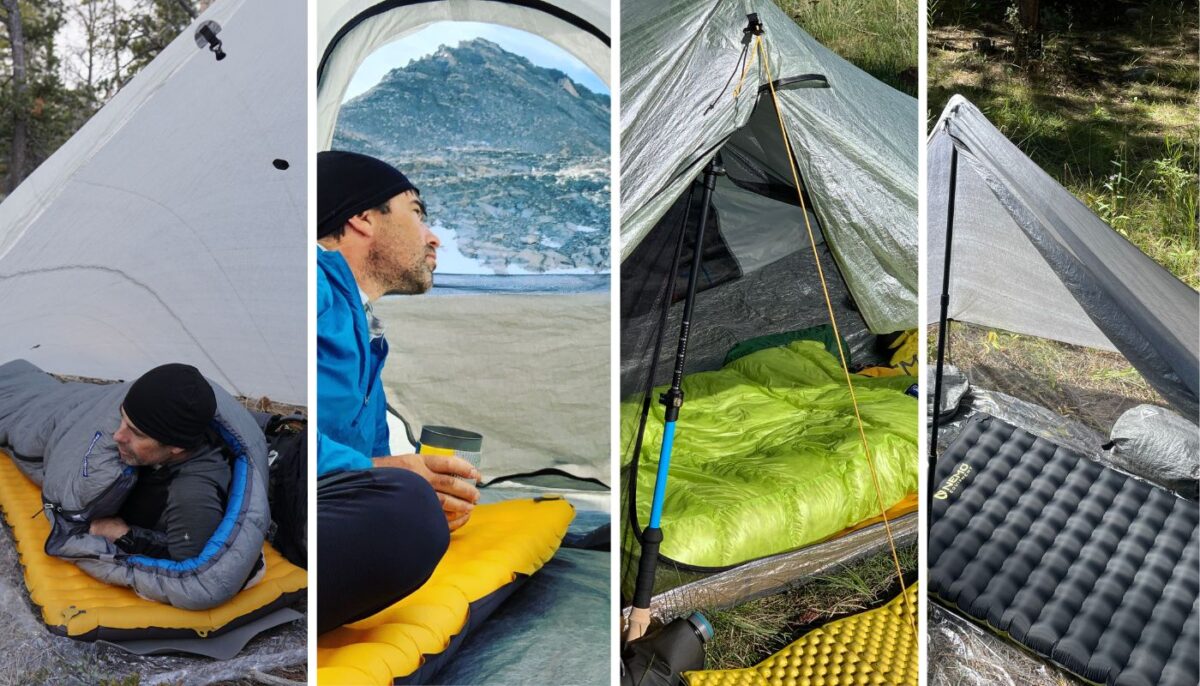
Comfort on an inflatable sleeping pad is not a number on a spec sheet – it is the output of a few variables you can control: inflation pressure, pad geometry (width, thickness, and baffle architecture), system integration with closed-cell foam or a bivy, and the skin-to-pad interface. In this article, comfort is treated as a set of measurable outcomes that can be optimized in the field, including pressure distribution at the shoulder and hip, lateral stability during position changes, thermal efficiency across the torso, and acoustic behavior at the fabric surface. The goal is not to inflate a pad until it “feels right,” but to hit objective targets that match your body, posture, shelter, and conditions.
You will see why width and edge stiffness influence roll‑off, how thickness interacts with inflation to affect bounce and bottom‑out, when a two-pad system improves both warmth and stability, and why slightly narrower pads often work better inside a bivy sack. Practical guidance includes inflation heuristics with deflection targets by sleep position, fast diagnostics you can run on the ground, and realistic expectations for pressure loss as evening temperatures drop.
Use this market report to select a high-performing starting point, then apply the Appendix protocol to tune your pad(s) for your specific use cases and contexts. If you standardize a few steps – select a geometry that fits your frame, set inflation to a measurable deflection, add foam or a textile layer when indicated, and match the pillow loft to the pad thickness – you will increase stability, reduce pressure points, and improve sleep continuity.
This market report identifies key products from a comprehensive specification analysis of more than 300 sleeping pads from 20+ brands across the US and Europe. Our database was updated in May 2026 and includes the most recent manufacturer-reported specifications for weight, dimensions, R-value, and materials. In addition, every pad featured or recommended in this market report has been tested in the field by Backpacking Light.
Prelude: It all started with closed-cell foam
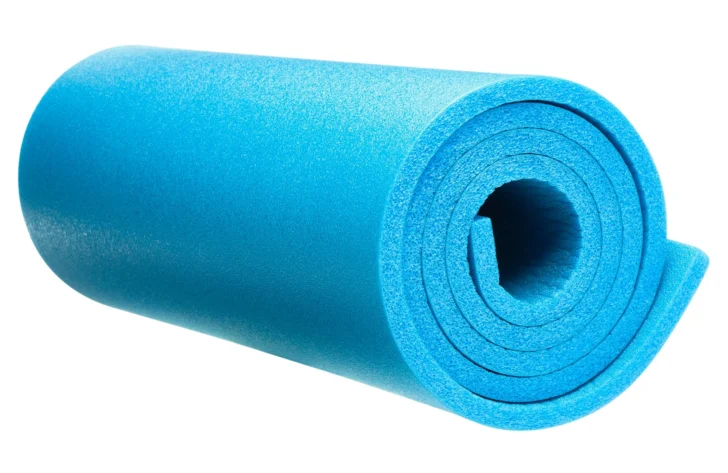
My first sleeping mat was blue and made of cross-linked polyolefin. It weighed about half a pound (a quarter kilo) and cost $6. I purchased it from a military supply store using my allowance when I was 9 years old when I was getting ready for a Cub Scout sleepaway camp. I never had to repair it, because it was made with closed-cell foam – there was nothing to break.
The sleeping pad I used on my last backpacking trip weighs nearly three times as much, costs nearly forty times as much, and requires that I carry a patch kit (which I’ve used on nearly every inflatable pad I’ve ever owned).
Few pieces of gear can be contrasted as much as the sleeping pad I used when I was a child vs. the sleeping pad I use today. Very little (and at the same time, a lot) has changed during this 45-year journey.
That ultralight blue foam pad represented (for me) the state of the art in backpacking sleeping mats. Even now, you can buy one at a discount big box retailer for less than fifteen bucks. They still weigh about half a pound.
Now, we have closed-cell foams that absorb less water, are a little more durable, and are slightly warmer. An example is cross-linked polyethylene (XLPE). XLPE 50 (i.e., 50 milligrams of weight per cubic centimeter of volume) is used in pads made by MEC. Lighter, less durable options include XLPE 30 (used in the Gossamer Gear Thinlight) and XLPE 20 (used in the Yamatomichi Minimalist).
The Gossamer Gear Thinlight Foam Pad is a closed-cell foam pad available in 1/8" thickness, with an estimated R-value of 0.5. Use it for protection and additional insulation from cold ground when paired with an inflatable pad, or keep it handy for on-trail and in-camp lounging.
Today, the most iconic closed-cell sleeping pad among long-distance hikers is the Therm-a-Rest Z-Lite. It’s puncture-proof – the Achilles’ heel of modern-day ultralight inflatable sleeping pads for backpacking. It’s a bit light on comfort and warmth, and it’s heavy and bulky for the little bit of warmth and comfort it does provide. However, if you’re a long-distance hiker on a budget, tough enough to sleep on a hard bed, and just want to throw your pad down on the ground without worrying about cactus spines and spruce needles, then the Therm-a-Rest Z-Lite may be your match made in heaven.
Another option – the Nemo Switchback. Like the Z-Lite, it’s an accordion-style folding pad, but offers slightly more thickness, and a hexagonal cell pattern that nests to a slightly more compact size. There are minor variants in R-value and comfort between the two, but in general, these performance characteristics will be indistinguishable to most users.
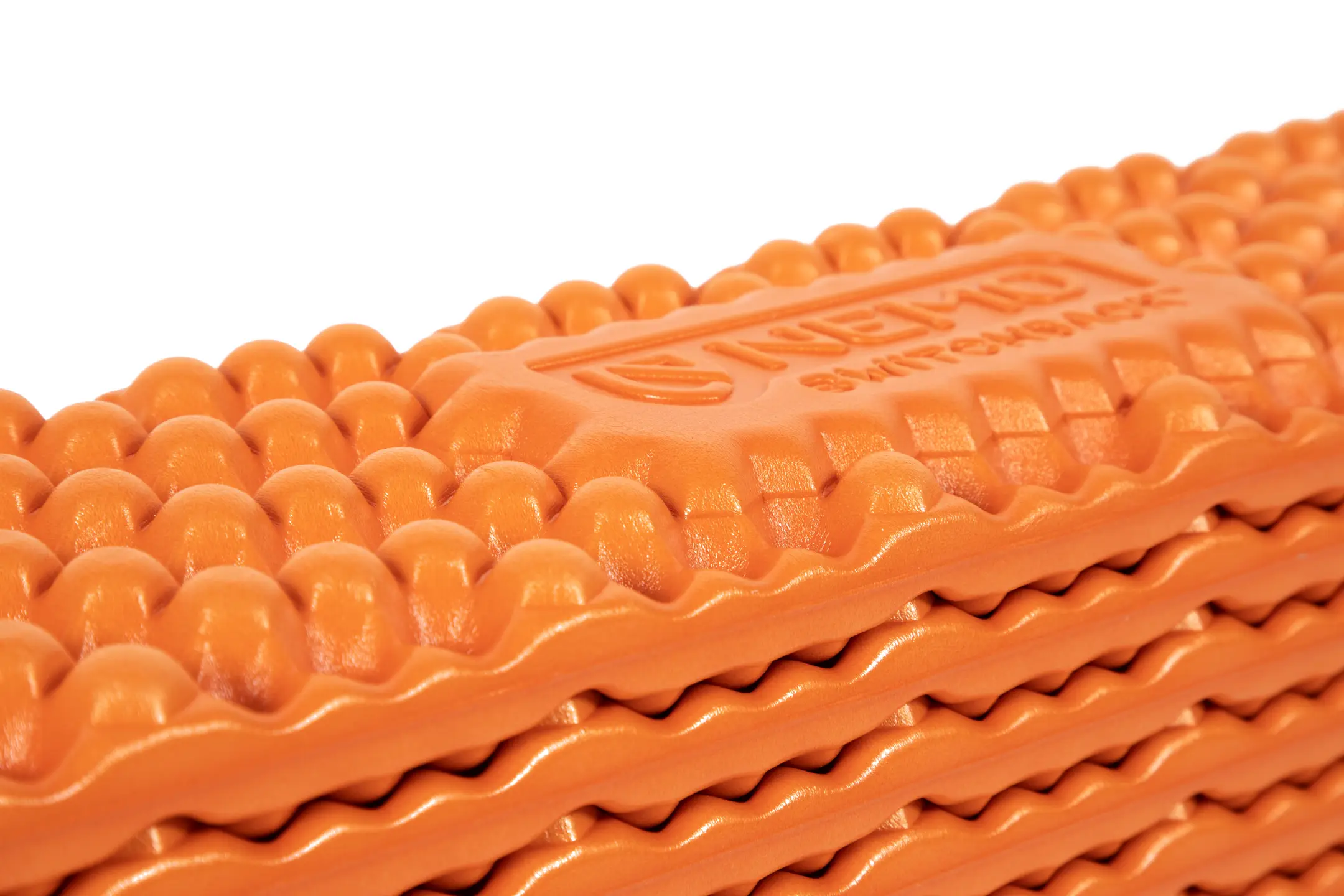
The Nemo Switchback offers more thickness (0.87 in) than both the Therm-a-Rest Z Lite Sol (0.75 in) and Exped FlexMat (0.7 in) in a dual-density foam and hexagonal cell nesting pattern. It folds more compactly than the Z Lite and provides better insulation (R-value 2.0) than the FlexMat (R-value 1.5). Among closed-cell foam pads, the Switchback is perhaps the most refined and versatile design.

The iconic sleeping pad for long-distance hiking.
- puncture-proof
- inexpensive
- durability (resistance to compression)
- comfort on hard ground
- warmth (R-2)
Open-cell inflatable (“self-inflating”) pads
I slept on a foam pad well into my late 20s but started experimenting with an inflatable sleeping pad that I purchased second-hand at a Seattle Mountaineers garage sale – a 1970s vintage Therm-a-Rest (a self-inflating open-cell foam-filled pad with durable fabric outer). It was about an inch thick, weighed a pound and a half, and failed many times under my ownership – both seam failures and fabric punctures.
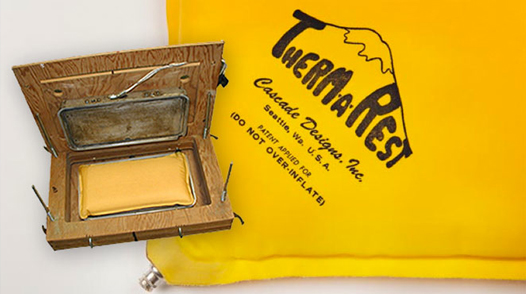
Seams have been more durably welded, and fabric puncture resistance-to-weight ratio has improved, but the overall design hasn’t changed in the past three decades. The Sea to Summit Pursuit defines the current state-of-the-art in this pad category and the Therm-a-Rest Trail Prolite incorporates lighter fabrics and more thickness to boost comfort and warmth a little.
I use the Pursuit in one of my bivy sack systems because of its durability and lower height for bivy sacks with limited interior volume.
|
Puncture-Proof

|
Most Durable

|
Modern Hybrid

|
And then, in the early 2000s, we saved weight in the most obvious way: we just made smaller pads.
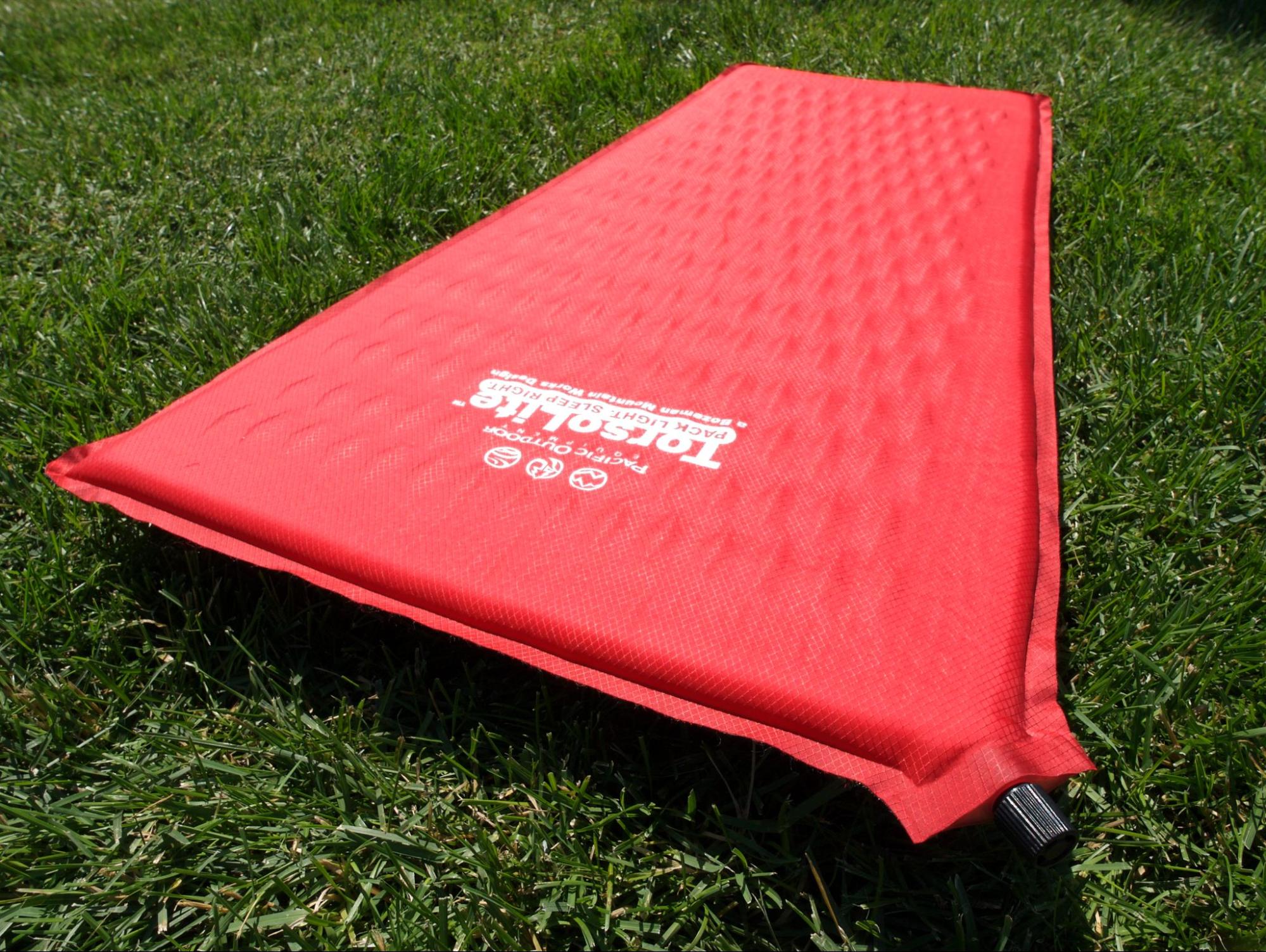
Evolution of the inflatable sleeping pad: leaving foam behind
As you can see from the table above, each of these styles of pads suffers from the following limitations:
- low comfort (thickness)-to-weight ratio
- low warmth (R-value)-to-weight ratio
However, in 2009, Therm-a-Rest introduced the first ultralight, uninsulated, non-self-inflating mattress to the backpacking market, the NeoAir. It was 3 inches (7.6 cm) thick, had an R-value of 2.5, and weighed only 14 ounces (397 g) in a 20 x 72 inch (51 x 183) cm mummy-shaped form factor. Although its weight was unremarkable (it weighed the same as the Z-Lite), its comfort-to-weight ratio certainly exceeded anything else on the market by a long shot.
The design characteristics of the NeoAir mattress that distinguished it from the Prolite mattress were the insulation, mode of inflation, and thickness. NeoAir mattresses were not insulated; they required manual inflation with your mouth or a bellows-style pump sack, and they were thick. That thickness translates to comfort, and it’s this feature alone that has resulted in their growing popularity over the past 15 years.
Since then, non-self-inflating mattresses have become the dominant product category within the overall backpacking sleeping pad market. NEMO, REI, Sea-to-Summit, Big Agnes, Zenbivy, Exped, and Klymit each offer several products within this category.
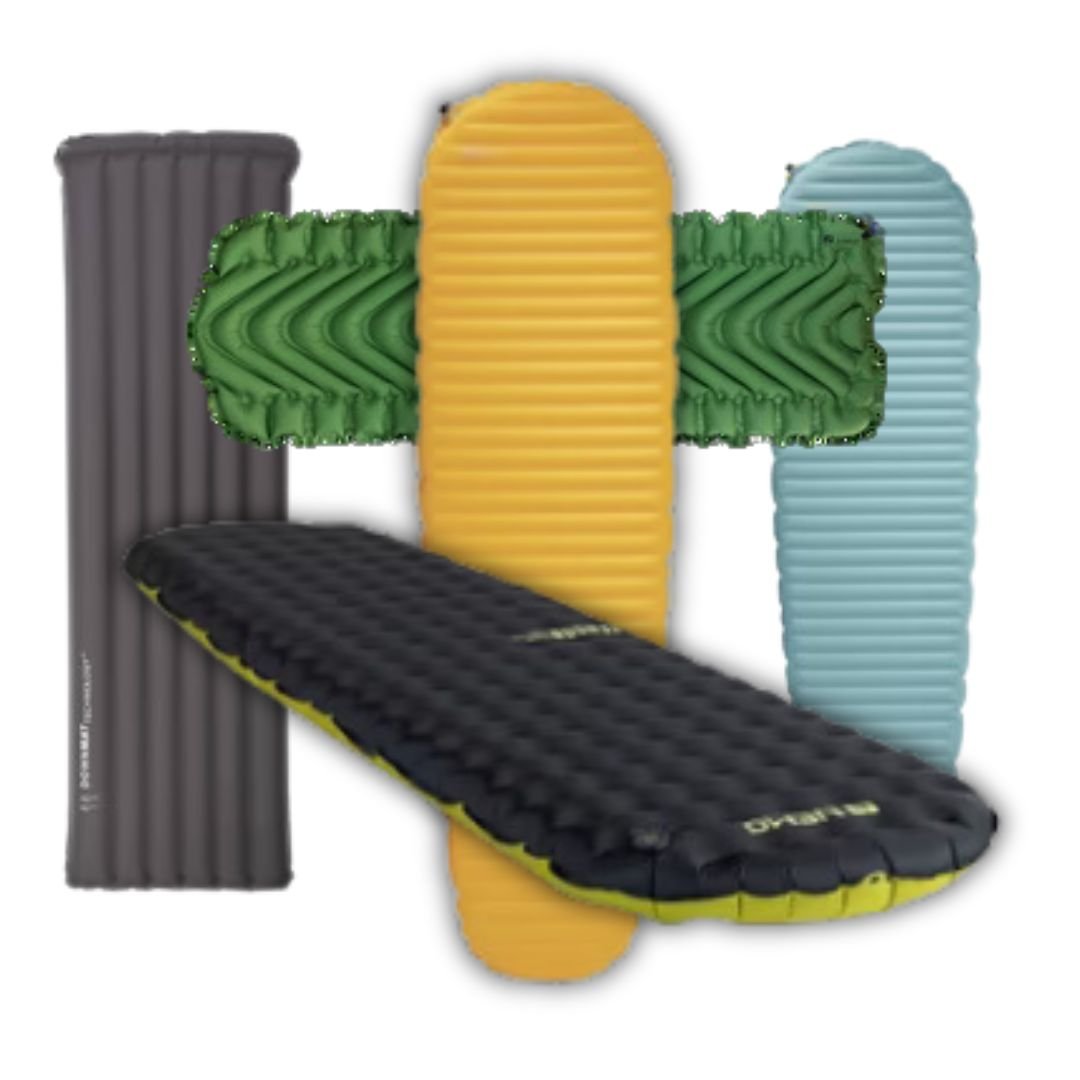
Some are insulated, some are not. Some are rectangular, others are mummy-shaped. Some are narrow (20 inches / 51 cm wide), some are wide (25 inches / 64 cm or wider). Some are short (down to about 47 inches / 119 cm), some are long (up to about 77 inches / 196 cm). Some are light (as light as 8 ounces / 227 g), some are heavy (as heavy as 40 ounces / 1,130 g). Some are quiet, others are noisy. Some are durable, others are fragile. Some are more stable, others are more wobbly.
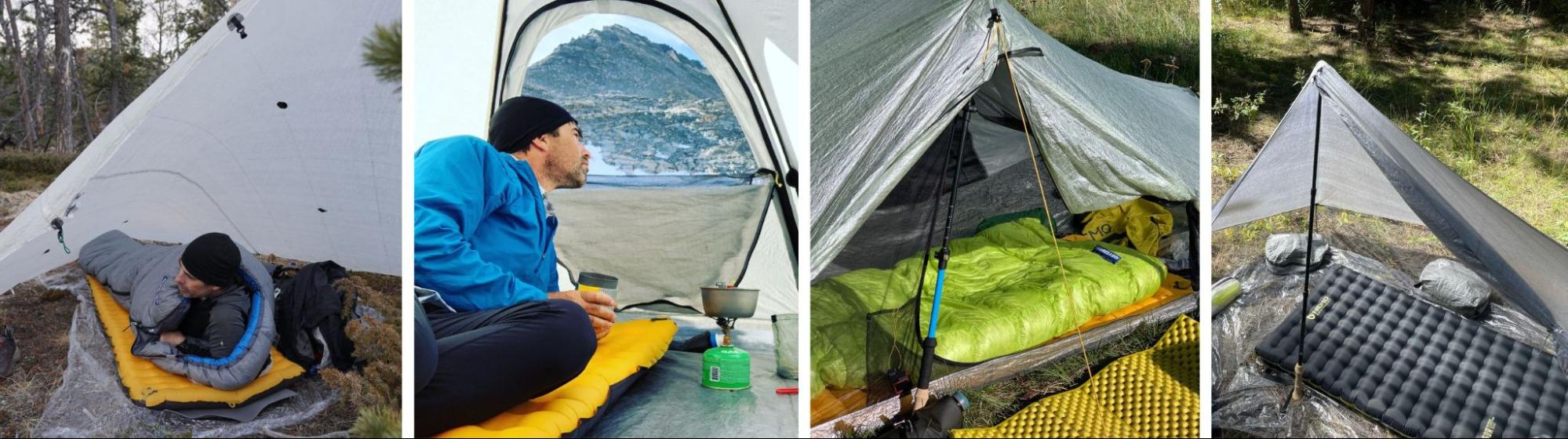
This product category, now comprised of dozens of different pads, has become commodified in the past five years or so, and the differences between many of the brands are a bit subtle.
However, two manufacturers – NEMO and Therm-a-Rest – have become market share leaders. The reason for this is two-fold:
- They have invested research and development resources into making these pads warmer using reflective surfaces and baffles (i.e., no foam or other high-loft fill materials).
- The quality of their construction and fabrics is relatively high. They tend to be fairly reliable in terms of seam integrity and fabric puncture resistance.
- They were the first companies to introduce regular length (72 inches / 183 cm), wide (25 inches / 64 cm) pads.
It is this latter feature – the “regular-wide” pad – that has probably changed my sleep comfort more than anything else in recent years. A wide pad is both more stable while sleeping or changing positions, and more comfortable because it provides a platform for resting your arms at your side (back sleeping), or for splaying your arms and legs into more comfortable, natural sleeping positions (side sleeping).
Having slept on more than 25 pads over the past three years, five pads stand out. Two are made by NEMO, two by Therm-a-Rest, and one is from a relatively small brand – Zenbivy. All of them represent each brand’s state-of-the-art models introduced in the past year.
The following table identifies the pads and compares their specifications for regular-wide size options:
Table: High R-Value Sleeping Pads
The following table outlines five sleeping pads worth considering if you're in the market for a high-R-value pad. Therm-a-Rest and NEMO are the market leaders. The Tensor and NXT series represent the market's current state-of-the-art in ultralight sleeping pad insulation combined with durable, lightweight fabrics. The Zenbivy Flex Air is unique for its soft, stretchy fabric surface, and is probably the most comfortable high-R-value pad to lay on with bare skin. Weights are reported to the nearest ounce for RW sized pads, so R/Weight ratios can be fairly compared.| Shape | Dimensions | Thickness | Weight | R-Value | R/Weight (oz) | |
|---|---|---|---|---|---|---|
| NEMO Tensor All-Season Ultralight Insulated Sleeping Pad | rectangular | 72 x 25 inches (183 x 64 cm) | 3.5 inches (8.9 cm) | 19 oz (539 g) | 5.4 | 0.28 |
| NEMO Tensor Extreme Conditions Ultralight Insulated Sleeping Pad | rectangular | 72 x 25 inches (183 x 64 cm) | 3.5 inches (8.9 cm) | 22 oz (624 g) | 8.5 | 0.39 |
| Therm-a-Rest NeoAir XTherm NXT Sleeping Pad | mummy | 72 x 25 inches (183 x 64 cm) | 3.0 inches (7.6 cm) | 20 oz (567 g) | 7.3 | 0.37 |
| Rab Ultrasphere 5 Sleep Mat | mummy | 72 x 25 inches (183 x 64 cm) | 3.5 inches (8.9 cm) | 16 oz (454 g) | 5.5 | 0.34 |
| Therm-a-Rest NeoAir XLite NXT Sleeping Pad | mummy | 72 x 25 inches (183 x 64 cm) | 3.0 inches (7.6 cm) | 16 oz (454 g) | 4.5 | 0.28 |
| Zenbivy Flex Air Mattress | mummy | 72 x 25 inches (183 x 64 cm) | 3.0 inches (7.6 cm) | 24 oz (680 g) | 4.8 | 0.20 |
State of the Market: Inflatable Air Pads
One of our big projects right now is investigating the performance (ground comfort and warmth) of sleeping pads. The following chart shows a plot of the top 100 or so pads on the market.
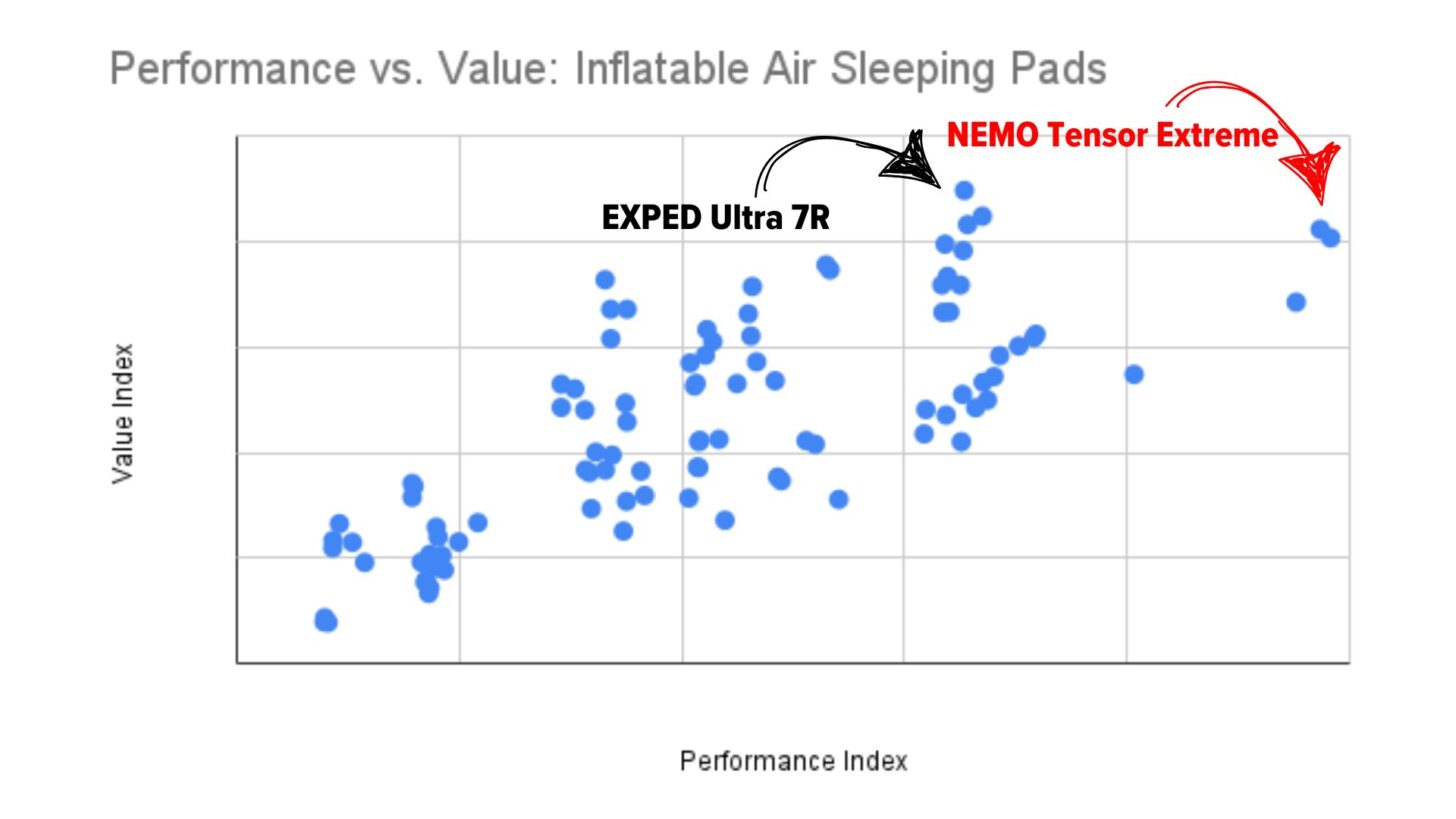
The x-axis (Performance Index) = comfort and warmth per ounce of product. The y-axis (Value Index) = comfort and warmth per dollar of product cost.
In terms of raw performance, the Nemo Tensor Extreme line scores the highest. They offer more performance per ounce than any other pad on the market.
Although they’re expensive, the Nemo Tensor Extreme line provides solid value, dollar for dollar, when compared to other pads. The only product line that scores higher in terms of the raw performance you get per dollar is the Exped Ultra 7R.
If we manipulate the Value Index a little bit, though, and replace the comfort+warmth per dollar of product cost with the comfort+warmth:weight per dollar of product cost, the Big Agnes Rapide SL line floats to the top of the Value chart:
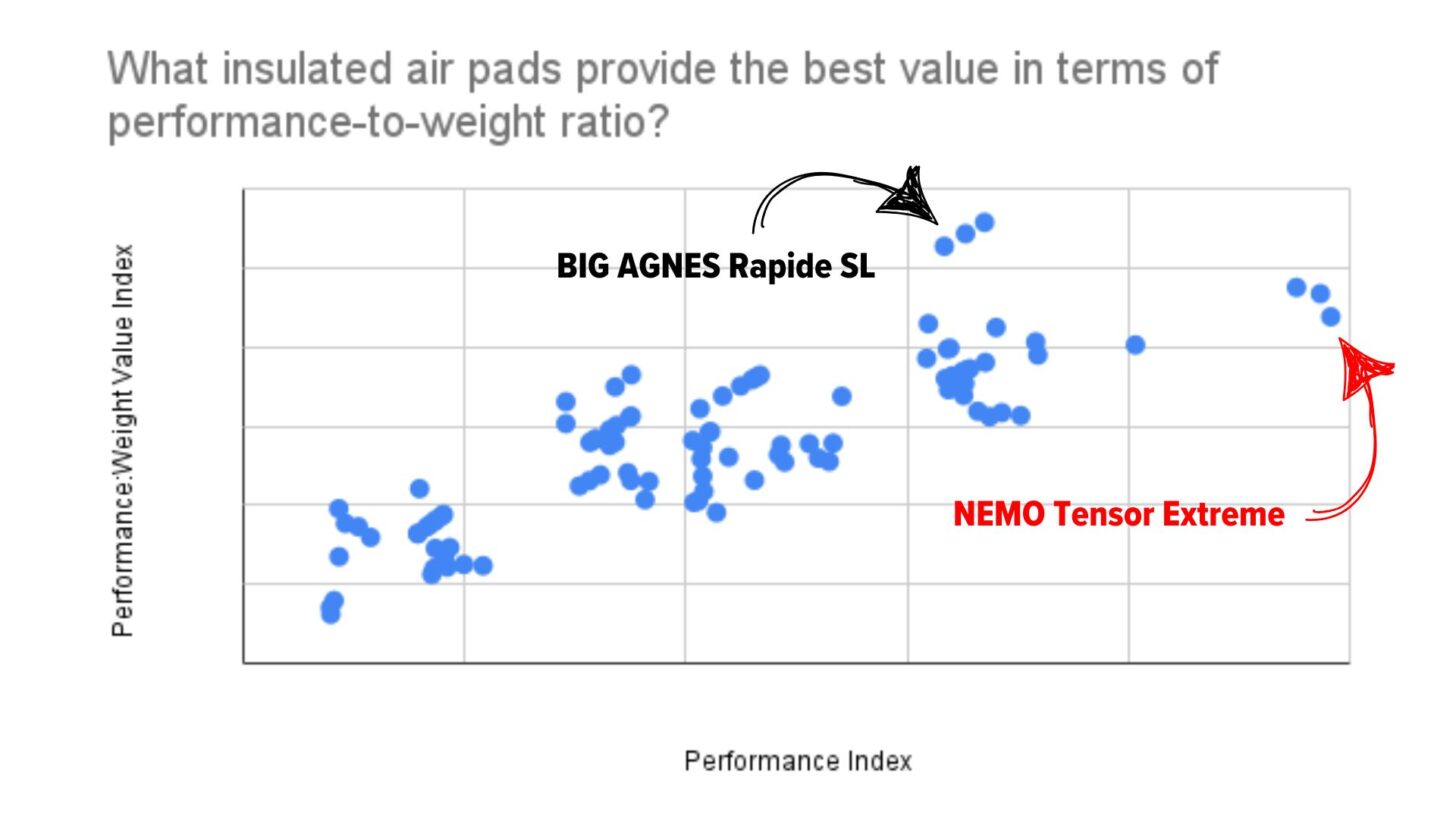
That means the Big Agnes Rapide SL provides the cheapest path towards optimizing your warmth:weight ratio – i.e., it offers the most “bang” for your “buck”.
In short, pads from any of these three product lines will reward you with high performance for their weight, and a lot of value.
Stability: Baffle Architecture
Stability is a term that is poorly understood and communicated by both users and outdoor gear reviewers. In its simplest terms, stability defines the ability of a pad to maintain its geometry in response to both user weight and movement. Stability is governed predominantly by baffle architecture, and it’s the primary predictor of user comfort, including warmth distrubiton, body stability, noise, and how well the pad supports different sleeping positions.
Let’s take a deeper look at the four primary baffle architectures used in today’s pads: horizontal, vertical, air-sprung cells, and 3D welds.

1. Horizontal Baffles
Horizontal baffles run side to side, across the width of the pad. This style uses continuous air chambers that span the full width, creating a gently contoured surface.
Performance Effects:
- Stability: Offers moderate lateral support – more than vertical baffles, but less than air-sprung cells or zoned designs.
- Cradling: Gently dips the sleeper into the middle of pad, which some find comforting, especially for back sleepers.
- Thermal Efficiency: Often paired with reflective layers and thermal baffle structures (e.g., triangular cross-sections) to restrict air movement and improve R-values.
Caveats:
- Can feel bouncy or springy under shifting weight.
- Heavier users may experience center sag if not fully inflated.
2. Vertical Baffles
Vertical baffles run the length of the pad, head to toe. They offer a consistent surface structure that aligns with the body’s longitudinal axis.
Performance Effects:
- Support Consistency: Provides a firm and stable feel, especially good for tall people or those who rotate a lot at night.
- Edge Stability: Usually poor, but can be enhanced by oversized outer baffles (“rails”), which help keep the user centered on the pad.
- Warmth Distribution: Efficient for convective control along the body, but less effective at preventing lateral heat loss compared to more complex baffle architectures.
Caveats:
- Can cause a “barrel roll” effect if side baffles are not oversized.
- May feel too rigid or flat for some sleepers, particularly on uneven ground or for side sleepers needing more hip/shoulder contouring.
3. Air-Sprung Cells
Comprised of a matrix of individual air cells created via dot welds. These chambers mimic a pocket-sprung mattress, where each cell can compress independently.
Performance Effects:
- Pressure Distribution: Good conformity to body contours – ideal for side sleepers or users with bony contact points.
- Stability: High. Movement in one area is isolated from others, reducing ripple effects across the pad.
Caveats:
- Slightly heavier and bulkier due to a greater number of welds and internal structure.
- May feel firmer overall, especially when inflated to high pressures.
4. 3D Welds
Uses traditional horizontal baffles modified with strategically placed internal welds to suspend insulation and control chamber depth. 3D welding also allows for more variation in baffle geometry and insulation thickness by zone (shoulders, hips, legs).
Performance Effects:
- Bottom-Out Resistance: 3D welds add internal tension, reducing the risk of hips or shoulders compressing the pad to the ground.
- Zoned Comfort: Provides targeted cushioning and warmth where it’s needed most.
Caveats:
- Less conforming than air-sprung cells – comfort depends more on baffle depth and pad thickness.
- Zoned padding can feel inconsistent to some sleepers who shift positions frequently.
Recommendations
Comfort: stability, warmth, and noise
In field use, my personal preference leans towards the three pads from NEMO – the Tensor Elite, Tensor All-Season Ultralight Insulated and the Tensor Extreme Conditions Ultralight Insulated. They are quieter and more stable than Therma-a-Rest NXT pads. And while I do think the Therm-a-Rest XTherm NXT is warmer than the NEMO Tensor Extreme Conditions (see below), I find the Tensor Extreme to be sufficiently warm for sleeping on snow in any 3-season condition, and more than warm enough when paired with a Gossamer Gear Thinlight underneath it for mid-winter camping in the Colorado and Wyoming Rockies.
In 2025, I’ve been experimenting more with Sea to Summit XR and XR Pro pads (which replace the old XT series). They are stable and I appreciate the slightly wider width for bivy sack use (the standard width pads are about 22 inches wide) – small enough so as not to constrict me inside a bivy sack but wide enough to provide a bit more comfort without having to go to a “wide” (25-inch) pad.
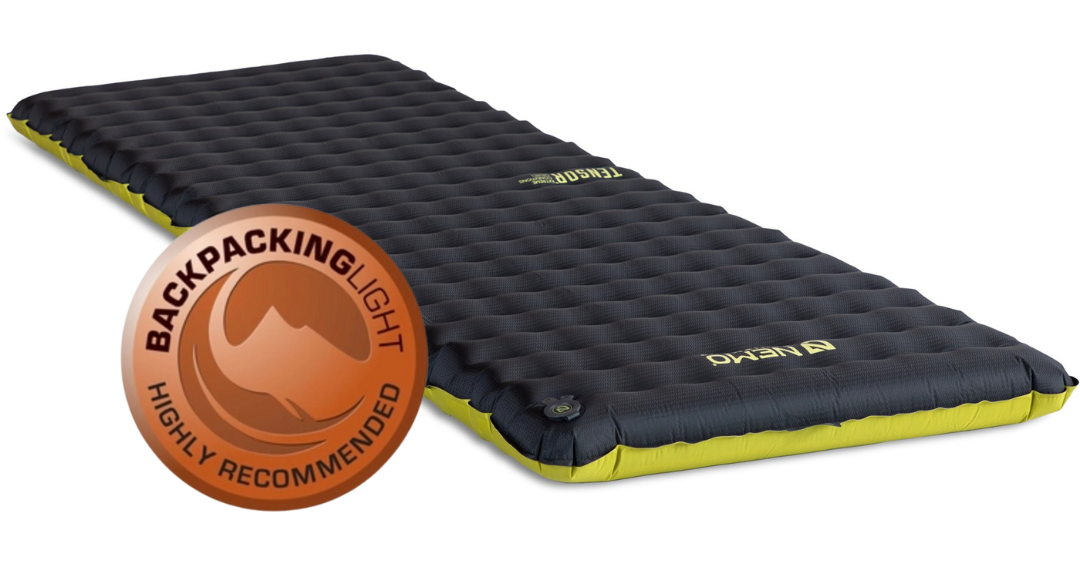
The NEMO Tensor Extreme Conditions Ultralight Insulated Sleeping Pad is a 1-person insulated air pad with Apex baffle construction, 4 floating Thermal Mirror film layers, 20-denier nylon top, 40-denier nylon bottom, 3.5 in. thickness, 8.5 R-value, Laylow valve, and 1 lb. 2 oz. Regular weight.
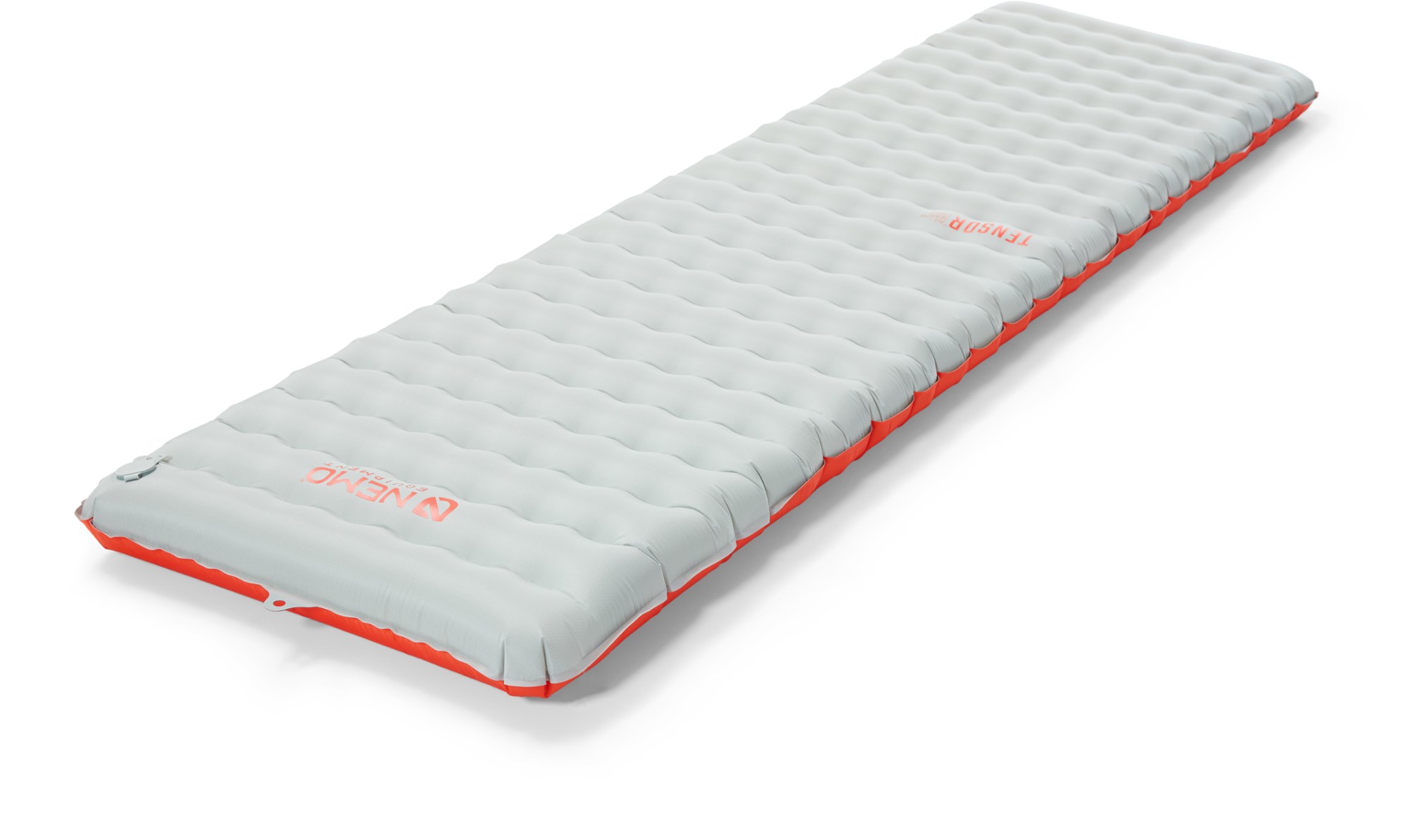
The NEMO Tensor All-Season Ultralight Insulated Sleeping Pad is a 1-person insulated air pad with Spaceframe baffles, two suspended Thermal Mirror film layers, 20-denier nylon top, 40-denier nylon bottom, 3.5 in. thickness, 5.4 R-value, Laylow valve, and 14.1 oz. minimum weight.
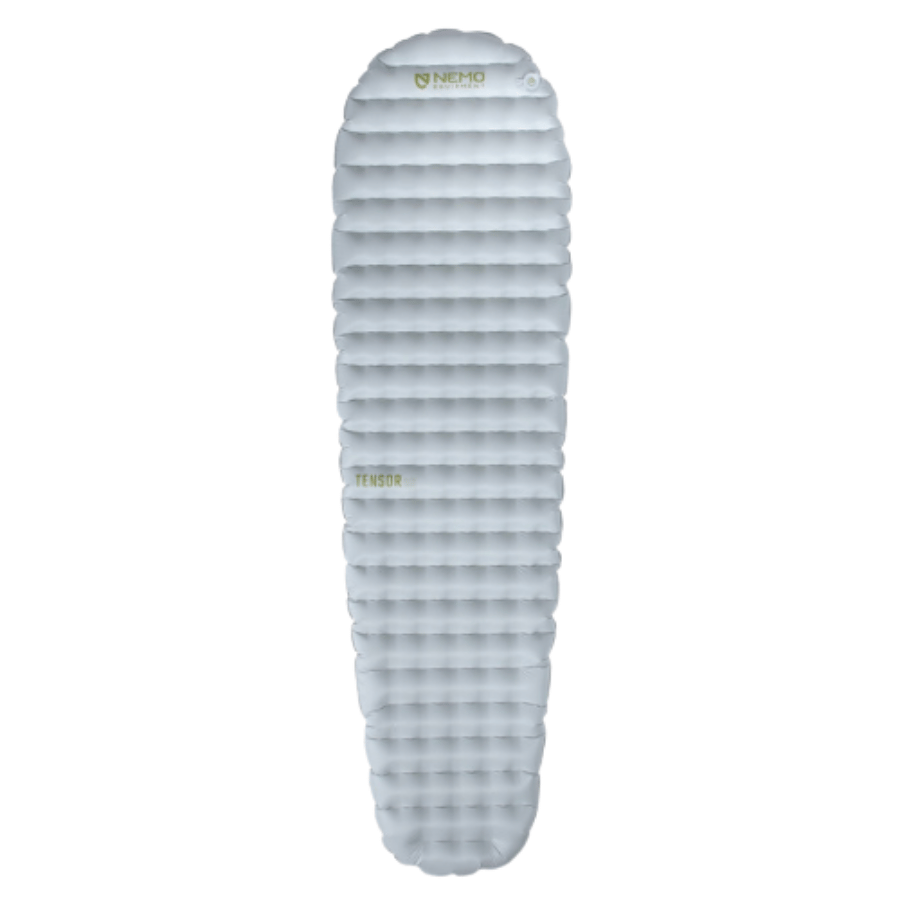
The NEMO Tensor Elite Mummy Sleeping Pad is an insulated mummy air pad with Apex baffle construction, 10D Cordura nylon ripstop fabric, single-layer Thermal Mirror film insulation, 3 in. thickness, 2.4 R-value, Laylow valve, and 8.5 oz / 240 g Regular Mummy minimum weight.
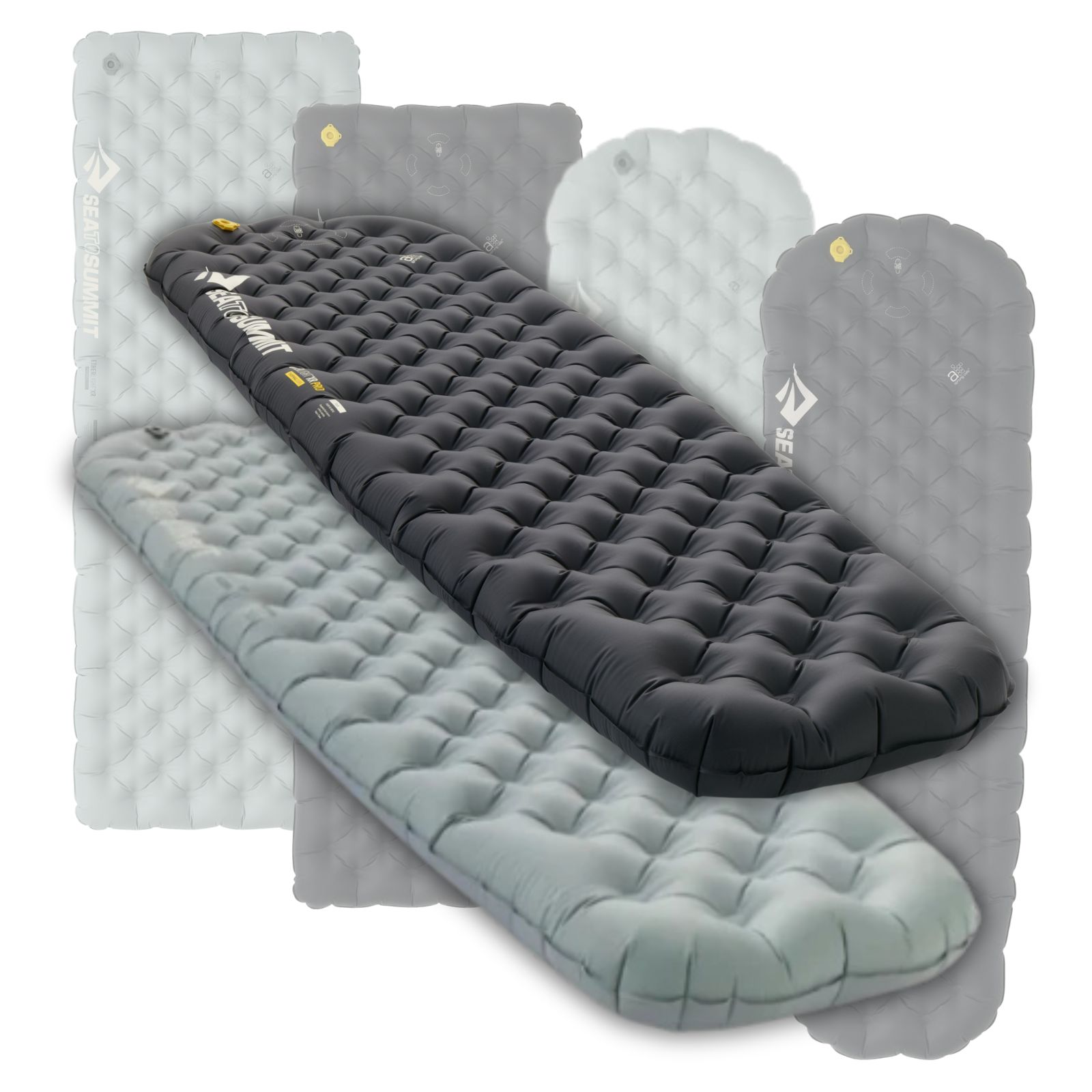
The Sea to Summit Ether Light XR Insulated ASC Sleeping Pad is an insulated air pad with Air Sprung Cell construction, ThermalCore insulation with a suspended TRM reflective layer, 10 cm thickness, 4.1 R-value, XPRESS valve, integrated pump sack, and 470 g Regular weight.
Sea to Summit XT vs. XR: The XT series pads are being sunsetted in 2025, and replaced by the XR series. XR pads are slightly warmer (R-value of 4.1 vs. 3.2). Standard (not Pro) pads now offer ThermalCore insulation. XR pads have improved weld strength (manufacturer claim, not tested) and a slightly smaller packed size.
Maximum warmth-to-weight ratio
If you value pure warmth (as the primary measure of performance) for the weight, the Therm-a-Rest NeoAir XTherm NXT is the new gold standard for warmth-to-weight ratio in inflatable sleeping pads (because of differences in baffle and insulation design, and based on our not-yet-published thermal kettle tests). Considering that it’s a true four-season pad that weighs only 20 ounces (567 g) in a regular-wide size (with a mummy shape), that’s quite a feat. Those who find the horizontal baffling of Therm-a-Rest NeoAir-style pads comfortable can enjoy a few less ounces over the NEMO Tensor Extreme. The only caveat: NXT pads are little noisy (crinkling sound) when moving around on the pad. Tent mates, beware! Almost as warm, and a bit lighter – see the new (post 2026) version of the Rab Ultrasphere pad. It’s the lightest high-R-value pad on the market today, with more stable baffles than NeoAir designs.

The Therm-a-Rest NeoAir XLite NXT is a 1-person mummy air sleeping pad with Triangular Core Matrix construction, ThermaCapture insulation, 3 in. thickness, 4.5 R-value, WingLock valve, multiple size options, and a listed Regular weight of 13 oz.
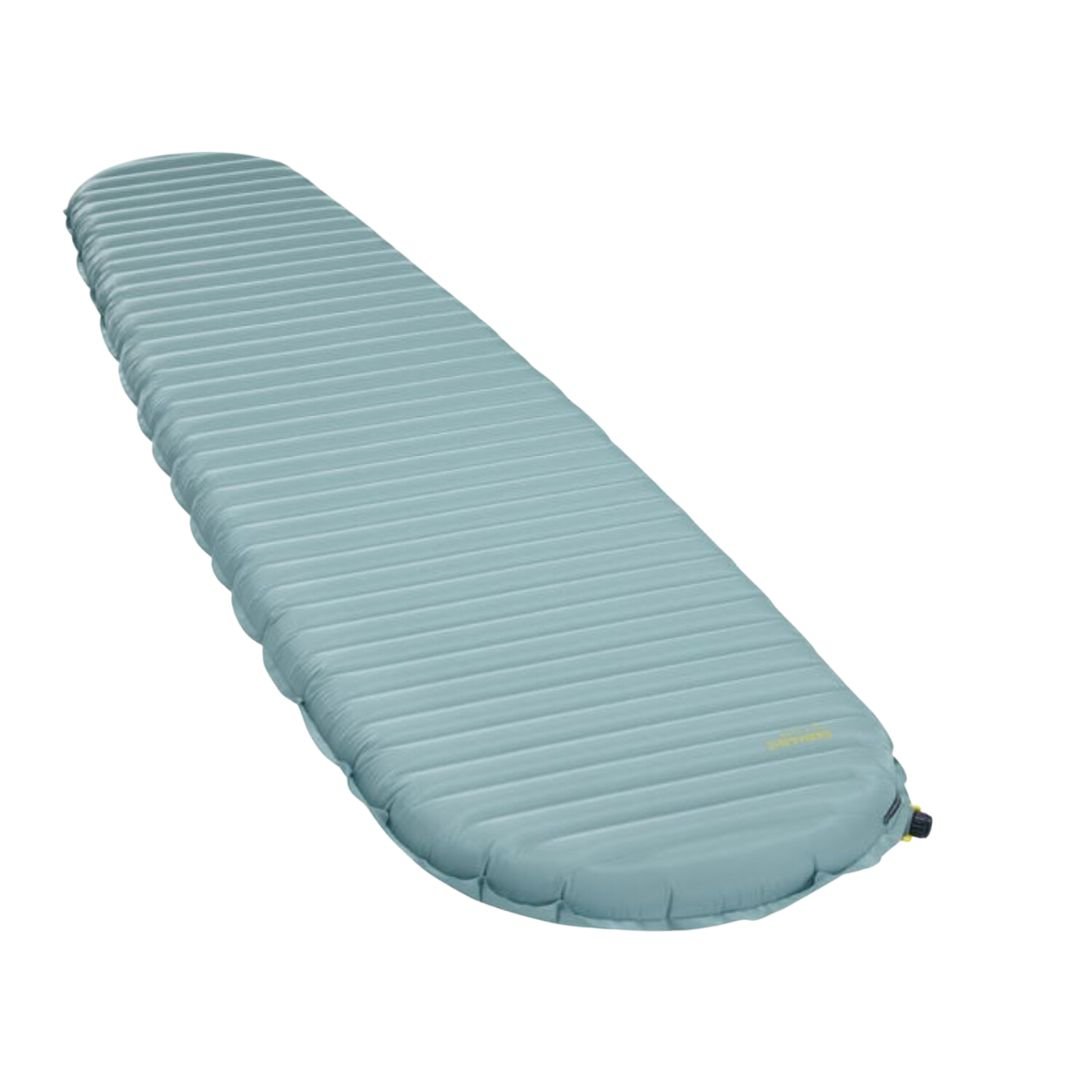
R-7.3, 3.0 inches thick. Higher warmth-to-weight ratio than the Tensor, but a little less stable and a bit more noisy.
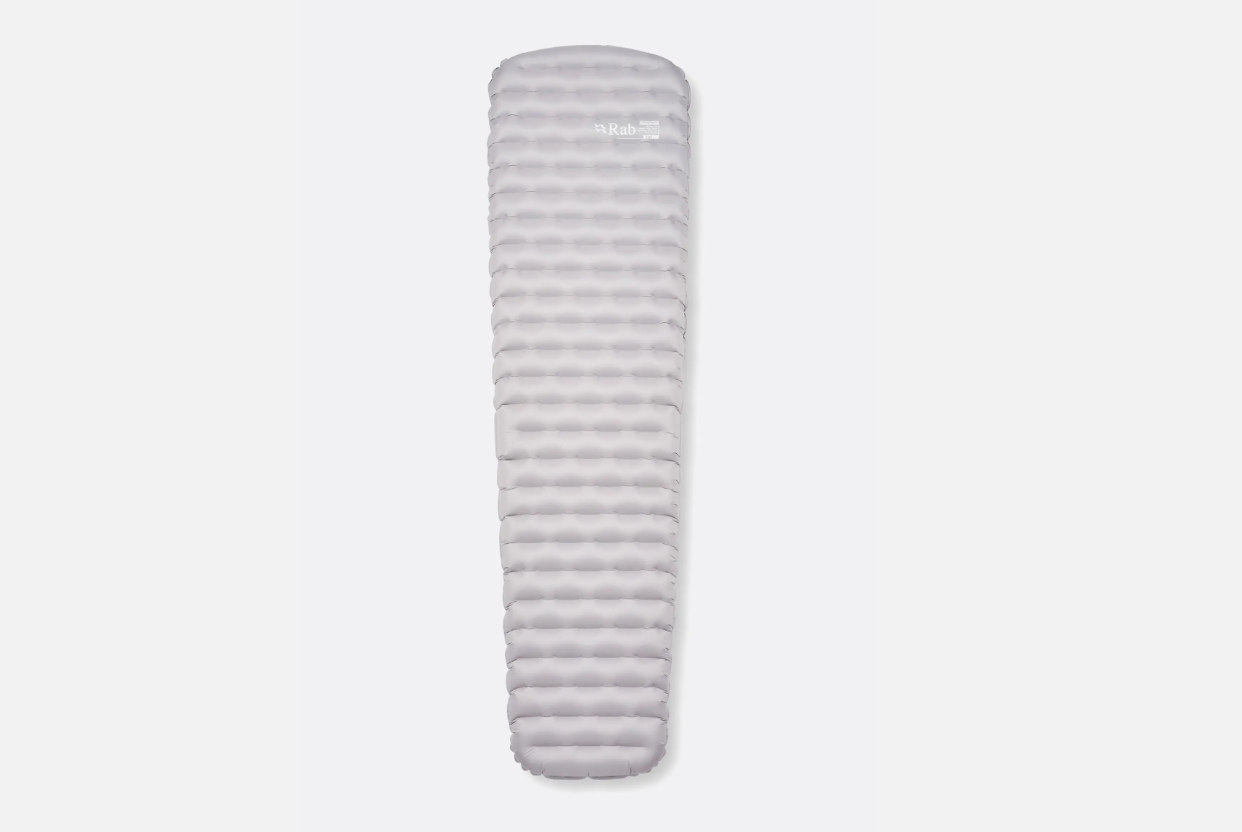
Inflatable tapered mummy sleep mat with offset air chambers, two layers of heat-reflective TILT, 20D fabric, an R-value of 5.5, 7.1 x 3.5 in (18 x 9 cm) packed size, and a 12.2 oz (345 g) listed weight.
Stretch fabrics: soft, quiet, and stable
Finally, there’s one more pad that’s somewhat unique and worth keeping an eye on – the Zenbivy Flex Air Mattress. It’s fairly warm (R-4.8) and fairly light in a regular-wide size (24 ounces / 680 g). Its unique feature, however, is its stretchy top fabric. While it sounds a little strange to put stretch-fabric on a sleeping pad, you may change your mind after lying on top of it. It’s quiet, soft, and the stretch keeps it from wobbling around a bit less when you move around on the pad. The effects are subtle and not earth-shattering, but they are noticeable and may contribute to additional comfort for you.
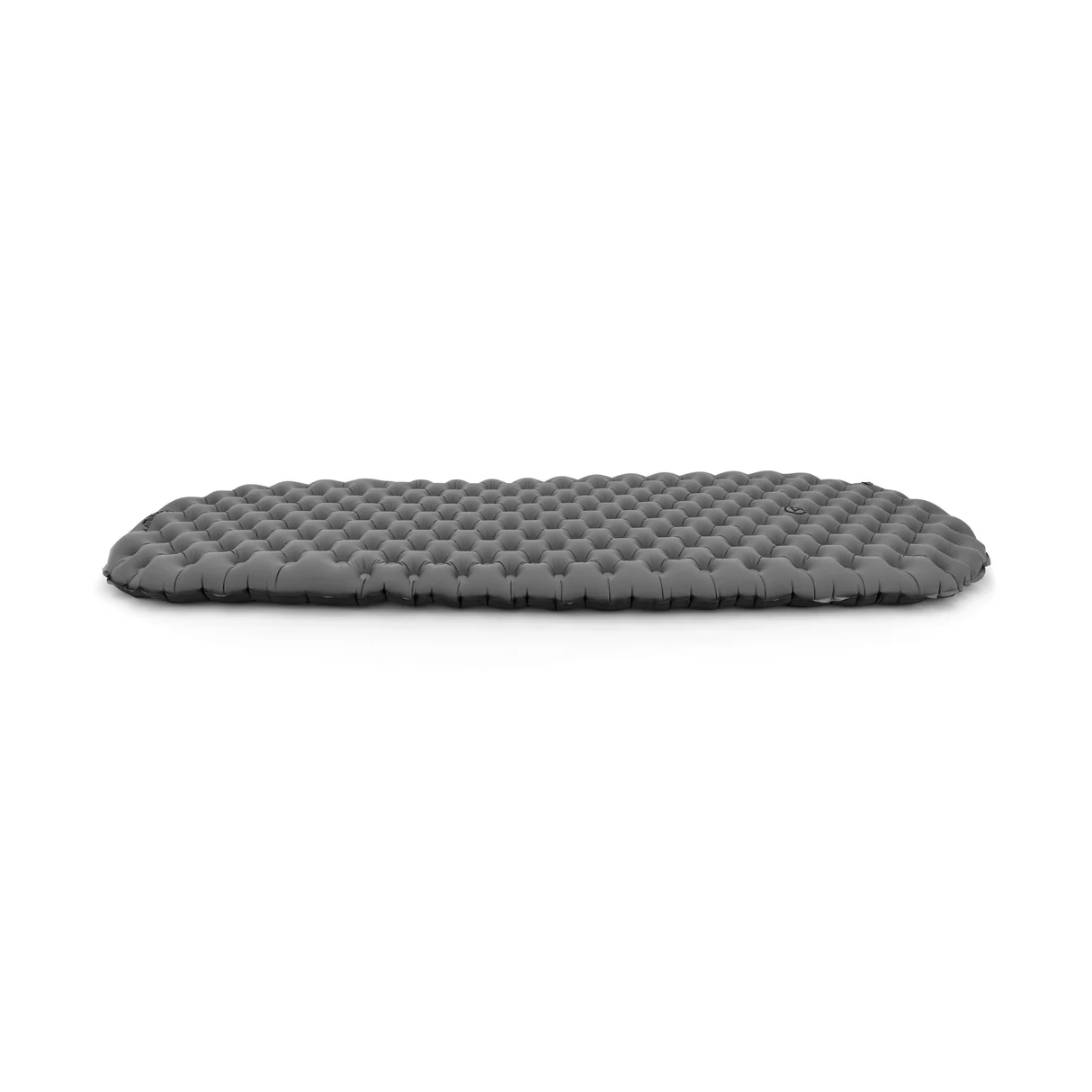
- stretch top fabric is quiet and soft, increases stability (reduces wobble) when changing positions on pad
On a budget?
The lightest premium inflatable pads with the highest R-values and lowest weights approach price tags nearing $300.
With an MSRP of $169 (and a sale price of less than $120 during Memorial Day, Labor Day, and Holiday sales), the REI Helix Insulated Pad strikes a good balance between cost, weight, thickness, stability, quietness, and insulative value.

Similar in warmth (R-4.9) to the Therm-a-Rest XLite NXT (R-4.5), but a more affordable option. The interior baffle design makes this pad impressively stable. Reasonably quiet, reasonably light, and reasonably durable - a very solid budget option with "wide" options in both regular and long lengths for additional comfort.
I’ve purchased, used to failure, dissected, and inspected more than a dozen other pads in the same weight class as the Helix, purchased primarily from white-label brands selling products through online marketplaces (including Amazon, Alibaba, and Temu). These pads ranged in price from $15 to $85. I’ve yet to discover any that meet reasonable quality standards for welded seam consistency, puncture resistance, or fabric QC uniformity. There are marked differences in both material and manufacturing quality between these products and those manufactured by Cascade Designs, NEMO, REI, Big Agnes, Exped, or Sea to Summit. Buyer beware.
Pumps and Pump Sacks
Inflatable sleeping pads have spawned a market for inflation pumps and pump sacks. Most inflatable mattresses include an inflation bag (“pump sack”) that works as follows:
- Attach the bag to the pad’s inflation valve (using the bag’s built-in adapter).
- Fill the bag with air.
- Roll the bag opening over to seal it, and expel the air into the pad like a bellows.
- Repeat steps 2 and 3 until the pad is filled.
- Remove the bag from the pad and top off with a few breaths.
An inflation bag can be filled with air in one of two ways:
- A Bernoulli effect – where you lightly blow air into a narrow opening of the sack, and Bernoulli forces draw additional air inside.
- A scoop effect – where you scoop the inflation bag’s large opening through the air or point it into the wind to fill it up.
Some of us try to take advantage of multiple-use inflation bags, by using them as pack liners or stow bags for other gear. Narrow-mouth bags don’t work well for this, but wide-opening (“dry-bag style”) inflation bags do. One of the most popular options in our community is the Exped Schnozzel.
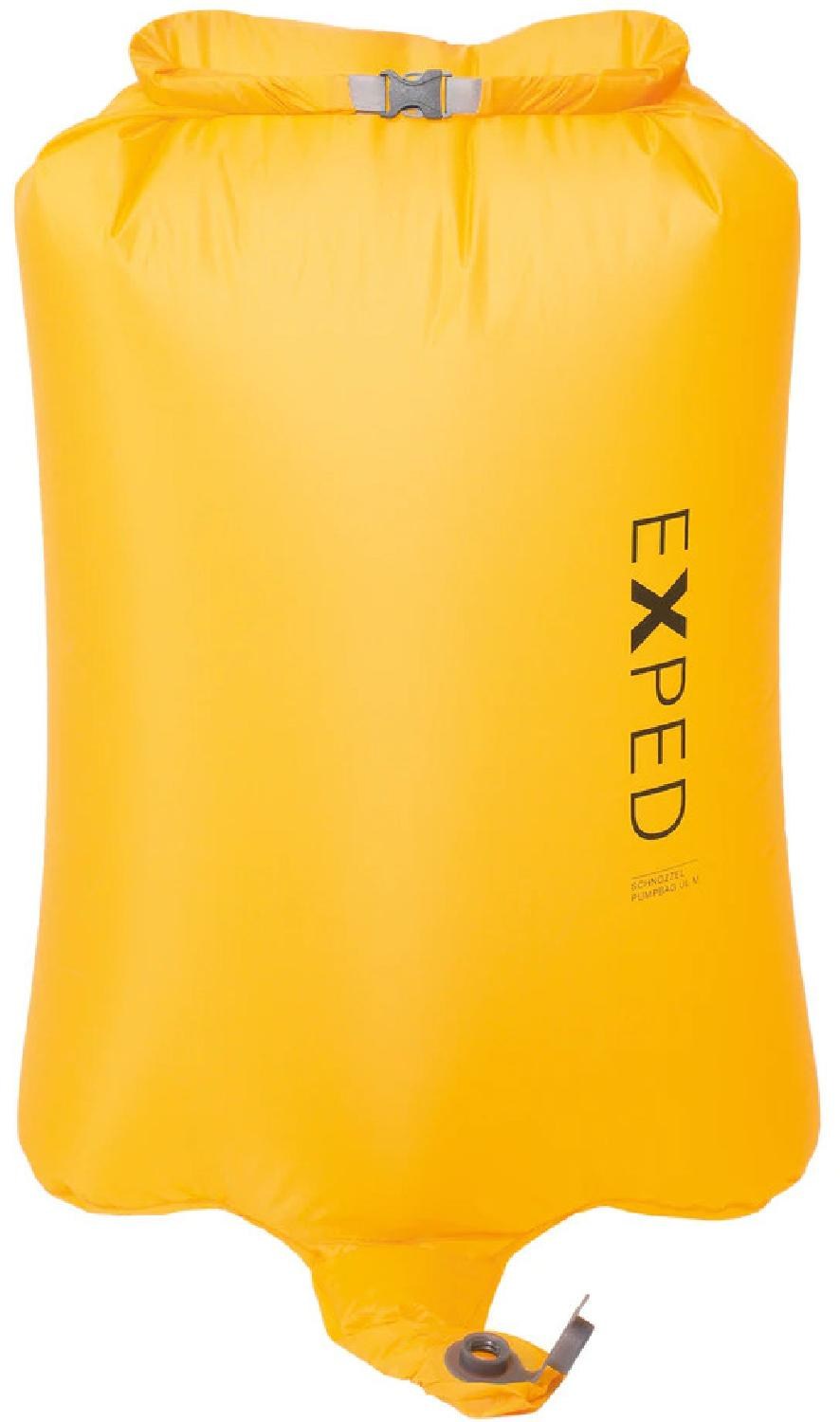
The Exped Schnozzel Pumpbag UL works like a bellows, delivering air into your inflatable sleeping pad. It also doubles as a waterproof roll-top stuff sack and a pack liner.
Usually, an inflation bag can fill a sleeping pad with air with about 4 to 6 bag fills (less for a larger bag like the Schnozzel, more for a smaller bag like those shipped with Zenbivy pads).
However, if you still think that’s too much effort, or you otherwise don’t want to fuss with an inflation bag or use it as a multi-use item, then there are tiny battery-operated and USB-rechargeable pumps available. Most of them weigh less than 5 ounces (142 g), and most of them (especially those available from mega-online-retailers) are junk. I’ve purchased several to test, and they often lack quality construction, water resistance, battery life, and pumping power. Several have failed in the field after only a few days of use.
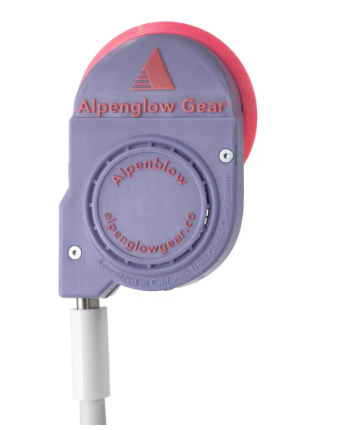
The Alpenblow Micro Inflator is an ultralight, 8-gram (0.28 oz) device that inflates sleeping pads in approximately three minutes, drawing minimal power (18 mAh at 5V) from USB-C devices such as smartphones or power banks. Operating at a noise level of 42 dBA, it includes multiple nozzles compatible with Therm-a-Rest (WingLock), NEMO (Laylow), Big Agnes, Sea-to-Summit, and EXPED sleeping pad valves.
If you are looking for a lightweight, quality pump that has good power, long battery life, a fast recharge time, and is durable enough for sustained outdoor use, consider the Flextail Zero Pump.
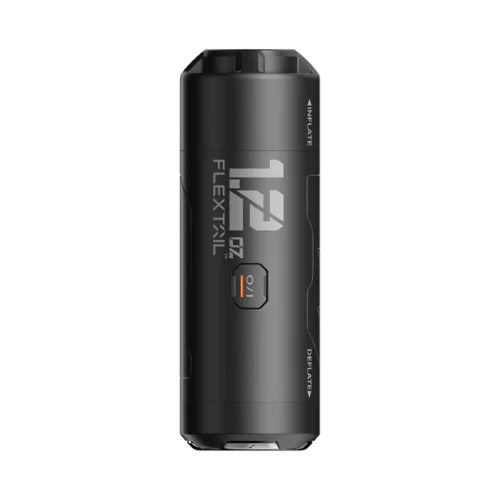
Save your breath, and leave the bulk of an inflation bag at home. One of the few pumps that actually works well and is still very light, with a decent battery life. You'll get 15 to 25 mattress inflations on a single charge if you use a full-sized mattress.
And our current recommendation for portable battery chargers with very high charge density-to-weight ratios:
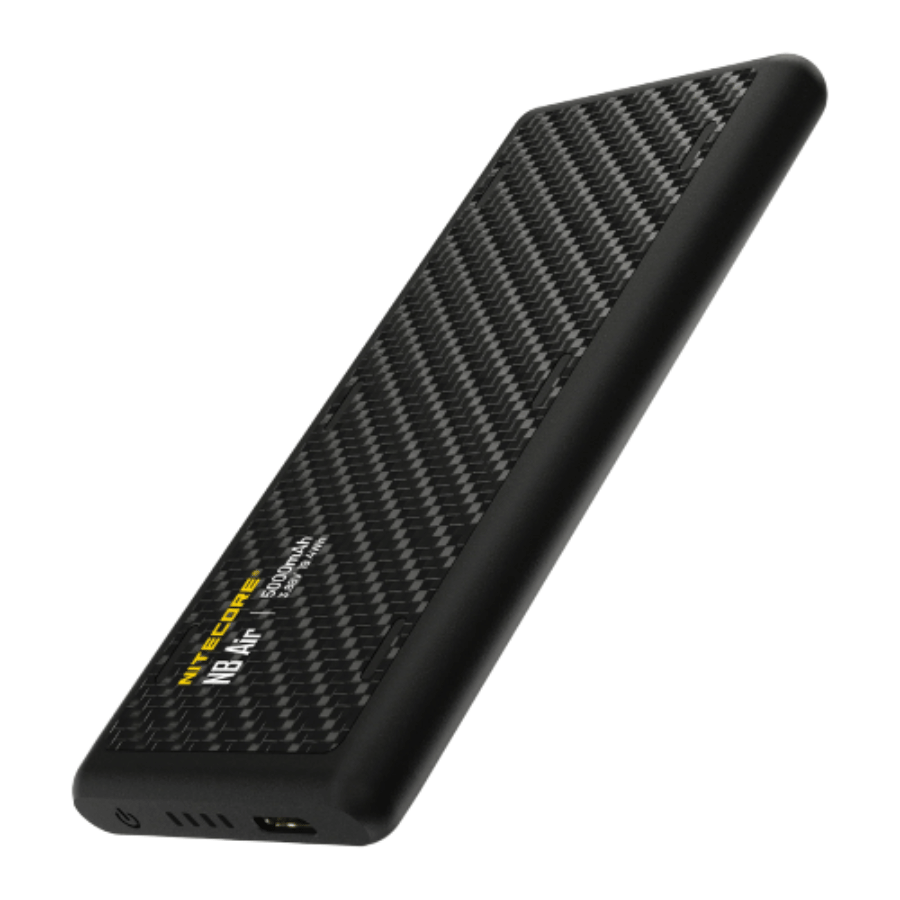
The Nitecore NB Air features a 5,000mAh Li-ion battery with 19.4Wh capacity, delivering 18W max power via USB-C with two-way PD/QC 3.0 support. Its IPX7 waterproof rating ensures reliability in outdoor conditions, while the carbon fiber construction provides durability with minimal weight at 89g.
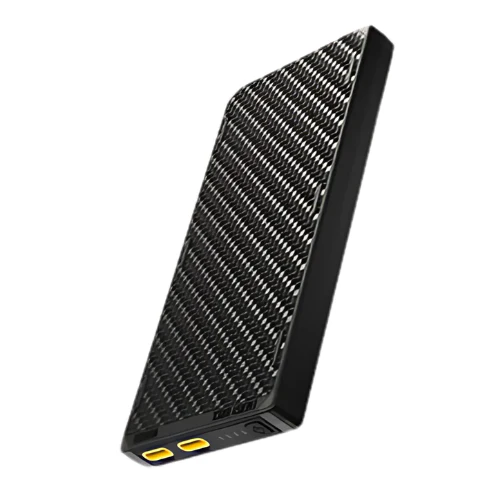
The Nitecore NB10000 Gen 3 Power Bank provides 10,000mAh of high-capacity, lightweight portable power with fast USB-C charging, designed for outdoor enthusiasts who need reliable energy for devices during extended trips in the backcountry. Its slim profile and durable construction offer efficient power management in rugged environments.
Appendix: Optimizing Inflatable Pad Comfort: Inflation, Geometry, and System Integration
This brief provides a practical, evidence‑informed approach to increasing comfort on inflatable sleeping pads. You will tune inflation, select geometry that matches your body and sleep style, integrate closed cell foam when indicated, manage fit in a bivy sack, and control the skin–pad interface. Each recommendation is actionable in the field with minimal gear.
Control inflation with intent
Method:
- Inflate to firm using a pump sack or inflation pump and top off by mouth to be as firm as possible.
- Lie in your habitual sleep position.
- Use the valve’s micro‑bleed to release air in 1 to 2 second increments, reassessing after each bleed.
Targets by sleeper type:
- Back sleeping benefits from slightly higher internal pressure. Aim for approximately 10 to 15% deflection of pad thickness under the pelvis and mid‑thoracic spine.
- Side sleeping benefits from additional conformance at the shoulder and greater trochanter. Aim for 15 to 25% deflection without bottoming out.
Heuristic for common thicknesses:
- 2.5 in pad: back sleeping 0.25 to 0.4 in deflection, side slepping 0.4 to 0.6 in.
- 3.0 to 3.5 in pad: back 0.3 to 0.5 in, side 0.5 to 0.9 in.
Diagnostics you can run quickly:
- Elbow press test. Supine, press an elbow into the pad. Easy ground contact indicates underinflation. No substantial depression indicates overinflation.
- Hip clearance test. Side‑lying, rock your upper knee forward 2 to 3 in. Pelvis rotation that pulls the lumbar spine into flexion suggests the pad is too soft.
- Edge roll test. Roll toward the edge. Perceived lateral collapse or sliding suggests adding a short burst of air or using a pad with raised edge rails.
Temperature effect on pressure:
- Pad pressure falls as ambient temperature drops. For a constant volume approximation, pressure scales with absolute temperature. A decrease from 25 °C to 5 °C results in approximately a 6 to 7% pressure reduction. Expect to add one short top‑off after dark.
Match pad geometry to your body and movement pattern
Width:
- 20 in is efficient, light, and bivy‑friendly but can reduce arm and knee support for back and restless sleepers.
- 25 in improves shoulder and knee support for most adults, may be cramped in some ultralight tents, especially 2-person tents where both occupants are using 25+ inch wide pads.
- 30 in can aid very broad frames or high night‑time movement, at a modest weight penalty and footprint penalty inside small shelters.
Length:
- Torso length pads are viable when supplemented with foam under calves and heels.
- Full length pads simplify thermal management and alignment in cold conditions.
Thickness:
- Greater thickness increases vertical compliance but can feel bouncy at high inflation. Pair thicker pads with deliberate micro‑bleeds to keep deflection within the targets above.
Baffle architecture:
- Horizontal baffles can produce a mild cradle. Versions with taller outer rails increase lateral stability.
- Vertical baffles distribute load along the body axis and can feel flatter under the spine.
- Box baffles or air-sprung cells often present a more uniform surface than I‑beam channels during position changes.
- Prioritize two properties you can perceive immediately: a uniform support surface under the torso and adequate edge stiffness to reduce roll‑off.
Use a two‑pad system when it improves outcomes
Stacking for warmth and redundancy:
- R‑values add linearly. An inflatable with R 3.2 plus a foam pad with R 1.5 yields R 4.7. This approach increases warmth and preserves a functional sleep surface if the inflatable fails.
Foam under the inflatable:
- Improves puncture resistance and total insulation.
- Adds friction to reduce pad creep on slippery floors.
Foam on top of the inflatable:
- Damps bounce and spreads load at the shoulder and hip.
- Increases surface friction so you remain centered.
- A thin sheet (1/8 to 1/4 in) typically yields a measurable comfort gain with modest mass.
Targeted layering:
- For side sleeping, a short CCF segment under the torso often provides most of the comfort benefit at minimal weight.
Integrate the pad correctly inside a bivy sack
Fit and selection:
- Many bivy sacks accommodate narrower and moderate‑thickness pads more cleanly. A 20 in pad often reduces zipper and seam stress. Very thick or very wide pads can reduce interior headroom.
Inflation and stability
- Slightly softer inflation inside a bivy increases surface contact and reduces sliding. Use a light ground cloth to protect the pad and bivy floor.
Condensation management:
- Maintain airflow at the hood and keep the pad surface dry. A thin textile layer on top of the pad decreases clamminess and can reduce perceived chill from evaporative cooling.
Manage the skin–pad interface for humidity, friction, and noise
Pad sheet or cover:
- A light sheet over the torso decreases stickiness and noise and is easy to launder. A half‑length sleeve provides most of the benefit at lower mass.
Clothing as a barrier:
- A thin long‑sleeve base layer and light tights form a stable microclimate, lower skin friction, and reduce squeak on high‑tenacity face fabrics.
Fabric considerations:
- Brushed or softer top fabrics feel less clammy than slick laminates. If your pad surface is tacky against skin, a thin textile layer is the most reliable mitigation.
Pillow height and cervical alignment:
- Pad thickness changes the pillow height you require. Match pillow loft to the final pad firmness to maintain a neutral cervical spine. Side sleeping typically needs greater loft than back sleeping. If the pillow migrates, add a low‑profile strap or a textured interface to increase friction.
Site selection and micro‑setup
- Remove debris and micro‑contours before deployment.
- A mild foot‑down slope is preferable to head‑down. As a guideline, keep head‑to‑foot elevation change below about 2.5 in across a 72 in pad.
- If the shelter floor is slippery, place thin foam or a grippy ground cloth under the inflatable to reduce creep.
Durability and moisture control
- Sit and cook on foam, not on the inflatable.
- Carry a small inflatables repair kit and alcohol wipe in your sleep kit.
- Dry the pad at home with valves open. Using a pump sack in cold weather limits internal condensation.
Summary of a field comfort protocol you can run in under two minutes
- Inflate to firm with a pump sack.
- Lie in your normal position and micro‑bleed to the deflection targets.
- Run three diagnostics: elbow press, hip clearance, edge roll.
- Add layers as indicated: foam under for protection and warmth, foam on top for damping and grip, textile layer for clamminess.
- Match pillow height to the tuned pad firmness.
- Recheck after sunset and add one short top‑off if the pad has cooled and softened.
Troubleshooting notes
- Sore shoulder on side sleeping – add a brief top‑off or place thin foam on top under the torso.
- Sliding off the edge – add a brief top‑off or choose a pad with raised rails; increase top‑surface friction with a textile layer.
- Pad creep on shelter floor – add thin foam or a grippy ground cloth under the pad.
- Clammy skin feel – deploy a pad sheet or wear a thin base layer.
- Bivy zipper tension – select a narrower pad or reduce inflation slightly after getting inside.
Appendix Summary
Comfort on an inflatable pad is the output of a few controllable variables. If you set inflation to a measurable deflection, choose geometry that fits your body, integrate foam when appropriate, and manage the skin interface, you will see immediate improvements in stability, pressure distribution, and sleep continuity.
Related
- Commentary: Sleeping Pad R-Values: Not That Useful
- Gear Review: NEMO Switchback, a Z-Lite alternative
DISCLOSURE (Updated April 9, 2024)
- Product mentions in this article are made by the author with no compensation in return. In addition, Backpacking Light does not accept compensation or donated/discounted products in exchange for product mentions or placements in editorial coverage.
- Some (but not all) of the links in this review may be affiliate links. If you click on one of these links and visit one of our affiliate partners (usually a retailer site), and subsequently place an order with that retailer, we receive a commission on your entire order, which varies between 3% and 15% of the purchase price. Affiliate commissions represent less than 15% of Backpacking Light's gross revenue. More than 70% of our revenue comes from Membership Fees. So if you'd really like to support our work, don't buy gear you don't need - support our consumer advocacy work and become a Member instead.
- Learn more about affiliate commissions, influencer marketing, and our consumer advocacy work by reading our article Stop wasting money on gear.


Discussion
Become a member to post in the forums.
Thanks, Ryan, *great* article as always. I have to agree about the Nemo R-values not lining up with their performance. My worst couple of nights ever were in Apr 2021 on the Tensor Insulated Expedition I think it was called, in spring conditions on snow -4C/25F. This pad was their best, with an R4.2 rating on the newly standardized system, and was less warm than my old Ridge Rest Std at R2.0. Now 3 years later they’re selling a mattress rated R8.5 that can’t be used in winter. I’m totally baffled! :)
I suspect the R ratings require full inflation. I have two older versions of the Neo Airs that for me, are far more comfortable with slightly less inflation. Fully inflated, they are like sleeping on hard ground. They seem to be colder with less inflation. Any science to that observation?
This is a good article. I have used a Prolite for some years and my only complaint is that I got many punctures. I had the same issue with the original Thermarest. I use a Big Agnes Seedhouse 2 and a ground cloth and of course check the ground. So I don’t get it. Maybe I should carry a sheet of Tyvek! Anyway I got a NeoAir quite by accident and hope it will be more durable, and warm enough. BTW the Flextail pump is great.
I use the Exped Schnozzle with my Thermarest and as my pack liner. The valve that comes with the Thermarest pump sack can be used as an adapter for the Schnozzle, but it’s unwieldy (even if you cut it out). Better is this converter available on Etsy. I’ve had both the Nemos and the Thermarest, and personally I find the Thermarests 95% as comfortable for less weight and (in the case of the XLite) more warmth. Those of you who have rejected Thermarests XLites or XTherms in the past because of their loud crinkly noise should check out the new ones: They are much, much quieter than the older models.
I just got back from an 8 day trip and took a new Flextail Zero pump and the Nemo Tensor Extreme pad. Happy with the tensor, not so much with the Flextail. First, it is not really rechargeable. It has a rechargeable battery, but you must take the battery out and recharge it separately. You can not recharge the unit it self. Worse, it doesn’t work well. Usually, it would pump up the pad but not firmly enough. I always had to top it off with 4-5 breaths. Not a big deal, but not what is promised. Then, it died after 7 inflations, nowhere near as many as advertised. I’ll be returning it.
The problem I find with R values are the way the pad is tested. Heat conductivity is measured from top to bottom and essentially ignores the heat loss from the sides. Take the Big Agnes Zoom. No physical insulation yet claimed a tested R value of 4.3. That was the test, so it’s accurate. The trouble is the test isn’t conducted in a room that’s – let’s say, 32°. So top and bottom tests are R 4.3, but cold air coming in from the sides of the pad dramatically lower that number to the point I sent it back and bought the Rapide, which is heavier, but has physical inflation and has is R4.8. A couple of trips on this reasonable bear this R rating out. Bottom line is there’s less heat loss from the sides of the pad, which isn’t accounted for in the room temperature lab tests. Beware.
Schnozzle rules. Basically foolproof and much, much easier than blowing a pad up by mouth when at 10,000 feet. And, it’s a really good dry bag/liner. I stuff my sleeping bag in a WP stuff sack, and my down jacket. But all clothes and items I need to keep dry are kept in the Schnozzle in my pack. So I feel doubly protected. I think I could take a slip in a river and come away with dry bag and clothes. Assuming I didn’t drown. In rain, it hasn’t failed me yet. Oh, and it’s super light!
I always use a thinlight pad for added puncture protection. It really only add a tiny bit of warmth, but still…and it’s also light enough to justify carrying. It’s slim and fits easily in an outer pocket of my pack.
Does the schnozzle work with the Nemo tensors without an adapter needed?
Yes, works great, and when you get to the correct inflation pressure it just pops out!
I’ve used a new Neoair NXT for close to 30 nights. I know sound is subjective but I don’t notice any crinkle, or much sound at all. I used the older Xtherm for years so know the dreaded crinkle these pads used to make. The NXT version are WAY quieter.
It’s amazing the difference a decent pillow has on sleeping mat comfort. I’m comfortably back onto CCF…. I bought one of Exped’s takes on the Z-lite, and cut it in half. With a decent foam pillow that properly supports my head, I’m comfortable on concrete. Took a while to dial in the pillow height (I’ve chopped down an Ikea pillow…).
I think getting your pillow/mat combo just right is important, especially if you are a side sleeper.
It’s amazing the difference a decent pillow has on sleeping mat comfort.
Agree. Sue & I carry decnet pillows for that reason. Sure, they are ‘UL’, but they are pillows.
Cheers
A newer Schnozzle fits my Thermarest where the old one doesn’t.
I just returned from hiking the Pacific Crest Trail for 108 days from Mexico to Canada. During my hike I used the Alpenblow Micro Inflator for inflating my Therm-a-Rest pad.
After this long-term test I can say that this tiny 8g inflator truly rocks. It was great to have my sleeping pad inflated effortlessly by the Alpenblow while I took care of other things.
I own both – a PadPal and an Alpenblow – and decided to take the Alpenblow with me as it
The Alpenblow, like the PadPal, relies on a battery charger and USB-C cable. which were things that I carry anyways to charge my smartphone, my inReach, my headlamp, etc. Thus their design is for my backpacking treks far superior to the Flextail pump.
How much usb battery does it consume to inflate mattress
Jerry, the Alpenblow Micro Inflator uses 90 mWh (18 mAh @5V) in its only mode that will inflate the sleeping pad to a level that requires 2-3 puffs for the level of firmness I prefer. The PalPad uses up to 150 mWh (30 mAh @5V) in its fastest and loudest mode and similarly requires 2-3 puffs to fully inflate the pad.
You said the FlexTail Zero weighs 1.2 oz, as reported on the label. Indeed, the pump alone weighs 1.2 oz on my scale, but it’s useless without a battery and adapter to connect to a pad. Including these, mine weighs 2.1 oz. Still worth it!
A 10,000 mah battery has 36,000 mwh, nominally
That 90 or 150 mwh to inflate mattress is a miniscule fraction
I’d take a 10,000 mah battery to charge my phone, so the amount required is insignificant
I’m old school. A battery to inflate a pad? When a schnozzle does it with big bags of air and no battery?
Hello?
“The PalPad uses up to 150 mWh (30 mAh @5V) …” etc.
Well, then that answers that!!
I’m happy that technocrats have invaded the wilderness. I sometimes wonder if they know what they’re doing there.
Take a deep breath and turn off your devices. then use that breath to blow up your pad; or better, use a Schnozzle. There’s a kind of transcendence to found out there that goes beyond you or me, and certainly our battery driven devices. Simplify and dive in! I don’t like being reliant on battery driven devices when out in the wild. indeed, the two things seem contradictory.
Theroux wrote a famous essay on “self reliance”. That used to define an aspect of the American spirit. I like the Schnozzle for its simplicity and potential for double duty. A battery won’t keep my down jacket from wetting out in my pack in a storm. the Schnozzle will.
Two different pictures of American ingenuity. The technocrats claim we need to connect with a satellite in order to know where we are.
Theroux? not so much. He points out another way to reach where you are.
more old school than that is to just blow
it takes 30 breaths to inflate uberlite
it takes 3 to inflate prolite
And the Prolite is arguably a better insulator as well, since it’s got open celled foam inside which restricts air movement, and doesn’t compress as much during “normal” use.
Speaking of which, I firmly believe the ASTM needs to examine their testing procedure, which doesn’t take pad compression, body movement, or ambient air wet/dry numb temperature into consideration, all factors which will invariably impact R value performance.
Building Insulation manufacturers are are held to strict standards regarding R value claims. Why shouldn’t camping pad manufacturers?
There are obviously life-safety concerns regarding sleeping in sub zero temperatures, and the claims of air-only mattresses are bogus, since they’d only apply if you:
1) don’t have any curvature to your body, where some parts may potentially compress more than other parts, and
2) you don’t move during a sub-zero night, an action which would quickly “recirculate” the air inside of a 2.5” thick mattress.
This is why most seasoned folks recommend a plain-ole CCF pad to supplement an air-only mattress during the winter, even though their ASTM R value tests are inferior.
Imho, Matt makes a very good point here.
Imho, the only thing air-only mats are good for is as pool toys (or canyoning).
CCF pads are good (we have several0, but there are other options. A fill of very loose Apex-type material works, and of course there are always the quite luxurious Down Air Mats (DAMs)
I did emphasise some of this (especially the compression part) in our Air Mat Survey back in 2011:
https://backpackinglight.com/airmat_sotmr_part1_2011/
https://backpackinglight.com/airmat_sotmr_part2_2011/
Cheers
Those are good articles
The only thing bad about ccf pads is they’re too firm for me to sleep by themselves, and if I take it in addition to an air mat, they’re too heavy. And too much bulk when packed
When car camping I do ccf and air mat
I like the prolite because it packs well. Burrito style. Then put the rest of my stuff inside. Then my pack as a whole is a solid package, resists sagging. Even though it weighs 12 ounces more than an uberlite, my pack carries better so maybe makes up for the added weight.
CCF really is king if you can sleep on it. I can’t, but envy the people that can. I used a CCF for 28 nights of a PCT section a few years back thinking I could train my body into accepting it, no success, but did find great enjoyment in the simplicity.
but did find great enjoyment in the simplicity.
but not so much in the suffering?
Cheers
Become a member to post in the forums.