Topic

Would you add ~1 oz to a sleeping pad for a built-in pump?

Viewing 25 posts - 1 through 25 (of 40 total)
Heidi Liu BPL Member
PostedSep 1, 2026 at 12:00 am

Hi Folks, I’ve been thinking about this idea quite a lot recently and wanted to see how people here would react to it.

Just for transparency, I work for an outdoor gear company and have been involved with lightweight pump products, so this is definitely something I have a professional interest in. But I’m not trying to announce or promote a product here. I’m mainly trying to figure out whether other backpackers would actually find this idea useful.

A team I worked with before had tried sleeping pads with a battery-powered pump built into the pad. Some people really liked the convenience, but the idea never really became mainstream.

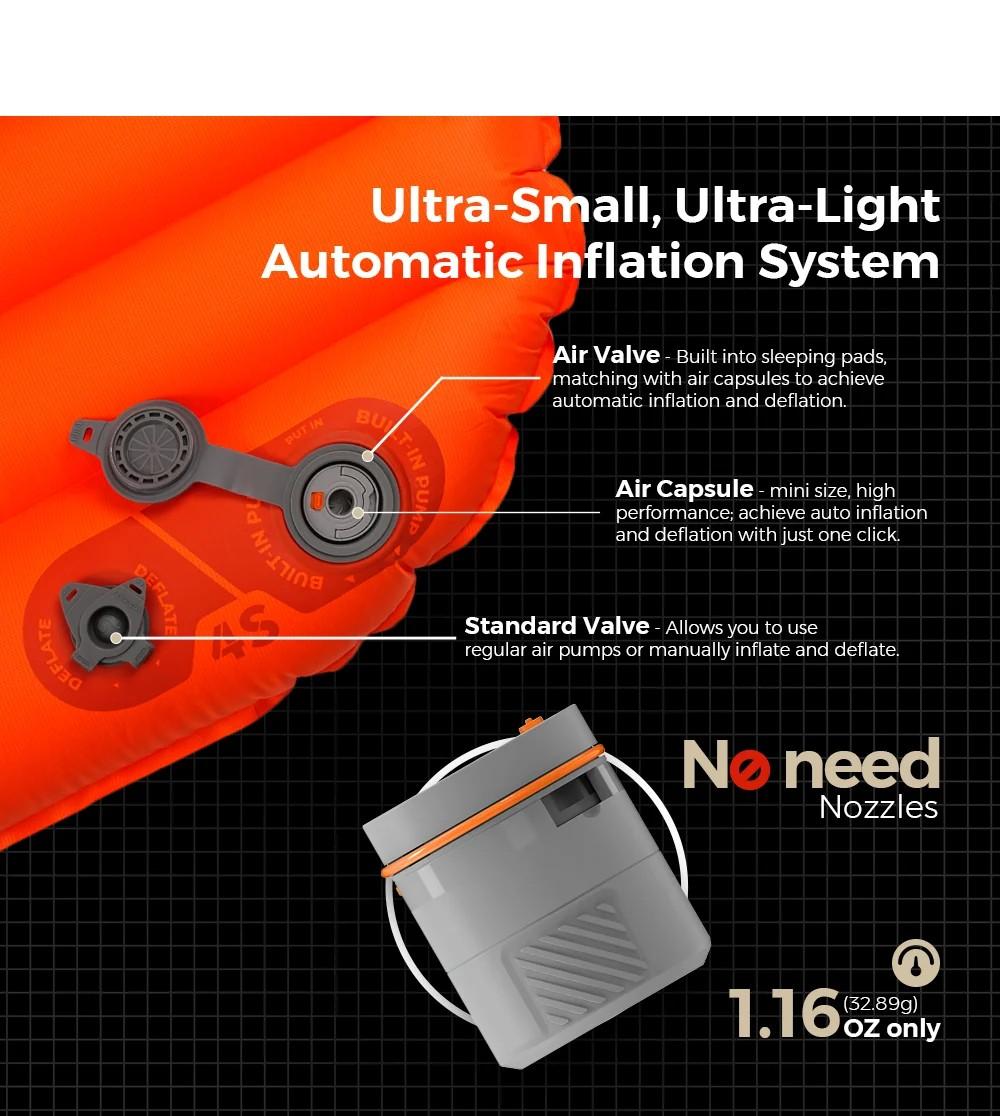
More recently, we’ve been working on a very small pump that doesn’t have a battery inside. It just takes power from a 5V source, like the power bank many people are already carrying.

And that made me start wondering: if the pump is already that small and light, why does it still need to be a separate thing?

When I look at a gear list, I normally think about it in systems anyway — sleep system, shelter, electronics, cooking, etc. So from that point of view, the pump isn’t really an independent product. It’s there to make the sleeping pad work more easily.

The scenario I keep imagining is pretty simple:

You get to camp, unroll the pad, connect a cable to your power bank, and around 30 seconds later the pad is ready.

No separate pump to take out, no nozzle to match, and no extra battery inside the pump to charge.

If doing that added less than an ounce to the pad, I personally find that pretty exciting.

I know that for someone trying to get every possible gram out of their pack, an extra 20–30g might already make this a non-starter. But I also wonder if there are people who care about weight while still being happy to carry a little more if the whole sleep setup becomes easier every night.

One thing I should clarify is that I wouldn’t imagine the pump replacing the normal inflation/deflation valve.

The pad would still have a regular valve, so if the pump failed, the power bank was dead, or you simply didn’t want to use it, the pad would still work normally.

Ideally, I’d also want the pump itself to be removable. It could sit inside or flush with the pad during normal use, so you still get the convenience of an integrated system, but if the pump eventually failed, you could replace that small module instead of replacing the whole sleeping pad.

That feels much more reasonable to me than permanently sealing electronics into the pad.

There are still trade-offs, of course. Once the pump is integrated into the pad, even if it’s removable, it still can’t really serve your pillow or another inflatable the way a separate pump can. The pad also becomes a little more complicated in terms of structure, waterproofing and durability.

And maybe that’s where the whole idea falls apart.

Maybe a separate 20–30g pump is already so light and simple that integrating it doesn’t really solve enough to justify changing the pad itself.

But before getting too far into solutions, I’m more curious about the basic reaction:

Does ā€œunroll the pad, plug it into your power bank, 30 seconds later it’s inflatedā€ actually sound appealing to you?

Would you take an extra ~1 oz for that convenience?

Or would you rather keep the pad and pump completely separate?

And if you immediately dislike the idea, I’d be really interested in knowing what kills it for you.

Roger Caffin BPL Member
PostedSep 1, 2026 at 2:21 am

One of our winter down-air mats has a built-in pump. There is very little to it: you have to use your hand as a valve closure. But this pump is very important: it stops people from blowing into the down and getting it damp. And it works fairly fast too.
For our summer air mats (Exped Symat UL-7) I use a ‘pillow-pump’ from Exped. It’s a very nice pillow. Can I count that as 0 g? It too works fast. I am not sure whether Exped still sell it though.

Cheers

Heidi Liu BPL Member
PostedSep 1, 2026 at 2:41 am

Thank you @Roger Caffin That’s a really useful point.

I’ve mostly been thinking about inflation as a progression from blowing by mouth, to pump sacks or inflatable pillows, and then to separate electric pumps — either with their own battery or powered by an external one. For someone chasing a really clean UL system, I can definitely see why a multi-use item like a pillow-pump is such an elegant solution.

I also didn’t realise built-in pumps had already been used in down-air mats specifically to help keep moisture out of the insulation. That’s a really interesting use case, and definitely something I want to look into further.

Thanks for sharing this — it gives me another angle to think about.

Roger Caffin BPL Member
PostedSep 1, 2026 at 3:08 am

I see that the Exped pillow-pump is still available. Excellent.
Cheers

Matthew / BPL Moderator
PostedSep 1, 2026 at 6:34 am

No thank you. I would prefer to keep any pump separate so that I can choose to bring it or not, use it on a different pads, or leave it home entirely.

Bill Budney BPL Member
PostedSep 1, 2026 at 6:53 am
  • If I have two air pads to inflate, and they both have built-in pumps, then that’s two ounces… at least one of them being redundant.
  • If my built-in pump fails, then that pad forever carries a one-ounce weight penalty (as well as extra bulk).
  • If I want to cut weight, then I just leave a separate pump at home. I can’t do that with the built-in pump.

Are there any benefits to having the pump built in?

JAshley73 BPL Member
PostedSep 1, 2026 at 7:50 am

Only if the pump could be reversed, pulling a vacuum & completely emptying the air from the pad, could I see this being a benefit. That said, I’m not sure if modern small pad inflators can do this or not…

My son & I share pads of the same make – meaning, we can use the same inflation bag for both pads. As-is, we can simply share inflation bags between us.

Would both pads having built-in pumps be a benefit? My guess is, not really. If one failed, the other couldn’t be used as a “backup” to inflate the other. In that scenario, a separate external pad inflator would be more desirable.

bradmacmt BPL Member
PostedSep 1, 2026 at 8:19 am

No thank you. I would prefer to keep any pump separate so that I can choose to bring it or not, use it on a different pads, or leave it home entirely.

This ^ 100%

Bob Shuff BPL Member
PostedSep 1, 2026 at 8:54 am

It’s interesting to me to have one less item in the ditty bag

I’ve used the pump zero and also have an outzac pico pump. Both are worth the weight and cost for me. It’s nice they can also inflate my pillow, but less important to me than the pad.

replaceable if it fails sounds important as a feature, but I worry about the logistics of that. Ideally the user can replace it with a robust warranty and easy fast availability. Even then this could be a source of negative reviews and when the company moves on the replacement logistics will get worse. If I had to send the pad off for service that might be a non starter.

cost is also a concern. Big brand pads are already expensive, and I see folks making compromises based on price regularly. It would have a mass market appeal but would then have to be priced at or below the premium brands like Thermarest or Nemo.

PostedSep 1, 2026 at 1:25 pm

I’ll echo a lot of what’s already being said. I would actually choose not to buy a pad if the pump was built in. If its removable, thats a bit better, but then I don’t understand the benefit over just having a separate pump, while introducing more failure points into the pad structure itself.

My rationale is less about weight, although that is still a factor, but rather more about versatility and failure point risk mitigation. I have multiple pads for different seasons from different manufacturers. I like that I can choose which pad to take and my pump works for both with the appropriate adapter.Ā  Electronics also introduce another failure point that are harder to troubleshoot than just patching with a patch kit or tenacious tape. And like you said, if it was an integrated pump, if there is a failure, I’m losing my pad for weeks/months to warranty it, or just carrying around extra weight while not getting the full experience I paid for.

Dan BPL Member
PostedSep 1, 2026 at 1:32 pm
bradmacmt BPL Member
PostedSep 1, 2026 at 2:53 pm

What the world really needs is a 25″ x 72″ x 1″ R-5 self-inflating pad that weighs under 17 oz’s.


PostedSep 1, 2026 at 4:37 pm

It would really depend upon the reliability of the pump relative to the pad. Ā It would have to be significantly good to be of value. Ā For example, piezo lighter on stoves fail that requirement and people bring back up lighters. Ā My 2 cents.

Roger Caffin BPL Member
PostedSep 1, 2026 at 5:57 pm

Jon has a good point here. Has anyone had an air pad fail in the middle of a long trip? Same problem.
Fwiiw, I have been using my Exped pillow-pump since about 2010. It is still going.
Well, truth is, there is so little to go wrong with it. No AI, no Wi-Fi, no batteries . . . you know?

Perhaps I should add: it also serves me as a very good pillow!

Cheers

Heidi Liu BPL Member
PostedSep 2, 2026 at 9:30 am

replaceable if it fails sounds important as a feature, but I worry about the logistics of that. Ideally the user can replace it with a robust warranty and easy fast availability. Even then this could be a source of negative reviews and when the company moves on the replacement logistics will get worse. If I had to send the pad off for service that might be a non starter.

cost is also a concern. Big brand pads are already expensive, and I see folks making compromises based on price regularly. It would have a mass market appeal but would then have to be priced at or below the premium brands like Thermarest or Nemo.

@Bob Shuff — this is really useful, especially coming from someone who already uses Pico.

The replacement/service point is one I hadn’t thought through enough. A removable module only really solves the problem if the user can replace it themselves, quickly, without sending the whole pad back — and if replacement parts are still available years later.

Your price point is a good reminder too. It’s easy to think about the extra 20–30g as the ā€œcostā€ of integration, but obviously there’s also actual product cost, warranty support and service complexity behind it.

I think this is pushing me toward a much stricter definition of ā€œremovableā€: not just technically removable, but genuinely user-serviceable.

Heidi Liu BPL Member
PostedSep 2, 2026 at 9:35 am

Thank you @Jon Fong — the stove piezo analogy really clicked for me!

I’d been thinking mostly in terms of convenience: if the pump is small enough, why not make it part of the pad? But your example makes the lifecycle mismatch much clearer. A simple separate lighter can outlive or back up a more integrated component, and the same logic could apply here.

That may be the strongest argument I’ve heard so far for keeping the pump removable rather than permanently integrated. :)


Heidi Liu BPL Member
PostedSep 2, 2026 at 9:43 am

Thanks everyone @ALL — this has been much more useful than I expected.

A few things have really changed how I’m thinking about the idea.

I originally focused mostly on weight vs. convenience: if a batteryless pump could inflate a pad in ~30 seconds, would an extra ounce be worth removing one more loose item from the sleep system?

What surprised me is that many of the strongest objections weren’t really about the ounce. They were more about optionality, sharing one pump across multiple pads, repairability, long-term replacement, price, and adding an electronic failure point to something that might otherwise last much longer.

Jon’s stove-piezo analogy especially made that lifecycle issue click for me.

So I’m much less convinced by a permanently built-in pump now. If I kept exploring this, I think the pump would have to be genuinely removable and user-replaceable, with a completely normal valve that works independently.

The more interesting question may actually be whether the interface can be improved rather than whether the pump should disappear as a separate object — something closer to ā€œsnap in, inflate/deflate, snap outā€ without adapters or fiddling.

Really appreciate all the different angles here. This is exactly the kind of feedback I was hoping for.

Thanks again. :)

Jerry Adams BPL Member
PostedSep 2, 2026 at 9:44 am

You could make the pump replaceable?

People on this site are into weight and functionality and skeptical of “influencers”.Ā  But this is a small part of the market.

Maybe your built in pump would appeal more to the mass market.

Heidi Liu BPL Member
PostedSep 2, 2026 at 10:09 am

Thanks! @Jerry Adams :)

That’s a really good reminder. I guess BPL probably isn’t the easiest crowd for adding anything extra to a sleeping pad šŸ˜„

We’ve actually discussed a replaceable built-in pump concept with a brand before, so that idea has come up on our side too. But I really enjoy hearing how people here look at it — there have already been quite a few things I simply hadn’t thought about.

Really appreciate it!

Jerry Adams BPL Member
PostedSep 2, 2026 at 10:23 am

yeah, even if this crowd isn’t your target market there’s still some good input

bradmacmt BPL Member
PostedSep 2, 2026 at 11:14 am

I’ve tried a number of pad inflators. Most are kind of janky, and I don’t like that most don’t have an on/off switch built into the pump (vs. relying on plugging in to a power bank or phone as an on/off – like the Pico).

Frankly the “best,” and lightest, I’ve found that positively connects to a Thermarest pad (this seems to be the hardest pad attachment to get right), which has an on/off switch is the Nightcore APo1.

Unless you could improve on this, I can’t really see the need for an integrated pump. And how would it be any better if it’s removable for servicing, etc? Wouldn’t that essentially be an attachable, external pump?

I also wouldn’t want the bulk of an integrated pump when folding/rolling/storing a pad while backpacking. I could see repeated folding/rolling as a source of pad and/or pump failure, adding another malfunction point on an already relatively fragile piece of gear.

https://www.nitecore.us/product/ap01


bradmacmt BPL Member
PostedSep 2, 2026 at 12:35 pm

Aerogogo

I have a Giga Pump given to me free by Aerogogo. No thanks. No on/off switch, and poor attachment (easily comes apart) for Thermarest pads.

Terran BPL Member
PostedSep 2, 2026 at 5:16 pm

An on/off switch won’t work correctly with a battery. The battery shuts down when no current is detected.

Flextail.

Viewing 25 posts - 1 through 25 (of 40 total)
Loading...