Topic

Why high boots?

Viewing 24 posts - 26 through 49 (of 49 total)
Arthur BPL Member
PostedFeb 8, 2022 at 11:50 am

I am backwards.  I hike a lot in the desert except in the summer.  I wear “waterproof” shoes to keep the dust out and my feet clean. And besides, the gortex type shoes are only waterproof until I pay for them. On any wet hike, even streams an inch deep, I wear non waterproof shoes and just get wet.  They drain better and stay lighter.  Snow is a whole other issue previously discussed a lot on this forum.

PostedFeb 8, 2022 at 12:22 pm

“…actually, what I wrote about was gaiters…”

Gaiters are useful to protect from sun, rain and scree; but they do little to keep even shallow water from running into trail shoes, no higher under the ankles than street shoes.

Like you, I’ve used WPB Keen boots, extensively, and can hike hours in the rain keeping my feet dry.  And have found that the Keen WPB is way better than GTX.  Given other folks’ different experiences, I think it may also have something to do with my Canadian Lorpen TEC sox that are a thick weave of tough polyester and contain none of the wool that is so popular.  The Lorpens do not become soggy and hard to dry out like wool.

So while you asked about gaiters, there may be other things that come into play, and result in the different experiences expressed here.  But don’t think low quarter trail shoes are even remotely commensurate with mids like the Keens, that come up all the way above the ankles, and are still extremely light compared with heavy high-top boots.  I think the trail shoes are fine for day hikes on nice days and walking around town, but would never dream of using them for treks.  They would quickly disintegrate, and my feet would be soaked and pruned in stretches of bad weather.  Can’t imagine why anyone would go trekking for weeks in trail shoes, so think they may be just another fad of the kind that predominate on BPL.  Or maybe I am wrong, and they do work in the great southwest, where the terrain is drier, the storms are short, and the sun intense enough to dry out footwear quickly.  But that does not come into play for me, since I prefer the mountains and forests of northern Colorado, New Hampshire and Maine for hiking trips.  Should you choose to hike in wetter country, and rely on gaiters to cope with the wet, I think you will be sadly disappointed, and might even have to seek shelter in the basements of hotels or other people’s camps, as occurred with the bold but inexperienced group who did the first mid-winter thru-hike of the Cohos Trail that runs from New Hampshire’s White Mountains near Mt. Washington, north to the Canadian border.  It could be a matter of different locales as well as different strokes for different folks.

Even a short hike of several days on the Cohos Trail in Spring can prove dangerous.  Starting on a sunny day from the northern border of the northernmost section of the National Forest in NH, I hiked south on the Cohos Trail to Unknown Pond, and then encountered deep snow going further south up Mt. Cabot.  Stayed at a small cabin on Cabot.  During the night, an ice storm arrived and did not abate.  In the morning, a well constructed series of switchbacks south of Cabot was covered in glare ice and took ages to negotiate down to lower country that is usually dry, but now confronted me with countless stream crossings from the run-off.  Soon came the first stages of hypothermia, so had to keep moving, and decided to head back north on a low trail back to Unknown Pond and north out to the car where the heater warmed me up.  Could have benefited from traction, like Microspikes, but gaiters would have made no difference.  Feet were not soaked, but the cold drizzle penetrated the shell climbing pants, so even with a Patty H2NO top my trunk was damp and freezing.   The ice storm was totally unexpected, but spikes and WPB pants would have helped.  Gaiters would not have though, as the shell pants did keep the drizzle out of the mids.

Ben C BPL Member
PostedFeb 9, 2022 at 1:50 pm

I think the trail shoes are fine for day hikes on nice days and walking around town, but would never dream of using them for treks.  They would quickly disintegrate, and my feet would be soaked and pruned in stretches of bad weather.  Can’t imagine why anyone would go trekking for weeks in trail shoes, so think they may be just another fad of the kind that predominate on BPL.

I really don’t think they are a fad. I wouldn’t consider going back to waterproof boots that won’t dry out on a multi-day trip. Trail runners don’t quickly disintegrate. And having wet feet for a few miles isn’t going to hurt you. I have had zero blisters since I quit using WPB boots.

I frequently hike in wet areas and cross streams that would go over any boots shy of waders. My feet are going to get wet. The only question is whether I want shoes that quickly dry out or WPB shoes that keep water in when wet. Having wet feet in waterproof boots for a few days can become a problem. How do you ever dry them out?

Roger Caffin BPL Member
PostedFeb 9, 2022 at 2:06 pm

I think the trail shoes are fine for day hikes on nice days and walking around town, but would never dream of using them for treks. They would quickly disintegrate, and my feet would be soaked and pruned in stretches of bad weather. Can’t imagine why anyone would go trekking for weeks in trail shoes, so think they may be just another fad of the kind that predominate on BPL.
Chuckle. Yeah, we get that reaction all the time.

As most trail shoes are totally synthetic, they do not disintegrate. Not even after many years. Wear out – sure. We give them a hard life.

Mind you, trail shoes with leather trim can give all sorts of problems when the leather dries out, and shrinks. NOT a good scene. Go totally synthetic. (bad experiences.)

Soaked feet are likely if you are crossing rivers. But they drain fast. On a hot day walking in the river can be pleasant.

Pruned feet: far more likely with leather boots or GTX shoes, where the water heats up and can’t escape. No great harm done if the shoes are big enough.

Trekking for weeks – make that trekking for several months on end, for many years. With happy feet the whole time. Rather tired shoes by the end, but feet OK.

If trail shoes are a fad, then one has to marvel at the longevity of the fad: 20, 30 + years and going strong. Once walkers make the switch, they never go back.

Cheers

jscott Blocked
PostedFeb 9, 2022 at 3:13 pm

Roger, everyone insists that Keen gore tex equivalent boots (not leather) will cause my feet to prune and never dry out and all sorts of things. Again, I use them in wet spring conditions over 3-7 days and also in the heat of summer and…my feet don’t sweat out or prune. they stay dry. I must be doing something wrong! My experience doesn’t match what everyone says it should.

I get blisters when my feet are wet. Hence, I take my boots off for deeper river crossings. and I can’t use trail runners.

I wish I could wear trail runners and just wade through everything. I’m glad they work for many people.

Roger Caffin BPL Member
PostedFeb 9, 2022 at 3:33 pm

Hi jscott

Taking your experiences seriously –

Maybe you don’t submerge your boots in the river? I can easily imagine your success if you never fill your boots with water in a river. To be sure, you might be walking through a lot of wet grass or similar, but maybe the GTX lining is keeping the water out? This could explain a lot. After all, a GTX lining is meant to breathe.

The next thing to consider is what socks you are wearing. We always wear thick Darn Tough wool socks, and never get blisters whether they are wet or dry. But socks made from other fibres may well behave differently. In particular I would be very doubtful about cotton socks, especially if they get wet. I don’t know about thin synthetic socks: I have never tried them.

I will add that even with thick wool socks in an Australian summer, my feet don’t seem to sweat a lot, and definitely don’t get pruny. Wearing GTX shoes on one trip however did make my feet pruny, but we had been walking through rivers on that trip. The socks did not have a chance to dry out.

We can take our shoes off for some rivers, when they have sandy bottoms. A lot of sandstone around here. But when there are rocks in the river, and when the water is very cold, we always keep our shoes on even if we remove our socks. Injuries to our feet from the rocks are just not to be considered.

There is always room for experiments if you want.

Cheers

jscott Blocked
PostedFeb 9, 2022 at 4:48 pm

I also use thick Darn Tough socks. And yes, I don’t wade through deep, wide waters, I take my boots off. Where I hike, especially in the Spring–or in the PNW–there can be dozens of water crossings that can be made in a few steps, often with rocks or logs serving as half assed points that allow one to cross without fully submersing boots, or maybe only for a quick step or two. . But the gaiters pulled up high will keep water from pouring in over the tops of the boots. Of course, walking through rivers for any period of time changes everything.

And yes, believe me, over the years I’ve experimented.

one spring I’d gone into Lake Merced (still lots of snow on the trail, so no people). A ranger came in later that evening. He was telling me how he jsut waded through all the water on the way in as there was NO WAY to keep feet dry with all the crossings. this included a fairly extensive marshy area. In fact, my feet were completely dry coming into camp. the next day was spent day hiking up through packed snow and back  for many hours, with more of those little water crossings. Still, dry feet. this is a trip I’ve done every year for decades (not lately.)

Roger Caffin BPL Member
PostedFeb 9, 2022 at 5:06 pm

Different strokes for different folks – or maybe for different routes in different areas.

Some of our rivers are a bit bigger. You have to cross this one every few km.

Cheers

jscott Blocked
PostedFeb 9, 2022 at 5:16 pm

Roger, yes, my strategy wouldn’t work in your part of the world. For mine, think of many, often seasonal rushing streams. In the spring trip I’m describing, in Yosemite back country, water is pouring off towering polished granite cliffs in a series of ascending canyons following the Merced River. Snow is melting. There’s no crossing the Merced at all, anywhere without a bridge. The Merced will flood some sections of trail, and that has to be negotiated as well. All of this changes depending on the snow year.

It’s a beautiful trip that I avoid later in the season due to crowds. Shhh, but it’s doable earlier than one might imagine in the Spring. Very few people make the trek however. yay!

Bonzo BPL Member
PostedFeb 9, 2022 at 5:48 pm

How are you guys getting this kind of mileage out of your footwear?  I kill trail runners in months, and my current pair of approach shoes are five months old and starting to collapse; they offer less and less support with every passing week.  I go through two pairs every year…

Roger Caffin BPL Member
PostedFeb 9, 2022 at 6:33 pm

Could you walk less?  :)

Yeah, they may be UL, but we have to accept that also means a shorter life. Like maybe race tires?

The New Balance Leadvilles were fantastic, but maybe they lasted too long (for NB).
We expected to wear out a pair of good trail shoes (usually NB) on any of our 2 – 3 month long walking trips in the Europe Alps. It was just part of the cost of living.
So big trips cost transport, food and shoes. That assumes that you already have the rest of the gear.

Hey: that is damn cheap compared to many other holidays!

Cheers

PostedFeb 10, 2022 at 12:18 am

Roger,  you once posted a photo of your feet in low trail shoes.  Looked very unstable.  Maybe some of us should chip in and buy you a pair of Keens (quite wide at the sole and toes and they do come in widths).

That river looks pretty tame.  Kind of like the Kennebec crossing on the AT at low water.  When the water is running downhill so fast that slippery rocks are being dislodged, see how you fare with that.

Granted, anything short of hip waders can take on water at times.  But who will confess to having slipped on a rocky creek bottom.  The Keens do wipe dry inside with a camp towel, and with a change of the above mentioned polyester hiking sox, one can go on with feet that are at worse, a bit damp.  Some of the Salomons do fairly well also; but as we know, it is not the brand, it is the fit that counts the most.

Some slips seem to be showing on the question of how long the low quarters can go before they fall apart.

We might also get jscott some water shoes, but I sense he is a diehard super light packer, and the darn things are pretty bulky to carry for something only needed briefly.  Suppose they might be good, though, for getting safely out of the bush after the low quarters have fallen apart.

Roger Caffin BPL Member
PostedFeb 10, 2022 at 2:38 am

Hi Sam

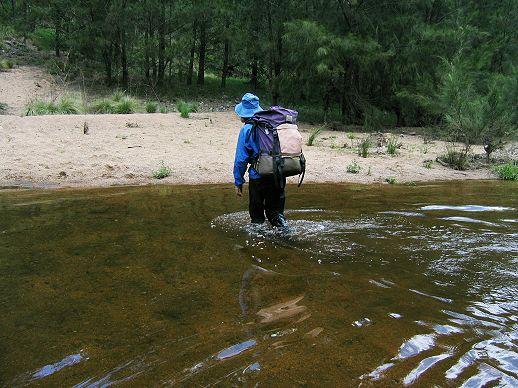
That river looks pretty tame.
Oh, it is too (Coxs R). But that was the first photo I came upon to illustrate wading.
Now, if you want a rough river – I am sure I could find something. :)

I remember crossing a river once with a very rough rocky base and fast water. We had to cross. Sue and I locked arms and advanced one step at a time, very carefully. We got across, and there was applause from other walkers who had not been game to cross.

But who will confess to having slipped on a rocky creek bottom.
Me? Often.
But that is why Sue and I work together: 3 feet fixed and only one moving. And each of us waits till the other has a good footing, at each step. If one slips the other supports. Crossing in pairs is very different from solo.

a photo of your feet in low trail shoes. Looked very unstable.
Hum – you would need to find that photo for me before I could comment. It does not ring a bell with me. But I do agree about the importance of fit.

how long the low quarters can go before they fall apart.
I have had leather boots fall apart (many many decades ago), but I have never had modern synthetic trail runners ‘fall apart’. To be sure, there have been a few torn uppers, but not to the point of collapse. Actually, the outer layer is often at least partly cosmetic, with the real strength in the inner layer, so small rips in the outer don’t matter. Now, that is for my preferred brand of New Balance; I cannot really speak to any other brands. I don’t know.

Cheers

Bonzo BPL Member
PostedFeb 10, 2022 at 5:32 am

…but I have never had modern synthetic trail runners ‘fall apart’.

I’ve had more than my fair share of delaminations at the sole, torn outer laters, blown stitching, rips and abrasions in the inner lining (especially at the heel), and collapsed midsoles and insoles.  The insoles are replacable; the rest, not so much…and I honestly don’t hike hard in any of my shoes.  If I was doing long miles on a tough trail, sure, I would expect this kind of thing…but half the time I’m walking around town or the local parks or a close-by national forest that offers easy to slightly-less-easy trails, and I’m going through two pairs of shoes a year.  I average 12,000 steps a day: that’s not much…but by Month 4 of any given shoe, I’m in physical pain at the end of the day and I can’t wait to just prop my legs up and rest them.

Roger Caffin BPL Member
PostedFeb 10, 2022 at 1:36 pm

Hi Bonzo

OK, I will have to modify my statement slightly:
but I have never had modern synthetic New Balance trail runners ‘fall apart’, nor our UL KT-26s shoes.

So, three comments:
What brand shoes? Have you tried a different brand? Some brands ARE better-made than others. Niche brands do not normally have the level of technology behind them which NB has. iirc, NB sells over 7 million pairs of shoes per year: that can cover a lot of R&D.

Also, have you measured your feet on a (genuine) Brannock Device? Tired feet at the end of the day often means the shoes are either slightly undersized, or more likely a bit too narrower for the feet. The problem here is that many niche brands only make one width – usually D, and many walkers now have feet wider than that due to exercise. Our very hard rule is to never ever wear shoes which are either smaller or narrower than our measured sizes.

You mentioned ‘by Month 4’. That can mean that the insole is collapsing a bit. The foam compresses, and that can cause problems. My wife Sue has this problem on one foot (old injury), so she has to replace her running shoes when they start to hurt. That’s OK: I can wear her ‘discards’ for another two years without any problem. Yes, very fortunately we have exactly the same size feet!

Cheers

Bonzo BPL Member
PostedFeb 10, 2022 at 2:42 pm

Quick answers:

Many different brands, and yes.  I’m generally comfortable in La Sportiva and Altra, but I’ve been all over the place with brands.

Yes, I have had a gen-u-wine Brannocking…and pressure maps…and 3D scanning.  The latter got me closer to pain-free than the former.

Usually, I lose insoles at Month 2.  Insoles The Second tend to go after Month 3, at which point midsoles are collapsing as well.  Some people can walk pain-free with dead shoes; I can’t.

Roger Caffin BPL Member
PostedFeb 10, 2022 at 3:18 pm

Ouch. Hard case!
I will recommend New Balance on the basis of my experiences, that is all. You could look at their ‘Fresh Foam’ series.

Cheers

BPLwiia BPL Member
PostedFeb 10, 2022 at 3:41 pm

All my life, I’ve wore running shoes and then trail runners when they came onto the market.  Then, in the summer of 2020, twice I encountered Timber Rattlers in the strike zone.

Now, I wear thick-leather boots to hopefully provide a measure of protection from a bite to the foot. When not in snake country, I’m wearing trail runners. I never could understand using a high boot. To each, their own.

jscott Blocked
PostedFeb 10, 2022 at 5:24 pm

We never did define terms. I wonder if we all are picturing the same thing when we write, “high boot”? for me, that means a boot that laces up over the ankle.

PostedFeb 11, 2022 at 7:32 am

Because of durability, I don’t wear trail runners, I wear very slightly heavier “trail shoes” from Salomon. No issues staying together.

Bonzo BPL Member
PostedFeb 11, 2022 at 8:23 am

Low: low-cut, full ankle exposure.
Mid: partial to nearly-full ankle coverage.
High: full ankle coverage, plus lower leg coverage.

My work, running and approach shoes are all just that: shoes. Ankles are fully exposed. My leather Tyrolean-esque “shoes” are mid-height boots that cover most of the ankle area (and boy are they comfy…). I don’t have any high boots that are applicable here, unless you want to count a double boot…but that doesn’t really count in the discussion of hiking footwear.

AK Granola BPL Member
PostedFeb 12, 2022 at 1:19 pm

I love how much we can all just talk about footwear. Endlessly. Thread after thread. As our primary tool for hiking, it makes sense. My husband just rolls his eyes when i come home with a new shoe box in hand. Hey, all my outdoor gear purchases still come under his fat bike purchases, price-wise. I could be collecting stuffed animals or glass statues or something.

My closet and shoe bin are full of shoes, boots – all kinds of footwear! the Imelda Marcos of outdoor footwear. I’ll push back on Roger a bit who says no one switches back from trail runners/sneakers to boots; i have in some cases. For me it’s 100% where I’m going and what I’m doing, and for how long. So many what ifs. For my two JMT hikes in the mostly low-humidity Sierra Nevada, on pretty well maintained trails, trail runners worked great; there I’d never go back. I didn’t use any river crossing shoes, despite the many streams to cross. My shoes dried out fast as did my very minimal socks. I had adequate support for my feet, no blisters, no soreness and they didn’t get cold at all, even up high.  My feet are reasonably strong from plenty of walking, yoga, stretching and massage. I take good care of them, always. I sit on the floor a lot these days to loosen my hip flexors, which brings my feet closer to my line of sight, so I pay attention to them. Get rid of your furniture.

In Alaska where i live, I’m often off trail, or on trails which are rarely maintained. The brush is wet, and humidity in wet weather can be enough to keep everything wet for days at a time, plus it can be cold, even in July. Nothing dries out.  Trail runners can still work for day hikes and short trips, because a day or two of wet feet is no big deal. Longer than that, it starts to be uncomfortable or even create hot spots. Goretex mids are a benefit here (I used to use Salomon and now use Keens) – not everyone agrees, of course! this is what has worked for me. I will use stream crossing shoes or at the very least, take my socks out when crossing. If the brush is super wet and I’m crossing lots of streams, I’ll use Sealskinz socks and just keep them on all day. My feet aren’t dry, but at least they’re not cold. And extra dry socks for the tent – or if warm enough, no socks – are critical. Got to dry those feet out at night. When the weather starts to turn, I definitely want the extra warmth of mids and thicker socks.

In cold winter – minus 20F or below – I wear the Salomon Toundras. Huge heavy boots, and man do I feel the weight. But… super duper warm, great support and never a blister. It’s a workout. I think my old leather summer hiking boots were kind of like these weight wise. I guess you could fairly call these “high boots,” falling just above the ankle. My thighs get a lot stronger when I wear them, especially with snowshoes on.

I can wear the Keens in winter if it’s above zero.

What else is in that shoe closet? At least three pair of old trail runners that are too worn for long hikes, but I can’t bear to toss them; they go to they gym or on short jaunts. Lots of sandals, which I hardly ever get to wear. Lightweight crocs (not normal crocs; this pair is 6 ounces total) for backpacking trips for camp use. Mukluks for winter cabin wear, more stylish winter boots for going to meetings, work, rain/muck boots, garden clogs… and a single pair of heels, which haven’t been worn in a very long time. I doubt they’ll fit without severing a toe or two!

Roger Caffin BPL Member
PostedFeb 12, 2022 at 2:15 pm

Well said Karen.
For really cold weather we have worn light joggers, and our feet were cold for a day on one 2-month long trip. OK, we were going over high pass, ploughing through snow with ice water underneath. Very cold water! But that did not last.
Otherwise, we would be wearing ski boots! NNN-BC. Boots!

Cheers

Jerry Adams BPL Member
PostedFeb 12, 2022 at 2:43 pm

my experience is more like Karen’s, especially if there’s a lot of wet plants to walk through

breathable shoes with light socks are constantly wet

WPB boots are much better

there are threads about what to do to keep your feet from pruning.  Putting some lotion on your feet.  With WPB mids I don’t have that problem so much.

I got some Danner Mountain 600s.  I was disappointed with breathability, but when I treated them with their waterproofing boot care which helps, although still not the best.  Maybe I’ll try some Keens next time.

Viewing 24 posts - 26 through 49 (of 49 total)
Loading...