I am writing something and just trying to understand the rationale behind why people buy boots. If gaiters are lighter and VBLs or GTX liners and wool socks are warmer, and just about anything dries faster than a boot, why boots? I realize that BPL advocates a trail running shoe as part of an overall footwear system, so I’m just trying to understand the thinking behind when a boot would be superior to a trail running shoe combined with liners, VBLs, gaiters, and, if necessary, snowshoes.
Topic
Why high boots?
Become a member to post in the forums.
- This topic has 48 replies, 22 voices, and was last updated 4 years, 6 months ago by .
Ankle and lower leg support are big reasons. Also, when the altitude increases past a certain point, the chance of needing a boot increases.
I’ve scraped, abraded, or torn open an ankle on rocks, roots and windfalls often enough that I can certainly appreciate boots. But ankle support is probably the number one reason I’d wear them.
“High boots” are 10″ or more like hunting boots so will assume we’re talking “mid’s” here.
Obviously some may have a physical condition that requires them to use a mid-height hiking boot or shoe, but that’s not the case for most. The NFL found when it quit wrapping ankles for practice and play, ankle injuries decreased. That’s because the foot/ankle, allowed a more natural free-range of motion, becomes strengthened and is, counter-intuitively, less prone to injury. I can see mid’s for certain bushwhacking/snow conditions, but for most of us the additional weight is unwarranted in normal backpacking situations. Even at my age (60), having come of age in the era of heavy leather “waffle stompers”, I still knew the Army’s adage – “a pound on your feet is equivalent to five on your back in energy expenditure” is absolutely true. I was slow to embrace low/lightweights, but in the last decade have whole heatedly (for most situations) adopted them. I’d never go back.
Have you every heard anyone brag about their strong ankles? I’m convinced everyone thinks they have fragile ankles. The reality is, we all do.
Hiking boots do not provide the support people think they do when it comes to preventing ankle injuries. You would need something closer to a ski boot to do that, and then hiking would be close to impossible.
I figured that in the same way everyone believes they are an above-average driver, that most people believe they have super-strong ankles. ;-) However, I know my ankles are a little compromised since I sprained them both in college –at the same time. I walked like Frankenstein’s monster for a couple of weeks. I only feel the remnants of the injury during very specific movements, which causes me to stop and wait for the pain to fade.
Like probably everyone here, I wore boots for years because I was told that I needed ankle support for the heavy pack I was carrying and I appreciated the protection from rocks, branches and scrapes from my own feet. I assumed that sore feet was just part of the bargain.
Also like most folks here, I tried out some old trail runners and felt like I was unchained. I felt freer, more nimble and able to step around trail hazards instead of plowing through. My feet, legs and back all feel better, so I have no plans to go back.
Every so often, though, I take a look at mid-heights because it would be nice to have a little padding when I rake my inner ankle with the sole of the other shoe, but for now gaiters do the job.
mids allow you to walk through streams without water pouring in
I’ve tried shoes, but I just don’t like my feet getting as wet
If the stream is higher than the mids then shoes are better because they dry out faster. If the streams are lower than the top of the shoes then they’re fine. It depends on where I’m hiking
Ankle protection can be important in rugged country… like scree and talus or a heavy bushwack… I once banged my ankle and got a hematoma… I was couch bound for 3 weeks it was so painful to walk.
“…and VBLs or GTX liners and wool socks are warmer…”
Not necessarily warmer… depends on which boot…
I wear trail runners in the summer. In the snow, I wear boots. I would never wear trail runners with snowshoes… If you are in REALLY cold snow, trail runners would be a good way to lose some toes… I have lived in the snow for over 30 years and I don’t know a single hiking buddy that would use trail runners in the snow… I think that’s a city person thing when they are out on a warm day hike/snowshoe… believe me, if you get caught out in a really cold bad storm you do NOT want to be in trail runners… though I am sure you will get differing opinions here on BPL…
Also, if you are in firm to icy snow, you will find that boots are better for kicking steps… lots of reasons and situations to want to be wearing boots…
I wear high boots for a few things: heavy loads (hunting), lots of sidehilling, lots of steep XC, some desert XC routes with lots of thorns.
Boots may give a marginal bit of extra ankle support, and that’s welcome, but for me the protection from rocks, stumps, roots, etc. is the main reason. Of course, I am often off trail and in rough conditions and find that I am frequently banging my ankles against things … maybe I’m clumsy. It wouldn’t be important to me if I just hiked on well-maintained trails. As Jerry mentioned, if they are waterproof boots, they also allow you to just walk through shallow water, and that’s a lot safer than trying to balance on rocks and logs.
I always used mid-high boots for ankle protection in scree and other loose junk.
I was wrong.
I have since been using mainly trail runners and TX3 approach shoes, with the added protection for my ankles coming from UL gaiters. I have thin section of foam I can put into them for even more padding. The only mid/tall boots I wear now are my winter Baffin Borealis boots which are 100% waterproof and much warmer.
The ankle stability thing always made me laugh though. Unless the stack height of the sole is kept low, the added upper height doesn’t help stability. But most burly hiking boots have really high stack heights, putting more leverage on the ankles. I had a pair of Five Ten Impact Hightop mountain biking shoes I used for riding North Shore and Whistler BC. The stack height of those is super thin for direct pedal contact on the bike. The added ankle stability when traversing nasty slopes was damn near close to wearing a ski boot. I also smashed my ankles into logs going 30+ MPH and hardly ever felt it, where as buddies in lesser shoes would be out for a day or two after a massive ankle strike.
I think it would be good to point out that the question of leg/ankle/foot support and the related efficacy of boots vs. shoes is far more nuanced and individual than can be provided in a simple, catch-all answer…but that debate wasn’t the original question.
What if you need to use crampons?
I don’t know of a substitute for full on mountaineering boot/crampon combination…does anyone else? Is there a viable solution for a non-vertical more classic mountaineering situation (no tools, just an axe)?
I’m not a fan of gaiters and instead I sew buttonholes in the hem of my pants and run a piece of bungee under the shoe sole as a stirrup. This keeps debris out of my footwear (sand and silt from tidal or swamp wading kills socks) and also keeps my pant legs from getting twisted around my lower legs when I go slogging through salmonberries (my bête noire). Low cut shoes would not be compatible with this system as it requires some pant-shoe overlap at all times, so I hike in mids.
For the last couple of summers I have been wearing non-waterproof Merrell Altalight mids for my packrafting trips. I liked the Altalight mids enough that I picked up a low-cut (standard shoe) style for light day hiking. I was surprised at how differently they performed on steep side hills in the alpine given that the construction of the lowers is identical to that in the mid-height boots. It wasn’t ankle support that was different, but rather fabric support that was different. The deformation in the lace area and the foot opening on the low cut shoes was just very striking under side-hilling forces. I would have to tie the shoe-cut version much tighter to achieve the same performance. The low cuts just felt, well, sloppy under the same conditions. This might only apply to this one series of shoes, but it was an interesting apples-to-apples comparison.
As to the crampon question; there is a nearly complete continuum of choices from “barely-there” tungsten carbide cleated slip-ons (think Kahtoola Nano) to light trail crampons (Kahtoola Micro-spikes) to ‘trail’ crampons (Kahtoola KTS) to full blown alpine crampons. True alpine crampons would be 100% miserable with trail runners, but the lighter/shorter-pointed models would be okay as long as there wasn’t an ankle strap digging into your bones.
…and an approach shoe is about the minimum you’re gonna want, with Micro-Spikes. I use them with a TX4 and they do reasonably well, but even the stiffness of that shoe isn’t quite up to them being comfortable. Definitely better in a stiffer boot.
“I think it would be good to point out that the question of leg/ankle/foot support and the related efficacy of boots vs. shoes is far more nuanced and individual than can be provided in a simple, catch-all answer…”
Yes to the above. I was born with a club foot. It was ‘corrected” (I’m not club footed now) but my left foot was surgically reconstructed in the process. I won’t go into the details. People have tried to tell me what shoes/boots to wear when hiking. Like I haven’t explored that deep dark forest already. Whatever.
As for UL gaiters protecting one’s ankles and lower legs from rocks and such…in my experience, that won’t work. An UL gaiter is even skinnier than a sock. Socks don’t protect us from bruises incurred on sharp rocks, etc.
For me, high boots have advantages when I want my ankles protected from rocks on a scree slope or while chain-sawing. And to keep my feet warm and the snow out during winter.
Otherwise? They offer no advantage and only weight for me. For taller boots to actually offer meaningful ankle support, they’d have to prevent your ankle from bending side to side (like a downhill ski boot), but you can’t walk down a trail like that.
They may shed some dew or water from a very shallow stream, but they hold more water from sweat or from a deeper stream.
For weed seeds and dust, gaiters are more flexible and far lighter. And they work for modest snow depths.
For cold streams, great socks make more of a difference (and can be swapped for cooler socks later when it heats up.
“mids allow you to walk through streams without water pouring in”
Thumbs up, Jerry! That is the only reason I wear mids, except possibly to also protect the achilles tendons on the backs of my feet. Injury there can be a lifetime curse. Gaiters may keep out snow, but they won’t keep out water and soupy mud. Sometimes I wonder how many on BPL really get out there. Used to think BPL fans must hike in the Sierras and similar places, but then realized it is just about fads and what’s in vogue.
In the Spring in the Sierra, when there’s lots of tiny to small stream crossings, or wading through flooded areas on the trail, I find that calf length waterproof gaiters along with mid boots actually can keep your feet dry, if you move quickly through the water. Gaiters keep water from pouring in over the tops of the boots and provide some protection to much of the lace area and the rest of the boot as well. It’s a matter of technique I suppose. I get blisters when my feet get wet, even in more minimalist shoes. So the whole ‘just live with wet feet’ approach doesn’t work for me. I wish it did! Much easier.
Of course, larger river crossings are another matter entirely.
I use MLD superlight waterproof gaiters–two ounces (!) for the pair. sweet!
“Gaiters keep water from pouring in over the tops of the boots …”
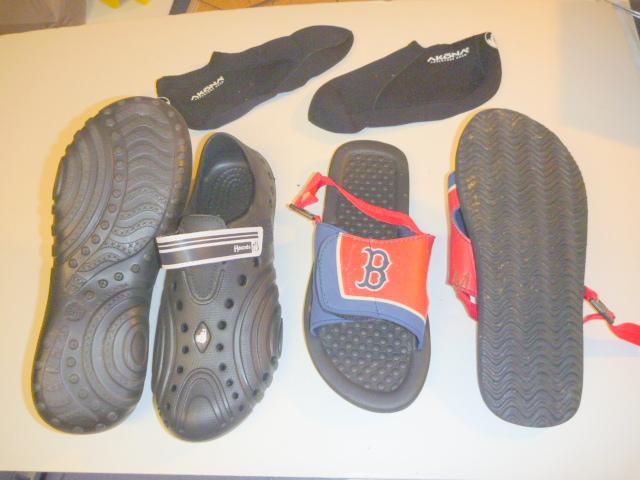
Boots, yes. But soft shelled trail shoes that don’t even come up to the ankles? I do use gaiters, waterproof breathable ones, but to keep out both sun, rain and scree. Confess that when behind schedule, am in a hurry and don’t want to get hypothermia, the gaiters help with decreasing the amount of water that pours in. But I should, and do take off the mids and put on water shoes most of the time. Though in northern New England and Colorado the ‘run-off’ is so intense in the spring and early summer, especially with a dog under one arm, and the water is so cold, the mids sometimes just get kept on and soaked to protect the feet that would be freezing wearing only dive sox under water shoes. Here are two kinds, pictured with one pair of dive sox:
On a more positive note, so good to hear that there is still so much water in the Sierras in the springtime.  The “B” is for the Boston Red Sox.
Yeah, relying on an additional couple inches of boot height to stop water is a bit of a dubious philosophy. And of course, it also implies using a goretex type boot.
With mid’s on many of the streams here you’d end up with wet plastic bags (goretex) on your feet. That’s why I carry water socks or shoes for crossings.
I’m not speaking philosophically : )
I’ve worn breathable shoes, WPB shoes, WPB mids
In the areas I hike, I found my socks got wet too much with shoes, especially the breathable ones.
With breathable shoes I can walk through maybe 2 inch deep water without it pouring into the shoe
WPB shoes 6 inches
WPB mids 8 inches
I have noticed that most people here prefer shoes.
I’ve also noticed topics about what to do when your feet get pruned from long water exposure from wearing breathable shoes
I’ve read that with breathable shoes, if your feet get wet, they quickly dry unlike WPB. But in my experience it takes all day to dry out with breathable shoes and thin socks. Several days with WPB. So, if my hike goes through many deeper streams, the breathable shoes are best
“Yeah, relying on an additional couple inches of boot height to stop water is a bit of a dubious philosophy. And of course, it also implies using a goretex type boot.
actually, what I wrote about was gaiters. But maybe you’re referencing another post? but yes, I’ve mostly used Keen Goretex (gasp!!) boots, especially in Spring when conditions are wet with some lengthy areas of snow. Everyone tells me they will definitely, positively, for sure and count on it wet out. Mine somehow stay dry! I ain’t lyin’, I gots the technique!
https://mountainlaureldesigns.com/product/superlight-gaiter/
It is rare that I reach for boots anymore. They have been relegated to the back of my closet. The depth of stream crossings varies so much from day to day. I could be 1 inch today and 15 inches tomorrow. So I don’t really feel like I can rely upon boots to keep my feet dry. And the waterproof boots make my feet retain sweat, so I always have damp feet. For me, it’s almost always trail runners. I don’t really even have to slow down for most stream crossings. The exception is when it’s really cold; I might take Gore-Tex socks then.
The only boots I own are technical mountaineering boots, which require the extra structure to use automatic crampons ice climbing and my “snow” boots. My snow boots are a lightweight La Sportiva model. The extra height coupled with gaiters allow me to posthole all day long without wet feet.
Become a member to post in the forums.