Topic

which solar charger do you prefer?

Viewing 20 posts - 1 through 20 (of 20 total)
Keith Fultz BPL Member
PostedApr 13, 2016 at 7:50 am

I might be carrying my Iphone 6s for GPS and syncing with an In Reach and maybe one time power up a Kindle.   I will be hiking JMT and in 4 years the PCT (hopefully, if I can retire then).     The issues for me are WEIGHT,   CAPACITY TO POWER UP, COST AND DURABILITY.   Thanks for your opinion and experience.    I am sure there are threads about this but I couldn’t find one.  It is ok to direct me to a thread

I posted this in Gear (general) but only got one response hoping for more.

Richard Nisley BPL Member
PostedApr 13, 2016 at 9:15 am

Keith,

It is very difficult to provide you an answer, with significant value, based on the lack of specifics in your questions. For example:

-I might be carrying my Iphone 6s for GPS and syncing with an InReach (what % of battery use per day average/)
maybe one time power up a Kindle (every day?)
I will be hiking the JMT (what time of year and for how many days determines the solar radiation potential. How many days between reply points where you can charge batteries?)
in 4 years the PCT (the technology available in 4 years is unknown but the trends indicate both batteries and solar chargers will be more efficient)

Kevin Burton BPL Member
PostedApr 13, 2016 at 10:30 am

You might actually be better off carrying a second external battery.  I’ve done the math on this every year or so and solar chargers don’t really make sense unless you’re going for more than 14 days.

With my S5 I can carry 4 batteries for which is about the weight of a solar charger and each lasts 2-4 days.

Keith Fultz BPL Member
PostedApr 13, 2016 at 10:28 pm

Thanks for helping me be more specific.

However, I have never taken iPhone hiking before.  I don’t know percentage.  I will be using Gaia GPS tracking on the iPhone 6s and will try to use it as sparingly as necessary to keep adequate charge.   No experience at this yet.   I will be purchasing an In Reach so have no experience there yet either..  I will probably not need to charge the kindle which I might not need, since I have all the same books on the iPhone, but the Kindle can make it a month without recharging, so it depends on how iphone and In Reach work.   I will be syncing the iPhone with the In Reach for messages, but will be limiting message to 1 or 2 a day at most.

I will be hiking   Aug, 23 until Sept 7

Yes I will not concern myself with PCT since technology hopefully will improve.

Hoping that gives enough specifics to make suggestions.

thanks


PostedApr 14, 2016 at 6:54 am

I personally had excellent results from my Suntastics-5, both on the JMT and on the VERY cloudy CT.  There have been spotty reports about how this works with the iPhone 6…you do need some pretty consistent sun for that since the phone keeps bleeping all the time as the power connects and disconnects, connects and disconnects…my guess is that this is what slows down that charge.  If, however, you can use lunch breaks in full sun (which in the sierra is pretty much all the time) you should be able to keep the phone topped off.

My delorme I simply kept attached to the solar panel (which is open and attached to the top of my pack) and the delorme is smooshed into the front (back?) pocket of my pack while I hike.  I seemed that no matter what direction i was hiking, how much cloud cover, etc, the delorme basically never used up any charge that way.  It was like the solar power was enough to keep it going while I hiked.  I was able to charge my nook on the go a few times as well.

So FOR ME, on both the super sunny/exposed JMT and the very cloudy CT the suntastics was perfect.  So much so that my companions always seemed to borrow mine at lunch stops to top off their devices.


Richard Nisley BPL Member
PostedApr 14, 2016 at 10:01 pm

Keith,

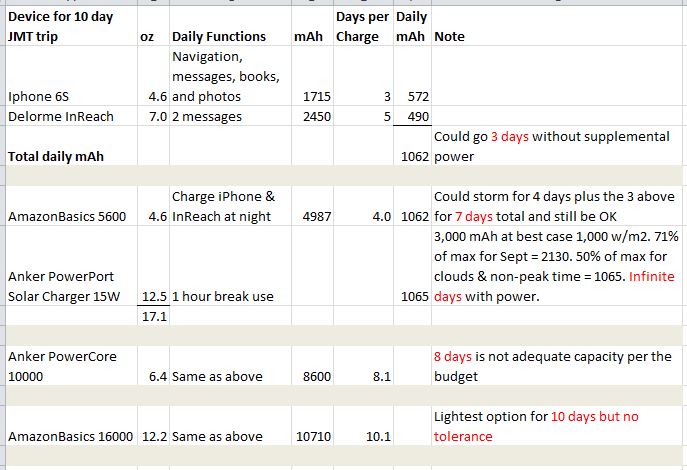
I have done detailed tests of the equipment suggested below as well as the Suntactics 5. The Suntactics 5 is an excellent solution for pre-iPhone 6 devices that are charged without the use of a buffer battery. It is not the best option for your requirements.

I see at least two near optimal solutions to your requirements. The lighter one has 0 days time tolerance and the 4.9 oz heavier one has infinite days time tolerance.


PostedApr 14, 2016 at 11:03 pm

Richard, the Anker PowerCore 20100 weighs nearly the same as the AmazonBasics battery (12.5 oz vs. 12.2 oz) and provides significantly more power. Assuming its efficiency is the same as the 10,000 mAh version, it’ll give you 17,200 mAh. That’s enough for just over 16 days of hiking—plenty of tolerance for a 10 day trip.

The downside to bringing a battery this large is that it takes a long time to recharge. According to Anker, it would take 11-12 hours with a 2A wall charger. That’s a serious logistical challenge for a thru-hiker.

Richard Nisley BPL Member
PostedApr 15, 2016 at 12:51 am

Mitchell,

Good point about the Anker PowerCore 20100. I haven’t tested that battery but, it looks impressive on paper. Keith is only planning on 210 miles, I think. So, potentially recharging a 16,000mAh, or larger, battery shouldn’t be required on his trip.

A good option to recharge that level of capacity quicker is to use a 2.92 oz. iClever BoostCube, or equivalent, wall charger (4.8A / 24W) in combination with 2 Anker PowerCore 10,000 batteries or alternatives. Each battery will charge in parallel at 2100mA (max and then less power over time) for a reduced charge time of ~6.5 hours vs ~11.5 hours for a single Anker PowerCore battery with 20,000 mAh of spec capacity.

The same parallel charging concept can obviously be applied to other battery manufactures and capacities to reduce charge time for thru-hikers.


PostedApr 15, 2016 at 2:18 pm

I’d just like to get a solar charger to use at home for SHTF type emergencies or car camping in remote areas. I’m looking at West Marine units that are fairly large but robust.

PostedMay 20, 2016 at 12:53 pm

I agree with the idea of an Anker charger. I have several sizes, they are solid. You can find tiny ones that weigh less than 2oz, and several in the 3-5oz range. You can get a lot of juice out of them, and unless you’re going for a ton of days and need to use your phone continuously, I think Anker (or similar) chargers are a much better option. I carry a 3oz Anker with me instead of a solar charger.

PostedJul 26, 2016 at 12:14 am

I agree with the Goal Zero.  I have a Venture 30 kit,  includes a panel and a separate waterproof battery pack. I can easily get 2 to 3 full charges of iPhone 6s’s and a DeLorme charge out of one full battery pack, and I can just plug one or two devices into the panel during the day if need be.  The panels are rainproof, waterproof, and pretty much indestructible.

Mike In Socal BPL Member
PostedJul 26, 2016 at 12:43 am

I use my iPhone 6S quite a bit; for me that means GPS (Gaia rocks!), barometer, music, reading, and most importantly to me, photos and video.  The Goal Zero Nomad 7 is the only solar charger I’ve used and it’s been rock solid for me.  Paired with the Goal Zero Guide 10 Plus recharger, I have been quite happy with its performance and ruggedness.  The Nomad 7 can recharge 4 AA batteries in about 3 hours with the Nomad 7 on my pack.  Note that it charges faster using the solar port than the usb port.  For a short trip, I can get away with a Jackery Giant+ 12000 mAh battery which is 10.4 oz.  While you might be able to use a battery for short hiking sections and recharge in between, keep in mind that recharging a large battery pack can take 8-12 hours or more.

Matthew / BPL Moderator
PostedJul 26, 2016 at 7:39 am

I found the Suntactics S5 inadequate for charging an iPhone 6 last June/July on the JMT. I had to have absolutely perfect full sun and precise alignment to charge the phone. Even a slight haze was enough to prevent charging. Many NOBO PCTers last year were carrying Suntactics on their packs going to small batteries. That might be a workable plan.

I can easily stretch my iPhone 6 to 4–5 days of use in airplane mode using Gaia and Guthook’s app plus lots of photos. Reading books and/or playing music really bleed the battery down quickly, however. I carried a tiny Sandisk MP3 player for audiobooks at night and occasional motivational music for difficult moments on passes with a single-ear headphone.

If I was hiking the JMT this year I’d pack a 6 ounce Anker 6700mah battery with me and not bring a solar charger. I can get 2+ phone charges out of that battery so that’s about 12 days of use. I’d mail a second battery and a wall power adapter to MTR(or VVR) and top off my phone while resupplying from their power strip. I’d leave the wall-charger and the first Anker battery (around $20 total cost) in the hiker bucket knowing I had made some PCT hiker’s day and consider it the cost of having juice on the trail. There’s also a reasonable chance you will make a friend along the way who will let you charge off their panel giving you extra buffer.

How much does the kindle weigh? How many iPhone charges could you carry for the same weight in a battery?

the Bluetooth connection between InReach and iPhone seems to use a lot of juice as well. I’d use pre-programmed messages and just not message much. Tracking eats a lot of battery… Set the tracking interval really long or just send a few “doing fine” messages with location info during the day. I recommend you test this right now leaving the InReach outside so you can see how much battery you go through in a day. I’m pretty sure you can keep the battery consumption down to 10% a day with minimal usage although it’s been a year since I used my InReach much so I’m not sure.

Jerry Adams BPL Member
PostedJul 26, 2016 at 7:53 am

“If I was hiking the JMT this year I’d pack a 6 ounce Anker 6700mah battery”

and they make other sizes like 10,000mah or 20,000mah or ones that are less than 6700mah with corresponding weight.

try one, see how long it lasts for you, and if necessary buy another one with a better size.  They’re pretty cheap, like $30 on amazon

Manfred BPL Member
PostedJul 26, 2016 at 11:58 am

I’m using the Powerfilm USB+AA foldable charger since 2010. It weighs only 4.9 oz, charges 2 AA batteries for my camera and headlamp, it charges my inReach and my SteriPen Freedom. It will charge even under the most cloudy conditions. Since it provides only 500mA it might not be enough for an iPhone 6. Thus, during our recent Iceland Traverse my daughter took the PowerFilm LightSaver which also weighs 4.9 oz and uses an internal lithium battery that can also be charged from the wall. It provides 1 A and charged her iPhone. We were nevertheless disappointed by the LightSaver as it required direct sunlight to work. In a backpacking situation that is often not the case and the weather in Iceland didn’t provide a lot of direct sunlight. My PowerFilm USB+AA would always charge both batteries – most days twice. We somehow expected the PowerFilm LightSaver would charge under the same conditions as our old PowerFilm USB+AA charger, which was unfortunately not the case. On the JMT, the Rnage of LIght,  the LightSaver might work better with more direct sunlight than in Iceland and its ability to wall charge would come in handy at Reds Meadow and MTR.


PostedJul 27, 2016 at 11:27 pm

My 4 oz. “Pocket Juice” charger has only 4,000 mAh but it can recharge my iPhone5 twice with it.

The “ANKER 1005” has that many mAh of charge but also weighs 8.5 oz., more than twice my charger’s weight.

So… whaddya want? Depends on yer usage.

Nick Gatel BPL Member
PostedApr 17, 2017 at 1:28 am

I am not into electronics for backpacking. Given that, there is nothing wrong for those who want to indulge. And to be honest, if I do another multi-month trip (which I am thinking of doing some time in the next couple of years), my wife isn’t going to agree for a long separation (e.g., more than 2 weeks) without check-in phone calls. So if I do a long trip I am going to have to compromise and take a phone.

Regarding solar… I have used fairly robust solar systems on our last 3 campers during the past 14 years. I often get asked the question, which is similar to this thread, “What solar panel should I get?” The answer is, “It depends.” It depends on daily amperage use, length of trip, time of year, weather, capacity of the battery bank, and a solar strategy. Often the answer is, “Solar isn’t for everyone and a second battery is a better solution for you.”

I have a Nomad 7 panel with Goal Zero’s Guide 10 battery pack. It was a gift from my wife and I have never taken it backpacking. But I have played with it a lot and used to take the Guide 10 battery pack with me on business trips, back when the large battery packs of today weren’t available. Four years ago I did a review of the Goal Zero system on my blog. It might be helpful as a thought starter for a battery charging strategy.

The last couple of years I worked (before retirement) I took a 12,000 mAH power bank on my business trips that outputs DC5V/1.0A and DC5V/2.1A. It can charge an iPhone 6 or 7 times. It only weights 8.5 ounces. Since I don’t use GPS units and can get along without them, it would make sense that I could probably do a long backpacking trip without any kind of charging on the trail, assuming I stop once a week in a town. But if I use the phone for other stuff, then I would  need to do some calculating. This needs to be done with every device one carries. For example, I have a RX100 and an A6000 camera. I have never done any testing on the cameras since I have lots of extra batteries, but the RX100 runs a long time on a single battery for me — like a few weeks. The A6000 often goes through a single battery in a couple days, which is why I haven’t and don’t plan on ever taking it backpacking.

Someone mentioned the charge time for a 20,000 mAH battery bank, however will the hiker get to a town with a fully discharged battery bank every time? This is part of the calculation.

PostedApr 19, 2017 at 8:55 am

On Amazon there’s now a 6.5oz, 10 watt solar panel using Sunpower cells.

Search for “kulomb 6oz 5V 10.6W Ultra Portable Solar Charger”

Viewing 20 posts - 1 through 20 (of 20 total)
Loading...