Topic

What Impacts Fuel Efficiency? Pot diameter?, Burn Rate? Stove Design?

Viewing 25 posts - 1 through 25 (of 35 total)
PostedMar 13, 2021 at 11:18 am

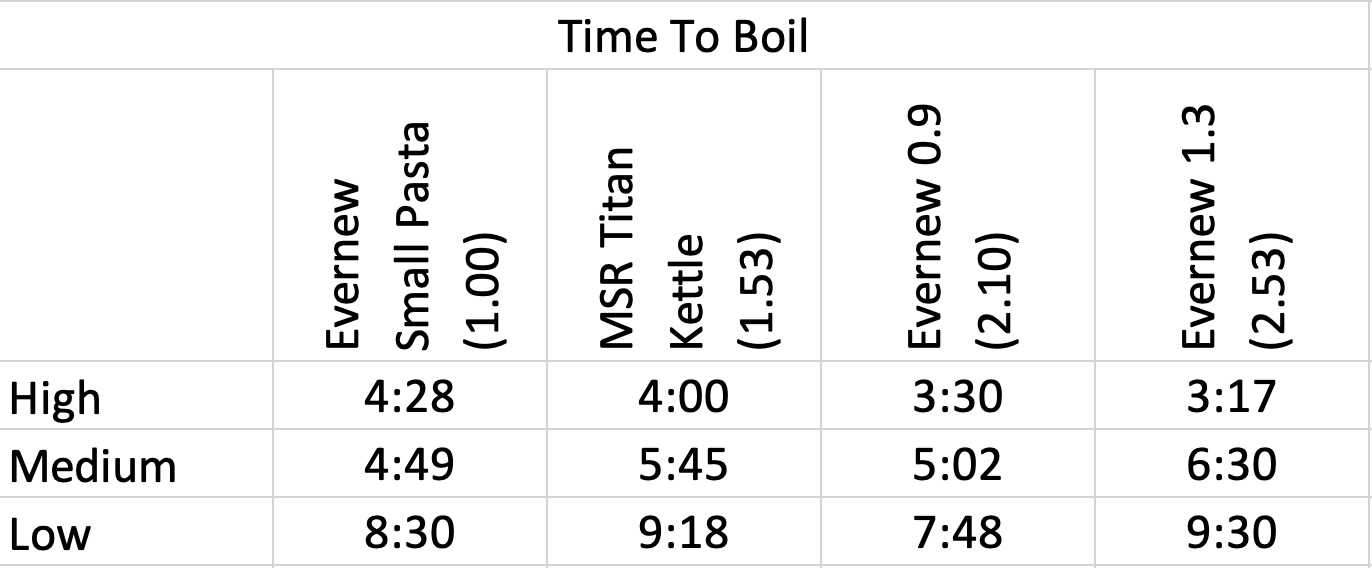
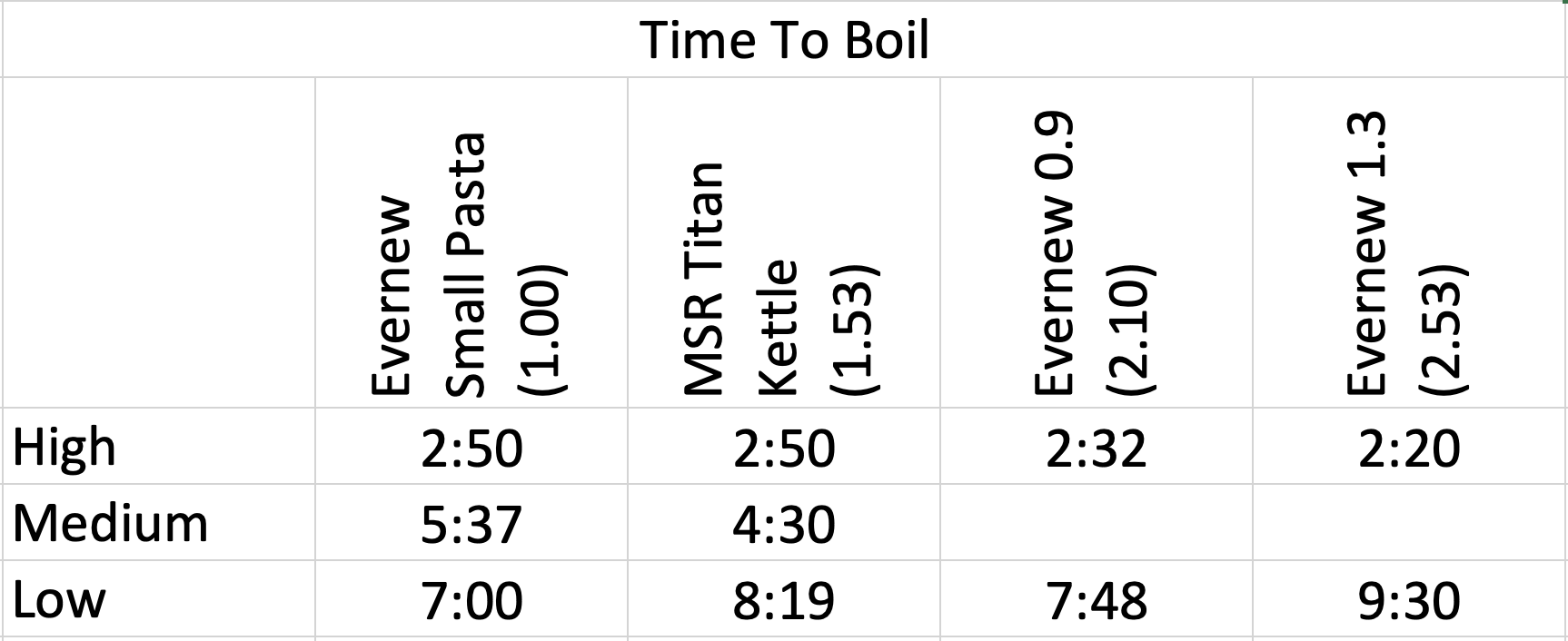
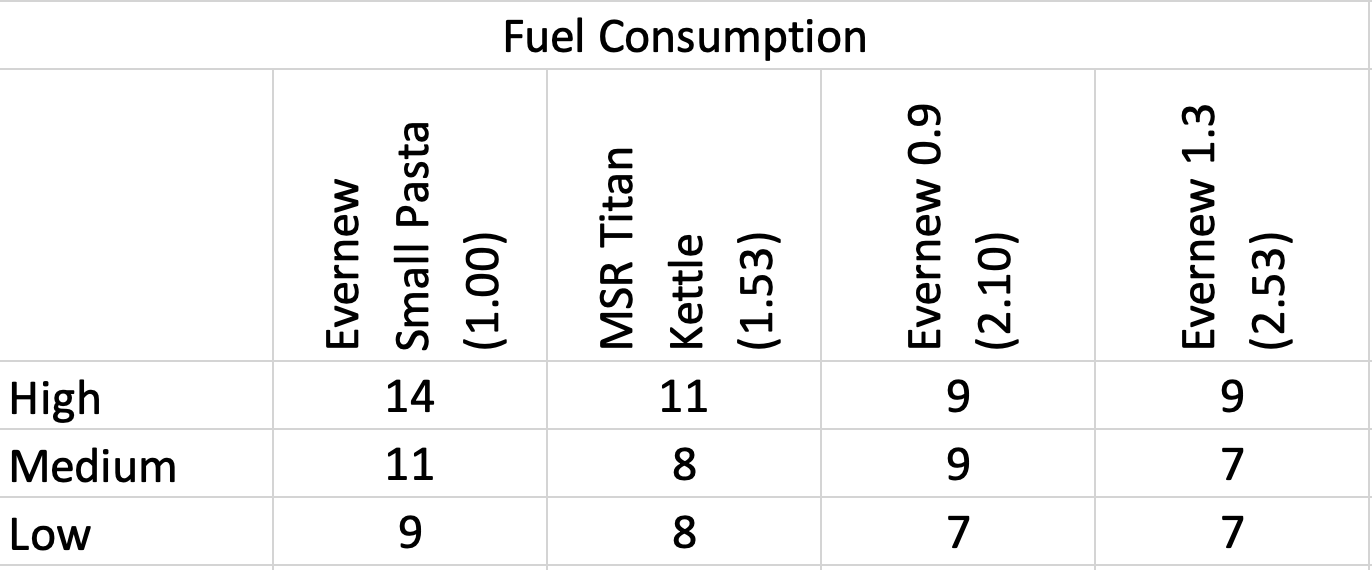
I started out investigating how pot size and fuel efficiency is impacted by the fuel burn rate.  I selected 4 pot sizes, using the Evernew Small Pasta Pot as a reference.  The pots were selected based upon there area relative to the Pasta Pot: Titan Kettle (50% more area), Evernew 0.9 (2X the area) and the Evernew 1.3 (2.5X the area).
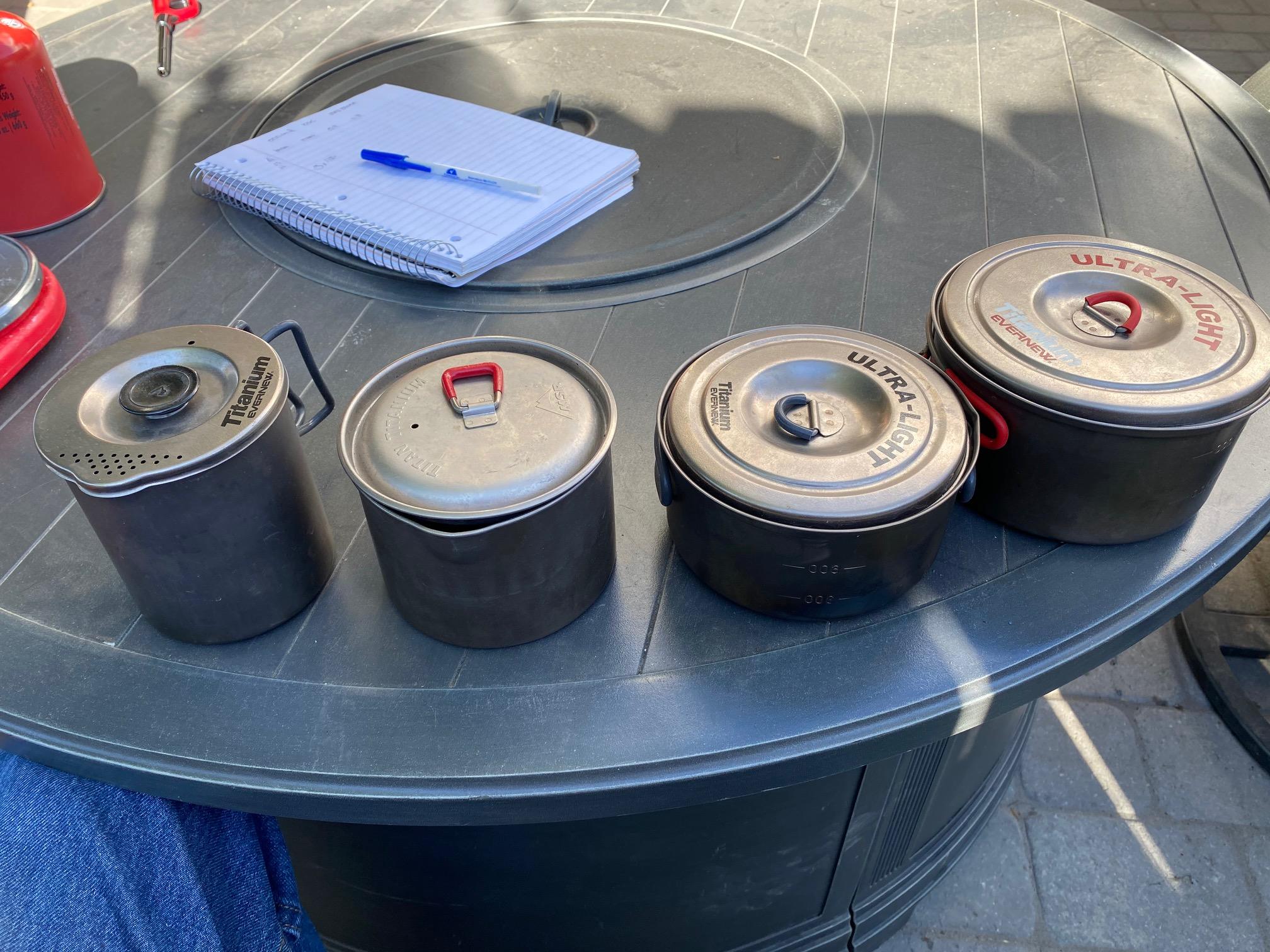
In all cases, I used 500 ml of 20 C water.  Testing was done about 10 feet above sea level.

For burn rates, I segmented them into low, medium and high
Low > 7 minutes to boil water
Med ~4-6 minutes
High <4 minutes

Here are the results for the BRS 3000t
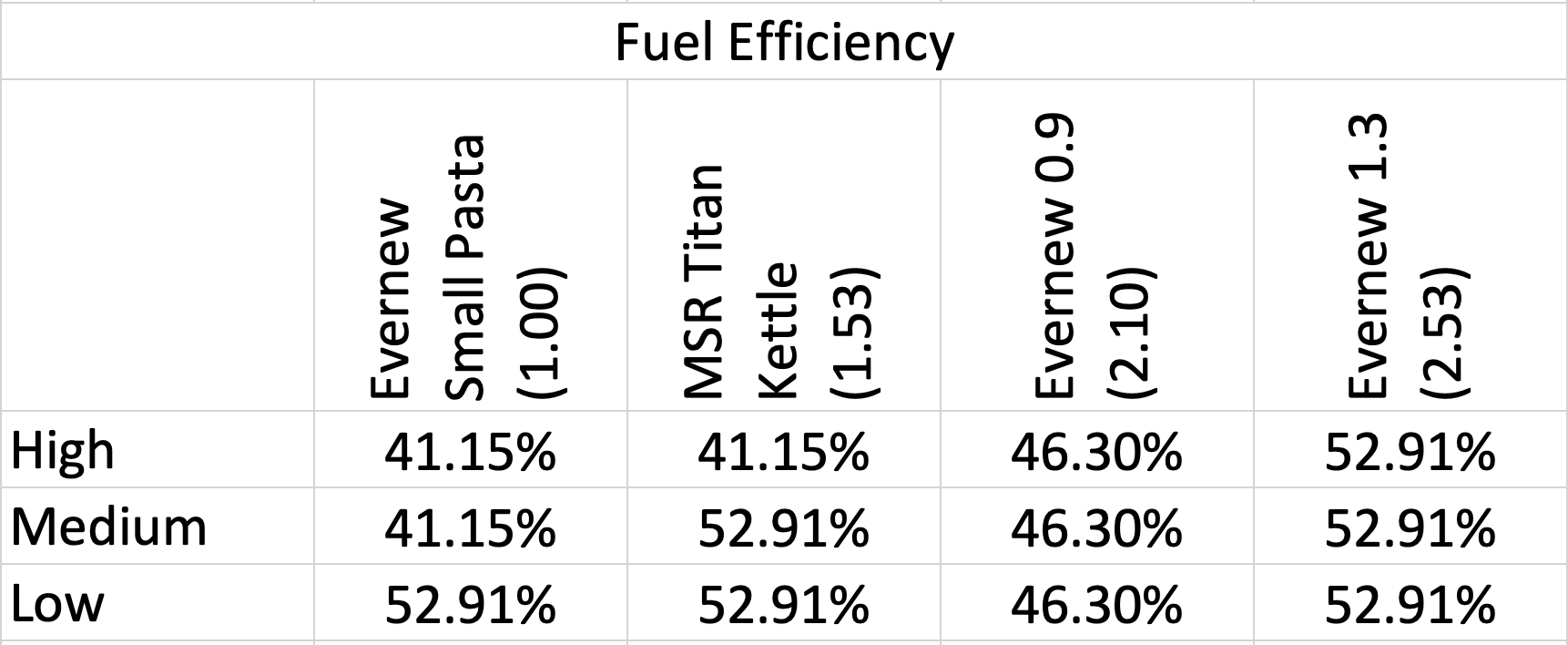
Results for the PocketRocket2 Deluxe
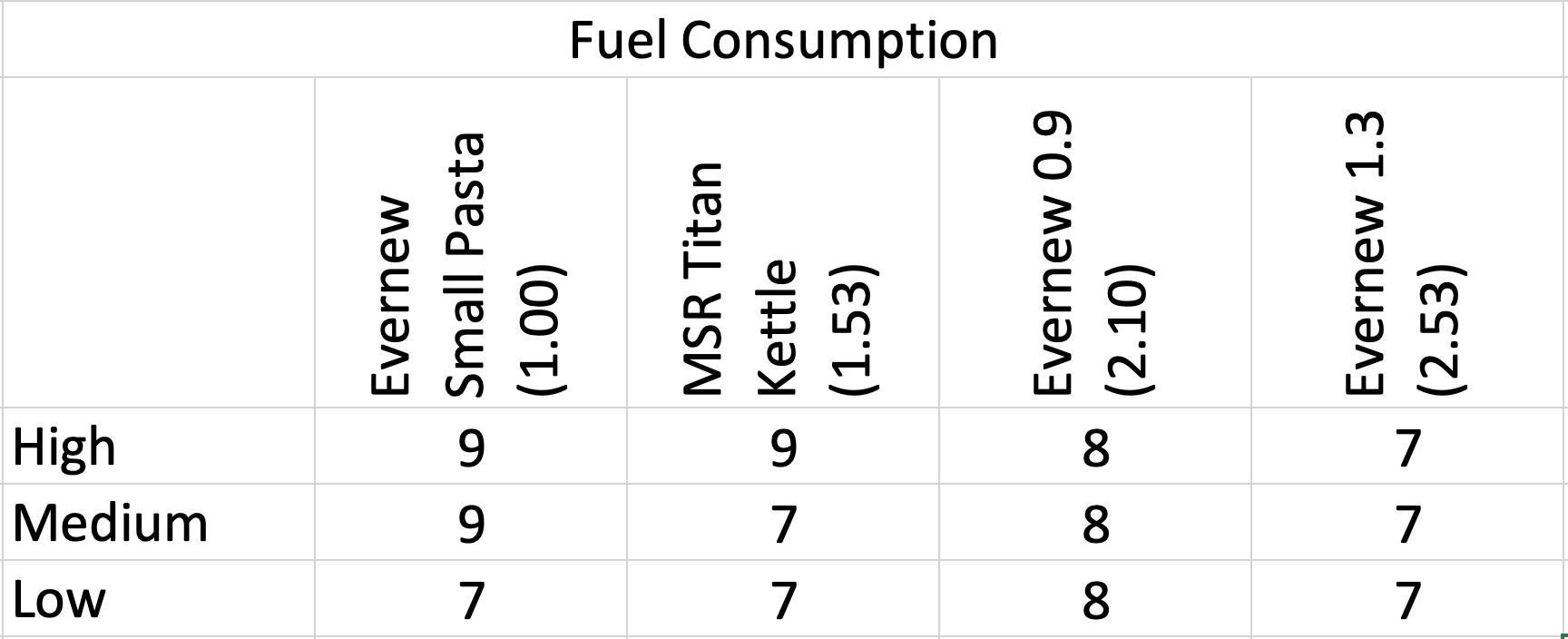
Summary – the stove design can have a greater impact on fuel efficiency than the pot size or burn rate.  While I mention the PocketRocket2 Deluxe, I believe that there are several classes of stoves that will yield similar results: Soto WindMaster, Soto Amicus & PocketRocket2.  My 2 cents.

Here is a video that I made for this experiment

Youtube video

PostedMar 13, 2021 at 11:50 am

That was brilliant. Thank you. I was always afraid of the large surface area (the side walls and lid) of larger pots giving up some of the heating gains as the water comes up to a boil, but apparently this is a total non issue. Air is a good insulator after all. Having the flame actually hit the pot bottom and not escape around the sides is the main thing.

PostedMar 13, 2021 at 12:15 pm

The BRS 3000 performance was so bad with the small Pasta pot at a high burn rate was that the heat was spilling over the edge and up the sides.  The time to boil was actually longer that at the medium burn level.  You could see the heat distortion in the shadows.  It was hot enough to burn the silicone tubing on the handles.

PostedMar 13, 2021 at 1:12 pm

Out of curiosity I used your starting state (500 ml 20 C water) in my JB Stash (10 cm base diameter)

Medium burn: 5:40 and 4 g fuel consumption.

High burn: 3:15 and 4 g fuel consumption.

Same (500 ml 20 C water) in my JB Sol AL with pot cozy (8.5 cm base diameter)

Medium burn: 3:35 and 5 g fuel consumption.

High burn: 1:52 and 5 g fuel consumption.

I’ve used JB Sol stoves for years and I know I use 17-19 g of fuel per day, so a 100 g canister will last me 5 days with a tiny bit of margin.

Jerry Adams BPL Member
PostedMar 13, 2021 at 1:18 pm

great data, interesting

did you do one repeat of each test?

so 12 for BRS3000 and 12 for PRD2?

Rex Sanders BPL Member
PostedMar 13, 2021 at 1:31 pm

Wow. Stove design can make a big fuel efficiency difference.

Wonder how a remote canister stove, like the Kovea Spider or MSR WindPro II might perform on these tests? Especially considering the broader flame of the WindPro II.

— Rex

PostedMar 13, 2021 at 1:34 pm

In general, 1 boil for each state: 12 boils to fill out the matrix.

My scale only as a 1 gram resolution

For the BRS data, I think that is fine as the range (7-14 grams) is broad enough where resolution doesn’t create that much error. and you get the sense that hotter and smaller is bad.

For the PocketRocket2, I skipped the medium burn on the Evernew 0.9 & 1.3 because the high and the low were identical (I filled in the fuel consumption in order to generate the surface chart).  Only 10 runs.  I don’t believe that the gram resolution was significant as the dynamic range was only 7-9 grams.

By the book, each of these test should have had at least 3 replicates for 36 burns. but that is using 400-500 grams of fuel.  It also takes a long time to run the test because you have to “guess” at the burn rate.  I probably threw away 3-4 test because they did not match the time buckets that I was shooting for.

When testing the the HX Burner plate, I went to 10 identical runs because I wanted a high resolution answer.

PostedMar 13, 2021 at 1:38 pm

If memory serves me correctly, I routinely get 2 cups of 70 F to boil using 6 grams with the Kovea Spider (mugs & pots).   The MSR WindPro was a flame thrower, I think that it was best for bog pots/fast boils.  I had one for a while but I could dial the output low enough to dry bake with it so I sold it.

Plus, I think that the BRS is just a poorly designed stove.  The burner head to far from the bottom of the pot and that produces poor coupling to the mug and a high sensitivity to the wind.  My 2 cents.

PostedMar 13, 2021 at 1:44 pm

The generally held belief is that an HX pot gives you a 30% improvement in fuel efficiency.

7 grams plain pot = 4.9 grams with an HX pot

So that seems to match what you are seeing.

Rex Sanders BPL Member
PostedMar 13, 2021 at 6:12 pm

Seems like MYOG stove and pot stand makers, like the infamous cat food can alcohol stoves, should pay much more attention to optimizing stove-pot distance for efficiency. Most alcohol stoves are bad enough without potentially giving up almost half your fuel for nothing.

Even swapping a slightly taller or shorter stove in an off-the-shelf stand or Caldera-style windscreen might … backfire.

— Rex

PostedMar 14, 2021 at 9:09 am

Jon, a very nice test. Much appreciated!

Taking in the data, it seems like the PR DLX coupled with the Titan Kettle is a nice compromise with weight, size, and fuel consumption taken into consideration.

I have a PR DLX and have been debating between the Titan Kettle and the Evernew Ti Mug Pot 900. I’m leaning towards the latter.

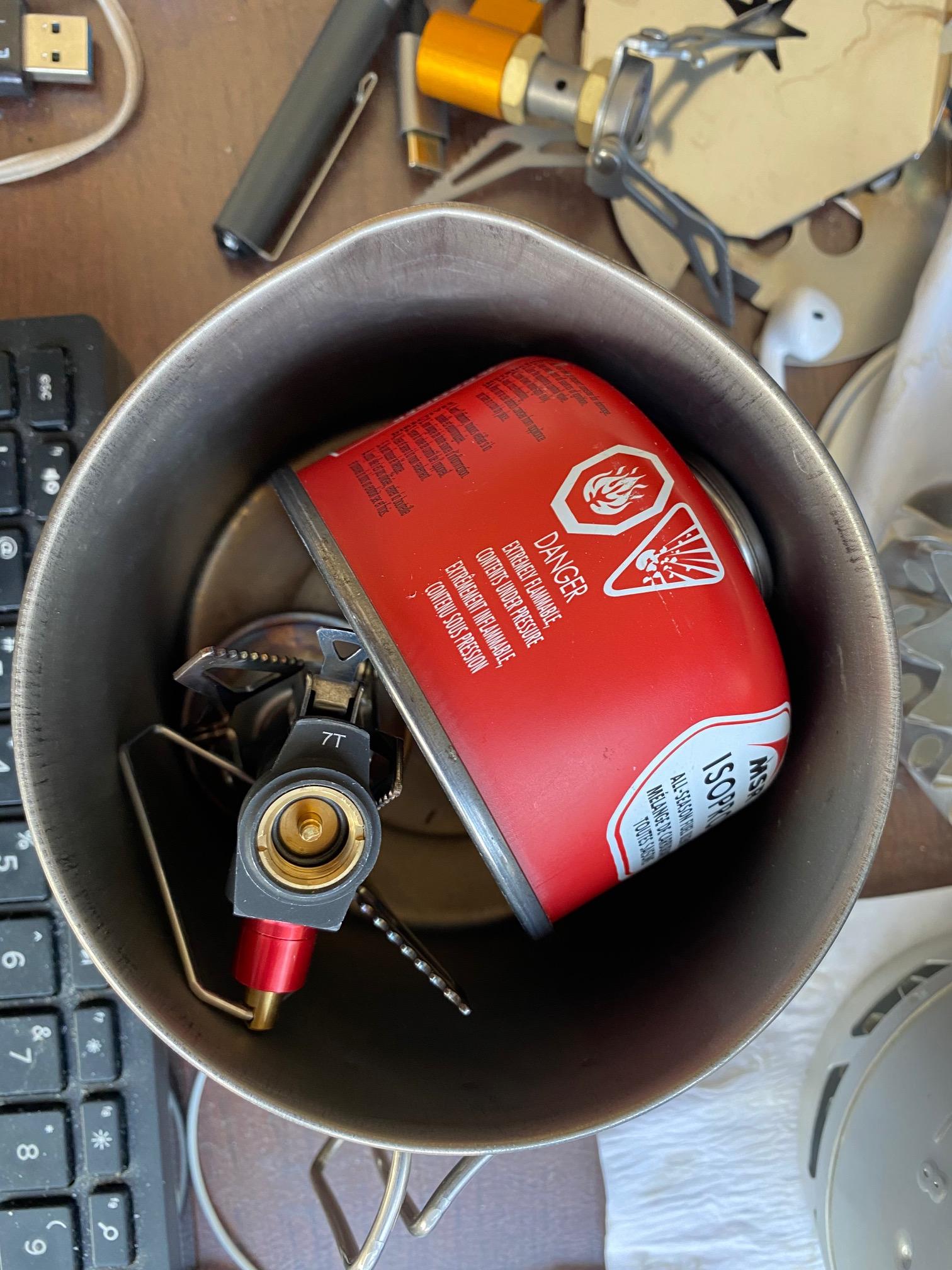
A question, since you have the PR DLX – will a 110 gr cartridge and the PR DLX fit inside the Titan Kettle with the lid on? It looks like it might be a bit short?

Some further thoughts, I wonder how a HX pot (thinking specifically of the sterno Al version) would have fared in the test with the PR DLX?

PostedMar 14, 2021 at 10:03 am

In the right orientation (burner down in the concave of the can), it just fits in the Titan Kettle.  Yes, the lid does slide over everything.

PostedMar 14, 2021 at 10:08 am

In the right orientation (burner down in the concave of the can), it just fits in the Titan Kettle. Yes, the lid does slide over everything.

You da man! Thanks.

Edward John M BPL Member
PostedMar 14, 2021 at 2:29 pm

110gram gas canisters are unstable when used so you almost always have to add a base unit which adds weight, their only advantage as far as I can see is being able to fit into a small pot

PostedMar 14, 2021 at 3:20 pm

110gram gas canisters are unstable when used so you almost always have to add a base unit which adds weight, their only advantage as far as I can see is being able to fit into a small pot

I’ve been using 110 gm canister stoves for over 25 years and have never needed a “base unit” no matter the stove. Color me simple :)

Edward John M BPL Member
PostedMar 14, 2021 at 3:46 pm

Maybe it’s just me needing a full litre of coffee in the AM to wake up, too many years in commercial kitchens with caffeine on tap 24/ 7

obx hiker BPL Member
PostedMar 14, 2021 at 9:18 pm

Jon really appreciate these reports!

Brad and Edward John: I was cleaning out some old gear tubs the other day and came across one of those 110 canister stands. Had to look at it for a minute before I realized what it was and for.  ;)

Michael B BPL Member
PostedMar 14, 2021 at 10:35 pm

So, Jon, just curious how much fuel you’ve burned in all these tests?

PostedMar 14, 2021 at 11:01 pm

@obx hiker – the question has been floating around for a while and needed an initial investigation.


@Michael
B – fuel is cheap, $10 for a 16 oz can.  I probably bought 3-4 of those.  Due to the pandemic, time is relatively cheap so it was a good time to run the test.  That and I had to fumigate my house and rented an AirBnB for a few days.  No rest for the wicked.

David Thomas BPL Member
PostedMar 14, 2021 at 11:52 pm

Jon, thanks for the very helpful and actionable data!

Qualitatively, I’ve been happy with a BRS-3000T on a medium setting paired with an HX pot in which it nestles up among the HX fins so it’s as close to the pot bottom as possible and gases exit through the fins.  I’ve run it on medium, but I think I’ve learned from your data to go towards low at least when using a non-HX pot in mild weather.

More so, to lean towards my larger diameter pots.

Erica R BPL Member
PostedMar 15, 2021 at 5:08 am

I chose the snowpeak gigapower stove based on the low CO emissions.

I guessed that low CO translates to efficiency.

Alex H BPL Member
PostedMar 15, 2021 at 5:09 am

Jon, did you do the tests with windscreen or without?

PostedMar 15, 2021 at 8:50 am

No windscreens were used in any of the test.  Test were conducted outdoor in fairly calm conditions.  Best regards

Dale Wambaugh BPL Member
PostedMar 15, 2021 at 5:19 pm

Wind has a huge effect. Remote canister stoves can deal with it nicely. I gave set up next to rocks or logs in a campsite to help or used a carefully placed sit pad. The folding sectional windscreens are a little heavy but can be set up with enough room to prevent overheating the canister.

PostedMar 15, 2021 at 5:46 pm

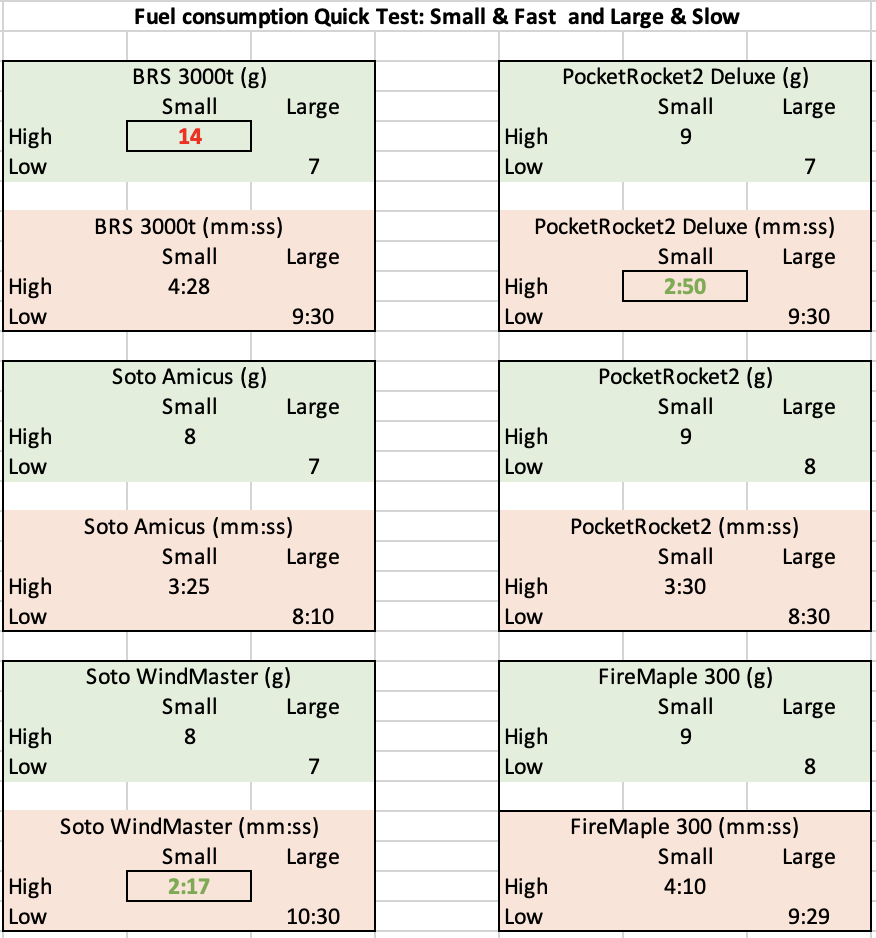
I started this investigation because in another backpacking forum, people were discussing how with the BRS 3000, they were using 12 grams of fuel to boil water.  The good news is that it seems that the BRS 3000t design itself is an anomaly (as in a bad design).   I decided to run an abbreviated test using other stoves; small pot – high burn rate and large pot – low burn rate.

In general, all of the other stoves have pretty good fuel efficiencies.  Here are a few observations (opinions):

  • Unregulated stoves on high sound like a blowtorch and it is pretty difficult to judge whether or not the stove is on high or not.
  • On unregulated stoves, the flames on high don’t appear to be very stable.  There is a lot of flames jumping about and often time appear to be lifting off of the stove a bit.
  • Regulated stoves seemed to have a linear and predictable relationship between turning the valve and the flame profile.
  • Regulated stoves can boil water quickly: sub 3-minute boils with no great loss in efficiency.
Viewing 25 posts - 1 through 25 (of 35 total)
Loading...