


I am lost with all the choices. ULA Photon like and size.
thanks thom
Topic
Become a member to post in the forums.
 .
.
I am lost with all the choices. ULA Photon like and size.
thanks thom

I’ve tried laminates, like xpac, but the inner waterproof layer develops holes and leaks
Most recently I used 210D robic nylon. Or any ~200D nylon. Just one layer lasts longer, but not 100% waterproof.

1.7 oz ROBIC XL Hybrid ripstop nylon
This is what I used for my last pack. Any ripstop nylon, uncoated, that weighs about 2 ounces per square yard works for me.

I’m going through the same decision right now as well. I’m trying towards waterproof materials like Ultra, but it seems like they are more prone to durability issues and I don’t really need the pack material to be waterproof.
I would go with 210d nylon.
I don’t like the white salt deposits from sweat showing on backpacks and I feel that black Ultra fabric shows a lot of that. White gets dirty pretty soon. XPAC and DCF are easier to clean – but, they also show. Gray DCF is pretty good – it doesn’t show. Though DCF looks like crap after 1000 miles or lesser. If you can live with weight of camo XPAC – it doesn’t show dirt easily and lasts a long time.
But, Nylon is the best – it looks brand new after 1000’s and 1000’s of miles! And you can build a very light backpack. I have Wasabi green MLD backpacks and they are the best!
“I don’t like the white salt deposits from sweat showing on backpacks”
This is the main reason I make my packs from uncoated ripstop. I can run them through the washer/dryer regularly. I sweat a lot.
I am proud of those white salt deposits
It shows that I actually use my gear rather than just unbox it in front of a camera : )

For moderate off-trail use, 210D Robic or 210D HDPE gridstop. For mostly on-trail use, 70D Robic.
210D is plenty beefy enough for UL loads and moderate off-trail bushwalking, and it’s lighter than comparable x-pac. 70D is fine for a pack if you take a little bit of care with abrasion, maybe using a little 210D material on high wear or stress areas.

I would make sure it has no mesh on the body. Fabric water bottle holders with elastic, same for large back pocket-fabric with elastic and small drain hole for dirt to fall out of.
Mesh is very convenient because you can see through it and find your gear quickly. But mesh tears easily during heavy bushwhacking or canyoneering. A good compromise is to use mesh on the front pocket (aka large back pocket) but regular fabric for the side pockets, at least for moderate off-trail use. Side pockets seem to get more abuse from tree limbs and rock outcroppings than the front pocket does.
@Lester I love mesh, works fantastic for storage. I have just had very bad luck with the mesh-tight knit or loose nit-either snagging or being abraded while passing through boulders. I figured a Robic pocket with elastic on the top and a drain hole-similar to how Zpacks does it’s water bottle side pockets-would really hold up the best.
I like a stiff fabric for the main body to provide structure and aid in packing things inside. All other fabrics I prefer to have some flex. The 210d w/ uhmwp reinforcement seems to be the sweet spot if you are not looking for a stiff fabric. I like how the laminates tend to have more stiffness though. A Breathable non-wp fabric (such as hex70 mentioned previously) is prefered for shoulder straps. These areas see a ton of sweat/salt buildup in WP fabric shoulder straps.
Curious if anyone has experienced any type of abrasion/durability issues with dyneema mesh? I know only offered by some of the cottage folks…
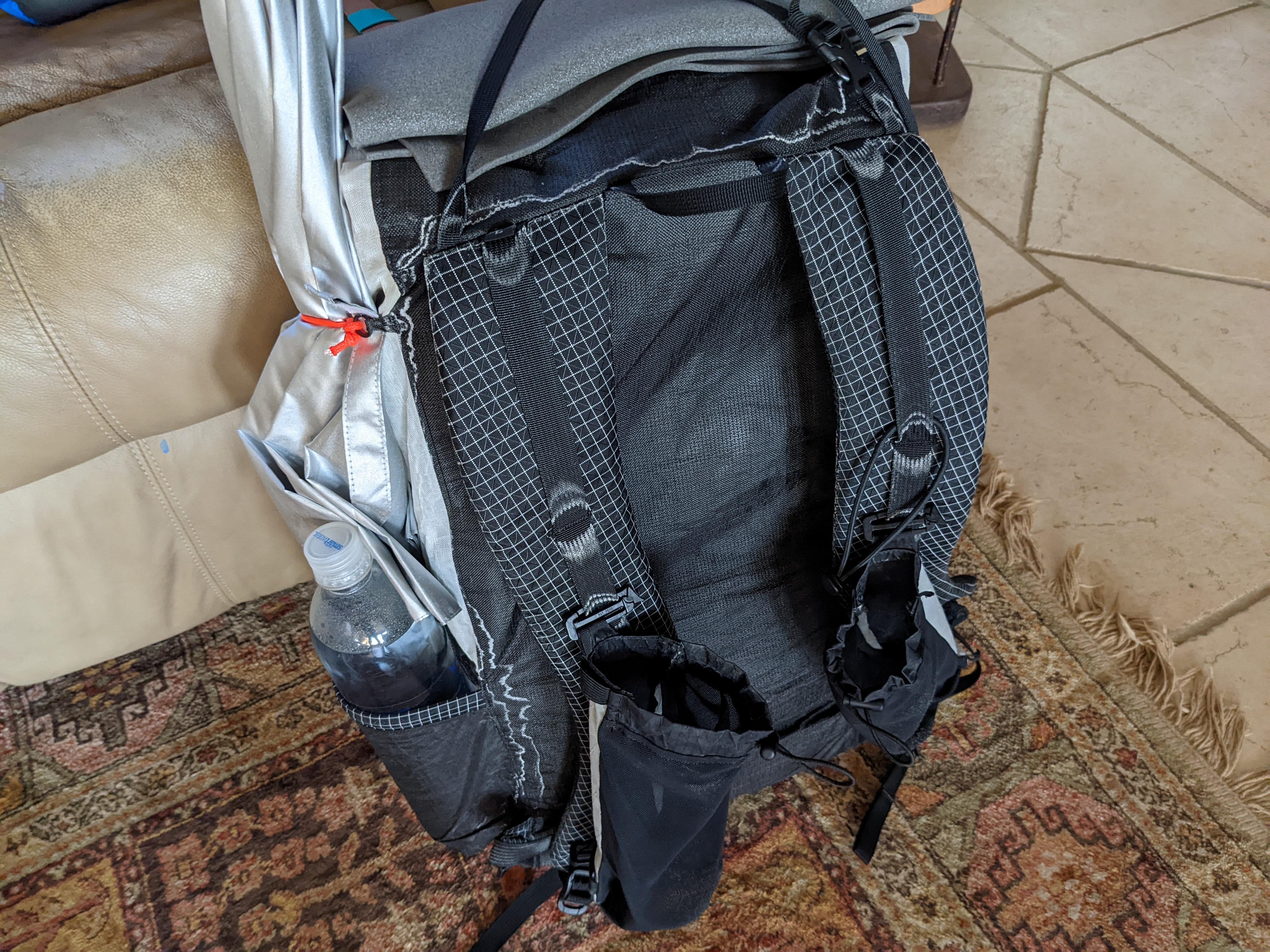
Here are two pictures after 11 miles of hiking in hot Austin, Texas. The first one is Ultra 200/Ultra 400 MLD Prophet – hiked from 1:30 PM during max heat. Max temp was 91 F. You can see the white crud on top of shoulder strap attachment points and on the sides and webbing on shoulder straps.
The second one is MLD Burn in Wasabi green – again from 130 PM the following day when max temp was 88 F. I went when it was real hot as I am training for my Arizona hike. You can see the white crud on webbing of the shoulder straps. There is some white crud near the bottom and where the shoulder straps are attached – but you really cannot see as it is Wasabi green.
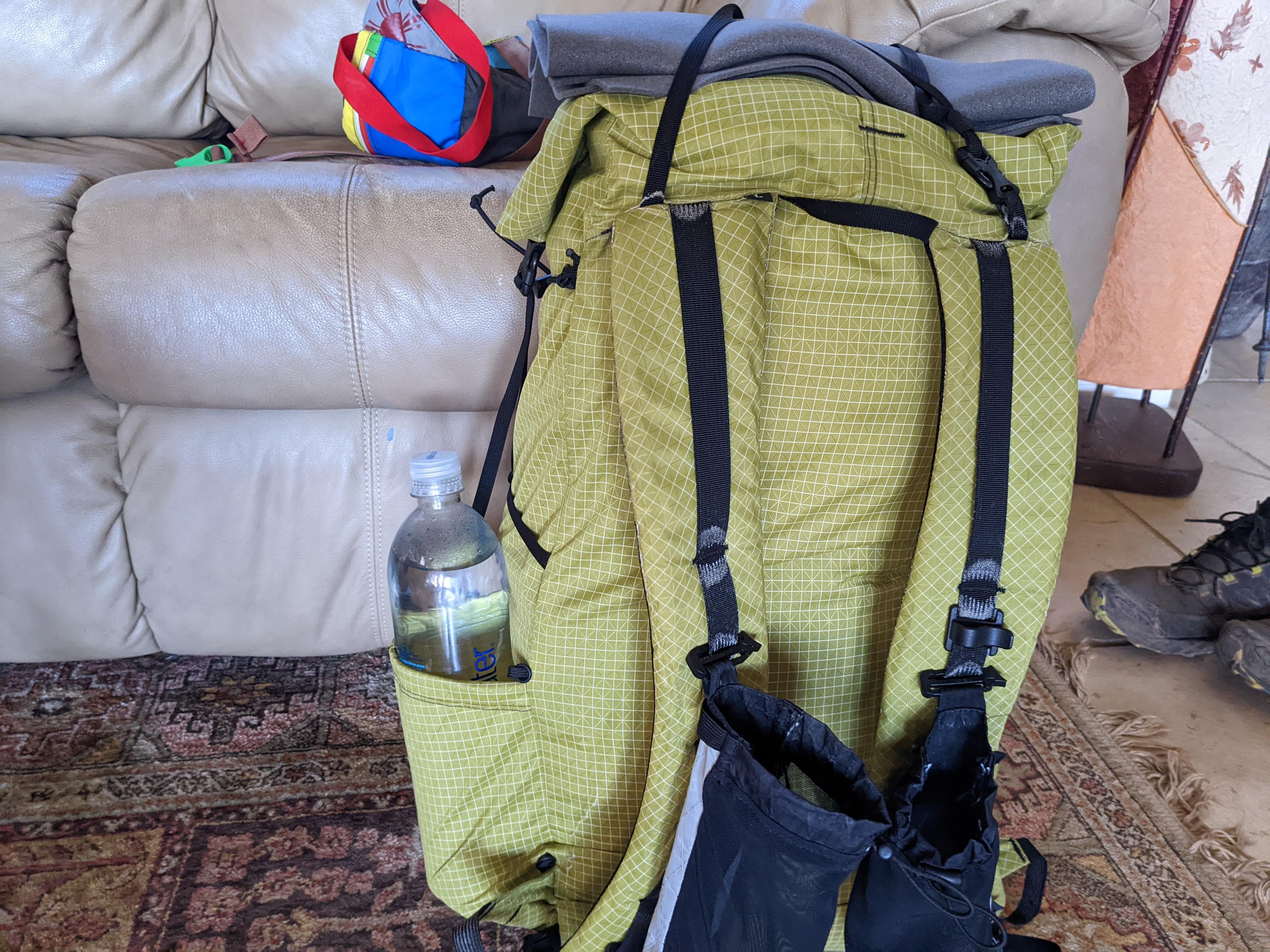
I like the Wasabi green for this purpose….easier to maintain on the trail. I am nitpicking here of course. Black fabric I feel is bad for the back. The grey DCF on MLD packs also never showed the white crud. I wish people would stop using black color for the back…..just gets too messy.
Interesting that the OP’s question could apply both here or on MYOG. In either case, I would look for a supple fabric, which would be very waterproof as well.
Supple, because it would be more abrasion resistant than stiffer fabrics and would not catch on rocks, branches, or anything else as high as the pack when on my back. It would also be easy to stuff. For a frameless pack, the supple would also allow the pack to conform better to the body.
Waterproof, because after a grizzly episode, I’m addicted to panel loaders with shelves on top to carry the food, and also depend on the WP to keep the stuff inside the pack dry. No need for pack covers. KISS rules. And it’s nice to have a WP pack on combo paddle/hike loops where the pack must be stuffed in waterborn transport for a large portion of the trip.
From the prior posts, it appears that many choose nylon, which meets the above criteria. So no need to experiment with new fibers like Dyneema etc. A caveat being that care is taken to not abuse the pack. There are places where chimneys must be descended, like descending the AT south from Katahdin, or west down from Mt Jefferson in NH’s Presidentials. And nylon of 200 denier or more has been adequate to drop the pack down the chimneys and follow packless to make the descent easier and safer. Especially if dogs also need carrying.
Weight is always an issue; however, with a smaller pack, unlike a tent or tarp, increases in fabric weight really don’t amount to much.
Become a member to post in the forums.
 Creamy Dijon ChickenCook-in-the-bag chicken, tarragon, and rice backcountry meal with 2 servings. Net weight 5.7oz | 162g
 © Beartooth Media Group Inc.
 Loading...