Topic

To slot an HX pot to restore factory burner to pot height or not?

Viewing 18 posts - 1 through 18 (of 18 total)
David Hartley BPL Member
PostedJan 19, 2026 at 11:12 am

I have recently acquired a Fire Maple FMC-XK6 HX pot (the slightly more than 1 liter pot that is essentially the same as the Olicamp 1 liter HX pot) in an attempt to improve efficiency and get by with fewer canisters when hiking with a partner (which is why I needed the larger capacity vs the smaller Fire Maple HX pots that already have slots). I plan to use this pot with an older Primus Micron Ti stove that I am fond of, and a recently purchased Ocelot 6 universal windscreen from Flat Cat Gear. So now to the question in the subject line – should I bother to cut slots in the heat exchanger to restore the original burner to pot distance or not?

Or should I just switch to a PR deluxe stove and get one of Jon’s Cheetah adapters for the 1 liter pot – which restores the factory burner to pot separation without adding slots, but at least visually does not look like it blocks wind into the HX fins?

PostedJan 19, 2026 at 1:08 pm

Here is my recommendation: test what you have first, there may not be a reason to change.  Do you have an efficiency goal in mind and in what conditions?  The biggest factor would be wind.  When the stove/HX mug are right in calm conditions, you should be able to boil 500 ml of 68 F water using 5-6 g.  In the high winds with a windscreen, the number can be between 9-15 g of fuel.

With that in mind, you have to determine how much fuel do you need for your trip (basically, how much water are you going to need to boil during that trip).  If you get that information, you may not need to change a thing as your set up meets your needs.  My 2 cents.

FYI – the Cheetah line is being completely revamped to target the Fire Maple Petrel G2, G3 & Ramen pots.  Other configurations are going to be discontinued.

David Hartley BPL Member
PostedJan 19, 2026 at 2:46 pm

Thanks Jon.  In previous hikes with just a non HX pot (an aluminum pot from Four Dogs with similar dimensions and capacity to the Fire Maple 1 liter pot) and the Primus Micron Ti stove our long term average fuel usage per 500 ml water boiled works out to approximately 7-8 grams under all conditions, without the use of a dedicated windscreen. If there was wind (more like just enough breeze to displace the flame) I usually would physically hold my sit pad around the cooking setup until the water boils – a bit tedious. However, other than a September trip to the Wind River range years ago I can’t say we have experienced a lot of trying to cook in windy conditions.

We are planning an 11 day hike in Scotland in early May and I am anticipating more exposed campsites and more wind than we typically have experienced. I estimate our water boiling needs at approximately 1.5 liters/day, excluding the first days breakfast and last days dinner (not on trail), that works out to a total of 15 liters to boil. I would love to get that out of a single 230 gram canister if I could, but that seems to be cutting things a little too close given the likely conditions (would require averaging 7.67 grams per 500 ml). I was hoping that adding the HX pot and the dedicated windscreen would improve my odds. We may be able to purchase another canister at the 1/2 way point and then the whole issue is moot, or the one shop that stocks them might be out and then we are in trouble.

I have watched many of your videos and the Gear Skeptics series on stoves, pots, wind, etc. I was hoping somewhere in internet land somebody had already tested this idea of stove to pot separation with HX pots. Before I commit to a single 230 gram canister I will definitely need to do some testing, but it is likely any testing I do will lack the precision that others have brought to this space. Perhaps I just need to carry an extra 100 gram canister and enjoy an extra cup of tea or coffee and worry less about grams of fuel per 500 ml water boiled. But it is winter here in Western NY and I have time on my hands to over think gear …

PostedJan 19, 2026 at 3:05 pm

Two of the windiest places I’ve ever been to have been in Scotland: Isle of Skye and the Cairngorms. That and depending on where you go, the tree line is a LOT lower there. If it is going to be super windy, you can’t go wrong with a MSR Windburner, it will boil 500 ml using 5-6 g even in stormy weather.

To me, expecting 7.67 grams per 500 ml is really aggressive. My bench test numbers are based upon a 68 F starting point and a 20 F lower temperature needs an additional gram of fuel.

Another thing to note is depending on where you go, you may not find any 4 oz canisters. 8 & 16 oz seems to be the popular choice.  My 2 cents.

David Hartley BPL Member
PostedJan 19, 2026 at 3:40 pm

We are not going to the Isle of Skye or the Cairngorms (we are planning a roughly 140 mile loop starting in Fort William that incorporates a section of the Cape Wrath trail), but I agree that 7.67 grams/500ml is probably too aggressive to plan on. I have also read that there may be limited availability of 4 oz canisters in Scotland. We will be purchasing fuel in Fort William – it looks like there are several gear shops there. Hopefully we can find 4 oz canisters – starting with a 4 oz and 8 oz would give us plenty of fuel, even with wind – as long as we are using a windscreen, and then we would not have to worry about fuel resupply en-route.

Of course the added weight of the Windburner vs our planned setup is less than a 4 oz canister – so there is that. I am just a little hesitant to introduce the complexity of a totally new type of stove system without having used it previously on any extended trips.

PostedJan 19, 2026 at 5:12 pm

Well, googgling Cape Wrath Trail and wind and this is what AI said.  Best wishes.

The Cape Wrath Trail in Scotland is notoriously windy, with strong Atlantic gales being a defining feature, often battering exposed ridges with speeds potentially reaching 50mph or more, necessitating robust gear like a windproof tent, proper rain gear, and skills to manage dangerous conditions like high winds and rain, which can drastically change from calm to tempestuous within a day, even leading to dangerous, boggy sections with minimal tree cover.

Roger Caffin BPL Member
PostedJan 19, 2026 at 8:59 pm

I sometimes wonder about having a paranoid obsession with fuel weight. Bear in mind that I walk with my wife, and having to tell her that she can’t have warm drink when it has been sleeting all day seems a little ‘off’.
Yes, we both go UL (of course), but maybe having UL gear and really light packs could let me take just a little bit more fuel so I can give her unscheduled warm drinks?

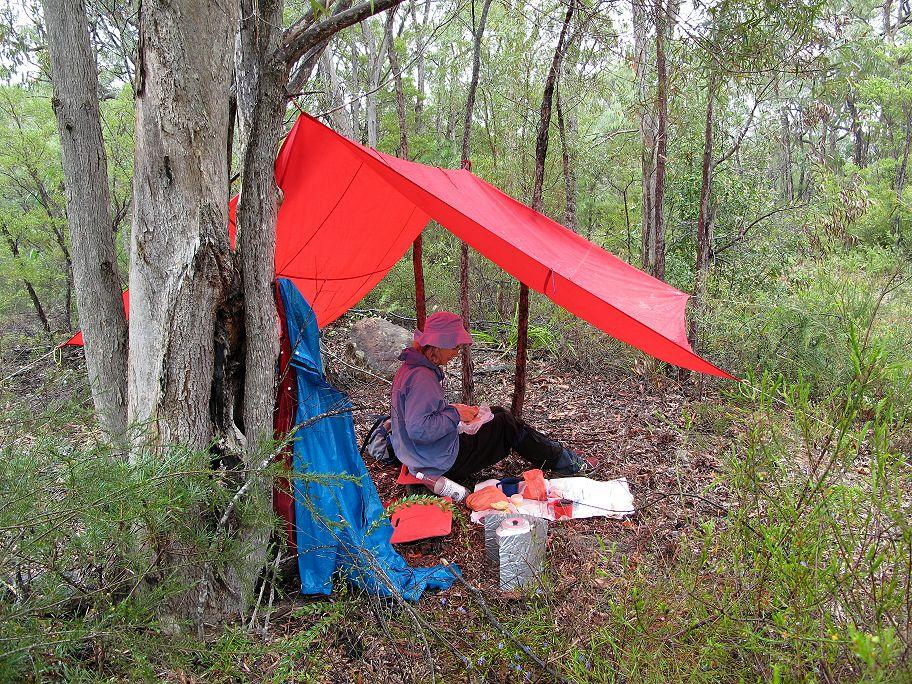
(Womerah Range, Wollemi NP, pouring with rain for the last few hours.)

Or to put it another way: why are you out there? To suffer, or to enjoy the trip?

Cheers

Mole J BPL Member
PostedJan 20, 2026 at 2:15 am

I have both an XK6 pot and a Petrel.
Soto windmaster with the xk6 pot performs well as it is. With the few tests I did, the XK6 as is is actually somewhat faster boiling for the same amount of gas than the slotted Petrel G3 with the windmaster.
. I suspect cutting into ithe xk6 and bringing the burner closer to the pot base could compromise performance. Depends on the burner. Test test test.

PostedJan 20, 2026 at 10:07 am

how do you know when the burner is too close to the pot?

If the burner head is too close to the bottom of the pot, the cooler surface can quench the flame and reduce optimal fuel consumption.  I believe that this is when CO generation can increase.  Roger is the guru of this topic and maybe he will chime in.


The thought is that with slots on the Petrel pot, the burner will be at the design center that the manufacture recommends.  Of course, there is no documentation on this.  I believe one manufacturer recommended not using their stove with HX pots but that could be a liability reaction on not from any test data.  Some users have claimed that they smell the CO when using an HX pot, but CO is odorless.  My take is that you should be using ANY stove in a well-ventilated area.  That should mitigate 99% of all the concerns (spit balling here)

Jerry Adams BPL Member
PostedJan 20, 2026 at 10:22 am

does the flame turn from yellow to red when it’s too close?

Terran BPL Member
PostedJan 20, 2026 at 11:21 am

I don’t know if it’s correct. I go by the spread of the flames. Too close and you don’t get the spread from the burner head. Too far away and you don’t get the spread from hitting the bottom of the pot.

David D BPL Member
PostedJan 20, 2026 at 12:10 pm

Flame should be blue.  If red, less complete combustion and more CO produced.  When my PRD is too close to a pot, flame gets redder (flame quenching) and it’s why I didn’t slot my Stash pot.  More safety margin for those rare occasions when I need to run it in the tent.  I never tested CO produced, just went with the approach that gave me more peace of mind.

As my PRD ages, flame is getting redder too (independent of the redder flame from quenching). Even after cleaning it with a brass brush.  Cause could be a leaking cannister o-ring as I refill and reuse my canisters.  Need to retest with a new cannister.

Jerry Adams BPL Member
PostedJan 20, 2026 at 1:37 pm

that’s what I was looking for – you can tell if it’s too close based on color.  Which is dependent on temperature.  Which should answer the original question.

I have this canister labeled “August 2020”.  So I’ve used it for 6 years.  That would be about 400 nights.  I haven’t noticed any defective behavior.  And my PRD is older than that without problem, but the flame could be a little redder without me noticing it.

Roger Caffin BPL Member
PostedJan 20, 2026 at 2:09 pm

Agree with Jerry.
A blue flame is complete combustion.
Anything yellow means that there is glowing carbon in the flame, incomplete combustion.
And incomplete combustion means CO coming off AND a waste of fuel.
Red is even worse.

Cheers

Jerry Adams BPL Member
PostedJan 20, 2026 at 2:21 pm

that’s what I was looking for, more detail, I know it’s something like that : )

David Hartley BPL Member
PostedJan 20, 2026 at 6:52 pm

The Primus Micron Ti stove that I have has 17mm spacing from the burner to the bottom of the pot – this appears to be a bit more than many of the current crop of stoves (at least from visually looking at pictures on the web). This was one of the reasons I was considering adding slots to my HX pot. The stove produces a fairly narrow flame pattern – maybe that makes it susceptible to CO production if too close to the pot bottom? It looks like a Micron Ti was included in Roger’s original test series (https://backpackinglight.com/stoves_tents_carbon_monoxide_pt_3/ ), with higher CO production than the best stoves in the test, but lower than the the original pocket rocket and several other stoves.

This thread https://backpackinglight.com/forums/topic/50284/ has some interesting discussion on HX pots and CO production, with David D linking to an interesting youtube video with a closed tent CO test comparing a flat bottomed pot to an HX pot. The HX pot resulted in much higher CO levels in the tent than a flat bottomed pot.

Viewing 18 posts - 1 through 18 (of 18 total)
Loading...