There is as test that I have been wanting to do on a Sawyer Filter. It’s called a conductivity test: what you do is set the pressure differential (gravity feed at a constant height) and then measure the flow rate (liters/minute on the Y-axis)) and plot that against the total liters (X-axis). With a uniform quality of water, this graph will produce a straight line (down and to the right) allowing you to project the life of the filter. We did this at work to evaluate material cleanliness. Of course, this is not practical from real usage. Where it becomes interesting is to do this on a new filter and then check at after each trip. You should see the flow rate stepwise drop after each trip. You should also see it stepwise rise after a backflush. My 2 cents
Topic
Thoughts on the Sawyer mini
Become a member to post in the forums.
- This topic has 97 replies, 34 voices, and was last updated 9 years, 10 months ago by .
I love my mini. Been using it since the summer of 2013, after my Squeeze quit working.
I use it only in clear mountain streams. Haven’t had one issue with it. Once home, I backflush with a high pressure attachment that fits on my garden hose. I just turn the faucet knob enough to get water flying out of the nozzle about 8′ then hold it against the Mini for several seconds.
I’ve gotten to the point that I don’t even take a water bottle or bladder if I know I’m not going to be more than an hour away from a water source. I just use the Mini like a straw, laying on the creek bank. No hoses, fittings, bottles, doo dads, or doo hickeys. Dead simple! And light!
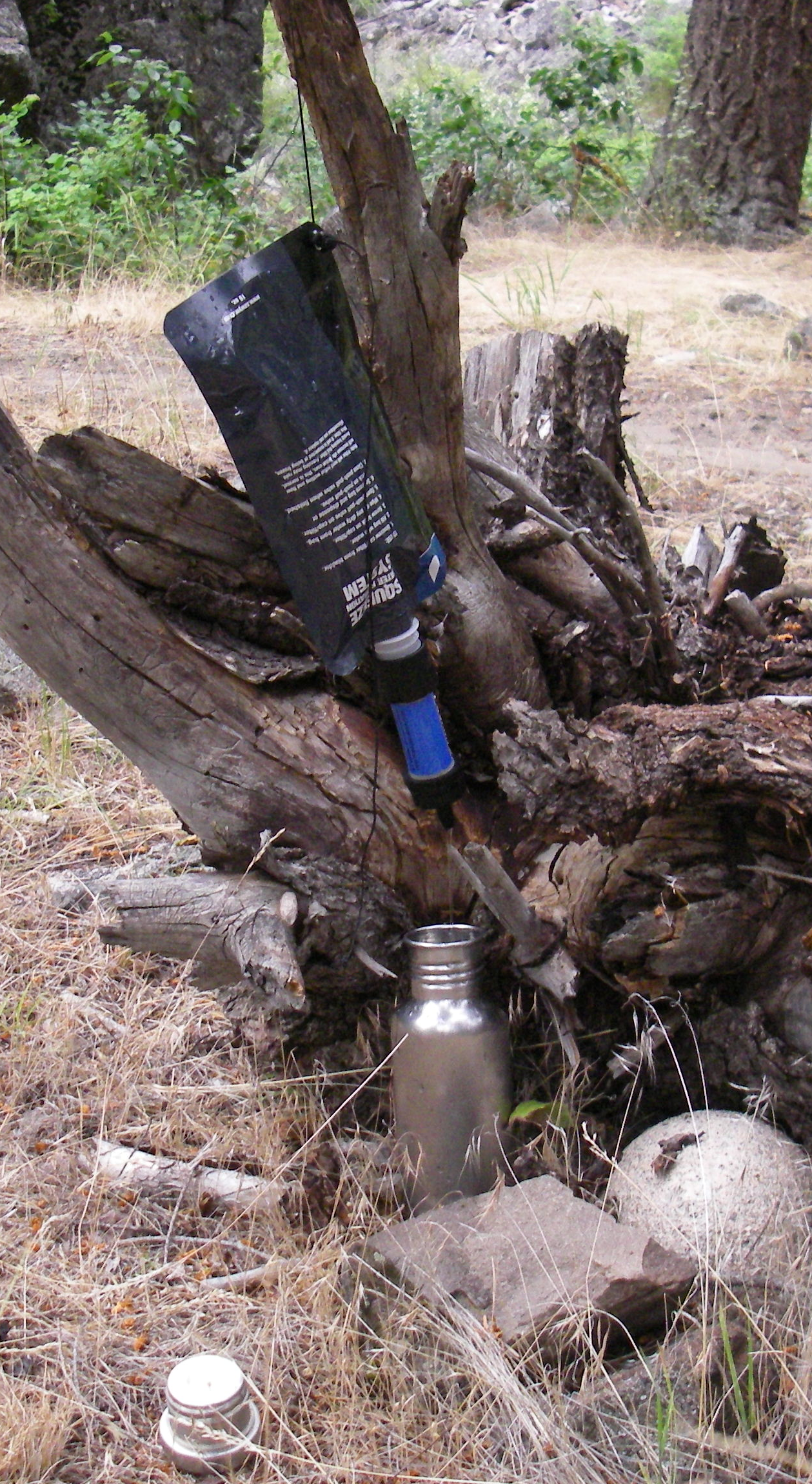
Of those times I do take a bottle, I use the Mini as a gravity filter. I just punched a hole in the bag’s corner, threaded string through, and hang from a bush or limb. I do this while preparing or eating a meal or some other chore. I don’t even notice how long it does or doesn’t take. See attached pic.
The Mini. Works for me. I love it!
The first mini could not be brought back to life after clogging up.
The second mini will be backflushed every 2-3 days and after each trip.
It that works, I’ll keep using it.
Otherwise, will try a Platy Gravityworks (Price just reduced) or RapidPure Scout 1.2L.
Any of them will fit on the DIY pump filter posted in Feb ’15 on MYOG.
Love the Pump.
David,
I have been using the Mini for the last year or year and a half, having retired my “black” Sawyer.
The reason for my switching was for weight savings, smaller size, and ease of use.
I have always made a point of back flushing all of my Sawyer filters once I returned from my trips with a combination of warm water and bleach.
So never had any growth like you have had on yours.
That said, I see no reason why you could not back flush your black Sawyer filter with a mixture of warm/hot soapy water with bleach in it a few times and then try soaking it in warm water with bleach in a cup over night to really give the bleach a chance to kill off anything.
Follow up with multiple back flushes with warm/hot water to wash off any soap & bleach residue.
Remember, the hollow fiber filter is plastic, so it really should not go bad.
You are simply trying to remove the organic growth that has accumulated.
Now, I am considering getting a squeeze for the reasons mentioned….the slower rate of flow through the mini.
I use mine as part of a hydration system.
I like the “dip and go” method for speed of getting water on the go.
I fill up a Nalgene Canteen, wide mouth, soft sided bottle and use a Blue Desert Hydration Tube System that ends with the Sawyer Mini with a Camelback bite valuve on the outflow nipple of the Sawyer mini.
It works well, but I do find that it can be a little bit of work to suck water though the filter.
The Squeeze should probably be a bit easier.
I admit that I am going the other way on weight…went as low as I was comfortable with, but I am adding a few ounces into my kit for ease of use/efficiency…speed of use on the trail.
Anyway, hope this helps.
Tony
Good day my fellow backpackers,
What about having this gravity filtering on the go? Take 2 1L soft bottles, connect the filter in between them. When at a stream, fill the dirty bottle and place the system in the pack side pocket + secure the upper dirty bottle with a strap. That’s it. You won’t even mention how long it takes for the Mini to filter a 1L.
take a piece of fine cloth and some cord
clove hitch the cord to the dirty bottle/platy … and then clove hitch the cloth to the cord … so you dont lose it
when filling the dirty bottle/platy simply hold the cloth over the opening as a pre-filter
you can also fold the cloth over once or twice increase the pre-filtration
;)
Tony,
Glad to hear you are alive and well. I’ve decided to ditch my black Sawyer due to the microbial growth and since it is now 7 yrs old.
A couple questions:
- Regarding your cleaning regimen. Can you tell me what the ratio of bleach to water is that you are using to clean your filter after each trip? Also, do you only backflush with bleach or do you also run bleach through from the dirty to clean side? Per Sawyer’s instructions, they say to backflush with tap water (using the hose faucet attachment) and then run a capful of bleach per Liter of water through from the dirty side to clean side and then let dry.
- Regarding the mini. What is the flow rate compared to the old black filter? Initially, at home they seemed to be the same, around 2 minutes per Liter. But my last trip really caused me to lose faith in the Mini. The difference on my scale is 0.7 oz when wet. Not very significant.
- I have just placed an order for the Sawyer water bottle filter, hoping it is the old black version to replace my contaminated one. I got it on ebay here http://www.ebay.com/itm/351647231316?_trksid=p2057872.m2749.l2649&ssPageName=STRK%3AMEBIDX%3AIT
Gregory,
Filtering on the go seems like an interesting idea, except that it would be hard to get the necessary height to get the flow to work. I suppose you could just hook the two bottles together. The main problem is you are carrying a lot of extra weight. Normally, I filter and then drink a bunch of water so I carry less.
David,
Regarding my cleaning method, I start by using the faucet attachment and pushing clean water through the “clean side” output nipple of the original black Sawyer and same for the mini.
I am just looking to blow out any material that is clogging the hollow pores with a very generous amount of clean water pushed through at high pressure.
Simply looking at the higher volume of water being pushed out the input part of the filter lets me know if I have cleared any clogging.
Then I will put in a half cap of bleach into a litter of water….again, roughly following what the instructions from Sawyer says. Don’t think a little too much bleach is going to damage the filter given that I am diluting the bleach with a good amount of water. (The more bleach you use, the more back flushing with clean water will be needed to remove any bleach/soap taste/residue from the filter.
In this case, I am using my hydration system to back flush by attaching the drinking tube to the output nipple.
Then I am simply squeezing the water water, soap, and bleach through the filter.
I might leave the wet filter to sit for a while to allow the soap and bleach to really have time to kill off anything inside the filter.
Then I will back flush a few liters or two of warm/hot water to rinse away any chemical taste/residue in the filter.
When I am satisfied with the results, I will suck on the output side of the filter to draw out as much water as I can so that it is not stored wet.
With the old black filter, I would open it up and remove the white cartridge to let it air dry….no such ability with the mini.
Regarding the water flow between the mini and the black filter, I found that the mini had a good rate of flow that might have seemed initially better than the black or if not equal.
For me, my future purchase of the Squeeze is to see if the flow is better than the mini so that less effort is used to suck dirty water through my hydration tube and through the filter.
I just want and easier drink of water and paying a 1 to 1.5 oz penalty is no big deal for me at this point, considering that I am using this piece of gear/filter all day as I am hiking.
I do like the form factor of the mini and wish that the Squeeze was redesigned to be the same as the mini, but just larger in diameter to allow for the greater surface area for water to easily pass through the hollow pores.
Tony
Are we sure or at least cleared by Sawyer to backflush their filters using very high pressure, such as with a garden hose full blast. In other words, do we know that we are not damaging the filter. That would certainly improve flow rate to burst open the fibers, but would defeat the purpose. I have no idea either way. Just asking the question.
The Sawyer 3-way filter comes with an attachment for backflushing using a faucet, or to use to filter water directly from a faucet where you don’t trust the water supply. If you turn up the faucet too much, you won’t be able to hold the attachment on completely and water will start squirting out. It seems that the filter will only allow a certain flow rate (which is pretty darn good with water pressure behind it though!), and since Sawyer sells this intending you to use it with a faucet, I think it’s safe enough to assume the filter isn’t going to be damaged by “normal” water pressures. I wouldn’t hook up a pressure washer to it but normal water pressure should be fine.
“Are we sure or at least cleared by Sawyer to backflush their filters using very high pressure, such as with a garden hose full blast.”
In my case, I’m not using the garden hose, with pressure tip, full blast. The amount of pressure I’m using is close to (likely a bit more) than one can get with the syringe that Sawyer includes. The difference is that instead of getting a short shot with the syringe, I’m getting a sustained flow with the hose. Far more effective……. in my humble opinion.
I think the best way to backflush it is with the faucet adapter that Sawyer provides. It works well, although you do have to hold it on there firmly to keep water from spraying everywhere.
Regarding the filter unit itself, I’m curious if anyone (esp. Tony, who like me as opened the filter) has thoughts about the way the filter was designed to work. If I understand correctly, pressure/gravity forces the dirty water into the 0.1 micron pores of the fibers and then it comes out the clean end through the fiber ends themselves. What I’m wondering about is whether the dirty water can ever “leak through” the fibers into the clean side. Having cracked open my old black Sawyer (reference my other thread), it seems that all that is preventing this is a kind of rubber o-ring or something of the sort.
This leads to a thought: What is the realistic life of one of these filters, setting the 100,000 gal or 1,000,000 gal claim aside? Based on the manufacturer claim, one would think that one has a lifetime of use. But this is deceiving. Aside from clogging issues, the question is: How do I know if the filter is working? I wish there was a way to tell.
A concern to flag about using a garden hose – most of them are not meant for drinking water.
Yeah, I know, we’re talking minute quantities. But still.
Great point, Katherine! I use a little shorty about 4′ long (won’t pick up as much of the nasties as water traveling though a 50 footer) then rinse with tap water. I hate the flavor a garden hose imparts to water! Some are worse than others.
BTW. I have the shorty hose attached to my hose bib for the rinsing of buckets, yard tools, etc without having a full length hose laying around. Sounds goofy but it’s really handy. :)
“Regarding the filter unit itself, I’m curious if anyone (esp. Tony, who like me as opened the filter) has thoughts about the way the filter was designed to work. If I understand correctly, pressure/gravity forces the dirty water into the 0.1 micron pores of the fibers and then it comes out the clean end through the fiber ends themselves. What I’m wondering about is whether the dirty water can ever “leak through” the fibers into the clean side. Having cracked open my old black Sawyer (reference my other thread), it seems that all that is preventing this is a kind of rubber o-ring or something of the sort.”
I don’t understand how the filter works, but haven’t taken one apart myself. The ends of the fibers are all on the dirty end of the filter, clear enough. But then on the clean end, they are just looped over, meaning that both ends of each fiber are on the dirty end? So how does water ever flow through the fibers? I don’t have any cause to doubt the filter’s effectiveness, but would like to understand how it works better…
David,
There are three ways that I can see how you can break/damage your Sawyer:
- Freezing the filter while wet. The expanding ice will tear the plastic hollow tubes.
- Cracking the exterior housing, allowing clean and dirty water to mix
- With the old Black Filter, allowing the O-Ring to crack or tear, allowing dirty water to mix with the clean water
Now, the difficult part is if you have any of these failures, you really wouldn’t know until you have gotten sick.
Using the Sawyer filter is a bit of faith in assuming that it works as there is no test that I can think of for you to run.
I was told by a Sawyer rep at REI that things dissolved at the molecular level will still pass.
The example that he gave was if you ran gatoraid through the filter, it would still come out the clean side the color of the gatoraid.
Regarding the black filter….the hollow tubes are cut and arranged in a U shape, with the cut ends pushed through a layer of resin. This layer of resin prevents any dirty water to pass. Only the open ends of the hollow tubes are penetrating this layer of resin.
So only clean water coming out of those hollow tubes should pass.
Given that the hollow tubes are plastic, there is no reason that they should not last “forever”/as long as they say.
I remember at one point, the Sawyer website was saying 1 million gallons of water.
Either way, effectively, you are talking about your lifetime of use while backpacking.
I have had a friend snap off one of the nipples on the black filter.
My guess is that the nipples/exterior casing will fail before the hollow tubes inside.
Tony
“….the hollow tubes are cut and arranged in a U shape, with the cut ends pushed through a layer of resin. This layer of resin prevents any dirty water to pass. Only the open ends of the hollow tubes are penetrating this layer of resin.
So only clean water coming out of those hollow tubes should pass.”
Buut where does the water come out? Are the tube walls somewhat porous?
Yes, they are porous.
Here’s a clear explanation found at the Sawyer website: https://sawyer.com/technology/water-filtration/
DIrty water enters the U-shaped tubes. The tubes have tiny perforations (0.1 micron in the Squeeze, Mini and 3-Way). Water is forced through those perforations into the body of the filter casing, on the outside of the tubes. Yucky stuff bigger than 0.1 microns stays trapped in the tubes.
So, dirty “side” is the inside of the U-shaped tubes and the clean “side” is the outside of the tubes.
Sawyer Water Filter Technology
JR posted just before me :) but looked the the logical place, Sawyer website :0
Awesome, should have looked that up myself. Thanks!
Tony, that’s a good summary of ways a filter can go bad. Freezing probably has the highest potential due to user error. Cracking one open, well that’s a no brainer, don’t do it and it won’t be an issue. Replacing seals (on models that have them) is a maintenance issue… yearly is probably sufficient.
There are tests to validate filters but they’re not practical for the Average Jane/Joe. Although, I guess anyone who happens to have access to a compound microscope could compare their filter’s output to a known “dirty” sample of water (looking for the presence of microorganisms).
Otherwise, if in doubt, throw it out and get another one.
Re: testing a filter…My old First Need came with a little vial of blue dye (most likely just food coloring). Instructions said put a drop to two in the dirty water and if any comes out the clean end replace the filter element. Too bad it can’t be as simple as that :)
Of course the First Need is a purifier…which makes me wonder if that method would work with the Sawyer Point Zero Two purifier?
Edit: When I first got the First Need many years ago, which included a charcoal element in the filter housing, I pumped a cup of coffee. Clear spring water came out the other end. No Color. No Taste. No Smell. Nothing! To bad that thing weighs 25 oz. AND you have to pump it. It’s performance was/is amazing.
I imagine it should be possible to have some sort of colored material with a larger size that would work similarly. Even if it settled to the bottom if you let it sit, it would work for the test, though then you’d have to backflush of course.
I’m skeptical if “blue dye” would be useful
Something that’s colored that’s bigger than 0.1 micron would be good
then you could verify it didn’t have freeze damage too
has anyone (other than the manufacturer who never publishes the tests) ever done any tests on these filters after REAL LIFE usage?
not just flow rate, but whether they still actually do what they are supposed to after a few years of use?
in real life thing get clogged, backflushed every and over again …. and the filter may well get dropped a few times
if we were to get a whole bunch of BPLers minis whove used them well over a few years and actually tested them …
sounds like the basis for a BPL article … or a lawsuit from the manufacturer
;)
Become a member to post in the forums.