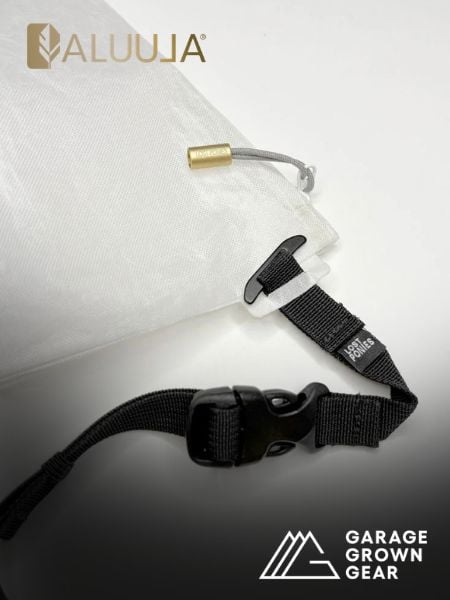
Even at 10lb or sub5kg pack weights, a hip belt works. While it may not be needed for loading, it is handy to stabilize the bottom of the pack, even if it is only a 20mm/3/4″ strap, letting your pack become integrated with your body. The distribution of any load it does pick up is an added bonus. Anyway…
You can certainly use your tent poles as stays. With the caveat that they will be straight and not curved to match your back. As was said by Sam… they can be a bit stiff.
So, it is often the case that some foam is also needed to supply padding/back conforming properties to the pack. A couple pad-keeper pockets on the outside of a pack will also let you hold a CCF pad, allowing it dual use by adding comfort and support. (Many have tried to simply use line for this, but line moves/slips, both up and sideways.) Two pockets whose depth is about 1/3 the length of the pad is really needed. The thickness of the pad is also considered, so for a 3/8″/1cm thick pad at 7 layers (roughly 178cm long) you need to add that to the pocket thickness (about 7cm or just over 2.5″.) The sleeping pad is enough padding over the stays. And, between the stays and pad, the pack panel becomes quite rigid for up to 30-35lb/15kg loads. Of course, this is only an example. A short/thicker pad can be used for even more support. Obviously not needed for 5kg loads, but pockets also solve the problem of straight stays against a curved human back.
The tent poles as supplied with many tents are not the correct length to work as stays. They often break down too short or too long to really support a pack. For example, a 48″/122cm pole is either broken in half or thirds. In half, it is too long, and, in thirds it is too short. Once you figure out what your pack needs, you can order special length poles, or, MYOG to fit. A couple 19″ pieces and a 10″ piece for example. (The 9″ piece will fit across the bottom of most packs and the 19″ piece will fit into the stay pocket.)
Now, you can simplify this system and remove any redundancy. You find that the stay keeper, sewn into the pack isn’t really necessary. The poles can be simply folded into the corners of the pad. This requires some care with selecting material for the construction of the of the pad pockets. They need to be elastic enough to accommodate the stretch needed around the poles. A 20″ limit is imposed, as the width of a standard pad, but shorter poles are now easily fitted. Some minor beefing up of the corners of the pockets to support the poles while carrying the pack might be needed. Anyway, this is more of a refinement, a piece of duct tape works well for this. Also, you no longer need a pack “back panel” sewn into the pack, nor the second layer of fabric to enclose it. Excess weight that can be removed usually accounting for some or all of the weight of the pad keeper pockets you added. The overall center of gravity might move a bit, but compared with your average body weight, a 5KG pack will not shift it enough to even notice. A 15kg pack might require a 2cm shift in your body position as you hike….barely noticeable if you are sensitive about it.
This is exactly what I do with my pack used for longer two and three week unsupported UL trips. As you can see, Hans, a shift in overall viewpoint is needed. From individual items (for example:”tent”, “tent pole”, “pack”, “sleeping pad”, “hiking staff”, etc) to an overall backpacking “system.” The integrated system uses everything you carry in different applications to make you as comfortable as possible when performing each task associated with “backpacking”: Hiking, Camping, Sleeping, etc. Dual use is a central concept behind using a backpacking system. People using Backpacking systems are usually simpler (less pieces) and lighter in total weight than non-system using backpackers. Using an item suited to the most vigorous task allows use for alternate tasks. Using a hiking staff as a tent pole will never really tax the staff, for example. But using a tent pole as a hiking staff will probably not work. You cannot use an item for two tasks at the same time. You cannot leave your tent set up and use your staff on a day hike, for example. Anyway…I am sure you follow this after this long winded puff of hot air…