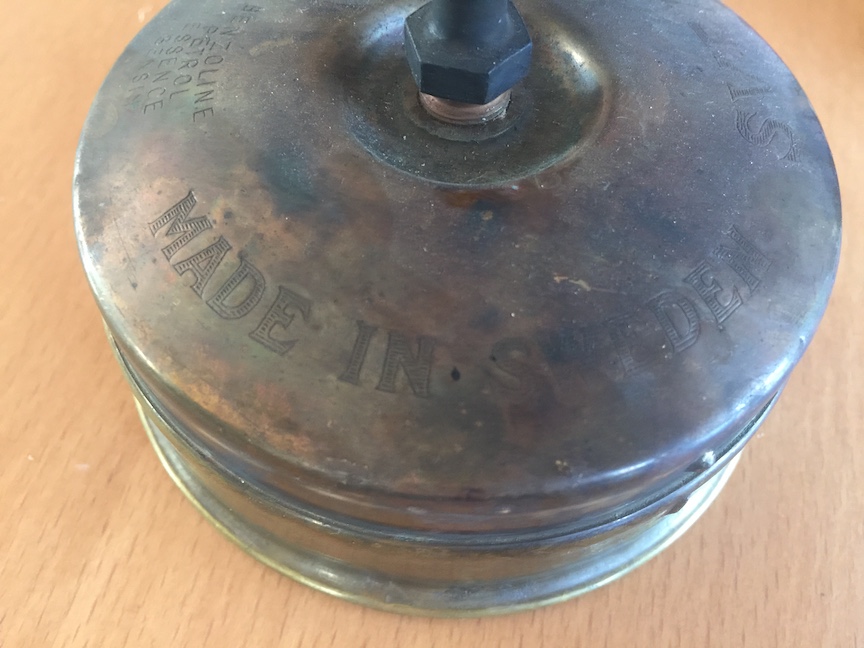
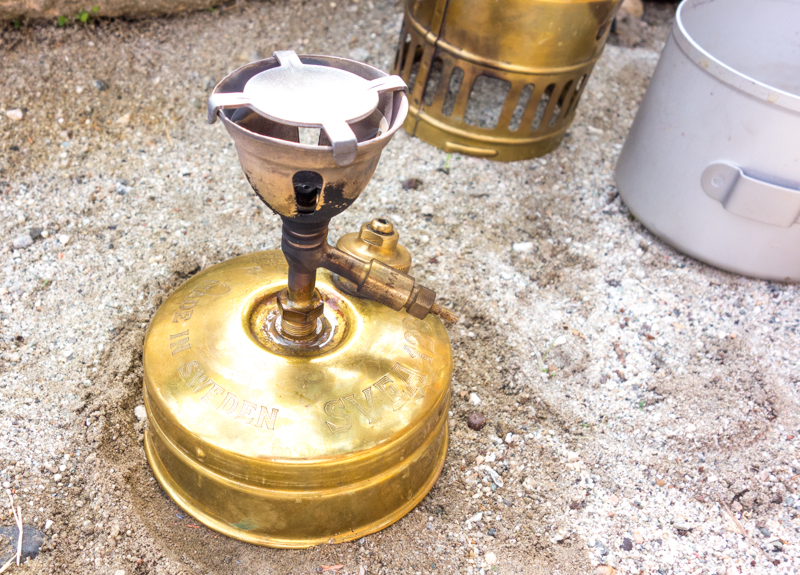
Actually, they simply changed the valve assembly on the 123 to incorporate a little needle (actuated by a complete backstroke.) At the time I got mine, I could get both models. Yes, I still have mine and use it fairly regularly. The old “Made in Sweden” logo was when the stove and parts were made in Sweden. Now days (as of about 4-5 years ago,) many of the parts are made elsewhere and only assembled in Sweden, hence the major difference. In between the two “Made in Sweden” and “Sweden” model stoves was a brief stint where the stove was made and assembled entirely in China. These were not marked and were a threatened knock-off, I think. That one was pretty much not the best to buy, since, the “brass” had a different formulation and was hastily put together (read low quality), inferior spot welds, etc…and, the aluminum cup/cap was badly made.
On part I had to change on the 123R, since the ’70s, was the valve stem. Mine was so worn, I could not turn it off. The best I could do was to simply turn it down to a very low yellow flame. And, of course, it leaked with decreasing pressure during climbs, weather fronts, etc. I kind’a miss the barometer effect (I could tell when low preasure was moving in by smelling the stove) but, it was a bit dangerous….
Valve, gas cap are the only moving parts…no pump and all those parts. I had some minor issues with the valve for many years, but when it started getting worse, I changed it. And, I lost a good measure of fuel economy. It went from around 15-16liters per four ounce tank to about 11-12. I need to carry significant more fuel (about 25%.) When I get around to it, I will see about doing an evaluation, why and correct it. However, I think the old jet was smaller. They were not worried as much about BTU ratings (at best around 6500BTU) back when. I could turn it down to Very Low and still maintain a good blue flame. The newer valve won’t do the very low even after changing the flame spreader/ flame cup.
Anyway, it will burn a lot of different fuels: Benzene, acetone, white gas and auto fuel (with alky in it.) Auto-gas can give it a problem and it clogs up, but the “R” model has a cleaning needle which you may need to use once or twice a day. Nor does it burn very fast. The additives are not real great, but are easily flushed out with tank full of a mixture of white gas and alky (about 10%, about the maximum that will dissolve into white gas.) In a pinch, it works well enough…that is to say, it works. BTW: white gas is lower order carbon chains, not “octane” itself. Usually a blend of pentane, hexane, septane…most auto fuels are mostly septane with some octane and other higher order alkanes. Older white gas actually burned better than newer white gas…soo, mixtures can change a bit.
Anyway, I think the smaller jet caused more pressure (the tank body ran a bit hotter) and utilized a more efficient combustion zone nearer to the bottom of the pot. Since I use a 1qt pot for almost all camping and normally run on low, I can likely drop the pot about 1/4-1/2″ closer, too. Anyway, the older one was about 1/4″ lower to the pot. I believe the pot stand had been hammered closer after I dropped a load of firewood on it. On the valve stem, it is possible to grind in some shallow grooves. This lets it heat up a bit more for easier priming. Also, many of the “stock” wicks are too full. You can drop several “old cotton mop” threads out of it to get a higher maximum BTU. The valve “gasket” can be replaced with finely ground pencil lead (graphite/ceramic) for slightly easier operation and *much* better control at low flames. You may need to pack this in two or three times for a good seal. (It had lasted in the old valve about 30 years or so.) The original/newer gaskets are a bit sticky.
And yes, this is still my go-to stove. I have been trying to replace it for more’n 40 years. Most of this stuff I have learned the hard way…fixing the stove in the field and/or noting some deficiencies in design and fixed when I got home. Be a bit careful about hitting the safety on the stove cap. My original old stove had a melt out safety or possibly a rusted out spring…never bothered to check it. Once you hit it, it ruined the cap it always leaked till I dropped a bit of superglue in it. Newer ones are all spring loaded and need some oil to allow them to work properly. I did replace the cap after that trip, around 40-45 years ago, with the add-on pressure pump just released. But, really, the pump only works in cold weather. In that kind of temperature, I simply hold it over the fire till it warms up. The key and chain make this a reasonable thing…check frequently…
The single most reliable, most durable stove out there. I think the antarctic Scott Expedition used a variety of this stove. The actual design is from the 1880’s I think… refinements only since. I also believe Primus was the original designer…
Good stove for two in the winter. Despite being low powered, it runs fine at -30F. Do not set it on snow!