Hi Justin
In addition to a somewhat standardised shoe sizing, there is also a standardised shoe width. Now, granted, US shoe sizes are 1/2 a size different from UK shoe sizes, and Euro shoe sizes and Japanese shoe sizes sometime use a totally different scale (millimetres I think).
Step 1: Google ‘Brannock Device’ and read up on it. Widths range from A (really narrow) through B, C, D, EE and 4E. I think New Balance even have a few shoes in 6E width.
Step 2: ask the leading outdoors shoe companies what their shoe widths are on this scale. Most of them offer a D fitting as ‘average’, and nothing else. Pity help the poor walker with a 4E width foot trying to wear a D fitting. It leads to nasty blisters, which is why i keep preaching ‘measure your foot width’.
Actually using a Brannock Device will show you that ‘shoe width’ is measured across the widest part of the foot. That solves a lot of shoe fitting problems, but not all. The next step is to look at the ‘last’ used for the shoe. New Balance used to have a really good web page about this, but I am not sure whether it is still there. The origin of the term lies in the wooden lasts or formers bootmakers used to use to shape the leather for a pair of boots. Anyhow, there are high-arch lasts, narrow-heel lasts, long pointy-toe lasts, … and so on.
For those of us with too many decades of walking with a pack, the 4E width is a common choice. Well, a common width, anyhow. Many walkers seem to have never heard of ‘shoe width’, so they just suffer. Many shoe companies don’t even publish the widths of their shoes: I had to ask them for this.
Why don’t shoe companies publicise this more? Because when you get shoes made in China these days, the factory wants an order of (say) 1,000 of each model or size. It’s expensive enough getting 6 – 8 different shoe sizes made in two colours, but having to add several width fittings in each size becomes too expensive for any but the biggest companies. And of course the common retailers only want the ‘average’ size because they have limited shelf space and want to keep their capex down.
Even Nike prefer to offer a range of colours for most of their shoes rather than a range of widths. Not that any of their ‘shoes’ would suit BPL walkers, but they are a big company. New Balance offers two or three widths in most models, sometimes in two or three colours. And 4E is a standard size for their serious footwear.
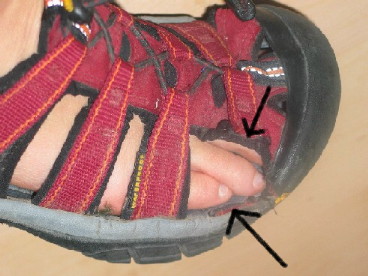
It may be that your little toes are extra splayed. That would be difficult. You could try sandals and cut off the strap that goes over the little toe. The person in this photo was nearly crippled by her narrow-fitting sandals on a long walk. She had layers of Duct tape wrapped around her feet. Eventually, in desperation, she cut that strap off (black arrows), and within a day or two her feet were recovering fine.

(photo from blog post at Backpackgeartest many years ago.)
Mind you, if you want to see REALLY BAD feet, and I mean feet which could upset your lunch, search on ‘ugly feet’ at http://www.runnersworld.com . Quote: ‘Oh, I had to pull the toenails off.’
End of sermon – for now :-)
Cheers