Topic

Sleeping: high R sleeping bag vs puffy coat/pants/summer quilt

Viewing 17 posts - 1 through 17 (of 17 total)
Russell Lawson BPL Member
PostedAug 26, 2018 at 7:14 pm

Hello,

I am looking for advice as I am gearing up to build a new sleeping quilt. My current climashield 5 oz quilt with drawstring footbox and 2.5oz jacket are great, but has lost significant R value in it’s 5th year and seem to struggle even with a bivy, when dipping below 20degrees especially, with my design flaw air leak in my footbox.


An idea I have is to salvage my quilt and make 5oz hoodie and pants with my current quilt and possibly 2.5oz insulated booties, while also purchasing more materials to create a 3oz climashield quilt. This way I can be most comfortable before bed as I cool down, while also having a quilt that doesn’t over heat me with have a closed footboard during the summer.


Is this rational? I find with multiple layers of nylon especially when mapped into armpits and crotch, as apposed to large air pockets of a bag, creates sweat build up. Could this be an undermining feature in the design. Would going with a 7 oz climashield, or even a 3 oz quilt with salvaged 5oz half bag and 5oz vest(for pit airflow) be smarter?


95% of my hikes are in the fall and winter in the PNW Olympic mountains, moisture management is the biggest comfort determining factor for multiple nights as it is hard to dry out gear in the rain forest. I am also allergic to down if that changes your suggestion.


Thank you wise backpackers, all advice is appreciated

PostedAug 26, 2018 at 7:33 pm

Interesting puzzle.

What’s your perspective on weight, cost, effort?  How do you feel about using a vapor barrier?


D M BPL Member
PostedAug 26, 2018 at 7:36 pm

I speak from a professional sewers’ viewpoint and a lightweight hiker…Why not just make a new quilt with a redesigned foot box? You could still salvage the old one into a “sleep /cooling down suit for frigid temps, but then you would have a new quilt for all your other purposes. I used snaps instead of drawstring on mine and was happier with the result. I over lapped the edges so it seals better. You need to weigh (literally and figuratively) the options and decide what is worth the effort, time and expense in your options. Personally I’d go with what takes less time sewing and is most lightweight, unless that isn’t a problem.


Jerry Adams BPL Member
PostedAug 26, 2018 at 11:44 pm

Why aren’t you considering down?  It weighs less for the same warmth.  And doesn’t lose it’s loft like synthetic.

I had a 5 oz quilt but found it not warm enough so I made a down quilt and that is much better.  I do winter in the Olympics and Cascades.

PostedAug 27, 2018 at 12:16 am

An option for the least time, effort, money:

Open up the seams of your current quilt at the foot and flip it inside out, add a layer of 2.5osy, and then fix the foot design as you close it back up

The new layer could be installed with a loose hand stitch to the existing insulation – it takes very little to stabilize.  It doesn’t have to cover the full area of the quilt – It could be considerably narrower, and possibly only extend down to mid-thigh.  This won’t lose as much total R-value as the new layer degrades as all new insulation would.  The drawback to this is you’re ending up w/ a heavier quilt.  Alternatively, you could replace all the old insulation and re-use the shell.

For the foot box, you could make a proper box with a flat panel at the bottom of your feet, but then split it up the middle w/ velcro so the quilt will still open up in warmer conditions.  Or more simply, just cork the draw string closer with a rolled up pair of socks or gloves.

Russell Lawson BPL Member
PostedAug 28, 2018 at 1:41 am

Great feedback.

I can’t use down, am allergic and always woken up with a killer headache when I’ve tried. I’ve read that 900 fill doesn’t enact as bad of a reaction, but when I was a kid I got tested for allergies and down was one of them.

I like how you guys think, money and time are not an issue because I’m nearing the end of my seasonal job. The biggest issue really is space. I live in a glorified shed and my current quilt is strapped loosely between my bed rafters. Anything I own has to be strapped to a wall.

I think I’ll be going to go with the 7 oz climashield bag, closed footbox and snaps under the legs so it can dry out maybe make a 3oz quilt next year if I see myself summer camping.

I do the plug footbox hole trick, but often don’t have much spare clothing in winter because the 5oz isn’t warm enough on its own. plus I made it a little to tight in order to save weight, adding more fill will make it harder to keep on me.

I am curious how you attach the snaps, sewn on? Do you back them with nylon webbing when using thin nylon shells?

I’ll probably use my current 5oz for summer and shoulder seasons, a loaner, or dismantle into a burly hoodie for around the house, sticking with my 2.5oz jacket while hiking.

Edward John M BPL Member
PostedAug 28, 2018 at 7:00 am

Living in a shoebox is a pain in the wardrobe.

I think after 5 years it could be time for a whole new quilt; salvaging the old one for clothing per your first post. Dual 5 ounce layers may be too heavy but using one off 3.6 plus a layer of 2.5 is reasonably warm and may be warmer if you use a decently large differential cut for the second layer and remember to use UL scrim between the layers

Russell Lawson BPL Member
PostedAug 28, 2018 at 10:00 am

Nice well rounded idea. Might hold up longer with each insulation layer not having as much loft room to compress and matt, and I can loosely hand sew it onto the scrim for stability.

Is silk 5 momme a good scrim choice? It’s rather cheap and may add some heat retention value. silk+3.6+2.5 would knock .5oz off per yard compared to 7.5oz climashield, but 7.5oz has a .3inch loft advantage, seeing that 3.6+2.5=1.5″ and 7.5oz is 1.8″ from a hammockforum’s specs.

Also at ripstopbytheroll climashield is on sale, 2.5+3.6 is a dollar cheaper than 7.5oz, would be 8 dollars more if not on sale. Stars aligning.

That’s why I come here, and pay subscription. Thanks fellas!

Edward John M BPL Member
PostedAug 28, 2018 at 10:02 pm

Best scrim I have found is the UL non-woven polypropylene stuff but UL No-See-Em mesh also works and the mesh adds some loft if used with a differential cut and synthetic shells should be differentially cut


Lester Moore BPL Member
PostedAug 28, 2018 at 10:59 pm

I am curious how you attach the snaps, sewn on? Do you back them with nylon webbing when using thin nylon shells?

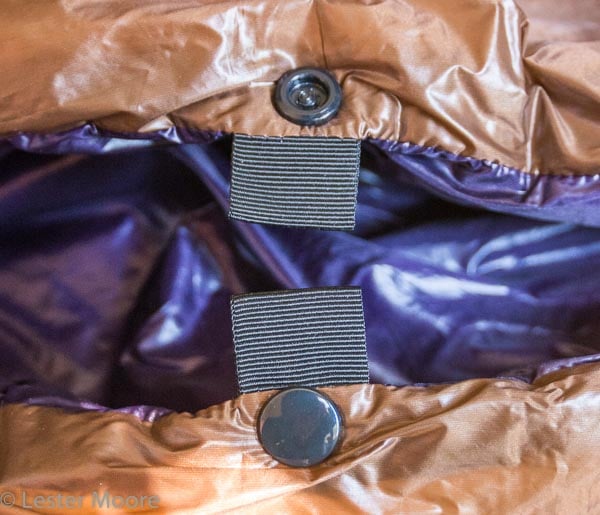
I used 3/4″ nylon grosgrain ribbon as reinforcement. A 2 1/2 piece of ribbon is folded in half (becomes 1 1/4″ long after folding) and the open half is sewn into the seam while the loop end is exposed and visible. After sewing, about 5/8″ of folded ribbon is hidden in the seam and about 5/8″ is exposed to facilitate snapping and un-snapping by your fingers. The KAM snap is placed through the outer quilt fabric, through the folded hidden ribbon and through the quilt inside lining. EE uses a similar reinforcement for their quilts. Here’s a photo showing both the male and female snap that it pairs with:

Lester Moore BPL Member
PostedAug 28, 2018 at 11:10 pm

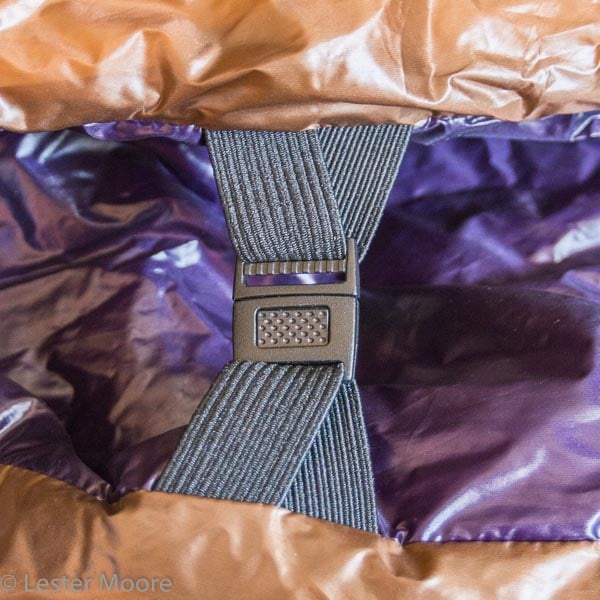
Forgot to mention: for the top-most foot box closure point (the one closest to your head) I use a small front-release buckle attached to 3/4″ elastic. Since the top-most closure it subject to lots of strain, the elastic stretches to help guard against high stress at this point. The V pattern of the elastic also distributes the force over a larger area of the seams. Additionally, the buckle releases on its own under enough pressure, further guarding against a ripped seam.

PostedAug 29, 2018 at 2:51 am

What’s the purpose of scrim with multiple layers of synthetic insulation?

And just to be clear – how are you defining ‘scrim’?

Edward John M BPL Member
PostedAug 30, 2018 at 5:26 am

Scrim in these terms is a very light weight open weave cloth or fabric but PolyPro nonwoven is both lighter and cheaper. Coarsely woven not coarse fibres. Think mosquito net on a diet

It acts to keep the layers from sticking to each other and when using the required differential sizing it also helps to preserve the differential. I got this information directly from Climashield and they did say that while people layer without using scrim it is recommended that scrim be used, especially if using two different fibres in the lay-up as Patagonia did with the older models of DAS parka

PostedAug 30, 2018 at 5:44 pm

Interesting. About what I thought for the material, but I wasn’t aware of the purpose.  I suppose with out it, the layers will stick in the wrong position.  I wonder if there’s any way to control that, so it sticks in a way that preserves the differential and then you wouldn’t need the scrim.  Maybe if you press the layers together and rub in a circle to entangle the fibers. Less complexity, more effort.

Edward John M BPL Member
PostedAug 30, 2018 at 11:20 pm

You don’t want the fibres to entangle tho. You want to maximise the separation to maximise free loft. I have an experimental overquilt being laid up at the moment, the UL polypro scrim I have laid out weighs so little it is hard to weigh on my cheap kitchen scales, I have to put it in a small plastic tub to weigh it. 3000mm * 2400mm in total weighs about 20 grams These are 20kg scales so accuracy is +/- 10 grams the same accuracy as my luggage scales.

You find it in sewing shops that have quilting supplies, it comes in various weights from ethereal to substantial. This reminds me; may decades ago I had a huge heavy parka from REI, it was double layer stitched through construction, it used cotton cheesecloth as the scrim layer; it really was heavy but people climbed Everest wearing them

Viewing 17 posts - 1 through 17 (of 17 total)
Loading...