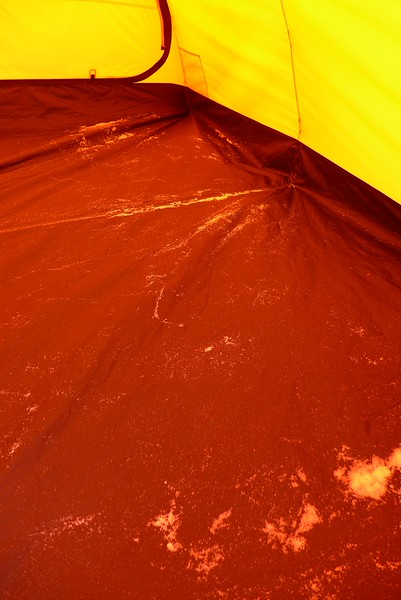
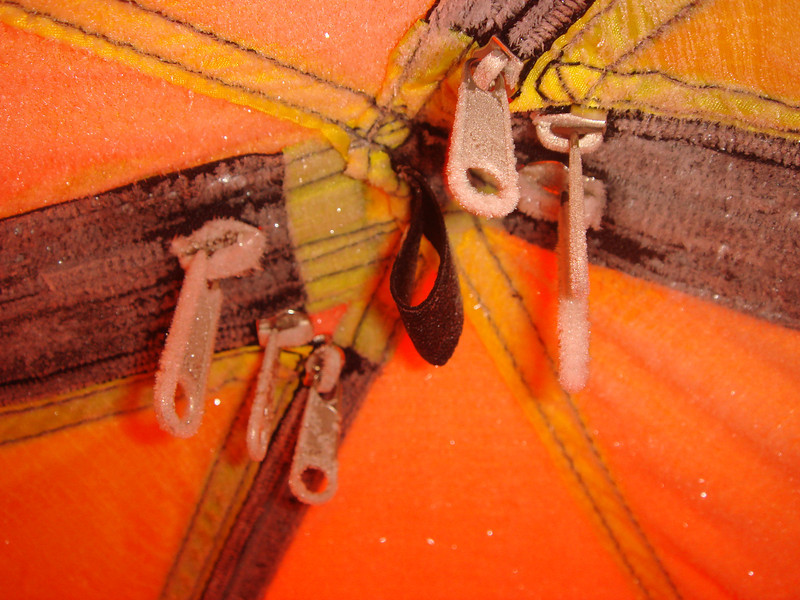
Basically, you need a higher tent wall to prevent touching it. I have the old Dyad 2 that condenses a LOT at cold temps, but this is also due to the size. Even with the extra length, everything gets a bit damp. But, the extra length also keeps my feet from touching the sidewalls. It doesn’t seem to help a lot though. The small Dyad (not much more than a glorified bivy) just condenses. It is not a cold weather tent. The humidity inside reaches the dew point and condenses all over, including my bag… Not much you can do except 1) Raise the tent off your feet, or, lower your sleeping pad 2) avoid touching the walls with your bag (You knew that) 3) Increase the internal volume to mitigate overall condensation 4) Cover the foot end of the bag 5) Increase overall ventilation.
I do not believe Gortex will help that much. Gortex will pass water vapor but not water. Condensation will still drip down from above, wetting the shell/down.
Raising the Tent:
Often, you can find a small concave area to set up in. While this can trap water from rain, it also has the effect of raising the tent a bit. In cold weather, water is of no big concern, it is snow. This is also against best site selection practice. You can also use a rock under each pole to lift the whole tent up a couple inches. (This also improves ventilation.) I am surprised you have trouble with the Jannu, though. This is a double walled tent that usually keeps the inner/people from touching the outer and commensurate condensation. When using the Duomid, often a 6″ cord on each loop is enough to raise the tent a bit. But, this also leaves a short gap under the edges. Anyway, changing setup location (and/or using a bit of guyline) is perhaps the cheapest option.
Lowering the sleeping pad:
Slightly more expensive, you can switch to a short inflatable and a short CCF pad under your feet. This will give you another inch or two above your feet. This may or may not be a good option for you. In some cases, I have tried a pad UNDER my tent allowing the tent to be raised slightly. It works OK if you also carry a CCF pad for directly under you. But in very cold weather (like -20F or -7C) this may not be an option because of the need for better ground insulation. But, it easy enough to raise the tent, slip your pad under it resulting in a couple inches (5-6CM) more foot room. A reflective IR sheet (emergency blanket) will help, but may already be present in a full Neoair. Two does not help more than one.
Covering your feet:
This will work in most conditions. Sometimes, it may make things worse. The majority of condensation will occur at the first cold/warm interface between them. So moist humid air will condense on the inside also. In cold weather, do NOT expect it to evaporate. Fleece might work better in warmer conditions or if your rain jacket is already wet from the day. Again, depending on temp/humidity, fleece may soak through distributing water along a greater area of the foot end of the bag making things worse.
Increasing the Internal Volume of the Tent:
This is just something that will help. Often, increasing the internal volume is a simple matter of raising the tent. Other times, you will need a larger tent. A larger volume of tent air will allow more humidity in the air without increasing the amount of associated condensation. This means changing the tent, usually, and is the most expensive option. But, you may find that you need a somewhat larger tent anyway. A dome allows the greatest amount of area for the least amount of fabric. This can also be a detriment by concentrating the condensation in the smallest amount of surface area… With a double walled tent, no one usually notices this effect. But, with small solo tents, it is pretty obvious.
Increase overall ventilation:
This has been touched on, but often you can do things that will help ventilation a lot. Raising the tent will help. Increase the size of the vents. Make sure to maximize a natural flow: in is low, out is high. Add a smaller candle lantern to the peak vent. Leave the door(s) open. Open all screening on the vents. Set the tent up in an open area. Some practices may be conflicting, like open doors in a rainstorm, or, setting up in a wind swept area at -10C, but thinking about it should allow better campsite selections, sometimes.