Topic

MLD Duomid Condensation

Viewing 19 posts - 1 through 19 (of 19 total)
Austin D BPL Member
PostedMar 9, 2016 at 3:45 pm

Hey guys,

I got a used Duomid middle of last year and living in Los Angeles I’ve never had to use it in heavy rain until last weekend. I was on a trip with a friend of mine and we knew it was supposed to rain but didn’t think it would end up dumping a mix of rain, slush, and ice for 12 hours straight with 50mph gusts of wind. (not kidding, it rained nonstop from 8pm to 8am and you could hear the wind ripping through the canyon for a good minute before it came through camp)

Needless to say the Duomid held up really well. Except.. I had a ton of condensation. It was practically drizzling inside. There was so much water on the inside that if my head barely brushed against the fabric it got soaking wet. I was curious if this is normal with the duomid in that bad of weather or if there might be another issue going on. Bad Seam sealing and its running down from the top maybe? It was used so I wasn’t the one to do the seam sealing. Is there a way to remove seam sealer to re apply it?

The other thing; If you’re looking at getting a duomid and live in an area with a lot of rain and potentially wind. I’d recommend going for the Cuben as the fabric stretch with the Sil is really quite bad. It was so heavy with rain that it was not tightly pitched at all, and it was actually sagging towards the middle. Maybe it was user error though. Please let me know!

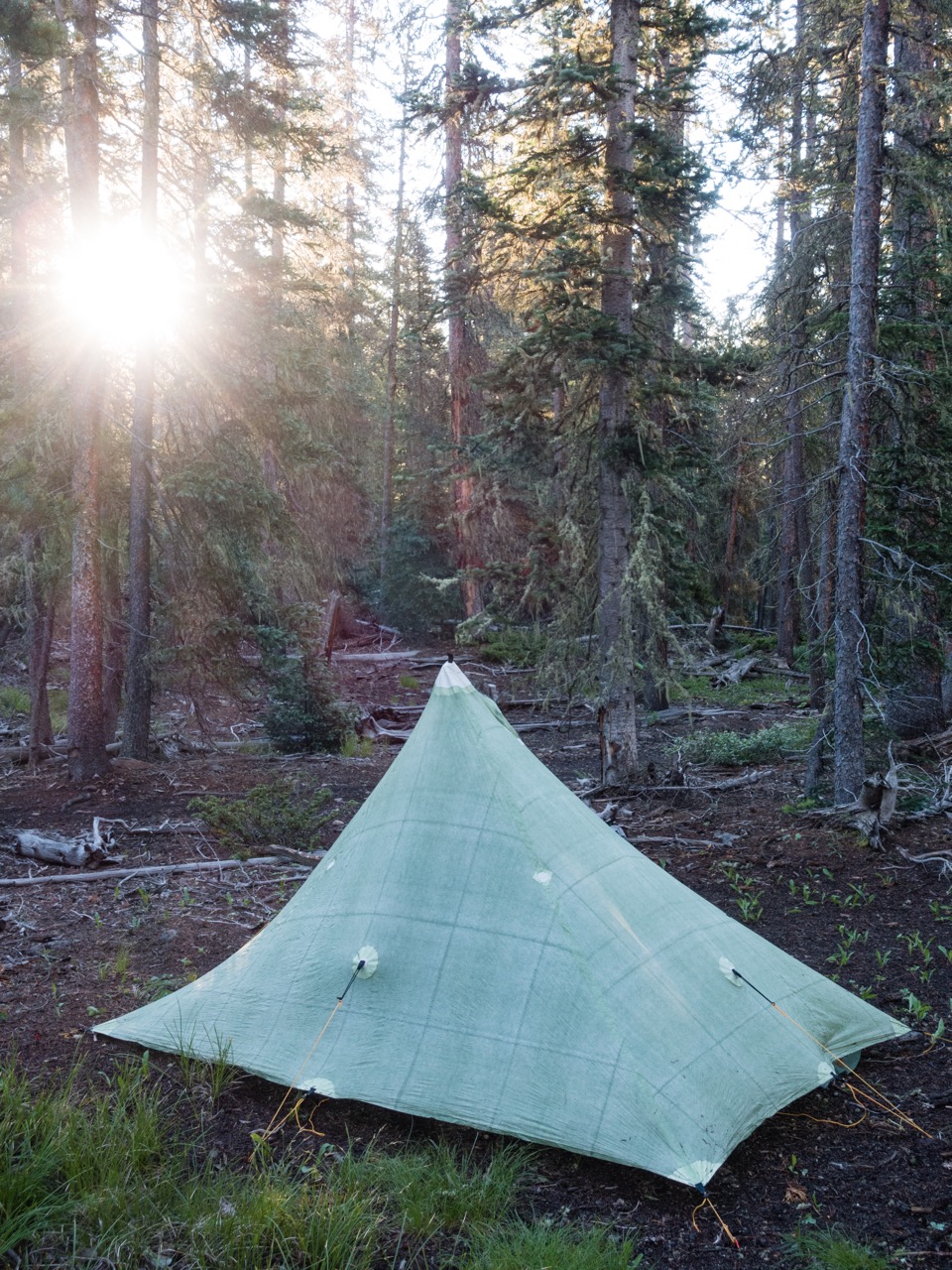
Heres a picture of my pitch for the night:
 photo DSC06830.jpg

Thanks everyone,

Paul S. BPL Member
PostedMar 9, 2016 at 4:10 pm

That is a very low pitch for just rain, unless it was blowing sideways. If you can pitch the bottom a few inches higher you’ll get a lot more ventilation and less condensation.

Austin D BPL Member
PostedMar 9, 2016 at 4:18 pm

Yeah, there was heavy wind and the rain was coming in at an angle against the back wall.
Any higher and I think we would have been wet. I actually had to take our backpacks half way through the night and push them against the back wall to keep the wind from coming through as I was getting misted with water. And I was worried it would create a lot of lift under the tent.

James holden BPL Member
PostedMar 9, 2016 at 4:55 pm

Using the additional guy points and readjusting them would have reduced the sagging

the condensation in the conditions you describe are to a large degree unavoidable …

  • constant non stop rain
  • blowing wind so unless u drop the tarp it comes under it
  • soaked slushy ground

you can mitigate it somewhat by facing the door away from thr wind and cracking it open

a doubled wall tent will also have less condensation on the inner than a single walled

also a full size ground sheet will mitigate the condensation coming from the ground

while high winds arent normal for the PNW non stop rain for days is, and anyone out in those conditions knows how to manage condensation … You will get it, you just need to deal with it smartly

;)

Austin D BPL Member
PostedMar 9, 2016 at 5:05 pm

Thank you for the helpful feedback!!

For the guylines, I noticed there is a lower and an upper tie out. Is there a proper way to use these? I have had a hard time finding a guide on when and how to use these guyline anchors. Currently I have an adjustable slip knot on all 8 lower anchors but nothing attached to the 3 upper anchors.

We thought we had the door facing away, but were in a canyon and the wind seemed to make a giant spiral in our campground. We were using a full size ground sheet as well. It seems like it was just the absolute best conditions to create a ton of discomforting condensation. haha

How would you prepare for these conditions? It seems like I have a lot of learning to do when it comes to wet conditions. I guess its a good think I live in CA haha

Alex Wallace BPL Member
PostedMar 9, 2016 at 5:31 pm

Yes, with the conditions you’ve described heavy condensation in any shelter is going to be bad. Especially bad in an enclosed tarp over soggy ground.

The seams are probably fine, but you can test them to confirm. Just pitch the shelter on a warm sunny California day and blast the seams on the outside with a garden hose. If you see drips or wicking then you’ll need to re-seal it.

Sounds like there were two of you using the DuoMid, correct? That’s a pretty tight fit even under good conditions. With wind, rain, and heavy condensation I’d want a much bigger space for two.

Additional guylines would have definitely helped, but you can also just raise the center pole a bit to tighten everything up again. If you’ve run out of pole to raise, just stack rocks, wood, etc. to give you a bit of height.

Sounds like a fun night.

Austin D BPL Member
PostedMar 9, 2016 at 6:17 pm

Yeah thats understandable given the conditions. Ill have to check the seams just to be safe.

correct, it was two of us. But we actually had plenty of room. No complaints on the space but I could definitely see how two bodies in a small enclosed shelter could generate a lot of condensation alone.

I would keep raising the pole but there was so much water weight it was sagging bad regardless of how tight I tried to pull it. To the point that when I packed it away in the stuff sack I strained all the water out and it was still a good quarter/half pound heavier just from water weight.

As far as the upper guyline anchors go, is there a guide out there to show exactly how to set them up? The person I bought it from had one guy line connected from the bottom to the top anchor. It just seemed off to me. So I tied it just to the bottom and left the top unused.

Bruce Tolley BPL Member
PostedMar 9, 2016 at 6:27 pm

From the photo, it looks like it is pitched over grass, a meadow?  I know when I practice with new gear in my back yard, a lot of water evaporates from the grass over night and condenses inside the tarp. But above you state that you used a full size ground sheet so that theory does not hold much water. :-))


PostedMar 9, 2016 at 6:43 pm

How important is the shock cord on those mid-panel tieout points?

James holden BPL Member
PostedMar 9, 2016 at 7:40 pm

your best bet is to ask RON at MLD about the tie outs … but i believe theyve stated in the past to use shockcord to insure that most of the load is on the main guylines, not the secondary ones

personally on my tents and tarps the main guy points are all cord, and the secondary ones are shockcorded

use easily adjustable guylines on all the points (line locs, blakes hitch, etc) with properly sized cord that doesnt slip … so you can easily adjust it without fumbling with tying knots in the freezing rain

also adjusting the pole under very windy conditions might not be best idea as under high wind loading it might collapse and you may not be able to get it back taught …

as to tips to keep manage moisture in the rain?

Lets go through the root causes and techniques to mitigate em

Leaking seams/ misting fabric (low HH)

  • seal seal/tape
  • recoat with sil mix
  • groundsheet under tent floor (for seeping low HH floors)

Windblown rain combing through floor gap

  • slamming the fly to the ground
  • solid inner (DWR needs to be good)
  • high bathtub floor
  • setup a break outside the tent on the windward side (packs, small tarp, etc …)
  • groundsheet can be made larger than normal and when needed you can fold it to give additional protection inside the tarp on the windward edges
  • bivy (has serious condensation issues)

Condensation from ground

  • site selection (not always possible)
  • full sizes groundsheet

Running water (ground turns into a small river)

  • site selection (not always possible)
  • bathtub floor

Rain coming through doors/vestibule

  • get a tent/tarp where the door doesnt overlap with the inner/sleeping space
  • hand a secondary tarp above the door

Condensation from people inside the tent

  • ventilation
  • inner tent (prevents condensation from transferring to you)

Condensation being knocked off by the large rain drops or wind hitting the outer 

  • bivy (has serious condensation issues)
  • solid inner (DWR needs to be good)

Techniques for preventing getting your down wet from condensation (external and internal) and spray

  • use a synthetic bag/quilt (standalone or overbag)
  • put a your fleece or and synthetic poofayz over your bag/quilt, especially the footbox
  • put your rain/wind jacket over the quilt, if possible put them over the fleece/synth jackets
  • bring a light fleece blanket to put over the sleeping bag/quilt, not UL but cheap and you can use it as a towel latter
  • use a bedsheet over yr quilt/bag, prevents internal condensation and some external, doesnt prevent spray much, microfiber works best but even cotton will work in a pinch if yr smart about it
  • use a HAWT nalgene to push out the moisture
  • candle, obvious fire and breathing risks (vent properly)
  • full or partial VBL
  • if you leave your bag for hours in the tent, keep it covered

as to wind direction … sometimes when behind a hill/mountain the direction can become unpredictable

;)

PostedMar 9, 2016 at 8:24 pm

just out of curiosity where were you camping?  We got about 4″ in the mountains above Santa Barbara this weekend, sounds like you got even more where you were.

Matthew / BPL Moderator
PostedMar 10, 2016 at 6:46 am

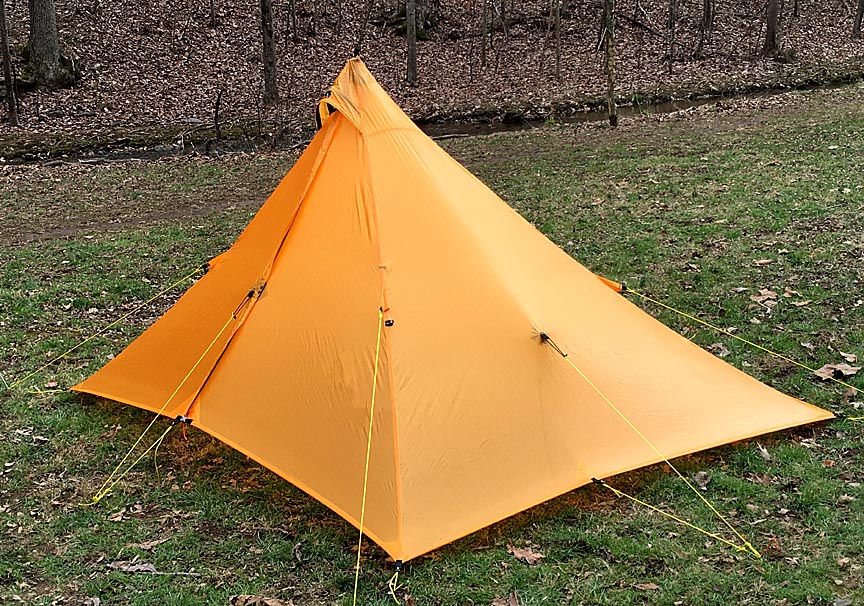
I would think that some tension on the guyouts on the middle bottom of each base edge would give you that nice eyebrow peak seen on the photo of the yellow mid above. You should be able to do that on least two sides even in weird shifting wind rather than pitching all four edges to the ground.

I don’t have experience with a mid but I know you have to have ventilation in a single wall tent. It’s really not an option to have it totally sealed or you are going to end up with condensation.

PostedMar 10, 2016 at 6:54 am

i tried to see if I have a good picture of my mid-panel tie outs, but I don’t.  This is the best I’ve got…

I use a single long piece of guy line to run through both the upper and the lower mid-points – it pulls out like a triangle and works really well to keep the mid-panels nice and taut.


Austin D BPL Member
PostedMar 10, 2016 at 12:09 pm

Matt –– We were in the Angeles Forest close to Mount Wilson. It was pretty crazy weather there, not so sure about SB though.

Matthew –– The issue with having the tent lifted was the draft that ran through the tent was carrying water. Again, it was bad enough that even flush to the ground I had to stuff our packs along the edge because we were getting wet from the mist. When we woke up in the morning the edge of our packs facing outside were soaked.

Jennifer –– My mid was setup that way when I first got it, but when I tried to pull it tight it would only pull the bottom and the top would get all of the slack. Maybe I just didn’t have my stakes far enough from the tent. Thanks for the picture!! I’ll definitely have to do some experimenting with it.

James holden BPL Member
PostedMar 10, 2016 at 1:23 pm

your best bet is actually to go ask them brits … outdoorsmagic, trek lite, ukclimbing forums …. or read the brit blogs

those limeys deal with those conditions every shoulder season … to them 50 mph gusts and all day rain is served daily with their guinness,scotch and haggis

youll often notice that the brit blogs REALLY go out and test a tent … things like “the pole collapsed and i couldnt re-extended it in gale force winds”, “the hilleberg leaked and the shape deformed in a storm, bag got soaked”, “i tore the fcuckang end off the duplex corner in high winds”, etc … yes all these actually happened

some blogs on this side of the pond seem more concerned with doing a “review” by putting up the tent in their backyard, and perhaps taking it out a few times in pleasant conditions

if you want to know how a tent REALLY performs in “extreme” conditions … ask the brits

;)

PostedMar 10, 2016 at 3:47 pm

Austin, mine does that too, but then all you have to do is adjust the line – after you pull it all the way out and stake it down, then pull the line from the stake towards whichever way it needs to go to adjust the tension.  That will slacken one part and tighten the other one…works like a champ!


PostedMar 11, 2016 at 4:00 pm

Or add a hitch clove to the guyline around your stake. that way you can have a different tension on either side of the guyline.

Viewing 19 posts - 1 through 19 (of 19 total)
Loading...