Topic

Separate post asking for deep stream crossing boot drying advice

Viewing 4 posts - 26 through 29 (of 29 total)
PostedMay 17, 2021 at 11:05 pm

From these related threads, it sounds like a first priority is finding light primary hiking footwear that fits and works best in the terrain where you trek.  That’s also what I concluded, trekking in the north country of New England and northern Colorado.  Do not need someone to sell me on some other primary footwear, when it took years to find what I have that works.

Having decided on the above, what about the OP’s water crossing issues?  As these threads attest, grievous injury can result from something that is too thin over sharper rocks, or too slippery (even with at least one trek pole of course).  Especially if the current is much stronger than apparent.

Wanted to have something to resort to, so looked for a thick closed cell foam sole, plenty of grip to keep the foot in the shoe, and plenty of protection for the feet.    Came up with these (Ignore the cheap plastic ones on the bottom left):
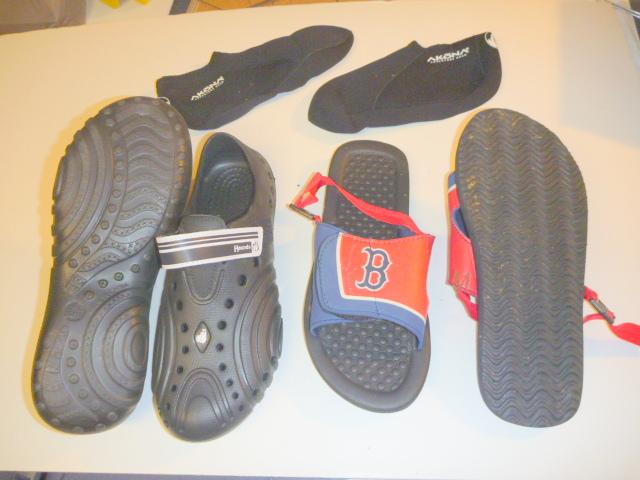
The ones on the right were the thickest and lightest I could find in Walmart, so added the straps to eliminate any flip-flop.  Then added some anklet dive sox to add protection and insulation for the feet (shown at top).

These are strictly for crossings (carrying two 25-30 lb. dogs one at a time – so one crossing for each dog, and 5 for me including the extra trip for the pack (These were spring runout conditions, and the stream bottom was very rocky – at the base of Long Mountain, in the Phillips Brook reserve in northern NH).  With a dog under one arm and holding the pole with the other arm, and the stream bottom moving underfoot.

I think these worked because the thick foam soles conformed somewhat to the creek bottom.   So enjoyed a long, and dry, day of trekking.  Weight for the whole deal is 8.42 oz for the pair, anklets, and a thin stuff sack that fits perfectly.

A few points: 1) Would it be worth the extra weight if there were no dogs along (but forget about sun drying in runout – it is water world); 2) We had to do it all over again on the trip back; and 3) What to wear for comfort at camp sites.   Still, I keep these around just in case a similar situation comes up and the extra half pound seems better than sloshing across in whatever you call your hiking boots.

P.S.  The ‘are you a human’ test when posting is an incredibly bad idea.  Don’t forget, I am paying for the privilege of posting on this forum, not trying to cadge a Covid shot.

Jacob BPL Member
PostedMay 18, 2021 at 1:30 pm

This might be stupid, I don’t have experience with it.

Why not consider adding ‘jungle boot’ water drainage holes to the medial instep of your preferred salomons?


Pictures of Altima and Belleville jungle boots.

Sure they’ll let water in, but you’re using mids for the ankle support anyways.

https://en.wikipedia.org/wiki/Jungle_boot and the first citation from that page http://www.junglesnafus.com/

Placed adjacent to the arch of your foot, holes along the medial instep should allow the motion of your foot to pump water out of the boot. I think a hot nail would do the trick with your salomon quest 4d.

If you try this I would be excited to hear if it actually works!


PostedMay 19, 2021 at 8:07 pm

I appreciate all the input on this thread & the thread on chairs & camp shoes.  I picked up a pair of swim shoes like many referenced to try on this trip.  Wasn’t looking to add 6.8 oz (size 10.5-11.5) to my kit but since I’ll be keeping my current gore-Tex boots for now it’s among the more responsible solutions.  Thanks everyone.

Ross Bleakney BPL Member
PostedMay 24, 2021 at 1:29 pm

Bring lots of socks and/or small thin camp towels (for example, these).

As Jerry recommended, take your socks and inserts off when you cross. Empty out all of the water. Put on the socks and walk around in the shoes. The socks will get saturated. Stop, squeeze as much water out as you can. Repeat a couple times. Now put in dry socks. If those get damp, do it again. Three pairs of socks (altogether) ought to do it. If it is nice out, the wet socks will dry out along the way.

Synthetic socks dry quicker. I’ve thought about making socks from towels, since it dries quickly (and is easy to wring out). I could see wrapping your feet in that sort of material as a middle step (after pouring all the water out, but not wearing socks). Again, you want to do the same process. One “wet” towel that you keep wringing out, and finally one dry one at the very end, when you can’t wring any more out of the towel.

This sort of process works in general for wet shoes. Trail runners through damp brush, for example. Yeah, it helps if you have gators, but if there is ventilation in the shoe, water will get in. This is a good way to dry them out.


Viewing 4 posts - 26 through 29 (of 29 total)
Loading...