Topic

Self-Inflating Mats & Minimum Thickness

Viewing 25 posts - 1 through 25 (of 31 total)
Andrew I BPL Member
PostedAug 7, 2026 at 4:25 am

Hopefully a simple question:

Is there any reason that the thinnest self-inflating mat (at least that I’m aware of) is 25mm (~1 inch) thick?   Many, perhaps most, serious trekking types mix inflatable mats with CCF.  CCF (unless 3mm thick) can add substantial additional comfort and warmth.

As such, it’s quite possible that just as one person might want a thick inflatable (SI or not) to go with a thin CCF, another person might want a thin inflatable to go with a thicker CCF.  AFAIK the lightest SI mat was the now discontinued Nordisk Ven 2.5 (might be wrong), yet it was, like many others, 25mm thick.

Is there some universal limit that I’m unaware of, like the speed of light.  You can’t go lower than 25mm or else …  Or is this simply because no one wanted to make a mat that required another mat, even though almost all air-filled mats do to some degree.  Put another way:  do the manufacturers like to pretend to themselves that their products are a discrete solution?

Any thoughts and help much appreciated.

Andy
Jerry Adams BPL Member
PostedAug 7, 2026 at 6:43 am

yeah

maybe 1 inch is the thinnest just because that’s what others do

but if you have the weight of the top and bottom fabric, then adding a little more self inflation foam in between won’t make that much difference.  Maybe 1 inch is a good thickness.

for years I’ve felt that one inch self inflating foam is comfortable enough.  Thinner CCF by itself is not.  so 1 inch seems to be a good solution

thermarest quit making a lightweight 1 inch foam pad and has a 2 inch pad instead.  I think that’s more comfortable.   Maybe this is a better solution.

Another thing would be to have a 36 inch long pad to save weight.  Under my head I can just have a thicker pillow.  Maybe CCF under my legs and feet for warmth if needed.  But I haven’t seen any 36inch self inflating pads.

I have a 1 inch pad that has a slow leak so I don’t use it.  I could cut it down to 36 inches to experiment.

Bob Shuff BPL Member
PostedAug 7, 2026 at 9:16 am

Thermarest still makes their scout 1” x 72” x 20” self inflating pad at 1 lb 8 oz.   REI has the kindercamp or trailmade short both 1.5” x 60” x 20” at 1 lb 13-15 oz. REI also has the Air Rail Short at 1x26x66 at 1 lb 9 oz.  I talk to folks every day that are looking for the new improved self inflating pad to replace their 20 year old Thermarest.

TBH I tell them I use a 3” plus inflatable that is warmer, lighter, wider, packs smaller and is more comfortable, such as is offered by Thermarest, Nemo, Exped to name a few popular options.  I often pair this with a 1/8” CCF pad that I believe is 60”?


I think I get more comfort with less weight than anything self inflating (or thicker CCF). Some can sleep with just a CCF and all the power to them. I saw Glen Van Peski use a small cut piece of 1/8” CCF under his shoulder (or was it hip?).

I want more comfort than that so HYOH. I just don’t see getting a lighter and more packable solution what I have by adding more foam inside or out.

Jerry Adams BPL Member
PostedAug 7, 2026 at 11:35 am

trailpro lite is 72 x 20 x 2 inches, 1 lb 8 ounces – I got that, pretty comfy


Andrew I BPL Member
PostedAug 7, 2026 at 3:32 pm

Yes, but these weights are ridiculously heavy.  The Ven 2.5 was under 300g (w/o stuff sack etc ..), just under 10oz for you Americans and 120cm long (47″).  I don’t understand why people need such long mats.  The area of concern is the torso to upper thigh (max).  Comfort is needed for shoulders, back and hips.  My head is supported with something else and my pack goes under my lower legs (a pretty standard approach for backpacking Light).

The reason for the question, was after a chat with Scramble’s editor where he was saying their ideal mat would be 2cm (0.79″) thick and 50 x 110 and would weigh around or less than 250g (8.8 oz). They would have it sandwiched between two Multimat Superlite 8 CCF mats (8mm) that were cut to 130cm long.

Total weight = ~  470g.  Est. R-Value (whatever that means in the field) would be ~ 5 (with enough foam in the mix for redundancy in case of failure).

They’d like another SI mat 30mm thick perhaps 55cm wide and 110cm long for low sub zero use and do the same sandwich (est. R-value = ~6, and +100g heavier, +3.5oz).  But the entire industry is focused on long air beds and no one is innovating when it comes to SI mats which is presumably what they meant by the mal-incentive of chasing the current R-value test.

That’s what got me thinking about why no one pushed the envelope and went below 25mm / 1 inch.  I do get your point about much of the weight being in the upper/lower fabrics + valve.  But we know foam still weighs enough otherwise manufacturers wouldn’t core it.

Andy

Jerry Adams BPL Member
PostedAug 7, 2026 at 7:12 pm

Just my opinion, manufacturers just aren’t into that type of optimization.  They don’t want to have to set up manufacturing and distribution for more models.  Easier to just stick with 1 inch thick and 72 inches long.

You wouldn’t save very much weight going from 1 inch to 0.79 inch.  If you went from 72 inches long to 36 inches long it would save 1/2 of the weight so that would be better.

Andrew I BPL Member
PostedAug 7, 2026 at 9:57 pm

I think 36″ would be pushing it – but I realise you chose half length to illustrate a point.  I guess my view is that if I was a manufacturer and wanted to create a genuine ultralight self inflating mat for a hardcore minority (and one might be surprised how many takers you might have) I’d do both, I’d trim the depth and the length (20 x 40 x 0.8″, 50 x 110 x 2cm) and I’d market it as a mat designed to pair with CCF mats and to provide additional comfort and warmth where needed.

The problem in my view, which was pointed out in the other thread  is that the current ASTM test is creating a skewed picture of the efficacy of “air-beds” and so many manufacturers are walking away from the SI model, because it doesn’t score well in their limited testing protocol.  I like the term Matt used “intrinsic R-value”.  They score a high intrinsic R-value which doesn’t necessarily carry over into the field.

UK old time reviewer and experienced trekker Chris Townsend is not alone in the move away from the thick inflatable air-mats.

Appreciate the level-headed feedback Jerry as always.

Andy

Bob Shuff BPL Member
PostedAug 7, 2026 at 10:56 pm

I recall others suggesting CCF vendors that catered mainly to commercial customers, and there was supposedly a big variance in durability. Still you can at least cut the foam to your preferred size.  Exped is supposedly coming out with a thicker 2.8R CCF egg crate pad, that will be about 15.5 oz

Bob Shuff BPL Member
PostedAug 7, 2026 at 11:06 pm

As for a thinner self inflating pad, I think it will be a very small market, as the trend at retail is definitely to the thicker self inflating or inflatable pads.  The trail pro is more popular than the trail scout and the megamat outsells both. Some still look for the lighter xlite or tensor, but more are looking at the 3.5” and thicker inflatables.  Those that prioritize weight over comfort get the Zrest or nemo switchback.

I’m all ears to hear about an innovative cottage vendor option.

Andrew I BPL Member
PostedAug 7, 2026 at 11:28 pm

As for a thinner self inflating pad, I think it will be a very small market, as the trend at retail is definitely to the thicker self inflating or inflatable pads.

Yes, well it’s hard to buy what isn’t made.  I’m not sure buyers drive the market.  That’s why companies have marketing departments, to (inorganically) develop markets.  People buy what’s promoted as a solution, until they lose faith in that solution.  In the sleeping mat sector more than any other I’ve seen in “outdoor world”, the gap between promise and reality is quite significant.

Were you referring to the Exped Flexmat 3R CCF, if so, that’s one of the mats Scramble are looking at. From what I’ve heard, pretty comfortable:
Exped Flexmat 3R XS (123 x 52 x 3.1cm) – 300g (10.58 oz) measured, 2.8 R-Value.

If someone made the 2cm thick SI mat I outlined above and paired it with the Exped. It would likely have a stated combined R-value of ~4.8.  I bet, in the real world, it would sleep a hell of lot warmer than it’s R-value would suggest.

Cheers,

Andy

Alex H BPL Member
PostedAug 8, 2026 at 5:40 am

Been using a 1″ thick Thermarest Prolite 36″ on top of a CCF pad for nearly twenty years. R of about 5, a little heavier than an air pad but much more reliable, easier to deploy and very comfortable.  You can still by 1″ mats from a few places I believe and if you want it shorter you can cut it down yourself easily enough.  Here is the piece I wrote about pads some years ago.

Jerry Adams BPL Member
PostedAug 8, 2026 at 7:21 am

Good subject to bring up Andrew.

One could make a 48 inch pad which would save 1/3 which would satisfy my desire to have even numbers :)

Alex, I just hate the idea of risking destruction of a pad to make it shorter, although I’ve seen youtube video of someone doing it and it seems straightforward.  I have a 1 inch pad with a slow leak, I think it lasts one night.  Maybe have to reinflate it once during the night.  I could shorten it.  Too bad someone doesn’t make such a pad.

bradmacmt BPL Member
PostedAug 8, 2026 at 7:50 am

I too wish a mfg would turn its collective brain trust to building a high quality, lightweight, self inflator. I would argue the high water mark of weight/r-value in a self inflator would be the circa 2012 Thermarest Prolites. I had a 47″ model and still have a 72″ model.

I think in practice the 2.2 R value is higher than its listed value, just as all thick pads R values are lower than listed. The testing doesn’t take into account heat loss and cold penetration in the sides. The taller the pad, the greater the possibility of heat loss/cold penetration (of course internal construction design can influence the amount). In general, a 1″ pad looses less heat/allows less cold than a 3″ pad.

Personally, I find the vertical pad race a bit absurd. I wish they’d stopped at 2.5 or no more than 3.” I’m 65 yo and can still sleep on a Nemo Switchback no problem. However, I find something softer more enjoyable. It just doesn’t need to be 3″ – a 1″ pad serves me fine.

Another thing I find is I’m fine with a 20″ wide pad that’s no more than 1″ tall. However, when it gets to 2.5″ and taller, I find I need a 25″ wide pad in order to be comfortable. Sliding off a 1″ pad is not a big deal. Sliding off a 3″ pad is not enjoyable in the middle of the night.

I started sleeping on a 3/8 ccf pad starting in 1975. Slept on snow all the way down to -15*F. Never thought anything about it lol. Then in 1986 I got my first Thermarest (1″ x 20″ x 47″). By then I was 25 and found I liked the extra comfort. Still, to this day, I’ll carry the additional weight of a FL pad over a 2/3’s pad. Some things are just worth a little extra weight for me.

My circa 2013 20 x 72 x 1 R2.2 Prolite weigh’s 16.29 oz’s. All the self inflating Prolites before 2012 and after approx 2014 were heavier (and weren’t listed honestly in terms of their actual weight). For whatever reason, the model year 2012/2013 were:


bradmacmt BPL Member
PostedAug 8, 2026 at 7:54 am

Aside, I see no value in a self inflating pad of less than 1″… the weight is primarily in the shell, and the difference in the shell of a 7/8″ pad vs 1″ is strictly conversational. Ditto its core. A 1″ self-inflating pad is comfortable, but I think it’s probably the end of the game. Undoubtedly Thermarest figured this out in the 1970’s. Jerry Adams above expounded on all this (and with other reasons) quite well.

Andrew I BPL Member
PostedAug 8, 2026 at 3:47 pm

I agree with the bulk of what has been said in the posts above.  Like Jerry, I’ve seen the videos and don’t like the idea of surgery to shorten a mat.

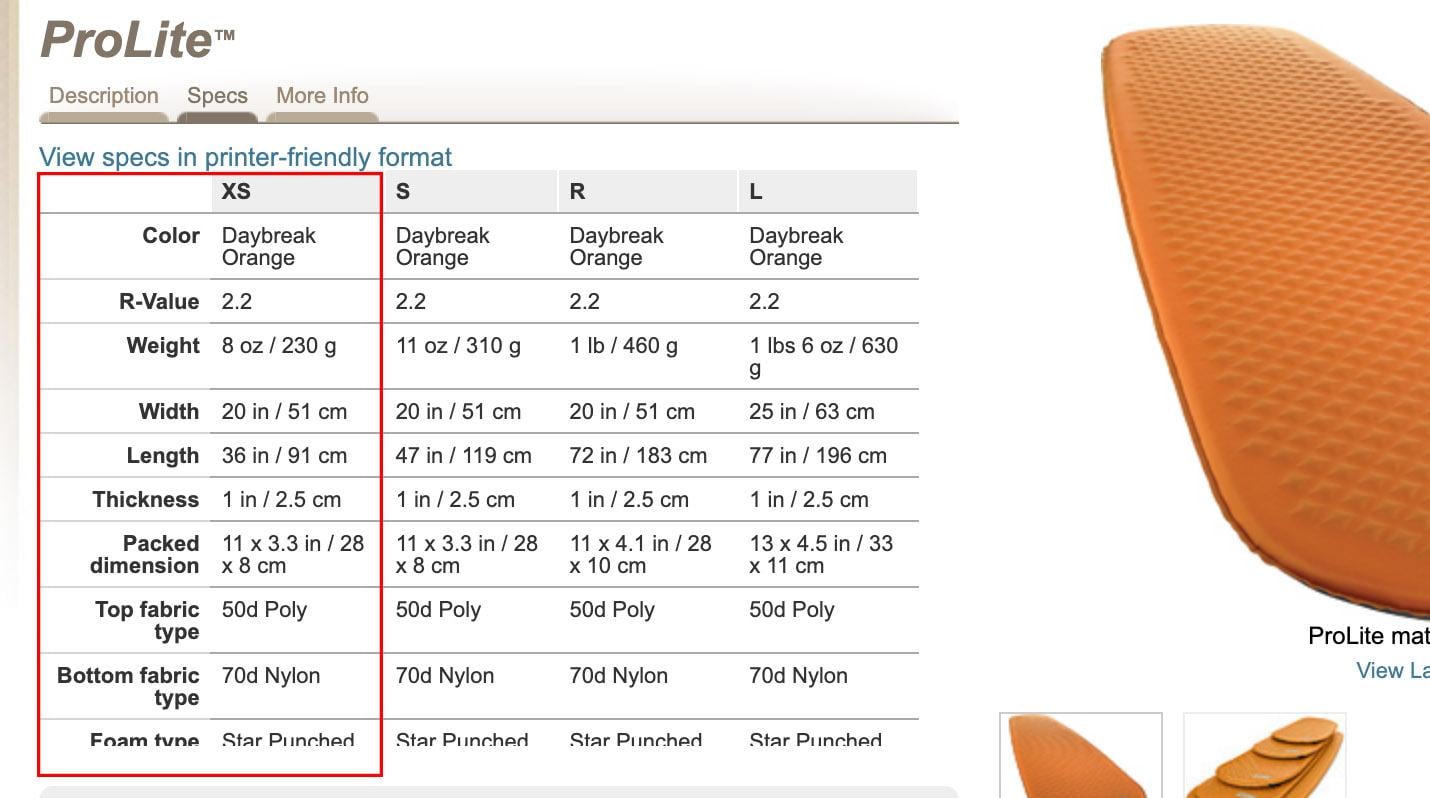
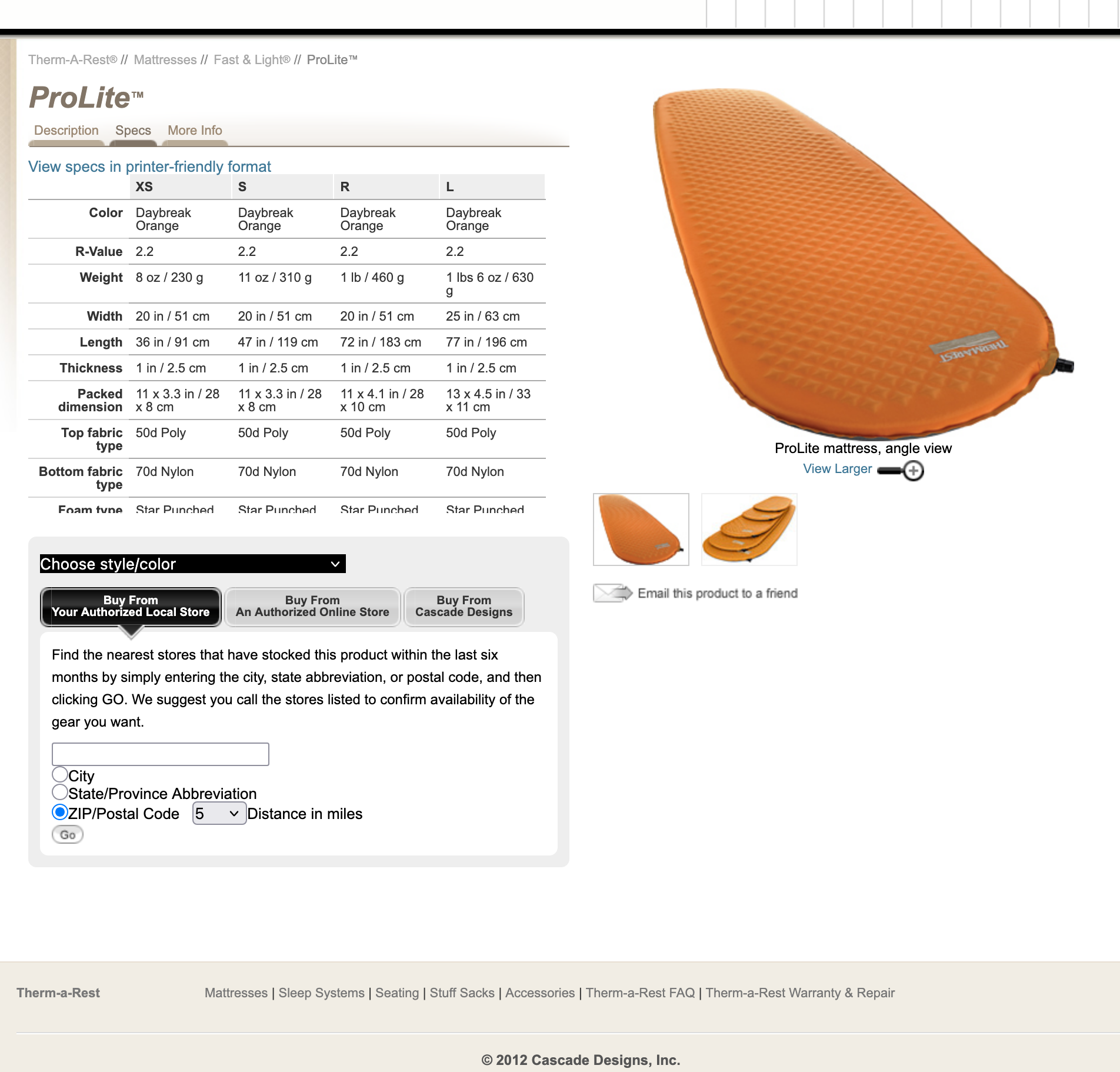
The bottom line, if the XS Prolite existed today, much of this conversation might be moot.

Prolite XS

I’d even be happy with a squarer (less rounded) torso pad using lighter fabrics.  Perhaps “conversational” but I’d still fork out for a 2cm (0.8″) version which was a 100cm rather than 91cm weighing 230g (8oz).  But these are minor preferences.

Such a shame Thermarest don’t make these mats anymore. I couldn’t agree more with bradmacmt:

I think in practice the 2.2 R value is higher than its listed value, just as all thick pads R values are lower than listed. The testing doesn’t take into account heat loss and cold penetration in the sides. […] Personally, I find the vertical pad race a bit absurd

All of which (and more) was covered in that Scramble piece.

230g / 8oz is absolutely in the ballpark and offers a lot of flexibility regarding which other mats to pair it with.  I think Scramble’s target is ~550g – 570g for a mat combo down to -20C (-4°F).

Does anyone know if those Prolite weights are for the mat only or mat + stuff sack and repair stuff? 

The Nordisk Ven 2.5 (same dimension as the Prolite Small, was 290g (mat only) and 320g with strap, stuff sack and patches.  Seems to be very much in the same weight class.

Cheers,
Andy

Andrew I BPL Member
PostedAug 8, 2026 at 3:56 pm

Also:

Another thing I find is I’m fine with a 20″ wide pad that’s no more than 1″ tall. However, when it gets to 2.5″ and taller, I find I need a 25″ wide pad in order to be comfortable.

An excellent point.  I’ve always been surprised at the desire for such wide mats, but that helps explain it.  Like you, with a 2.5cm (1″) or 3.8cm (1.5″) SI mat, I’ve never felt the need for greater than 50cm (20″) width.

But of course, if I’m re-enacting the princess and the pea extra width becomes an issue.

Andy

Jerry Adams BPL Member
PostedAug 8, 2026 at 4:18 pm

With a 20 inch pad that’s 2.5 inches thick, 2.5 inches of the 20 get’s used up making the height, so it’s actually 17.5 inches wide.  Not quite that bad because the edges are rounded.

I don’t like my 3 inch uberlite – I feel unstable on it, want to tip over, uncomfortable to sleep on.

Oh yeah, I now remember those shorter prolites.  They must not have sold many of them so they quit offering.  47 inches to satisfy Andrew, 36 inches to satisfy me need for even numbers : )

It seems like a difficult problem to solve to make a self inflating pad that doesn’t delaminate, based on the fact that thermarest kept coming up with new (heavier) versions.  I think mine tended to delaminate where I’d put my hand and put all my body weight on it so a lot of weight on a small surface area.  I am really careful now to put my hand off the pad as I get onto it, gently put my shoulder weight onto it.  Just a theory.

bradmacmt BPL Member
PostedAug 8, 2026 at 4:40 pm

Does anyone know if those Prolite weights are for the mat only or mat + stuff sack and repair stuff? 

Mat only.

Me, I’ve never used a mat stuff sack.

bradmacmt BPL Member
PostedAug 8, 2026 at 4:48 pm

With a 20 inch pad that’s 2.5 inches thick, 2.5 inches of the 20 get’s used up making the height, so it’s actually 17.5 inches wide. Not quite that bad because the edges are rounded.

I sold off my 20″ wide 2.5″  & 3″ Thermarest pads. It felt like a Quixotic ordeal to stay on them. If it’s tall, I’ll go 25″ – otherwise I’ll hoard 1″ x 20″ Prolites.

Andrew I BPL Member
PostedAug 8, 2026 at 4:51 pm

@bradmacmt. Thanks for Prolite mat weight clarification.

Jerry Adams BPL Member
PostedAug 8, 2026 at 5:44 pm

my gripe was that their weights were actually an ounce or two heavier than their “spec”.  Just for the pad, not including the bag.

and they’d come out with a newer (heavier) model (to solve the delamination problem?) without saying anything about it

I think they did that because if they said the newer (heavier) model was to solve the delamination problem.  If they admitted that, then all the users of the older model would expect a free upgrade.

Someone posted many years ago that they several times had delamination and then thermarest gave them a new one for free, on warranty.

although I gripe about their weights being heavier than spec, I like their product and keep buying new ones

I just weighed my 2 inch matt – 24 ounces – that’s just what their spec is – I guess I can’t gripe about that anymore : )

Alex H BPL Member
PostedAug 9, 2026 at 6:16 am

I own two Prolite XS, the original from 2009? and still in use weighs 8.3 oz alone.  The second one is just in case the first one has some catastrophic failure.

Ross Bleakney BPL Member
PostedAug 9, 2026 at 7:00 pm

I first want to say that comfort is subjective. Given that, you are bound to have a lot of different opinions when it comes to mattresses. Backpackers have other issues. Camping spots are often different. Thus a particular mattress might work great in one place but be terrible in an another. Given all that, the following is a common opinion towards backcountry mattresses:

On smooth ground, self-inflating mattresses — and even just straight foam — can be quite comfortable. But when you have roots and rocks it becomes a lot more challenging. Modern inflatable mattresses are typically light-weight, warm and thick. The thickness reduces the impact of roots and rocks. It is the combination that is key. This is why Thermarest still sells self-inflating pads (of various thickness). Some are willing to live with the weight penalty and get a thick version. Others still prefer the thinner self-inflating pads. But most people prefer the combination that is light, warm and comfortable enough.

But to answer your question, I think most companies sell  a discreet solution because most users only consider a discreet solution. I carry a thin foam mattress and have for years. I initially bought it because the first NeoAir mattresses were a bit on the cold side. I figured it made sense to add a little warmth while also protecting the mattress. Doing so now — for the trips I take — seems a bit silly. I use an X-Therm and it is probably overkill. Unless I went winter camping, the foam isn’t necessary for warmth. Meanwhile, the X-Therm is tough enough. But I still use it just to reduce slipping and sliding. It is also nice to have another foam option to use inside the tent. I use it for day hikes as well (or just lounging around the camp if the bugs aren’t too bad). But despite the versatile nature and low weight of my thin foam pad I don’t think this is common. Lots of people prefer one tool for each job. It used to be a big part of ultralight discussions but it isn’t any more. Partly it is because the specialized tools are so light.


Roger Caffin BPL Member
PostedAug 9, 2026 at 10:02 pm

Entirely personal opinion: I would prefer to sleep on snow than on concrete. With an airmat of course!

Cheers

Viewing 25 posts - 1 through 25 (of 31 total)
Loading...