Topic

Inflatable Sleeping Pads: Finding Comfort when Sleeping on the Ground (Updated)

Viewing 7 posts - 51 through 57 (of 57 total)
AK Granola BPL Member
PostedSep 2, 2025 at 12:06 pm

I finally bought a Thermarest NeoAir XLite NXT (had to look up the name of what I bought – jeez), back in March. I bought a regular which is super long and takes up almost all the lengthwise space in my Marmot Tungsten tent. Fits better in my TT Notch Li. My primary sleeping bag is also too long, so at least the toe end rests on the mattress instead of on the floor.

The pad is very comfortable and the 20 inch wide is fine for me (I’m 5’7″ and 160 pounds). As with all my sleeping pads, I put any extra clothes or gear alongside, so if my arms drape off in the night, they land on something that also provides insulation from cold ground. I’m a flip flopper when I sleep, and the mattress is not especially slippery. It really hasn’t bothered me. I am finding that it adds a wee bit more warmth than my old Uberlite, which I loved to death, alas.

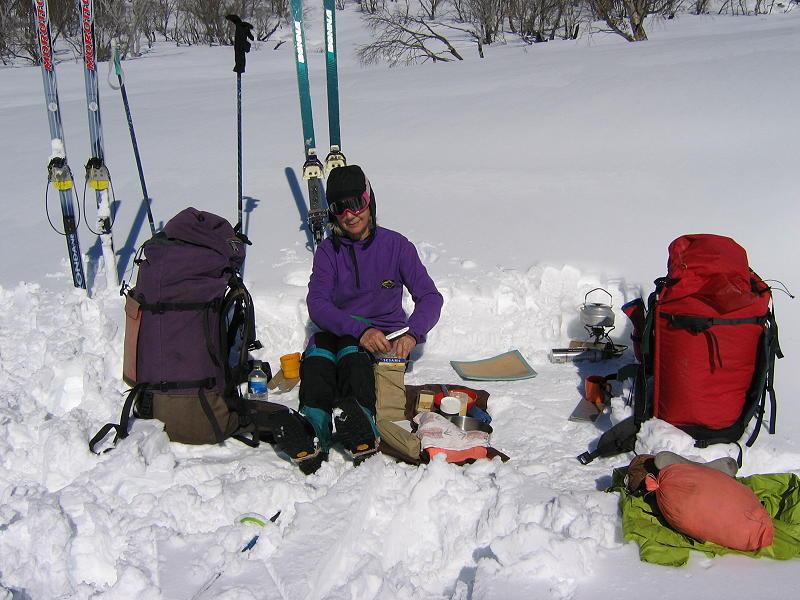
I do use a Gossamer Gear thinlight pad underneath. That thing is so useful in so many ways that it’s totally worth the (minimal) weight and bulk. For sitting on rocks at 40F, so much nicer to sit on something that protects against the cold and wet. Sitting on a wet picnic bench, or damp ground, or sand. And of course protection for the inflatable pad. Heck, cut into pieces it might be a good First Aid item too.

I just inflate the Neoair by mouth. It never takes 5 minutes; I can’t imagine why people need 5 minutes to blow up a mattress unless they are physically impaired in some way. Lifelong smoker maybe? Heart issues? Even at 10,000 feet, it’s just not that hard and I’m not a super athlete or anything. If you can hoof it up a 3000 foot climb you can blow up a mattress, no devices needed. Plus deep breathing is good for you. I’ll change my tune if my health declines I’m sure, so no shade on those who need them as an assistive technology! I hate filtering water far more than I dislike inflating my sleeping pad, as far as camp chores go.

So far the mattress is sturdy, but time will tell. I am more careful than I used to be about site selection and clearing sharp rocks. If it fails, I’ll make do and survive.


AK Granola BPL Member
PostedSep 2, 2025 at 12:58 pm

For pillow creep – I just use a tshirt or a jacket to attach the pillow to the mattress; just slide it over the top as if you were “dressing” the mattress. Might not work for very small people with tiny tshirts.

Brett Peugh BPL Member
PostedSep 3, 2025 at 12:49 pm

As a tall side sleeper I am interested in the Sea to Summit Ether Light XR.  I currently use the Exped 3R and was wondering if anyone had thoughts.  Thank you.

Andrew I BPL Member
PostedJul 16, 2026 at 8:56 am

Agree with Matt and Roger.  A recent post on Scramble may be of interest and if you see any errors in their thinking let me know and I’ll pass it on to them:

Chasing R-Values, The Malincentive of ASTM FF3340-18
https://scramblekit.uk/review/index.php?id=outdoor&post=sleeping-mats-r-values-and-astm-ff3340-18-malincentives

I think the last section is interesting: “Final Words:  Some Useful Advice From On High” re. High Altitude Alpine Style Sleeping Systems.

Cheers,

Andy

Jerry Adams BPL Member
PostedJul 16, 2026 at 10:30 am

interesting article, thanks – moving body in real world will produce different results so their standard tests aren’t very good

One thing I’ve noticed is that when I measure the temperature of the ground directly under me it can be 20F warmer than the ground elsewhere – the body gradually warms it up – the ground has both thermal insulation and thermal mass.  If you camp on snow or ice the ground will be 32F.

Maybe a better approach would be to instrument a human sleeping over night.  Have temperature sensors on the ground and on the surface of the skin of the human.

Then, maybe you could construct a lab test that produces the same results.  Have a “body” that moves around,…

Then you could compare different sleeping mats.

Maybe you could construct a formula for calculating R value based on thickness, what type of foam or whatever is inside the mattress.  Reflective layers.  etc.  Then you wouldn’t have to test every sleeping pad on the market, but there aren’t that many so you could just test everything on your lab instrument.

For sleeping bags this is worse because there are so many brands of sleeping bags, sizes, different variations – it’s prohibitively expensive for small manufacturers.

Roger Caffin BPL Member
PostedJul 16, 2026 at 9:05 pm

Blowing my own trumpet: you could read our own BPL survey:
https://backpackinglight.com/airmat_sotmr_part1_2011/
and
https://backpackinglight.com/airmat_sotmr_part2_2011/

I think the author of the scramble article may have a bit of a bee in his bonnet. He makes a few good points, but also makes many unsupported claims. I will cover a few of them.

* Air movement inside an air mat: full agreement here. An empty airmat can be quite cold. Read the review cited. You need baffles in it, or better still some very light fluffy insulation, to limit air movement Of course, a Down Air Mat (DAM) is the top performer, but the author does not mention them. Yes, I have two.

* His disdain for lab testing seems to be a reaction against something he cannot handle, or perform. He suggests ‘real world testing’, but makes no suggestions as to how you can standardise or calibrate such things. He suggests that testing in a lab will give different results form testing on snow (for instance). Waffle.

* There is no technical reason why snow might make any real difference. In fact, as Jerry points out, sleeping on snow usually results in the snow under you melting, so you are fairly soon on a 0 C surface. In the morning, when we pack everything away in the snow, there is always a depression below where we were sleeping, especially at the hips.

* The author seems to have missed out on the reason many of us have a thin foam mat under our nice comfortable air mat. When you are sleeping on snow, the floor of the tent is going to be at 0 C. Any stray vapour – from your mouth for instance, is going to condense when it hits a 0 C surface. Translation: you will end up with a puddle of water under your mat in the morning. Yes, in general it WILL be water, not ice. I am not worried about my air mat (or my foam mat) sitting on a thin puddle of water, but I am definitely worried that my down quilt might contact the puddle. Fortunately, a wide foam mat, even just 1/8″ thick, will keep the water under it in the depression my body heat makes and away from my down gear.

* The author worries about every one standing around freezing while you blow up your air mat with your mouth. Blimey: who in their right mind blows hot breath (humid air) into their air mat??? The vapour in your breath will immediately condense and fill your air mat with water. Stupid. We use a manual pump for our air mats. In fact, Sue dives in as soon as the tent is up, sits on a small foam mat, and starts pumping, while I am guying out the tent, getting water if available, and so on. By the time I am ready to get into the tent, both air mats will be inflated and Sue will be laying out our quilts (and pillows).

I do agree that some foam is very useful. I kneel on a my little bit of foam when cooking dinner in the tent, We also sit on our little foam mats (sit-upons) for lunch.

Cheers

Viewing 7 posts - 51 through 57 (of 57 total)
Loading...