


https://seekoutside.com/eolus-fst/
Interesting design on the vestibule doors.
I like offset pole configurations better, but space wise it’s similar to Gossamer Gear’s “The Two”.
Topic
Become a member to post in the forums.
 .
.
https://seekoutside.com/eolus-fst/
Interesting design on the vestibule doors.
I like offset pole configurations better, but space wise it’s similar to Gossamer Gear’s “The Two”.

Sage green – great color choice :)
Looks like a variation on the classic hexagon trekking pole shelter shape (e.g. TrekkerTent Drift 2, or SMD Haven) but with new ideas for avoiding door zippers and for improving space at the ends.
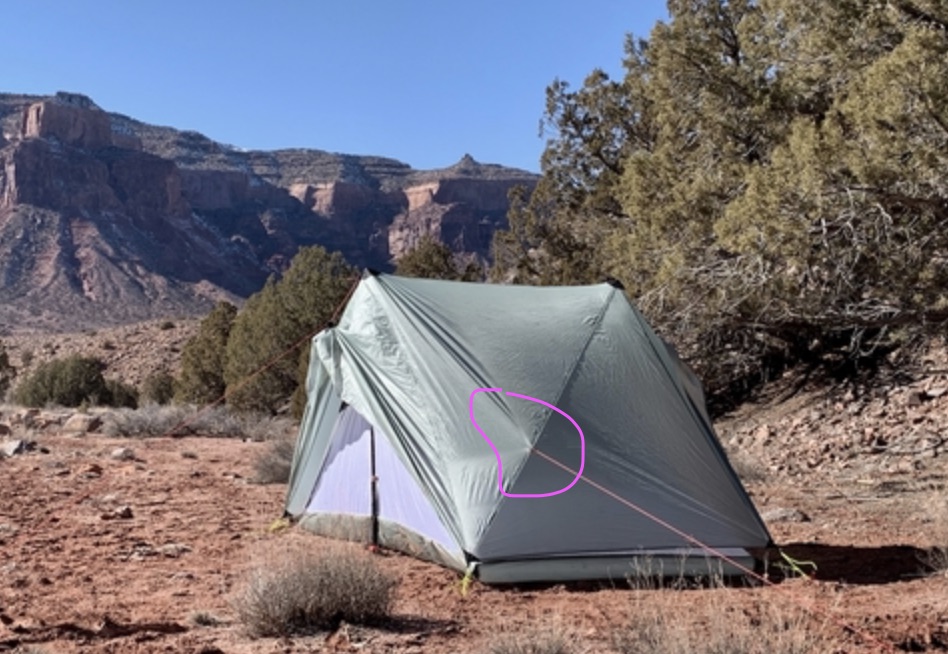
The floor is wide enough (50″) for two people sleeping the same way, but Seek Outside is recommending that you sleep the opposite way and they have added these off-center guyouts to pull out the fly for more headroom on one side of each end like the picture below. I’m not sure if an 8 stake pitch with an opposite sleeping position is pretty much mandatory, or if there is enough space that it’s also reasonable to skip the mid-panel guyouts and sleep in the same direction.

Another tent demo without pads. :(
Tips up :(
Fly too far from ground:(
Have to open the whole side to get in or out :(
3+ pounds plus poles :(
The zipperless closure is noteworthy, I like that
+1 ^^ on the offset pole preference, and not going all the way the ground. and I don’t like the bit Dan circled in purple, prefer cleaner lines.
also would be more interested if it were poly v nylon. Curious about his decision to add some PU to the sil.

Well, they always seem to come out with an interesting twist or two, and in this case it’s the zipperless door and the asymmetric side tie outs.
I was a bit surprised by their claim that they are patenting the zipperless door, as there must surely be prior art? I’ve been playing with pretty much the same idea for my own beaked tarp, but have decided to go with a zip. It may be a touch heavier, but a straight #5 should be reliable and it’s much more flexible as you can leave one or both flaps open or porched depending on conditions and wind direction. Plus you can tie back the doors neatly, while it looks as if their open vestibule will be flappy and liable to pool rainwater. Most of their products are superb, but I’m not convinced they’ve got this one right. Like the other posters, I would prefer one of the transverse alternatives if I was in this market.
The offset tie outs to increase headroom seen neat, if you can see past the aesthetics. And from the pics, it seems that they tension the panels quite nicely. Having said that, I’ve never liked sleeping head to tail, particularly with a partner…
The zipperless closure is a neat idea. It has a simplicity to it that is lacking in all of the door clip designs on the market. In the photos it does look like it leaves a fair bit of potentially wet fabric hanging in the doorway, so a few more loops along the cord might help it sit more out of the way when open.
There are some interesting geometric constraints to a design like this. Basically, the distance from the corners of the tent to the bottom of the door (“X Distance”) has to be greater than or equal to the distance from those same corners to the top of the door like this, or you wouldn’t be able to open it:
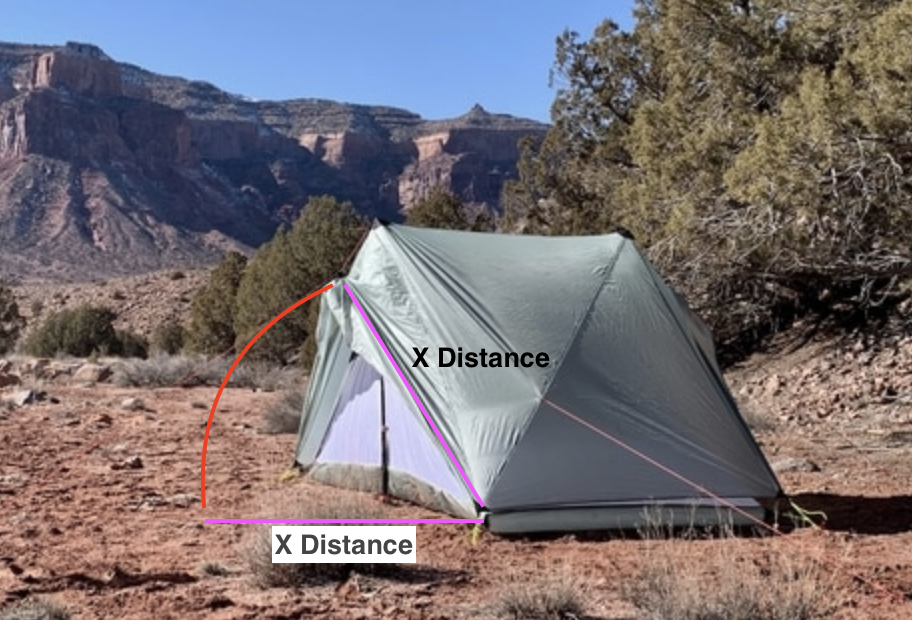
In other words, the vestibule has to be at least about deep as it is tall. But simply doing that is problematic because the height of this tent is about 50″ and a 50″ deep vestibule would be a heck of a reach to close. So Seek Outside has made two tweaks to improve this. First the “door” isn’t as tall as the tent. You can see that it only comes up to about a foot below the peak, and secondly, the door doesn’t extend all the way to the ground (see below):.
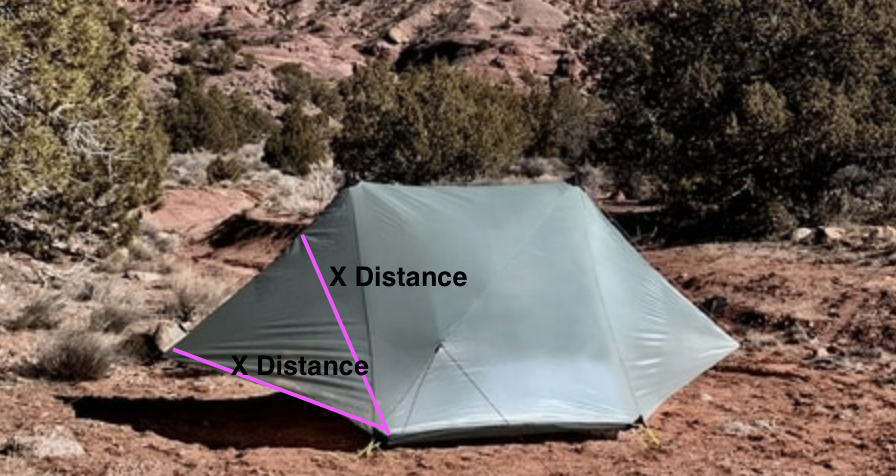
So the result is a door that is simple and free of failure points, but can’t open as high as a zipper door, doesn’t fully block wind on that side, and is still a fair reach (per the video). I think it’s an interesting idea that some people may prefer. I hope they add a few more rings to reduce the fabric billowing into the doorway. That’s easily solve-able, whereas the trade-off between having a tall door that is a far reach, or a shorter door that is a more manageable reach is a more fundamental constraint in the geometry. It looks like Seek Outside has compromised about as well as possible here with a door that is a bit shorter but not way short, a reach that is a bit long but not way long, and coverage that still blocks most of the wind.

I’ll chime in a bit. Let me know if you have questions.
Thanks Let me know if I can answer any other questions
Kevin
I was a bit surprised by their claim that they are patenting the zipperless door, as there must surely be prior art?
There is , the Exped Vela 1 and 2 from 2004 , still for sale now
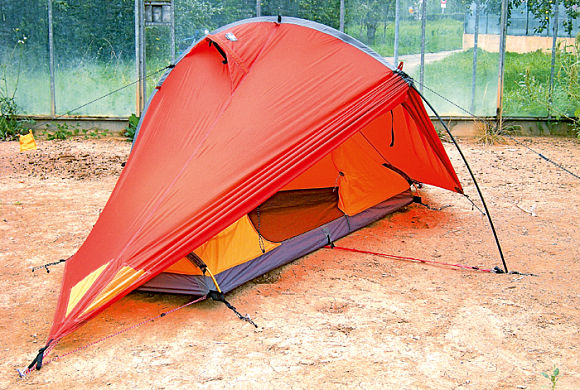
http://www.exped.com/international/en/product-category/tents/vela-i-ul
They may be patenting the way it slides on a cord. The Exped Vela does look similar but it slides on a pole. Obviously I don’t know how specific S.O. patent application is.
“I don’t know how specific S.O. patent application is’
True.
The Exped version is sleeve based and the S.O. one is done with ring.
I posted that photo because I am familiar with those tents and so they came to mind.
I’m thinking that a way to improve the door would be to run a guy from the bottom of the beak rather than just from the apex.
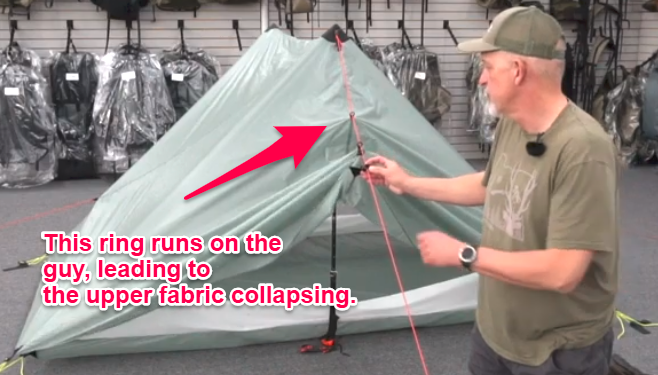
In his TrampLite shelter Colin Ibbotson actually runs a guy from both, to the same anchor. It makes for a stable pitch with a water-shedding beak when the door is open. I guess the double guy is for max stability, as the shelter is designed for windy North European conditions. But I suspect the door would work fine with just the guy from the bottom of the beak.
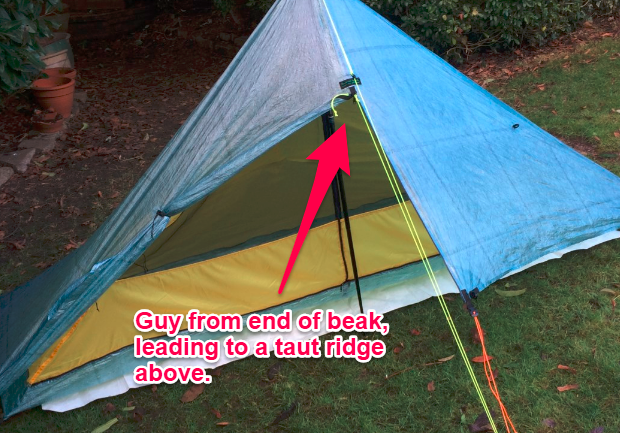
I do think that this might be a cleaner solution.

“Sage green – great color choice :)”
Ha ha Dan-looks like Pantone may be on the fashion upswing.

I’d encourage folks to pause and reflect on how aggressive that pricepoint is for a US-made shelter.
I’ve always been underwhelmed by the headroom and weather performance of these designs, but so long as everyone wants side entry there are only so many options.
David – I’m not sure I follow.
$200 for fly only. $399.00 for Fly + inner.
The SMD Lunar Duo is $325.
The GossamrGear TheTwo is $389
The TarpTent SS2 is about $350 (site seems to be loading SLOWLY, so I can’t confirm)
Neither the SMD Lunar Duo nor the GG The Two are US made. However the TT SS2 is made in Seattle.
$200 for fly only. $399.00 for Fly + inner.
Yeah I heard from a few people that thought $200 was for everything. It does kinda look like that on FST page because it is described as a full shelter system and the price is listed at $200. It’s not until you’re down in the options where you actually select the inner to make it a full shelter and the price doubles.
Whoops. Was guilty as Dan notes. With that price and weight kinda hard to make a compelling argument of something in this class (SS2 et al) v. a Hubba Hubba.

The geometry looks simple, a wide A frame with a couple of retractable beaks on each end.
At first look I immediately thought GG The Two and ZPacks Duplex.The design has been around for a long time. $225 MSRP max.
In 40 mph plus winds the Eolus might not be fun. Though I hear nothing but rave reviews for Seek Outside packs.
I’ll chime in to address a few other items:
Wind – Actually in testing, it did really well. When we get some wind events and the snow gets a bit gone I’ll try to film a snippet .
Higher Vestibule Beak – If I recall it is 8 inches above the base pitch. In the initial photos, it is pitched closely to what a standard tent canopy is (4 inches off the ground). You can pitch it lower if desired. One of our reasons was to get some good venting. When used with the inner nest, the inner nest does a lot of breeze blocking. Part of our reason for the vestibules is that wind speed is lower a foot or so, and often terrain features will form some blocking.
Door opening – It opens up to 40 ish inches, which is as tall as most smaller tents.
More Loops rings – Loops start really have diminishing returns after 3. I think 5 rings moves it about an inch .
Door Tie Back ? As a note, we actually initially had a door tie back near the top that held the opening up a little neater. In testing, it was never used once, so we considered it one of those features that was not needed and likely had more negative impact (think a toggle slapping in the wind )
Cross Seam where Guy out is located: There is a cat cut there to tighten the panel and improve performance in addition to adding a guy out location for stability and a little more head room. That is the why. Generally, our shelters loose a wrinkle or two after some usage.
Water / Rain – Rain should actually flow into the creases and not dump on you .. or at least that is what has happened in testing so it essentially flows off to the side. It’s not a big deal, it isn’t like water pools there unless maybe you try to make it pool there.
Pricing – Yes we are American made, and put a lot of time into our construction / QA and materials. pricing will likely move up a bit after the first run. It is just one of those facts. As a brand, we have never had much luck offering less expensive variations the couple times we have tried it. People wanted the real deal.
To a certain extent , I think the perception or expectations are a little skewed. Yes with an inner you can think of it as a trekking pole supported double wall shelter .. however without the inner I think the more correct way to think of it is as a tarp that provides good coverage in every direction where as most tarps will have an open side or two.
Thanks
Kevin
“Loops start really have diminishing returns after 3. I think 5 rings moves it about an inch.”
Could you use a fabric sleeve rather than rings? If the cord ran through a sleeve that might be like having an infinite number of rings, yet perhaps with no more weight than the existing 3 rings. Would be a clean look too. Maybe it’s a problem during snow/ice though.
It sounds like the existing system is working well. I only ask because it’s an interesting concept that seems worth mulling over as much as possible.
Hi Dan
Excellent point and we did consider the fabric sleeve route. It would likely work well, however what steered us to our current route is that it is simple to inspect, and if an issue ever does arise (say busted cordage) it is easy to resolve. The fabric sleeve, may get worn, stuck or possibly frozen without you having ability to troubleshoot it. For the record, I only had issue with cordage once and it was a chewy puppy .. but you could see how that could happen. In the end, the sleeve is more elegant , but we felt the rings are a more reliable solution that if for some reason something did happen it was also easy to resolve and even repair if need be. IMO .. one of the really cool things about this is the field repairability. No need to find a seamstress or send something in. Also, as a side note, we actually started with a cordage only solution using friction hitches. Friction hitches are a viable option if for some reason Line Locs ever broke.
Thanks
Kevin
Here you go with the best most accurate wind testing we could get .. plus we had a little fun
Pole were black diamond Z carbon 135 on the DCF and Leki carbon at 120 on the sage green
https://www.facebook.com/SeekOutside/videos/330641420970965/
And here is in DCF
https://www.facebook.com/SeekOutside/videos/369076500345867/
I see this as a worthy alternative to the MLD Trailstar. It has the same footprint, same weight, is slightly higher when pitched flush to the ground, also has no zippers, and is more convenient for couples who prefer not to be separated by a pole. In other words, it’s a tarp-like shelter that takes advantage of clever geometry to offer a few different pitch options while preserving design simplicity:

I wish more companies offered more tan colors, particularly lighter tans.
Become a member to post in the forums.
 Vaer C4 Tactical Field SolarDurable timepiece for wilderness users - 20ATM (200m) water resistance, 120-click bezel, 316L SS casing, sapphire glass, solar-powered, Epson VS-42 Japanese movement, C3 Lume, USA assembly.
 © Beartooth Media Group Inc.
 Loading...