


WI am wondering about this rain shell. Since the WPB laminate is on the outside, how well does the jacket stand up to backpacking use?
If anyone can comment on their experiences with this rain shell, thanks!
Topic
Become a member to post in the forums.
 .
.
WI am wondering about this rain shell. Since the WPB laminate is on the outside, how well does the jacket stand up to backpacking use?
If anyone can comment on their experiences with this rain shell, thanks!

The Whistler Peak jacket has “reinforcements” in the shoulder and waist areas for your pack straps. I recently bought and tired one.
While I liked it overall, I would say one criticism is that the “waist” reinforcements are pretty low on the jacket. To get these to line up with the pack’s waist belt, I would have to pull the jacket up some before tightening the waist belt.
Otherwise, pretty nice jacket. I wrote about my short experience with the Whistler Peak here.
I purchased a Reign No Shine on sale a couple of months back. I have not worn it, but I just got around to measuring its MVTR as I have for many generations of Outdry Extreme. This one sets two records. It is the lowest MVTR among the Outdry Extremes I have tested over the years. Also, at 320 g/sq meter/24 hours, it is the lowest MVTR I have measured, by far, of any WPB I have tested. At least it has pit zips.
I compared this jacket to another older version here: https://backpackinglight.com/forums/topic/why-you-should-spend-a-few-ounces-of-pack-weight-on-rainwear-ventilation-features/page/4/#post-3852197
The problem with these jackets is that from one version to the next, the consumer has no idea how they perform. I have no doubt this will keep the rain out: the outer polymer layer is very thick. That is why the MVTR is so low. For added ventilation, the front left and right pockets open into a vast mesh exterior.

Wow disappointing on the low MVTR!
Yes, very disappointed about the low MVTR.
Stephen, in that linked post you said,
The Columbia Extreme jackets have definately improved. In older models, the polymer they painted on the face fabric was so thin that when viewed under the microscope you could see the pattern of the underlying yarns. In the recent models I have looked at, the coating is thicker and its surface is highly uniform. This means less chance of exterior water getting through. It also means that vapor has a harder time getting out. Fortunately, they have servicable pit zips. I have a small collection of these jackets because they often go on sale at very low prices.
I’m confused, as you mentioned the “polymer painted on the surface” of the jackets… I thought that on OutDry garments, what we “see” on the outside, is the actual membrane material – Is that not correct?
I know that they have different colors available. Are you saying that what we “see” is actually a “painted” surface, over the membrane material? If that’s true, then your post makes more sense [to me.] I can’t imagine a scenario where “painting” the surface wouldn’t have some effect on performance – which your experience certainly is suggesting.
I guess my next question then – what “color” is the actual membrane? More appropriate – Is there a color-option that is NOT painted, where we are seeing the actual membrane material, and it’s performance is uninhibited by any cosmetic (painting, coating) processes…
The irony for me is that this has been an extremely dry spring & summer so far for me. So my latest obsession with rain gear has certainly felt ironic. It would make no sense for me to buy & keep (2) WPB jackets, but there is a part of me that still wants/wanted to keep that OutDry jacket, just to get some experience with it…
There is no membrane in the sense of a thin waterproof barrier bonded to a face fabric and inner fabric. Instead, a waterproof urethane coating is applied to the exterior of a nylon woven fabric. I don’t know how the thick urethane coating is applied, there are several available processes. I should not have used the word “painted”.
Become a member to post in the forums.
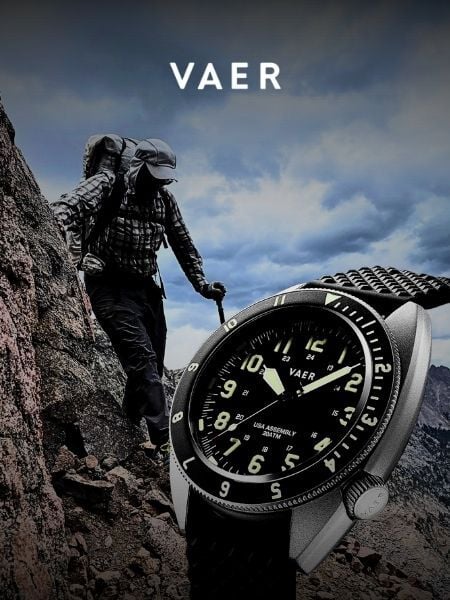 Vaer C4 Tactical Field SolarDurable timepiece for wilderness users - 20ATM (200m) water resistance, 120-click bezel, 316L SS casing, sapphire glass, solar-powered, Epson VS-42 Japanese movement, C3 Lume, USA assembly.
 © Beartooth Media Group Inc.
 Loading...