Topic

Rechargeable CR123 batteries for Steripen

  • This topic has 26 replies, 13 voices, and was last updated 4 years ago by Ian.
Viewing 25 posts - 1 through 25 (of 27 total)
Michael B BPL Member
PostedMar 26, 2021 at 4:09 pm

I just bought a bunch of non-rechargeable CR123s from Amazon  – about $2 each. I thought that was reasonable compared to buying from a store. Not sure how many you are going through per year.

Just looked at that rechargeable – that is a pretty good solution as long as you make sure to charge before going out to make sure it’s topped off.

Jerry Adams BPL Member
PostedMar 26, 2021 at 4:14 pm

I tried rechargeable CR123 batteries in Adventurer Opti but they only treated a few pints of water before they said they were not charged enough

I also tried some non conventional brand non rechargeables and they didn’t work very good either

Michael B BPL Member
PostedMar 26, 2021 at 4:28 pm

It is interesting the Steripen literature doesn’t give a real wattage spec for its lamp. That would seem to be more useful than stating “50L per set of batteries”.

Jerry, which brand of non-rechargeable batteries did you try? I just got them for a little flashlight my wife carries in her purse, so not as big a deal as clean water.

Roger Caffin BPL Member
PostedMar 27, 2021 at 3:28 pm

a real wattage spec for its lamp
They don’t, because such a spec would be meaningless. This is not an incandescent bulb.

Cheers

Ken White BPL Member
PostedMar 27, 2021 at 5:47 pm

I gave up on rechargeables for my various steripens and satellite communicators (when they used batteries). Many brands and I found the results to be inconsistent. That said, I use Panasonic 18650s to charge all my internal battery powered devices via usb with no ill effect.

David Thomas BPL Member
PostedMar 27, 2021 at 6:21 pm

I’ve got the similar unit with the built-in rechargeable batteries and it does okay maintaining charge during storage.

But I have an older SteriPen model that had “smart” switches on it (no definitive click like an old flashlight disconnecting the power) and it would drain batteries while in storage so I took to removing one lithium battery from it during storage and then re-installing prior to a trip.  For the few days of a trip, it didn’t seem to make a difference.

Jerry Adams BPL Member
PostedMar 27, 2021 at 7:39 pm

I forget now which brands I tried

Maybe Everready non rechargeable worked

Tenergy rechargeable did not work

Michael B BPL Member
PostedMar 27, 2021 at 8:58 pm

They don’t, because such a spec would be meaningless. This is not an incandescent bulb.

That is a silly notion. It has one function. It is exactly like a cycling light or any other LED with exception to the wavelength. Oddly, those other things typically list wattage for the various settings, or at least many of them do.

Joshua B BPL Member
PostedMar 30, 2021 at 2:14 pm

I don’t own a Steripen, so I don’t know if it is designed for use with lithium-ion batteries.   Are the batteries used in parallel (3.0V) or series (6.0V)?  The reason I ask is that the working voltage for the batteries linked in the OP above would be 3.6V (parallel) or 7.2V (series).  If the Steripen electronics aren’t designed with a buck converter that can handle the extra voltage, you may fry the pcb.  Flashlights have been a hobby of mine for the last couple of decades, so I had to wrestle with these issues frequently to find rechargeable options.  If you can’t find an answer to these questions in Steripen literature, then the safer option might be to use LiFePO4 batteries.  These rechargeable batteries have a lower working voltage (3.2V vs 3.6V) and are “safer” to use in electronics not specifically designed for higher Li-ion voltages.  If you go this route, LiFePO4 require a special charger that charges at the lower voltage.  Here’s a link to one supplier: LiFePO4

Jerry Adams BPL Member
PostedMar 30, 2021 at 2:24 pm

I think the rechargeable lithium CR123 batteries have a lower voltage, and that’s why they don’t work very well.  They treat a couple pints of water, then stop.  For Adventurer Opti.

It was quite a while ago when I tried that.  Memory cells weak : )

That’s why name brand non rechargeable batteries are best.


Joshua B BPL Member
PostedMar 30, 2021 at 2:31 pm

@ Jerry Adams

Nope, starting voltage for Li-ion is 4.2V with a working voltage of 3.6.  That starting voltage is what can fry electronics that are only designed for primary cells (CR123a @ 3.0V).  Probably what you experienced was less capacity.  At best, rechargeable batteries tend to only have 60 – 70% capacity compared to non-rechargeables (primaries).

Jerry Adams BPL Member
PostedMar 30, 2021 at 2:56 pm

whatever the chemistry or electricals are

they advertise 50 liters on a set of batteries

if the rechargeable batteries have 60% the capacity, they don’t treat 60% of 50 liter capacity = 30 liters, it was more like 2

maybe the non rechargeable batteries have a larger maximum current.  The Steripen bulb takes a lot of current.

Jerry Adams BPL Member
PostedMar 30, 2021 at 3:13 pm

googling a bit:

CR123 non rechargeable has a max current of 1.5 amps

RCR123 rechargeable 0.55 amps

An adventurer opti treats 50 liters per set of batteries, 1.5 minutes per treatment, 75 minutes total, 1.25 hours

CR123 is 1500 mAh, so, if it’s used up treating 50 liters (1.25 hours), then it uses 1.2 amps

(oversimplification – the actual mAh is less if you draw more current, etc., but that would be in the ballpark)

the 1.2 amps is less than the 1.5 amps a RC123 cam deliver – so that should work

the 1.2 amps exceeds the 0.55 amp maximum an RCR123 can deliver.  Maybe when it’s fully charged it can deliver more current so it works for a short time.

Roger Caffin BPL Member
PostedMar 30, 2021 at 4:29 pm

My rule of thumb is to only use primary batteries in critical things, as the rechargeables all died far too fast on me. The idea that the rechargeables were better for the environment just did not work in practice.

I also found that the brand name batteries were generally much better than the cheap ebay ones when it came to a high current draw. This does matter for things like powerful torches and Steripens, but not for other things.

When I take a Steripen (which is not always), it is a Classic3. This one takes 4 off AA lithiums which can be bought anywhere.

Cheers

Joshua B BPL Member
PostedMar 31, 2021 at 8:11 am

@ Jerry Adams

Good points about current limits.  Some rechargeable Li-ion batteries have a built in protection circuit that helps prevent bad things from happening (fire, explosion, venting with flame).  These circuits can limit current draw as well as offer low-voltage protection (or over-discharge).  This could also be an explanation for your experience of decreased runtime.

Unprotected Li-ion cells used together in parallel or series are very dangerous.  Bad things can happen if the cells are unequally charged or one is compromised in some way.  Fortunately, most consumer electronics (phones, laptops, power tools, etc) have protection circuits built in to avoid this (as do the batteries linked in the OP).

I don’t have a Steripen, but a simple multimeter could determine the current draw and then it should not be too difficult to find a brand of rechargeables with specs that can match that current draw.  But also try to figure out the voltage limitations of the Steripen circuitry before using rechargeables.

@ Roger Caffin

For the AA battery category, Eneloop AAs are a fantastic rechargeable.  They have a low self-discharge rate and have a relatively high capacity and high current draw that operates in a pretty wide temperature range.  They easily exceed the the performance of alkaline batteries (Duracell, Energizer, etc) in high drain applications.  However, you are absolutely correct that Lithium AA primaries are superior in capacity, weight, shelf life, and temperature range over any 1.2V rechargeable.

PostedApr 29, 2022 at 5:56 pm

This has been discussed on a thread 10 years ago – which means no-one has found a good solution to this except buy good name brand CR123s as cheap as possible

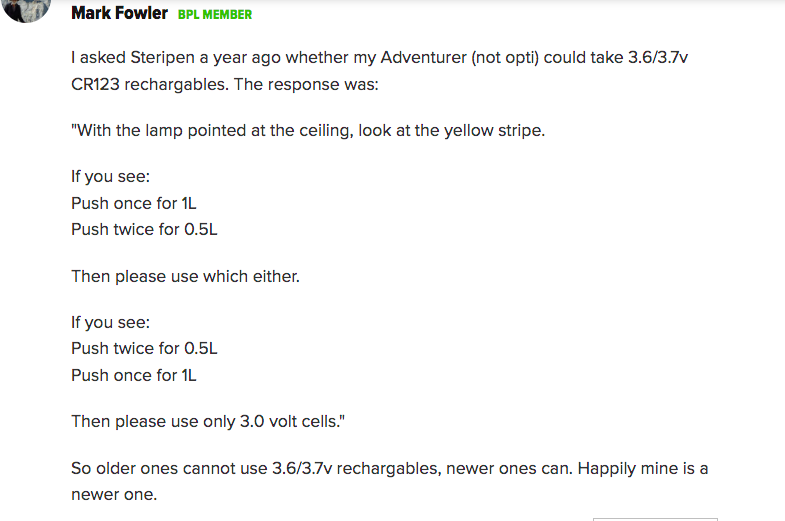
Sorry I am not sure how to quote in, so I put in a screen shot.

Long story short

1) LiFePO4 don’t work because they can’t supply the required high current of ~1A. Those cells you linked to have a max discharge rate of 650mA

2) The new version of the steripen can take take the higher voltage that ICR/INR/IMR chemistry puts out

quote from earlier thread

Ian B BPL Member
PostedApr 30, 2022 at 6:52 am

Mine is a new model. Any one have a recommendations on any particular brand or specific battery based on personal experience please?

Ben H. BPL Member
PostedMay 2, 2022 at 3:45 pm

Last I checked Katyden had a list of batteries that would work in the opti. I can’t find it now. I am not sure if they have made the electronics less demanding in the current version of the Opti. I always bought off of that list. I think I always got the Energizer lithiums.

Rebecca 510 BPL Member
PostedMay 9, 2022 at 7:55 pm

I had good results last year with the Fenix batteries in Iago’s initial link, although I didn’t get to test them for more than a long weekend. There’s one problem with them: the handy micro-USB charger makes the battery a little longer, and the cap on the steripen doesn’t screw down quite far enough to get a complete seal with the rubber gasket. If I can find my old broken steripen, I’m going to scavenge its gasket and see what happens when I stack two of them.

Viewing 25 posts - 1 through 25 (of 27 total)
Loading...