I should amend my statistics post: the backcountry data trends are a bit more complex. The total visitor numbers by year jump around more, but there were times in the early 80’s when the backcountry camper visitor amounts were similar to what they are today. A huge spike did occur in 2014-2017 and its possible we will return to that.
Topic
Permits: Good Luck.
Become a member to post in the forums.
- This topic has 53 replies, 23 voices, and was last updated 4 years, 2 months ago by .
Campflare. Who knew? CS are those mostly or almost exclusively drive up sites or is there a re-sale market for backcountry sites as well?
Yep the backcountry too, if it’s not a lottery (or at least no one appears to be gaming the lottery out in the open with a website.) CampNab talks about how they scan for backcountry permits here.
^^ SO campflare just scans for cancellations or maybe rather current openings (or both together)
How does Campflare make money? Is there a subscription fee or a fee to book through Campflare or are they trying to make enough $ through visitation and ad revenue?
Is it possible to book a reserved site and then transfer that booking?
How does Campflare make money?
Campflare says they’re college students, and seem to just take donations to cover costs (so somebody’s parents are probably subsidizing it). I’m happy to take them at their word.
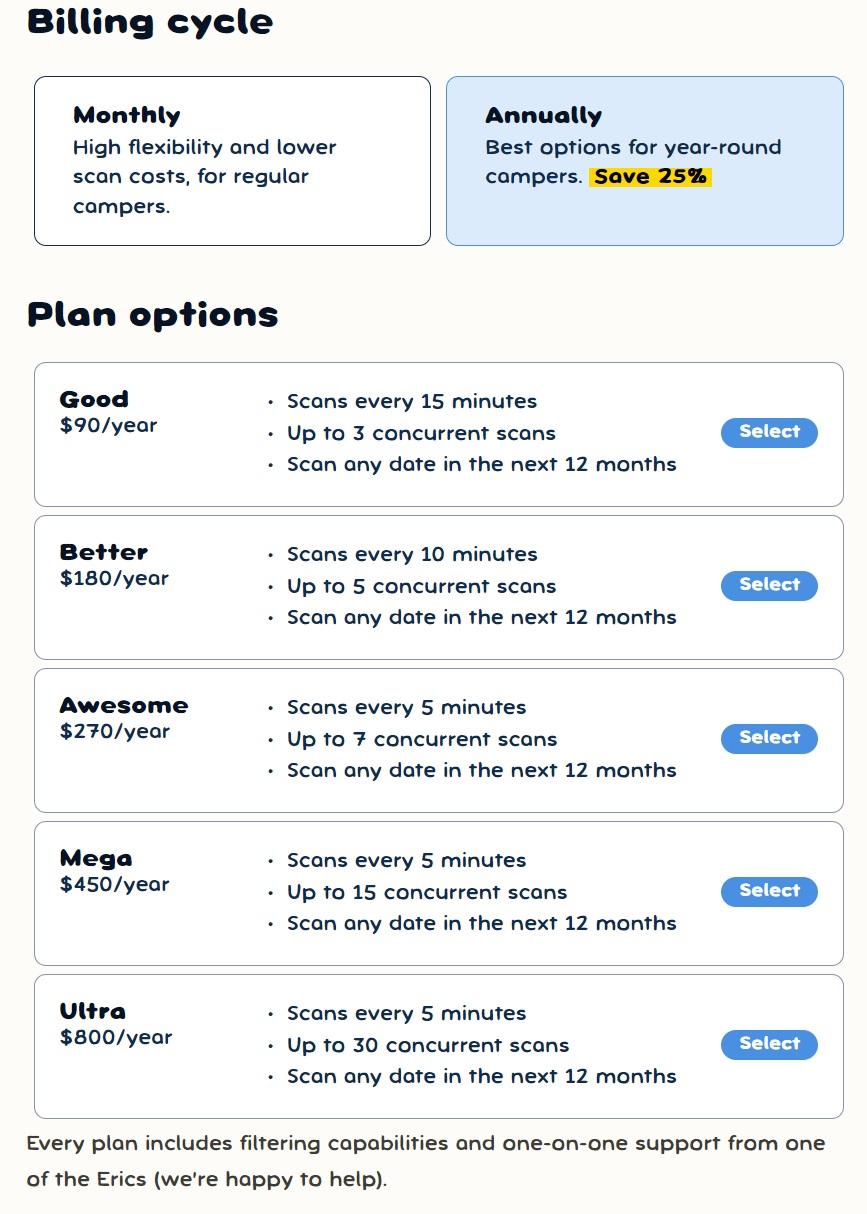
CampNab however is for profit, and charges, like a lot a lot. Omg.

OK so there’s enough demand for cancellation scanning that the service can charge more than a max premium subscription to something like say Garmin InReach. There may also be potentially as many subscribers.
Seems like a combination of enough demand = enough $ to incentivize cancellations that are currently no-shows. I imagine this is also primarily frontcountry sites in demand by the touring culture. Interesting. But probably not much help on backcountry no-shows.
maybe recreation.gov should ban automated servers. that would even out the playing field a bit.
^^ That had me looking up automated servers. I got maybe a hint of a clue. Want to elaborate? Are you suggesting that requesting system wide cancellation updates be de-automated? Something like that? So that at least for a period of time cancellation searches would have to be somewhat specific by locale or something like that? And so presumably more likely to be individually generated? Am I even close? Like same hemisphere?
This has reminded me of an anecdotal story I read somewhere back @ 2018 about trying to get a permit for a backcountry site in Glacier out of 2 Medicine. The person telling the tale as I recall said there was a schedule for permits becoming available like 180 days before the date? and they had like 4 people in the group in different locations around the country on multiple computers primed to apply for the crucial permit (first day in!) and still missed it on the first try. Think that would lend itself to an automated digital effort?
It is odd they don’t just have a waiting list though. Maybe it could be randomized instead of being a queue, to further reduce the gaming.
More regulations on the regulations which will further choke the system. Perfect! If the park is overrun by $100k fancy campers, you think they’ll give a dang about a fine? Don’t get a permit, skirt the system, go off trail, avoid the crowds, enjoy the peace and solitude.
“It is odd they don’t just have a waiting list though. Maybe it could be randomized instead of being a queue, to further reduce the gaming.”
Yosemite’s system now effectively does this for all permits. A random lottery for spots in the trailhead quotas. Seems to work OK. Any spots not taken for any trailhead in the lottery then become available online a few days after the lottery ends.
” Don’t get a permit, skirt the system, go off trail, avoid the crowds, enjoy the peace and solitude.”
This often works. I go places that don’t require a permit, and I do tend to go places that are away from the crowds, often off trail. But that doesn’t mean I never want to go backpacking in Yosemite again…
Personally I think more wilderness, more recreational area, all while pushing motorized access back would be an ideal solution across the board. Visitors beat a place up by loving a place, but plunking down a house just murders a wild area. As one architectural course lamented, placing a house on a scenic view alters that view. Hope the need for a big lawn, especially in the desert (trying to turn American deserts into Scotland) subsides as more kids opt for online communities.. another discussion I guess.
Permits are needed to cope with backcountry overuse in the meantime, at least for the most popular season(s).
One of the longest running is the Grand Canyon
Some points from the GC experience
part of [managing permits] is knowing how the finesse the system: go in on a weekday, the earlier in the week the better;
In the Grand Canyon, actually Tuesdays became tough to get as more backcountry users had the same idea.
Think some US parks wanted to push back vehicle access but were defeated. Still think it should be brought up again with maybe using the surrounding lands for outdoor recreation plus giving larger wildlife a bigger buffer geographically. This would also spread out outdoor recreationalistas and maybe spread out the wealth too … cause sandwiches.
[fines]
The problem here is economic access. People who cannot afford to visit parks and wilderness will not support these later (politically). One UCLA geography professor went so far as to say our concept of wilderness in North America is pretty Euro-centric. Last thing needed is less political support for conservation and preservation IMHO.
..
More generally..
I feel population has increased to the point that there are just too many people in the world
World population has actually flatlined as more realize they can’t afford it (do an internet search on “baby bust” .. a socio-economic discussion though best left for economic forums); where this affects wild areas is municipal code management and engineering = replacing more spread out older properties with denser newer ones. Heck even looking at a place in fairly benign San Diego, the foundation heaved a bit as decades of swimming pool water went under the (slab) foundation. Would be nice to replace these old shaky homes with more efficient newer ones if a beach view isn’t involved (let’s be realistic too). As I wrote this, a neighboring house just got covered for a termite fumigation, so wondering what the lifespan of said older developments really are? Nothing like rotted wood in an earthquake zone/ bust it up and put in a more modern/more raised (raised) triplex I say.
Not that there’s a central committee for all this, but something conservation groups may want to look at
tl: dr; think we will need more recreational and wilderness areas vs development especially in mountain areas. Not to turn this into a discussion of neighborhood [re]design, but that’s what it’ll take honestly.
“One UCLA geography professor went so far as to say our concept of wilderness in North America is pretty Euro-centric.”
Not sure about the wilderness concept but there are some things about Europe I wish were more prevalent here. One is the relative ease with which one can go almost anywhere without a damned automobile. The other is the apparent concept of rights of way for foot traffic along property lines that have been in use for centuries so there are paths all over the place. The various countries have stitched together these traditional pathways into a multitude of trails. There are trails everywhere. In this country we (they) are closing off traditional back roads and paths as fast as possible it seems with private property owners all over and especially the west shutting off routes that used to lead through the private property to tracts of public property; often to then effectively monopolize the use of that now almost inaccessible public property.
Interesting discussion and solutions, if any, are complicated. Penalties for no-shows – what if you get into a car accident on your way to the trail? Have projectile vomiting and diarrhea? Sure, probably most are just lazy or forgetful. But so many what-ifs; as a teacher, I know my students can come up with excuses I never imagined and so can people with permit reservations and not showing up.
Public land managers do sometimes come up with ridiculous rules that serve no one. Denali NP used to have one loop for RVs and one for tents, in their main campground. Even if it was 10pm and there were 10 RV sites vacant and unreserved, they wouldn’t allow tent campers there. Several times I had to go find back roads and stealth camp rather than pay a fee and camp in the campground, because I didn’t have an RV. NPS didn’t see the problem.
I agree with Murali, we have an ever expanding population and the situation is only going to grow worse as demand increases. At least right now we’re only debating over access to hiking and camping and not access to food and water. Yet. First world problems.
My daughter sent me a link to this article. Good read and relevant if not exactly on target. The Writing on the Wall
Great article and those expansive pictures of Crested Butte looks amazing!
I was thinking that maybe the overcrowding of beautiful places happens more easily nowadays due to social media like Instagram, Youtube, Facebook etc. These pictures reach more people now compared to before.
Social media makes a big difference as has the pandemic. Here on the OBX we have seen almost exactly the same #’s as specified in the article with 2020 up @ 20%+ over any past year and then 2021 up again by 5-10% with big; almost 100% increases in October and May. A 25% increase is the type of growth you’d like to have and be hard pressed to manage in a typical decade especially without a large or commensurate growth in properties. To give you another # that might bring it into better focus it’s @ going from 300,000 population on a summer week to 400,000. In less than 2 years by complete surprise. In early May of 2020 I could walk down the sidewalk beside the main and only highway and not see a single auto at times. We didn’t know then if we’d even have a season.
It’s pretty staggering. Just take 1 item for example like garbage. If you’ve been running that system close to capacity all of a sudden now you need 25% more trucks? (you know how much a garbage truck costs?) or 25% more trash pickups plus drivers/staff plus wages/time, plus maintenance-repair plus tipping fees and landfill capacity and so forth. And that’s just one item of dozens. It’s staggering and likely un-sustainable. How about water? No one is talking about that or not publicly or officially but we can see pressure swings and one has to wonder? But let me say that our local governments are top notch and on the surface other than all the traffic and people around and lines to get into restaurants you really wouldn’t know that much was going on. Things are running smoothly. We’ve got some really competent people in the right places.
I think what the article hints is that the combination of the 2 (pandemic + social media) have given us a foretaste of the future. The pressure on resources may likely abate once people can get back to other activities where close contact is typical but what we’ve seen the past couple of years and from the reservations here on the OBX we will see this coming season as well is like an HG Wells time machine trip into the future.
What the folks in Crested Butte seem to be doing a good job of is preparing for that future. What we need to be advocating is not just a better permitting system that avoids waste but also greater capacity which means more parks and more recreational opportunities/trails/campsites and so forth. This wave may likely subside but it’s given us a look into the future.
For those frustrated by high park visitation making it hard to get permits… try one of these less visited parks:
15 least-visited US National Parks in 2021
1. Gates of the Arctic National Park & Preserve, Alaska – 7,362 recreation visits
2. National Park of American Samoa – 8,495 recreation visits
3. Kobuk Valley National Park, Alaska – 11,540 recreation visits
4. North Cascades National Park, Washington – 17,855 recreation visits
5. Lake Clark National Park & Preserve, Alaska – 18,278 recreation visits
6. Katmai National Park & Preserve, Alaska – 24,764 recreation visits
7. Isle Royale National Park, Michigan – 25,844 recreation visits
8. Wrangell-St. Elias National Park & Preserve, Alaska – 50,189 recreation visits
9. Dry Tortugas National Park, Florida – 83,817 recreation visits
10. Glacier Bay National Park & Preserve, Alaska – 89,768 recreation visits
11. Great Basin National Park, Nevada – 144,875 recreation visits
12. Congaree National Park, South Carolina – 215,181 recreation visits
13. Denali National Park & Preserve, Alaska – 229,521 recreation visits
14. Voyageurs National Park, Minnesota – 243,042 recreation visits
15. Guadalupe Mountains National Park, Texas – 243,291 recreation visits
How is the Henry W. Coe park these days? I spent a lot of time there in the early to mid 2000s when I lived an hour or two away, and recall after you got past Coyote Creek you could go for over a week without seeing a soul. Especially in the Orestimba Wilderness, it was just wildlife, escaped cattle, aaaaand airliners flying directly overhead.
That’s a nice list of parks, but the 2021 numbers do not reflect normal years, especially for those connected by roads. Many of the Alaska listed ones require expensive flights from the hub airports, and lodging options are expensive and minimal. They also require the ability for backcountry users to be very well prepared and experienced. As a long time Alaskan, I wish I could visit some of those; it’s less costly to fly to the lower 48 in most cases. And while permits may be easier to obtain, logistics are not simple.
Obx, interesting article regarding Crested Butte–has great interest to me as I live 1.5 hours away, and usually get to the area once or twice a year. And yes, I did see ridiculous amount of dispersed camping the past two years by folks who didn’t clean up after themselves. I would hope that those who choose to disperse camp could practice leave no trace ethics, but I can see that as a tough hill to climb. p.s. the times I was in the area was to access a trailhead, and then camp a number of miles up the trail in the backcountry, where for the most part I didn’t see these issues.
What if rec.gov sent an email 30 days before your entry date and you had 72 hours to respond in order to keep your permit? It’s not so different than my dentist calling me a week before a cleaning to confirm the appointment.
30 days is a lot different that a week… and committing to a one hour appointment is different than committing to a multi-day backpack.
Me… I never know FOR SURE that I am going 30 days out… never…
or, within one week of the trip you have to download the official permit
if you don’t do it before the due date, that slot gets assigned to someone else
I think Olympic National Park does something like that. I don’t know if it’s to reduce no shows.
Are no-shows an issue? You may think removing no-shows increase the permits available to everyone else, but if people are gaming the system then those additional permits will go to those same people. Also, those same trails with quotas seem pretty full as is. The park service probably takes no-shows into account when setting the trail quota. Reducing the waste may just end up reducing the quota. To me if you don’t fix the system so everyone has a fair chance, you haven’t done anything.
Fair???? …. ha… No matter what system, there will always be people who think it not ‘fair’.
We have 300+ million people in the USA… and 300+ million ideas of what ‘fair’ means… :)
I bet the park service already put a ton of hours into trying to figure out what is ‘fair’… and manageable… but… hey… not going to change anything by these posts alone… contact the park services… write letters… get petitions going… and even call your congressman…
Become a member to post in the forums.