Topic

Parallel Karo?

Viewing 21 posts - 1 through 21 (of 21 total)
PostedOct 30, 2017 at 11:44 pm

<div></div>
<div></div>
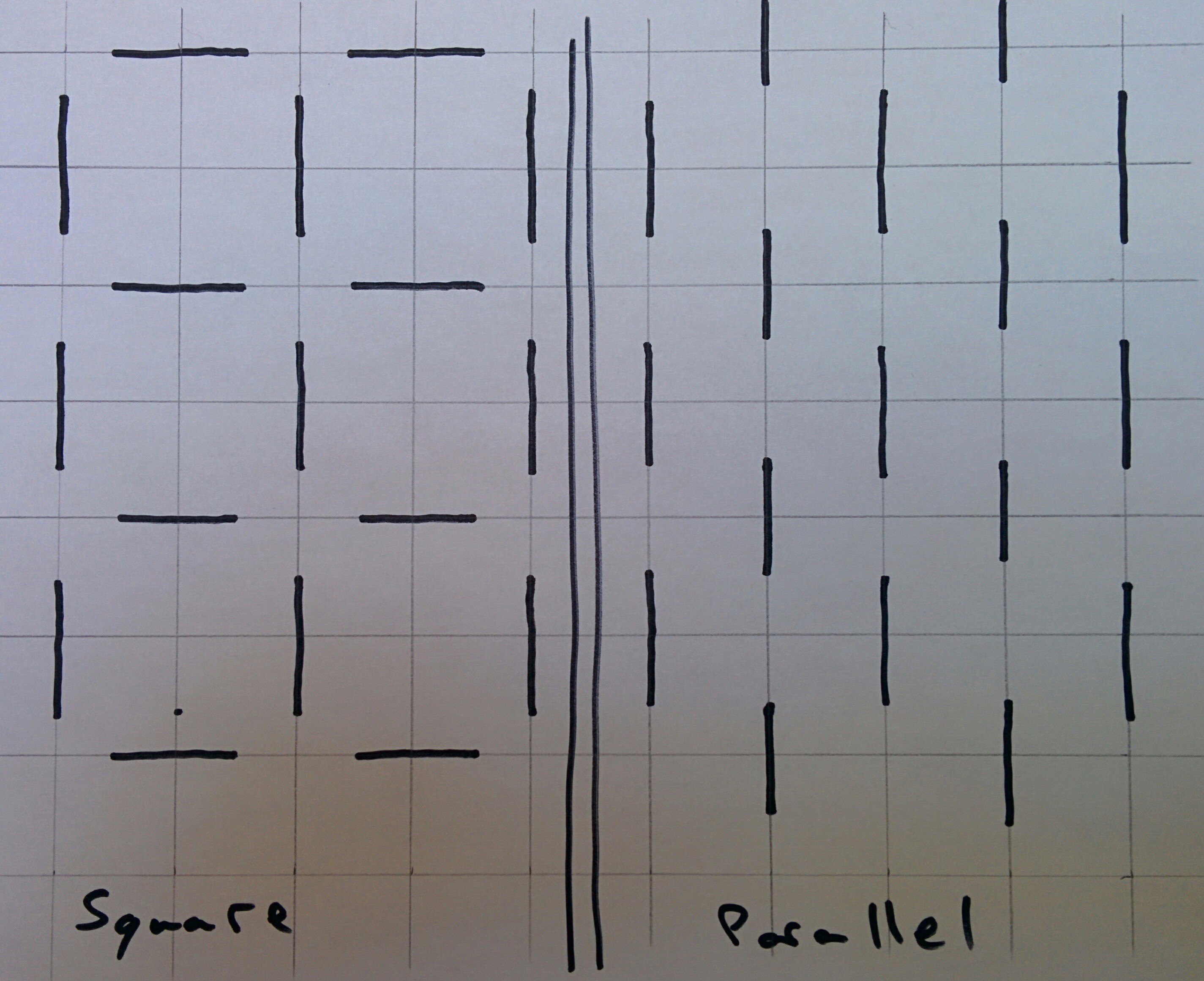
<div>Has anyone tried this?  Easier to sew because all the seams are in the same direction.  Basically just take all the horizontal seams and make them vertical.  Same seam count, seam length, baffle weight or cold spot area as the equivalent square.  It’ll definitely be easier to move down in one direction, not sure about the other.</div>

Geoff Caplan BPL Member
PostedOct 31, 2017 at 11:44 am

Hmm – I’d have though you might have problems with the down migrating from top to bottom, and it might be quite difficult to move it from side to side.

I have a good quality lightweight bag that uses unobstructed vertical baffles similar to what you are proposing. I like to concentrate the down above my hips, as that’s where i tend to feel the cold. But the down just won’t stay there – it migrates during the night towards my head and feet. When I use the bag near its limit this can end up uncomfortable.

The traditional Karo step has a bit of history behind it and most people seem to find it works pretty well if you get the proportions right. Why do you feel the need for something different? Before he switched  away from Karo to his current design for economic reasons, Tim Marshall of Enlightened Equipment did a lot of experimentation and eventually settled on the conventional square design in a  10/6 ratio. He says that strikes a good balance between loft and down control.

I’d have though you’d need a very good reason to reject that approach for something more experimental.

James Marco BPL Member
PostedOct 31, 2017 at 11:49 am

I agree, down will simply slip down along the “vertical tubes” you end up creating.

JCH BPL Member
PostedOct 31, 2017 at 12:56 pm

I have two EE quilts with vertical baffles that work great, and there are a number of other bags with the same architecture (marmot, memo, big agnes).  What is it that makes the down in those not “slip down”?

Geoff – you specified “unobstructed” baffles.  Are obstructions normal in vertical baffle construction?

Geoff Caplan BPL Member
PostedOct 31, 2017 at 2:07 pm

@JHC

If the vertical baffles work, I’d guess it would because there was a bit more overfill. My bag seems quite lightly filled for the baffle volume.

I mentioned that the vertical baffles were unobstructed just to make it clear that they ran from head to toe. I’ve never seen vertical baffles that had some kind of additional cross-baffle to inhibit top-to-bottom movement, though I can’t see any reason against it in principle?

Geoff Caplan BPL Member
PostedOct 31, 2017 at 3:10 pm

You folk who are planning a vertical Karo – what advantages do you feel it offers over the conventional square design?

Ken Thompson BPL Member
PostedOct 31, 2017 at 3:20 pm

OP states up front what those are,

” Easier to sew because all the seams are in the same direction. Basically just take all the horizontal seams and make them vertical. Same seam count, seam length, baffle weight or cold spot area as the equivalent square. It’ll definitely be easier to move down in one direction, not sure about the other.”

JCH BPL Member
PostedOct 31, 2017 at 6:51 pm

It took a little google-fu to come up with the right combination of search terms, but I finally found this re: “down flow gates” from a few years back.  Since I’ve never seen it mentioned since, I suspect the technology either didn’t work, wasn’t needed or died for some business/marketing/licensing reason.

Geoff – like you, “insufficient” fill was the only reason I could imagine for excessive shift.

PostedOct 31, 2017 at 8:13 pm

Yeah, motivation is easier to sew.  Justification of why it should work is the 2 dominant continuous baffle paradigms: vertical and horizontal.  Adequate fill makes both work.  So a parallel karo certainly has greater resistance to horizontal down shift than a horizontal continuous baffle – check that off.  And I don’t think it could really have significantly less resistance to vertical movement than a continuous baffle – so presumably we’re safe there as well.

As with any karo, there’s less weight in baffle fabric than continuous, and you only have to weigh and stuff one measure of down.

Yes, there is an established tried and true: the square karo in 10-6 or 12-6.  I’ve seen little experimentation outside this paradigm.  A while back I proposed a delta pattern may make more efficient use of materials.  Somebody made one and said it worked, but he made some mods for additional down control and didn’t offer much detail on performance.  I never tried it because I wasn’t in need of a down quilt.  Now I am, and I’m looking to optimize ease of assembly – baffle weight is already miniscule. (I have a sample of tulle that tips the scale at 0.25 osy – lighter than cuben.)

If I go with this, I’ll use either 5″ or 6″ for everything: channel width, wall length, wall gap.  Equivalent to either a 10-5 or 12-6 w/ the horizontal walls rotated.

This could just as easily be run horizontally rather than vertically.  That just means more rows of seams, so more time transitioning from one row to the next when sewing.

Adam BPL Member
PostedOct 31, 2017 at 11:54 pm

I think there is merit in your idea Rene. Try it and report back!

What width are Tim’s Enigma/Revelation vertical channels. It would make sense I think to be a little narrower than that and with perhaps shorter baffle height relative to desired loft…otherwise if the width and baffle height are the same for the same amount of fill, then it is garanteed to have more down shift than an Enigma. If that makes sense?

I agree, it looks much easier to sew than a normal Karo.

One thing that I think is advantageous is that vertical baffles/seems run in line with the length of the body, rather than (horizontal baffles) trying to force a straight line around the circumference…of course with horizontal baffles you can design with curved baffles but that is very painful.

Report back…I have a bunch of 950 down and materials sitting there (inc tulle baffles and .33oz cuben) intended for a quilt but I’ve never gotten around to it. My baffle designs were more complex (probably unneccessarily) and put me off.

:-)


PostedNov 1, 2017 at 4:57 pm

Good point about curved horizontal baffles.


Still mulling over various design aspects….

todd BPL Member
PostedNov 2, 2017 at 1:59 am

Other than leaving it under-stuffed, I see absolutely no reason why this wouldn’t work!  I love the idea.

My EE “vertical” quilts work phenomenally (is that a word?) so I am very optimistic and wish I thought of it first :)

I may try this myself.

Hoosier T BPL Member
PostedNov 2, 2017 at 2:31 pm

Having sewn a baffled underquilt, I can say that I feel like this would actually be MORE time consuming than just sewing continuous baffles. Having to sew the partial baffle, then stop and start another seams like it would take longer than just blasting through one continuous baffle. Also, I would not be a fan of having a bunch of lock stitches throughout the middle of my quilt as opposed to just having them at the ends. Everyone is different but I found sewing the baffles on to be very easy so I didn’t wish at all for less baffling. The only benefit I see to the above is easier stuffing and allowing down migration neither of which I care about since stuffing with the down eductor was a cakewalk and I don’t desire down migration. YMMV…

PostedNov 3, 2017 at 1:01 am

I’m not opposed to running a single seam the full length of the bag and adding the baffle segments at intervals along the way :)

Thanks for pointing me at the eductor.  Hadn’t seen that gadget before.

Edward John M BPL Member
PostedNov 3, 2017 at 2:29 am

I’m a little confused here so please enlighten me

Are you talking about stitched thru Karo step or do you intend to use short baffles? If using stitched thru I see no problems but if using baffle material I fail to see the point

As far as I’m aware the Karo step was first seen in Swiss EGGE sleeping bags in the early 70s in their Eskimo series and was a technical innovation to maximise loft with minimal stitching and create a warmer bag more cheaply and was most often seen as the inner in their  HA/Arctic  double, expedition sleeping bag series

PostedNov 3, 2017 at 5:24 am

Vertical baffles – not sewn through.  Seems to me the trouble of turning the quilt 90d in your machine is far worse for vertical baffles.  You can do the first side as a bunch of straight lines, then turn the whole thing and do it again (and if you were doing sewn through, you’d be done).  But you can’t do that when attaching the second half – much more manipulation of the fabric.  So the simplifying advantage of all parallel is even greater for vertical baffles.


Edward John M BPL Member
PostedNov 3, 2017 at 11:17 am

OK That isn’t a Karo step as I understood it but I still don’t understand why you think it is better than full channels, it is a lot more work and the down control will not be as good

PostedNov 3, 2017 at 5:34 pm

I don’t think cutting a long baffle in to 6″ segments is going to take much time, nor do I think inserting them at intervals on a long seam will be much more difficult than aligning a much longer strip of baffle material on the same seam.  It will however be much easier to measure, stuff and seal a karo quilt than a bunch of continuous baffles.  And based on the similarities to the accepted square karo, I have good reason to believe the down control will be adequate.

Viewing 21 posts - 1 through 21 (of 21 total)
Loading...