Topic

Outdoor Gear Journalism: Developing Trust Standards


Forum Posting

A Membership is required to post in the forums. Login or become a member to post in the member forums!

Home Forums Campfire Editor’s Roundtable Outdoor Gear Journalism: Developing Trust Standards

Viewing 9 posts - 1 through 9 (of 9 total)
  • Author
    Posts
  • #3843287
    Ryan Jordan
    Admin

    @ryan

    Locale: Central Rockies

    Companion forum thread to: Outdoor Gear Journalism: Developing Trust Standards

    The integrity of gear reviews is currently experiencing a decline in consumer trust. Consequently, the GearTrust framework, which is substantiated by research, has been developed to conduct credibility audits and elevate consumer confidence.

    #3843332
    Jeff McWilliams
    BPL Member

    @jjmcwill

    Locale: Midwest

    I have some objection to the claim that, First, most outdoor publications relied on subscription revenue, which gave them a financial buffer that helped insulate editorial decisions from advertiser influence. This revenue model fostered loyalty to readers, not brands.

    https://www.ftc.gov/sites/default/files/documents/public_comments/2009/11/544505-00025.pdf?utm_source=chatgpt.com

    In the traditional media model, advertising and circulation revenues have been relatively
    evenly split. Depending on the economy, the relative shares for circulation and
    advertising have been fluid, but for the magazine industry as a whole have stayed within
    a relatively narrow band. In 2007, advertising’s contribution to magazine revenue was
    just under 60 percent; circulation’s contribution just over 40 percent. Circulation’s share
    is larger now, with the falloff in ad pages and dollars in 2008 and 2009.

    The publication goes on to say that advertising dollars dropped significantly on or after 2008.  But before then, I don’t agree with the claim that traditional print media was funded primarily by subscription revenue and thus the conclusion that print media was more loyal to subscribers than to advertisers.

    The FTC publication is about print magazines IN GENERAL and not outdoor magazines specifically. I skimmed your quotes sources at the end but I didn’t see anything that suggested specific data about revenue from outdoor recreation magazines vs the print magazine market in general.

    Can you point to some research to back the claim?

    #3843338
    Ryan Jordan
    Admin

    @ryan

    Locale: Central Rockies

    Jeff – Thanks for catching that – I appreciate the pushback.

    My original wording wasn’t as precise as it should have been. I said that “most outdoor publications relied on subscription revenue, which gave them a financial buffer that helped insulate editorial decisions from advertiser influence.” That overstates the degree to which subscriptions drove the economics of outdoor magazines in the print era. I’ve logged this for an update to the article so that future readers get a more accurate framing.

    To clarify:

    The FTC’s 2009 report on magazine economics (comment from the Magazine Publishers of America) notes that in 2007, “advertising’s contribution to magazine revenue was just under 60 percent; circulation’s contribution just over 40 percent.” That means advertising was still the majority revenue source.

    There’s no specific evidence that outdoor magazines (e.g., Outside, Backpacker, Field & Stream, Ski, Runner’s World) deviated much from that mix. Those titles published hundreds to more than a thousand ad pages per year before the 2008 downturn, which suggests they were substantially ad-funded like most consumer magazines.

    The Pew Research Center’s State of the News Media report (also citing 2007 data) supports the same ratio: about 58% ad revenue, 41% circulation, and 2% digital.

    That said, the underlying intent, and the point I wanted to make, was about relative dependence – not absolutes. Compared to today’s online media models (where nearly 100% of revenue often comes from advertising, affiliate commissions, or sponsorships), the print-era mix was more diversified. That balance – even if roughly 60/40 – created at least some structural buffer between editorial and advertising.

    Circulation revenue, even as a (substantial) minority, provided a direct economic relationship with readers that today’s ad-driven and algorithmic distribution models have largely eroded.

    A more accurate way to restate my original idea would be something like this:

    “Earlier outdoor magazines operated under a more balanced mix of subscription and advertising revenue. While they weren’t fully insulated from advertiser influence, this diversified model fostered stronger alignment with readers than the single-source digital models that dominate today.”

    That better captures what I meant – and your critique helps get it there. Thanks again for prompting the clarification, and I’ll log this for a correction/update for this article with some others that I’m already working on.

    #3843341
    Jeff McWilliams
    BPL Member

    @jjmcwill

    Locale: Midwest

    Thanks for the clarification, Ryan.


    #3843560
    David C
    BPL Member

    @dcaspira

    Hey Ryan,

    To be fair, consumerism has driven the economy for a while now (as has advertising, as a way of directing our desires & consumption patterns). If I’m reading this correctly, BPL is a members based site – so rather than advertising centric algo’s or publications determining our desires, BPL will aid here with a metric to the membership base, rather than have to navigate advertising economies – a BPL “Trust” if you will – is that the gist ?

    #3843567
    Terran Terran
    BPL Member

    @terran

    After years of following Consumer Reports, I came to the realization that their biggest fault was through omission of the products that they failed to report on. While it’s virtually impossible to cover them all, learning to recognize red flags and false claims can be a virtue.

    #3843609
    Jon Fong / Flat Cat Gear
    BPL Member

    @jonfong

    Locale: FLAT CAT GEAR

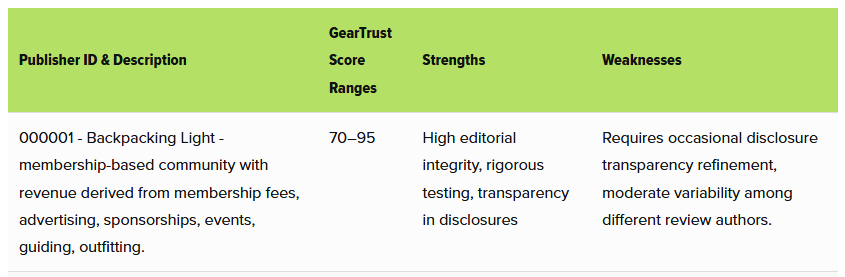
    So, by your metric, Backpackinglight rates very high.  Apparently, you do not see an issue with self-evaluation?  I do enjoy Rogers articles as I find them very well written and balanced.  I wish that other BPL articles were as well documented and researched.  There certainly was a lot of thought and energy put into writing about journalistic integrity.  That being said, in pursuing this journalistic integrity, this is usually down as a third party function and should be independent of Backpackinglight.  Ther is too high of a chance of bias or lack of independence to be considered relevant and trustworthy.  My 2 cents.

    #3843665
    David C
    BPL Member

    @dcaspira

    Jon, my thoughts to your point, the score is mostly useful outside this site. But to what reason would the publishers, algo’s or anyone else be interested in supporting the overhead. Perhaps it’s a folly, or perhaps Ryan has something up his sleeve ?

    #3843680
    Terran Terran
    BPL Member

    @terran

    I guess we could find a bias in all things. I’ve learned to expect it and try to use my own rational for evaluation. Certainly if all those with any perceived bias quit writing articles, we would have very little information. Often the goal is not to inform as much as it is to get the conversation started. Open source in which we’re all free, excluding the cost of membership,  to contribute. Good subject matter.

Viewing 9 posts - 1 through 9 (of 9 total)
  • You must be logged in to reply to this topic.
Forum Posting

A Membership is required to post in the forums. Login or become a member to post in the member forums!

Loading...