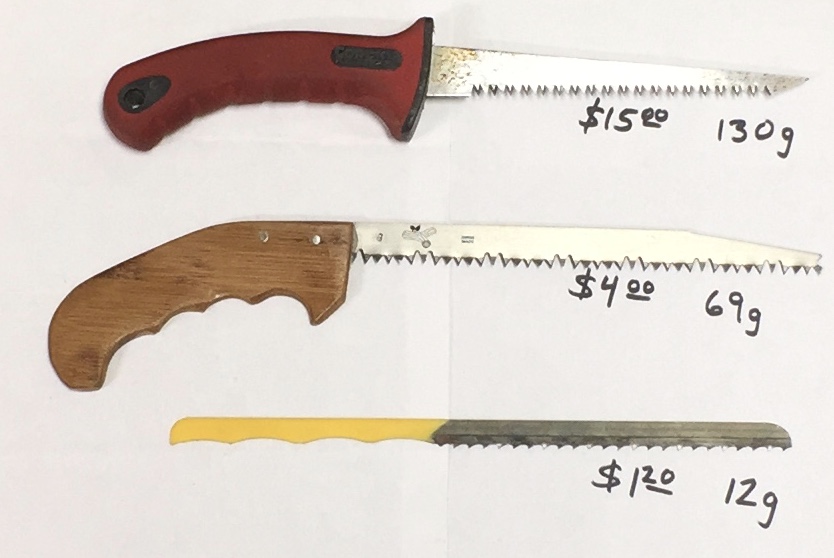
I’ve done a couple of batches of MYOG, SUL wood saws from band-saw blades. Cheap (about a $1 of materials each), really light (11-14 grams depending on length) and pretty quick to make, but kind of limited to 1″ diameter branches. You could do 2-3″ stuff in a pinch, especially if you wear a glove or a sock on your hand. That’s fine for what I do up here and because the driest firewood is the dead branches at the bottom of spruce trees. So gathering those up works well, as long as you don’t need bigger stuff to burn through the night.
I’ve played with various jigsaw blades and while they are cheaper, light, and sharp, they aren’t quite long enough to be very useful. And I’ve struggled to make a solid connection from their tiny shanks to some manner of handle.
I’ve also used reciprocating saw blades, but most of ones sold in hardware stores are for metal or wood with embedded nails and while long-lasting, aren’t super sharp. But the ones sold for pruning trees? They’re really sharp:

$3-$4 in a 3- or 5-pack on Amazon. 9 to 12 inches is about right – some will end up in the handle.
So I set out to see if I could beat an name-brand (Corona) prune saw that already had a nice handle. (Spoiler: yes, you can. In both weight, cost, and ergonomics.)
First, I cut some cardboard patterns so get the right finger widths for my hand. I put a good bump at the end so I could pull hard on it and a substantial bump on the front so I couldn’t push my hand onto the blade. I used that pattern to roughly cut a piece of bamboo flooring into handle. The bamboo is very stable and uniform. A lighter wood would be, well, lighter, and quicker to sand down, but I like how stable bamboo is when it gets wet. Before I cut it down, I run one edge over my table saw so it had an 1/8″ slot to receive the blade. I used Gorilla glue (water-activated) to fix the blade in the handle, drilled two holes for two counter-sunk screws, and Gorilla-glued them in as well. To do it again, I’d have drilled smaller holes and used 16-penny nails (super cheap and high shear strength).
Most of the shaping, I did on a belt sander: