Topic

MYOG USB power bank


Forum Posting

A Membership is required to post in the forums. Login or become a member to post in the member forums!

Home Forums Gear Forums Make Your Own Gear MYOG USB power bank

Viewing 25 posts - 51 through 75 (of 78 total)
  • Author
    Posts
  • #3836565
    Jerry Adams
    BPL Member

    @retiredjerry

    Locale: Oregon and Washington

    Looking at the nitecore website, the NB10000 gen 2 has a capacity of 38.5 Wh.

    Powerbanks are always spec’d by the size of  the lithium batteries on board.  The NB10000 has 10,000 mAh of lithium batteries.  38.5 Wh would require 10 Ah of 3.85 volt lithium.  Hmmm… that exactly matches, I wonder if the Wh they list is just 10,000 mAh times 3.85 V.  Or do they actually measure it.

    Ahhh… there’s another nitecore1000, the gen3.  That has a 10,000 mAh battery (38.5 Wh).  Maybe they again just multiplied 10,000 time 3.85 V.  Then it says rated energy: 5,400 mAh 5V (TYP 2A).  I wonder what that means.  5,400 mAh at 5V converts to 7,013 mAh at 3.85 volts.  Nowhere close to the 10,000 mAh spec.  If the electronics inefficiency causes the 10,000 mAh to be 7,013, that would be very inefficient.  If you look at something like digikey, 95% efficient convertors are routine.  I wonder what the “energy mAh (TYP2A) means???

    Nitecore lists an 18650 that’s 4000 mAh and  \$23. Compared to about \$5 each for various batteries on amazon, including that 9,900 mAh battery I bought that was actually 1,000 mAh.

    That’s weird.  if you type \$$, that instructs the text to go into an italic mode and if you type \$$ again, it goes back to normal mode.

    If you put a back slash before the dollar sign, it doesn’t.

    #3836747
    Jerry Adams
    BPL Member

    @retiredjerry

    Locale: Oregon and Washington

    after listening to Bill

    I used my MYOG power bank to charge phone.  It delivered 6 Wh.

    I charged it back up, and it required 12.4 Wh.

    If you assume it’s equally inefficient charging and discharging, that would be 70% efficiency.  12.4 * 0.7 * 0.7 = 6.  Like Bill said.  And the battery would be charged to 12.4 * 0.7 = 8.68 mWh = 2250 mAh.  Not that bad compared to the 3000 mAh label.

    I did the same with my 10,000 mAh Anker power bank, a fairly old one.  23 Wh to discharge (into a 1A load).  36.5 Wh to recharge.  So that would be 80% efficiency, a little better than my MYOG power bank.  36.5 * 0.8 * 0.8 = 23.  And the battery inside must be 36.5 * 0.8 = 29 Wh = 7600 mAh of 3.85 V lithium battery voltage.  It’s pretty old so reasonable that it lost capacity from the nominal 10,000 mAh.

    The 23 Wh of the 10,000 Anker is good for 3 days, so I need 8 Wh per day.

    If my MYOG power bank is 70% efficient, one 4000 mAh nitecore 18650 battery would provide 10.8 Wh.  4000 * 3.85 * 0.7 = 10800.  Maybe 3 batteries would suffice for 4 days.  batteries are 1.7 ounces.  the power supply is 0.7 ounces.  I would want to carry a second power supply because I don’t trust this cheap stuff from China.  So, that would be 6.5 ounces total.

    Currently, I use an Anker 13K power bank for 4 days, which weighs 8.5 ounces.  My MYOG power bank saves 2 ounces.

    Of course, the modularity allows you to take just as many batteries as you need for any trip which would be an advantage.

    I suspect my MYOG would be more reliable because both power banks would have to fail.  And if just one battery failed that wouldn’t be a big deal.

    If the 13K Anker failed, it wouldn’t be that big a deal, I’d just stop using my phone.

    And my 9900 mAh battery would be a little better than I said, maybe 1200 mAh.

    #3837680
    Jerry Adams
    BPL Member

    @retiredjerry

    Locale: Oregon and Washington

    Uh oh, I put a nitecore 18650 battery in my cheap power supply.  It’s longer than the other 18650 by about 1/16 th inch.  The way my cheap power supply is designed, with the battery holder soldered to the board, caused it to flex.  I think something shorted out.  Anyway, small puff of smoke and it’s dead.  About what I expected from a cheap power supply.  It worked for quite a few cycles.

    #3837714
    Scott S
    BPL Member

    @jumberlack

    I don’t think anyone on this thread mentioned the Nitecore NL2150RX 5000mAH USB-C 21700 battery .. it’s 2.5oz and the USB-C port runs both ways so no need for anything but a cable.  The main thing comparing this to the Vapcell is Nitecore is a well-known brand.  The Vapcell P2150A has similar weight and uses a good cell, but the circuitry I’m not so sure about.  There are reports of it not charging watches due to lack of load and also phones that can charge other devices through their port can start charging the battery if it gets down to zero while charging the phone.  So you just ping-pong the electrons back and forth and burn away a lot of power until you realize what’s happening.

    I painted the ends of my NL2150RX with epoxy so it won’t short when its wet.

    #3837732
    Jerry Adams
    BPL Member

    @retiredjerry

    Locale: Oregon and Washington

    Yeah, having a USB c connector on the battery is a good idea.

    If you brought more than one the redundancy would provide good reliability

    #3837749
    William Chilton
    BPL Member

    @williamc3

    Locale: Antakya

    I don’t think anyone on this thread mentioned the Nitecore NL2150RX 5000mAH USB-C 21700 battery .. it’s 2.5oz and the USB-C port runs both ways so no need for anything but a cable.

    I have this, and it’s served me well so far. However, there are several reports of them failing on the British trek-lite forum.

    #3839662
    Jerry Adams
    BPL Member

    @retiredjerry

    Locale: Oregon and Washington

    My MYOG USB powerbank blew up – maybe it was because I plugged the battery in backwards.  I bought a similar product, the powerboost 1000 from adafruit.  That seems like a better product than some unknown manufacturer on amazon.  There are data sheets for the parts.  There are discussion forums where adafruit people actually answer questions and seem to know something.

    First, I tested the Anker 13,000 with the USB power meter and load as suggest by Rex.  I charged it, then ran it with 1A load until it turned off and I measured 40.8 Wh.  I can’t find any specs for this.  Anker has no specs.  I found someone online that measured it at 42 Wh.  So maybe I’m close.

    This is good for 4 days, maybe 5 days of my backpacking, so I need something like 8 or 10 Wh per day.  I take a gaia track, and listen to podcasts with earbud.

    I tested two Nitecore 4000 mAh batteries. I soldered an 18650 battery holder to a usb connector, then plugged in a USB power meter and 1A load, 3A load, and 0.2 A load.  The USB power meter works down to about 3 V, which is the lowest I want to run the 18650 battery.   This tests the capacity of just the battery without any electronics.  Rex suggested the USB power meter and load.

    Bat #  load   avg current  Wh

    1         1A       0.7A              12.45

    1        3A       1.8A              11.6

    1        0.2A   0.12A            11.1

    2       1A       0.7A              12.2

    The first line is battery #1.  I have two Nitecores.  It uses the 1A load, which is at USB voltage of 5V.  I’m using it with the nominal 3.6V battery voltage so the actual current averages at 0.7A – it’s higher when the battery starts at 4.2 V, and gradually drops to 3.0 V.  The Wh measured was 12.45 Wh.

    You get the most Wh with an intermediate load – ~0.7A.  It must be that as you increase the current, there’s some loss, so it has less capacity.  At really low currents, the parasitic loads, like the bright LED, are on for a longer time so capacity is less. I didn’t repeat this so I may be off on this, but I try to have the current out of the battery about 0.7A to optimize capacity.

    The measurements of the two batteries are about the same – 12.3 Wh average.  Nitecore specs it as 14.4 Wh, but maybe they’re just multiplying 3.6 V * 4000 mAh and they don’t actually test it.  I found someone that measured it online, but they measured 4032 mAh.  If they measured close to 4000 mAh, then it should have about 14.4 Wh.  Maybe there’s some error in my measurement, or maybe the batteries are a little below spec.

    12.35 Wh average capacity of batteries.  The spec is 14.4 Wh.  Why do I measure them less than spec?  I only went down to 3.0V on the batteries. I could have have gone a little below that and got maybe another 0.5 Wh.  I measured a 2.048 reference voltage which is +- 0.1%, and determined the USB power meter measures voltage 1% low.  If the current was also measured 1% low, the power would be calculated 2% low.  That would be 0.26 Wh.  So, maybe the capacity is actually 12.35+0.5+0.26 = 13.1 Wh. Within 9% of spec.  For some reason, battery manufacturers mostly just spec the mAh but I never see in verification.  I won’t be critical of manufacturers that aren’t meeting spec.

    Then, I charged bat #1 and used it to charge my phone with the powerboost 1000.  I ran the battery down to 3.0V.  You can actually go lower but it might risk the battery.  If you go below maybe 2.9 V the nitecores have protection circuitry and they shut down.  I repeated for battery #2.

    The USB current when I charged the phone was 0.49 A – so the current out of the battery was about 0.7A because of conversion and inefficiency, about where the optimum is for Wh capacity.

    Bat #1 – 11.5 Wh, charged the phone 47%

    Bat #2 – 11.26 Wh – 46%

    The average of just the batteries is 12.3 Wh.  The average of charging the phone is 11.4 Wh. So, the efficiency is 93%.  The data sheet for the part says something like 95%.  93% of the battery capacity actually goes out the USB port.  7% is consumed by the powerboost 1000.

    The guy at adafruit said another device – “ubec” – was more efficient so I tried it.  That requires 2 batteries in series to produce about 7 volts, then use a step down converter to lower that to the 5V USB voltage.  With 2 bats in series, and a 1A load, it delivered 23.84 Wh.  The capacity of the two bats is 12.2 + 12.45 = 24.65 Wh.  So, the efficiency is 23.84 / 24.65 = 97%.  That’s consistent with what the adafruit guy said, but, it’s such a small improvement compared to the powerboost 1000 that it’s not important.  Part of what makes the 1 battery solution good, is the flexibility of taking just as many bats as you need, not being restricted to an even number of batteries, and there are no LEDs or anything on it so you don’t know how discharged it is as you use it.

    But, if someone wanted to design a more efficient powerbank they could do something like this, only include LEDs, charging circuitry (the ubec is just a voltage regulator),…  Powerbank manufacturers don’t seem to be into high capacity per weight, as BPL people would like, but instead are into fast charging and wireless charging.   And influencers.

    The powerboost 1000 has a blue LED indicating it’s working, and a red LED comes on when you used up about 60% of the bat.  Neither ubec or powerboost have battery protection – they’ll just keep going until the battery goes down to zero (?).  At some point the battery can be damaged.  The nitecores have protection internally and turn off when the battery gets below something like 2.9V so I don’t have to worry about that.

    Weight of Anker 13,000 8.5 ounces.  Weight of powerboost 1000 + battery holder 0.6 ounces.  Weight of nitecore 4000 battery – 1.8 ounces.

    If you wanted to have a 13,000 mAh solution with powerboost, it would require 3.25 batteries, that would weigh 6.5 ounces – so you save 2 ounces compared to Anker with this solution.

    If you wanted to have a 40.8 Wh solution with the powerboost, it would require 3.6 batteries (11.4 Wh).  That would weigh 7 ounces – so you save 1.5 ounces.

    I think most people would not consider that weight savings worth it.  If you wanted to have just enough for 1 day, and took 1 nitecore battery, that would weigh 2.4 ounces.  That might actually be a useful strategy – saving 6 ounces compared to the Anker.

    I measured the bat #2 charging – it took 18.58 Wh. The battery capacity is 12.2 Wh.  Efficiency – 12.2 / 18.58 = 66%. Not very efficient. Fortunately, it doesn’t matter, the wall has unlimited power.


    #3839663
    Jerry Adams
    BPL Member

    @retiredjerry

    Locale: Oregon and Washington

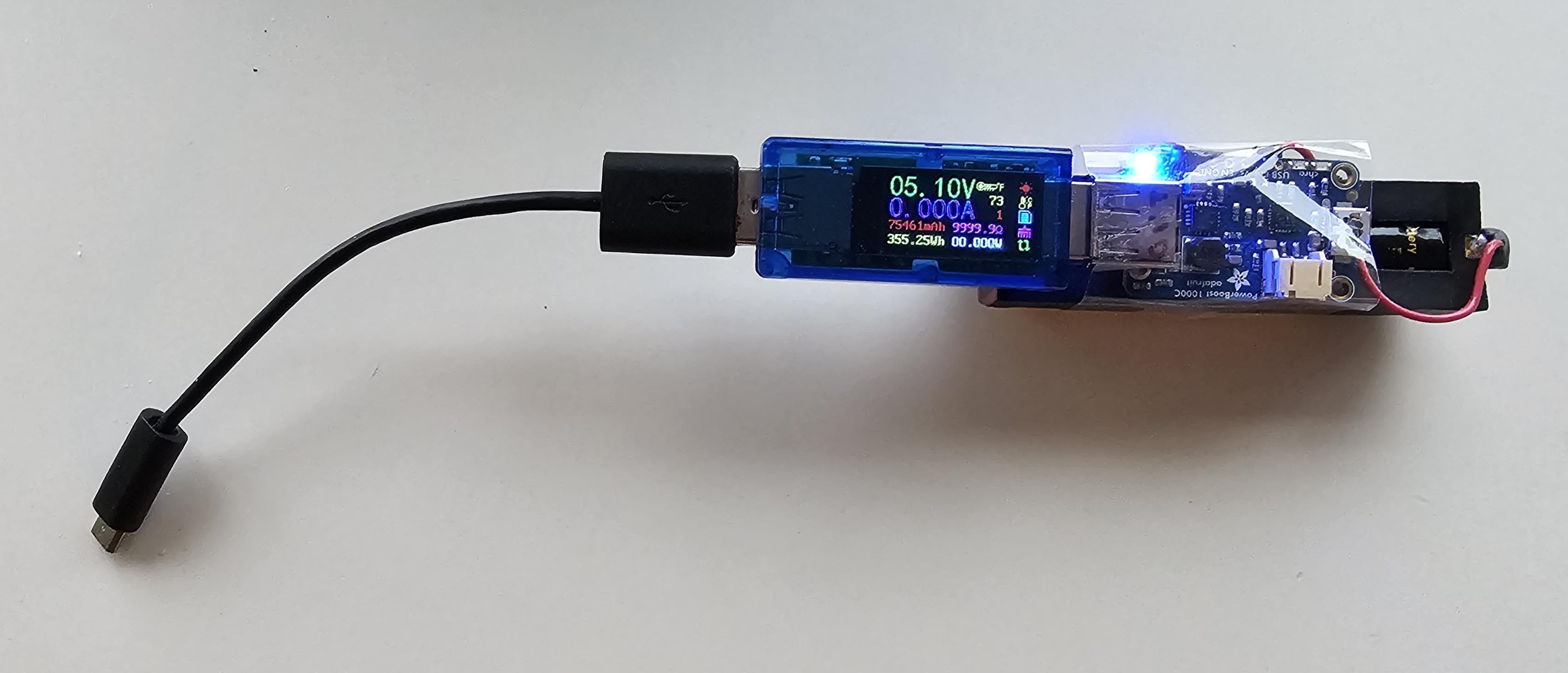
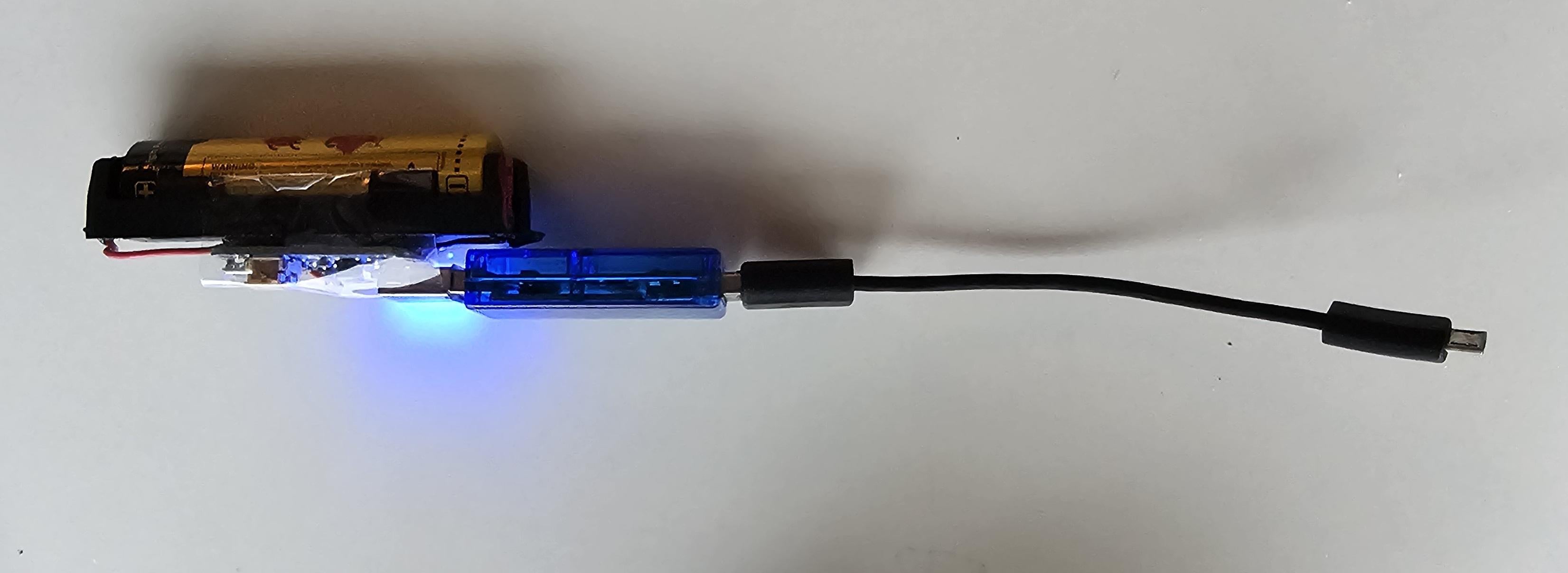
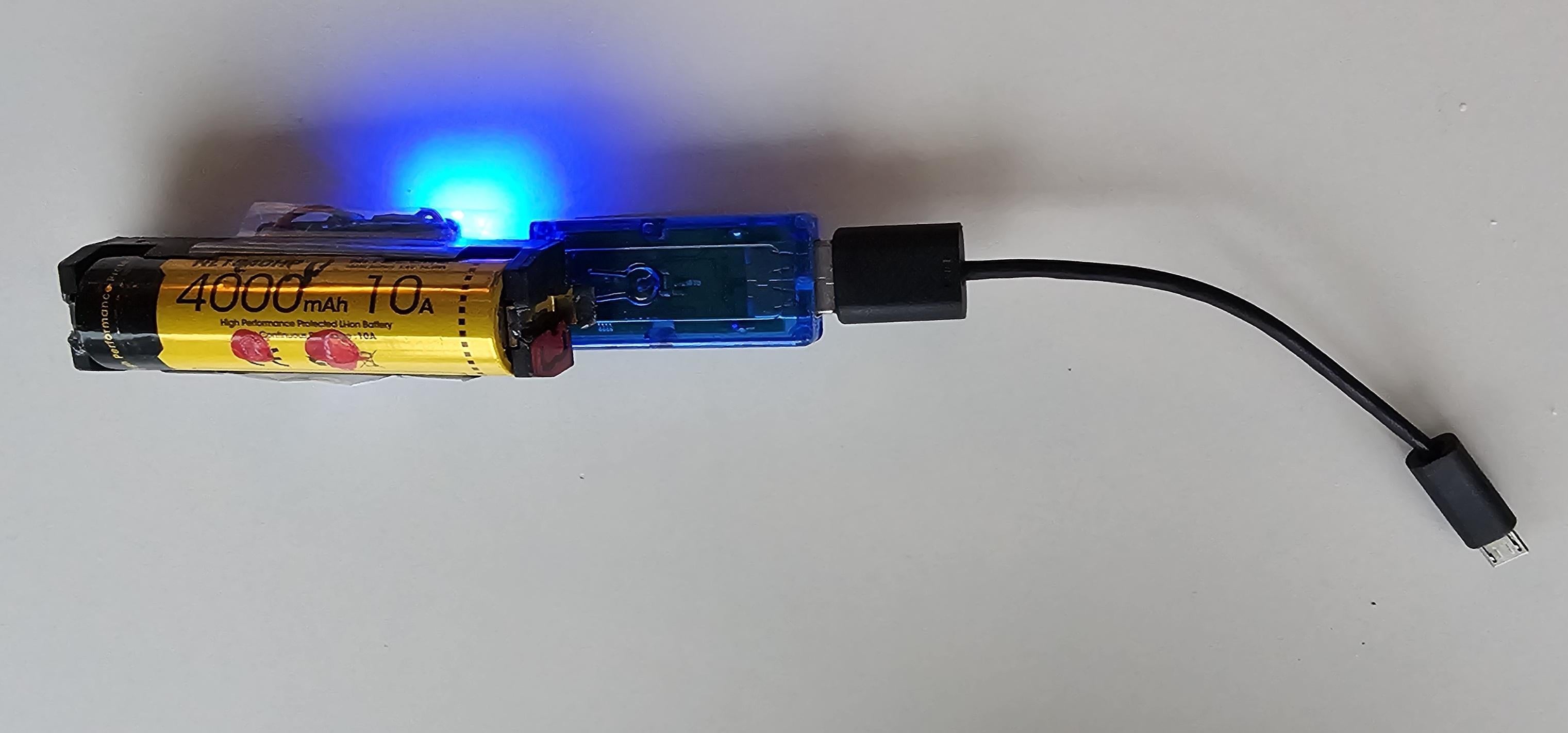
    Top view.  The powerboost is attached to the holder with tape.  To protect the circuit.  There’s also some epoxy a couple places to prevent it from touching anything metal.  There’s a USB power meter plugged in, and the phone charging cable.


    Side view:

    Rear view.  Nitecore battery plugged into holder:


    #3839805
    Jeff McWilliams
    BPL Member

    @jjmcwill

    Locale: Midwest

    Interesting tests of battery capacity and efficiency.

    That being said, I would never take that Adafruit PowerBoost 1000 backpacking.  Those things are designed to be part of electronics projects, not to be thrown in a backpack where they would be abused, squashed, banged around, rolled on in the middle of the night etc.  In real world use, I would expect them to fail relatively quickly.

    My XTAR PB2S is good enough in terms of size, efficiency, and flexibility.  The newly released PB2SL V2.0 looks even better.  It works with 1 battery or 2.  It can work with flat-top and button-top 18650 and 21700 batteries.  It supports more quick charge standards.  What’s not to love?

    #3839814
    Jerry Adams
    BPL Member

    @retiredjerry

    Locale: Oregon and Washington

    Yeah.  That XTAR looks pretty good.

    Or the 217000 batteries have everything – built in charger and discharger.

    Or maybe better yet is to just take an Anker power bank.  One package with everything in it.  Or NB10000 is lighter.

    Yeah, the powerboost intended application is hobby projects.  Mostly, it’s just a vehicle for me to figure it all out.

    #3839817
    Bill Budney
    BPL Member

    @billb

    Locale: Central NYS

    Jeff, I just received an XTar PB2SL v 2, inspired by your recommendation. It’s a very nice device.

    What’s not to like? It weighs 3 ounces, mostly case, without the batteries! On the other hand, it’s also robust, so seems unlikely to fail. Tradeoffs.

    Once I get over the weight, though, the elegance of being able to carry exactly as much capacity as necessary is great.

    As a power bank, it has many fast-charging profiles and a low-power mode, so it does everything that I want a battery bank to do. As a charger, it is fast and the built-in display is terrific. It’s a nice package.

    #3839818
    Jeff McWilliams
    BPL Member

    @jjmcwill

    Locale: Midwest

    Bill,

    Thanks for the update!  Did you order the PB2SL V2 from China or somewhere else?  I’ve ordered 21700 cells and at least one PB2S from https://imrbatteries.com/ but they don’t currently have the PB2SL V2.’

    Jeff


    #3839819
    Bill Budney
    BPL Member

    @billb

    Locale: Central NYS

    Yes, I had to look around for the -sl variant. Found it on Amazon. It took several weeks to arrive, so probably shipped from China.

    #3839828
    Jerry Adams
    BPL Member

    @retiredjerry

    Locale: Oregon and Washington

    3 ounces???  That’s 2.4 ounces heavier than powerboost + holder.  Blasphemous : )

    That’s weird we’re still getting cheap stuff from China.  What about the tariffs?

    #3839879
    FlyingAvocado
    BPL Member

    @rhass

    @retiredjerry, That was really good write up, it’s really appreciated.

    With regards to the XTar chargers. I can share my experiences with these as I have owned two of these using 5000mAh 21700 cells, and used both on the trail; PB2S (I think) and PB2SL, running Samsung INR21700-50E unprotected cells.

    The TL;DR is I ended up switching to a Nitecore 10000NB gen2. Here is why.

    For both the I found the actual charging capacity to be underwhelming given the battery cell capacity. I was expecting at least 1.5x charges of my phone, but reality I usually would get out one full charge at best for two 21700s. My phone at the time was a Pixel 5a, which had a 4680mAh battery. Nevertheless, this limitation was a part of the large reason I made my original comment about the commercial packs outperforming most DIY solutions.

    I believe the two models I used operated the cells in series rather than in parallel. I think as result of this design, the charger would get pretty hot. I assume this is because it used a cheap VRM. For me, this was a tell that the VRM was fairly inefficient and would burn a lot energy as heat rather than pass it through to my devices to output the right voltage to whatever it is charging. If I recall correctly, this seemed to get worse as the cell voltages dropped.

    Another reason I ended up switching to the Nitecore packs was that the original model, had a seperate charge (input current) ports and output ports. This poor design caused it to let out the magic smoke on the trail when a store clerk plugged it into the wrong port, and fried the charger. This got me thinking about the importance of reliability, as my primary navigation at the time was my phone. I realized that the Xtar would not do well in adverse weather conditions.

    The final nail in the coffin was I had a lot of issues with the 21700 cells popping out of the PB2SL while trying to charge stuff in my pack or in my pocket. Finding yourself with a dead device after 5+ hours of “charging” due to a battery coming loose just wasn’t worth the frustration for me.

    Despite me poo-pooing over all this — I would love to see someone build a better charger, so please do tinker and try these things out. However, I wanted to share all this because I think it is important to choose the right gear for any given trip. The Xtar chargers are fine for short trips where you can bail out easily. But if you are going to be in a very remote place and are depending on your charger for devices that might be helping to keep you safe, you might want to select something more durable and reliable.


    #3839880
    FlyingAvocado
    BPL Member

    @rhass

    I just remembered that there was an old reddit thread where someone made a Google spreadsheet of battery chargers.

    This was the thread: https://www.reddit.com/r/Ultralight/comments/gmq3uq/hiking_power_banks_comparison/

    This is the sheet linked: https://docs.google.com/spreadsheets/d/1-AL_bU5yGwcGXiqpIQ8qeoi4_XGkkug8HGxDbnnkkQc/edit?gid=1623186548#gid=1623186548


    I am not sure if anyone has updated this since then though.

    #3839882
    David D
    BPL Member

    @ddf

    I have the PC2, the v1 version of the PBSL and use it at home and it’s nice.  On the plus side, there is the flexibility of choosing the cells for highest density and the display is interesting if more of a geeky fascination.

    A few things keep me from carrying it in my pack: weight, flimsy door, and its easy to forget it on in low charge mode and deplete the batteries even with nothing connected (just did that again yesterday!).

    #3839889
    Jerry Adams
    BPL Member

    @retiredjerry

    Locale: Oregon and Washington

    Flying avocado, are you saying the xtar has two plugs, one is an input, and the other is an output.  Some connected a cable with USB voltage on it, into the output, and that fried the xtar?

    #3839890
    Jeff McWilliams
    BPL Member

    @jjmcwill

    Locale: Midwest

    I always charge my PB2S with a USB C to USB C cable.  And I use the same USB C to USB C cable to charge my Pixel 6 from the PB2S.  In a pinch I’ve charged my phone using a USB-A to USB C cable, but the charging speed was slower because it didn’t deliver the same amount of power as USB C to USB C.


    #3839899
    Jerry Adams
    BPL Member

    @retiredjerry

    Locale: Oregon and Washington

    In that spreadsheet, FA, I wonder what the column “output mAh @ 5v” is.  Did someone measure all those power banks?

    And for batteries, I wonder if someone actually measures them

    Sometimes a manufacturer will state the wh, but it appears to just be the just advertised mAh * nominal battery voltage.  Sometimes people use 3.6 v for nominal, sometimes 3.7 v, sometimes 3.85 v.

    Whenever I try to (crudely) measure, they’re about 15% below spec.

    Is this just manufacturers exaggerating to sell more?

    It is so difficult to measure that hardly anyone would notice

    #3839900
    FlyingAvocado
    BPL Member

    @rhass

    Flying avocado, are you saying the xtar has two plugs, one is an input, and the other is an output.  Some connected a cable with USB voltage on it, into the output, and that fried the xtar?

    Correct, On the original model that was the case.

    #3839901
    Jerry Adams
    BPL Member

    @retiredjerry

    Locale: Oregon and Washington

    On my (old) Ankers, there’s a USB micro input and two USB a outputs.  I have no cables that connect to a power supply that have a male USB a that has 5 volts on it that I could plug into my Anker outputs, so I couldn’t screw it up if I wanted to.


    #3839902
    FlyingAvocado
    BPL Member

    @rhass

    In my case, I didn’t have the cable to screw it up either — but he did. 😂 It was a well intentioned accident though.

    #3839912
    Jerry Adams
    BPL Member

    @retiredjerry

    Locale: Oregon and Washington

    Bill showed me this https://www.reddit.com/r/myog/comments/1mts4wg/10g_powerbank_v3_3d_printed/

    I thought I was the only one that would do this, but there’s another person.  Rather than an 18650 battery holder, he uses clips with magnets that just stick on each end of the 18650 battery.

    He has a cute 3D printed case around the electronics where I used tape.  Jerry rigged if you will : )

    #3849765
    Stefan H
    BPL Member

    @sphinxxx

    I started from scratch for my new hike/bike kit. Ended up with the Vapecell P2160B and a 7.8w lixada solar panel from Amazon. I have blazing high altitude Nevada sun almost always. It’s working really well.

    I trimmed the edges off the lixada, got it just under 3oz. I think it gets rubbish reviews because people don’t have realistic expectations. I have charged the vapecell from nil to to nearly full in a day but there’s no way that’s happening with it on top of my pack. Still, that’s proof of concept enough for me. 5.6oz for limitless power…yes please.

    Notes:

    I don’t have a light that will fit that monster 21700. It’s more like 76mm. I bet there are some flashlights that take protected batteries that will work.

    I have had no compatibility issues charging either directly solar or with P2160B to a MotoG phone, manker 10440 USB-C battery, Lumintop GT Nano light, Suunto watch and a few other randoms I tested. But that doesn’t mean they works with everything.

    Ive never had a battery nuke itself, but I am going to tape the ends and protect this battery so it doesn’t incinerate $2k worth of gear in my bag. BUT….Ide suggest not packing it with stuff that will thermally insulate it while in use. If it’s cold, keep it warm. But Vapecell says it’s power bank functions are limited by it’s ability to handle heat. It gets reasonably warm charging/discharging at full tilt. If it’s packed in a down jacket, I can see that being an expensive problem. Also don’t put it out in the same sun as the panel. For this reason I got a slightly longer cord so I can tuck the battery away in the shade.

    Ide love to know what experiences people have with that Lixada panel in less ideal sun. Ide test it when it’s overcast but um….that’s unlikely.

    Happy Easter.

Viewing 25 posts - 51 through 75 (of 78 total)
  • You must be logged in to reply to this topic.
Forum Posting

A Membership is required to post in the forums. Login or become a member to post in the member forums!

Loading...