Priming for a liquid fuel start
If you are trying to start an inverted canister stove with the canister already inverted, something less than desirable may happen. You can get liquid fuel coming out the jet immediately, without vaporisation (assuming cold weather). When the liquid fuel comes out the jet a flare-up is definitely possible. Tall wavering orange flames. These may not be good for your eyebrows or your tent.
Handling this sort of a start can be bit tricky if done incorrectly, but it can be done smoothly. The problem applies especially to Powermax canisters, which can only give a liquid feed. Commercial inverted canister stoves usually have a preheat tube over the top of the flames, but my V7 stove does not: it uses a Heat Shunt instead. On the other hand, the V7 is meant for use in the snow, and the Powermax canisters are very light, so there has to be a way.
The secret to handling this problem with a V7 stove is to start with an extremely small flame: definitely NOT with a large one. Start with the control valve almost closed, because what will come out may well be liquid fuel. Forget any idea of ‘power priming’!
Note that it may take a little while for the fuel to come down the hose to the burner head. The hose was originally full of air you see. Don’t open the valve more to hurry this up: that just takes you back into flare-up territory.

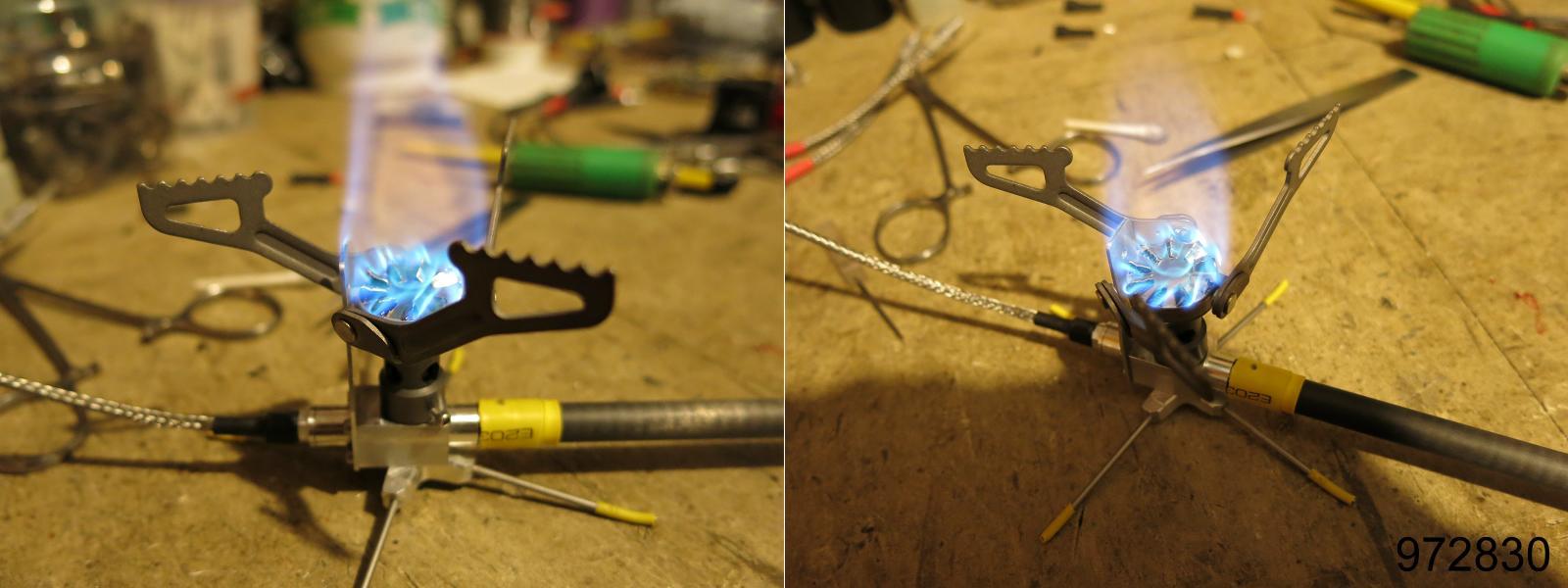
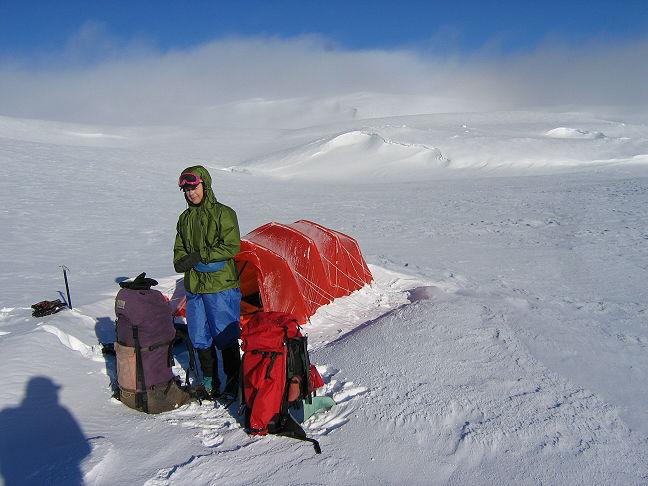
In the photo on the left we have quite a small flame (the camera makes it look bigger than it is); on the right we have a very small flame. In fact, it is hard to photograph a flame without it appearing bigger than it is. Anyhow, this is the way to smooth operation.
How does this work? There are two things in play here. The first is that you cannot get much of a flare when the liquid flow is minute: the heat of the flame vaporises the liquid fuel below it at once. The second thing is more cunning.
While the flame is extremely small, it is nonetheless hitting the top end of the Heat Shunt (HS) full on. That’s the strip of aluminium sticking up to the left of the burner head. The HS is getting hot fast, and that means it is taking heat down to the hose connector inlet. Here it will serve to vaporise the fuel.
In fact, the HS gets hotter under these conditions than when the stove is flaring, because a flare often goes over the top of the HS, almost missing it. With a little flame, the tips of the flame hit the top of the HS very nicely. We can see this with my data logger.
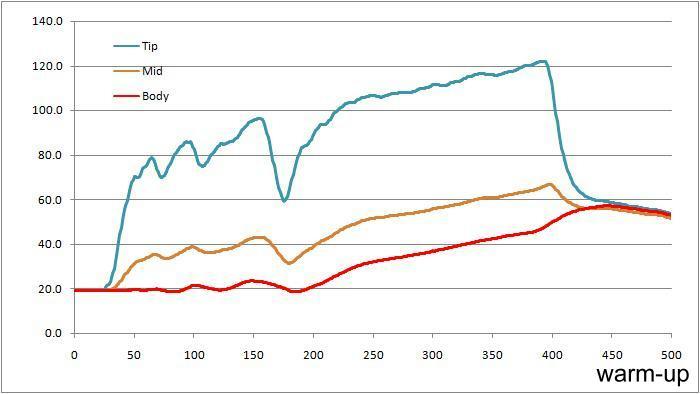
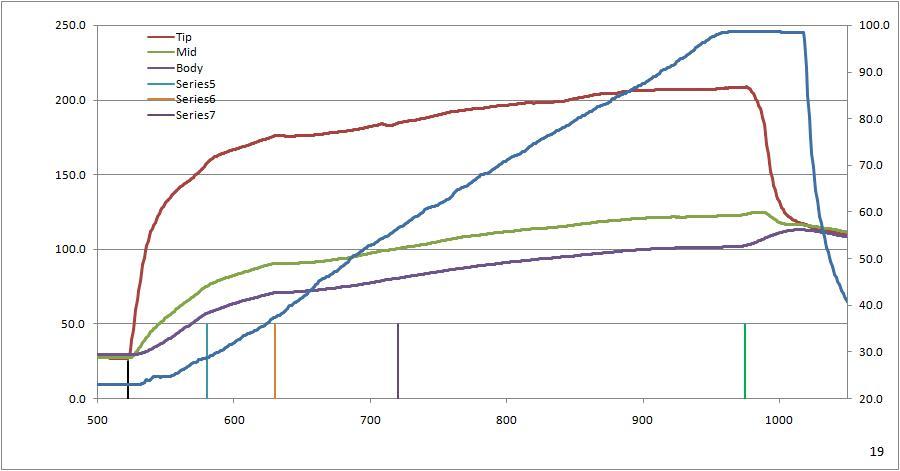
This log of operation shows graphically what happens when the stove is (deliberately) allowed to flare. The temperature of the top of the HS (blue) goes up and down like a yo-yo as I close and open the control valve, trying to prevent a disaster. The bottom of the HS gets a little warm, but only a little. The result is not heating the body at all for a long while.
The dip in temperature at the HS tip shortly before 200 seconds is where the stove was almost shut down because of a big flare. It was time to show what should be happening. At that point the tips of the flames came to bear on the top of the HS, and the flames started to heat the HS properly. Prior to that the liquid fuel was evaporating where it spilled out of the hose inside the stove body, sucking energy out of the cold stove body. While this was happening, the flaring flames were going straight up, past the HS, not really doing very much for it.
However, once the flames were heating the top end of the HS properly, the bottom end of the HS and then the stove body temperature started to climb – but only then. Once the body got a little warm, the fuel was able to vaporise without sucking too much heat out of the aluminium. Finally the flame settled down, after ~230 seconds.
But a lot of fuel can be wasted getting there with the liquid feed if you go too fast. Start real slow, allowing maybe 20 – 30 seconds warm-up, before you ramp up the power. Mind you, you don’t have to waste any of this fuel: I put the kettle on the stove as soon as the flame is lit. The flame energy is going into the water, even if the stove is on low.