


Companion forum thread to: Learning Curve: Risk Assessment
It takes a close call for Maggie Slepian to dial in her risk assessment skills.
Topic
Become a member to post in the forums.
 .
.
Companion forum thread to: Learning Curve: Risk Assessment
It takes a close call for Maggie Slepian to dial in her risk assessment skills.

Thank you for writing this, it was interesting.
I find that the hardest part of risk assessment is accurately determining the the components of risk. The components of risk are the relationship between the exposure/frequency/likelihood and the consequences/severity/potential outcome. In your kayaking scenario, the risk was high, because, in this case, the likelihood was medium to high (unfamiliar water, inexperience, etc.) and the consequences were high (the potential of course would be death). I found that determining accurate risk components is deceptively difficult.
Thank you again for writing this, as it has renewed my interest in pondering different risks; often we get complacent in our activities.

I hope you get this figured out sooner, rather than later, Maggie. Mountains and moving water are two particularly unforgiving environments in which to misjudge your capabilities and the corresponding level of risk. You’ve been very fortunate so far, but it will catch up with you eventually. I will think good thoughts on your behalf and hope for the best.

The author discusses how a life changing event (kayak accident) changed her perspective on risk assessment. The author stated that her learning curve was basically flat until that point. My takeaway was that she ignored the previous warning signs in the pursuit of an ego driven goals: demonstrated by photos of mountain biking accidents and the statement below.
I took huge falls, including losing massive swaths of skin on both elbows and knees in one agonizing day of wrecks, but I was determined to push those fears out of my head in pursuit of being above average at something.
I went kayaking with a friend I was trying to impress… By the time my partner beached his boat and swam the rapid to reach me, I was unconscious.
You want to reduce risk? I recommend that you internalize why you are interested in taking the risk: understand the benefit. Improving skills set, becoming better at something – I am good with that. Trying to impress someone is not a great reason. My 2 cents.
Can anyone point to good practical resources on the risk assessment process in an outdoor setting that Mark V mentions above (assessing the relationship between the exposure/frequency/likelihood and the consequences/severity/potential outcome) and coming to a decision based on that?
https://en.wikipedia.org/wiki/Risk_matrix
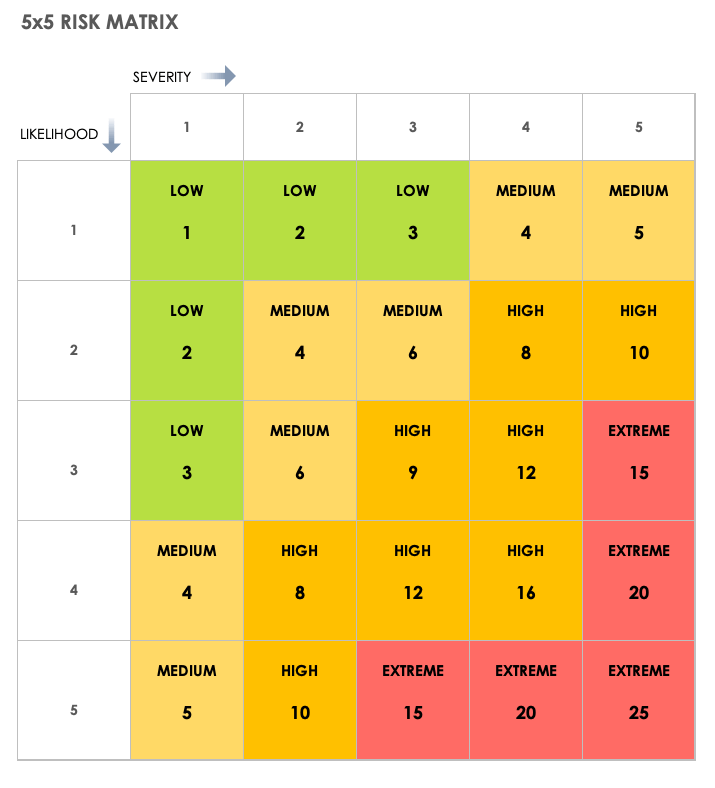
How do you know likelihood and severity? Data is great, experience is better, both is best.
It seems to me most people take a ‘denial’ attitude towards risk. Lack of data = assuming it never happens. Near misses are quickly forgotten. Consequences ignored. If you don’t know how many people get hurt/need rescue/ go missing/ turn up dead doing whatever it is you’re doing; its illogical to assume no one gets hurt. Don’t ignore obvious dangers just because you assume everyone does it. If you slip, trip, fall, dodge falling rocks, fumble your stove or knife etc but don’t get hurt, make a huge note of that! Near misses, bad stuff almost happening, are your only warnings. Some people don’t get any warnings, don’t ignore the ones you get.
With respect to backpacking
Some aspects of severity can be mitigated by having the correct gear for the situation.
Some aspects of likelihood can be mitigated by training / practice.
Both Severity and Likelihood benefit from experience or at least mentorship. My 2 cents.
“… but I was determined to push those fears out of my head in pursuit of being above average at something.”
take up classical guitar? That’s humbling as well.
Kudos for exposing yourself in this article. That takes guts and anyway, lots of people share this perspective. As you know, bashing headlong into an activity and trying to take it over by force and the need to excel simply doesn’t work. Excellence comes from patience and slow growth and experience. Inevitably we ourselves end up changing in the process, for the better. This is how we become above average, but by then, it doesn’t matter anymore.

I see “Likelihood” as the component of time spent outdoors (backpacking/hiking/kayaking etc). Meaning: If someone lives outside 24-7 she/he/they/it faces a far greater risk of injury/death than for someone out on a weekend trip. It’s geometry and math.
If you spend 5 days at home in a house and 25 days in the woods per month chances are far greater you’ll experience a heart attack/stroke or fall or falling tree in the woods where 911 “rescue” could be nonexistent—than at home.
Hum … I wonder.
An alternate PoV is that someone who lives outside 24-7, spending 25 days in the woods per month, is going to be far healthier than someone who only goes out on the occasional weekend, with far LESS chance of suffering from a disease of the moribund.
Perspective, and activity.
Cheers
I have never, and probably will never, think of backpacking as a “sport” or people who backpack as “athletes.” HYOH I guess!
Become a member to post in the forums.
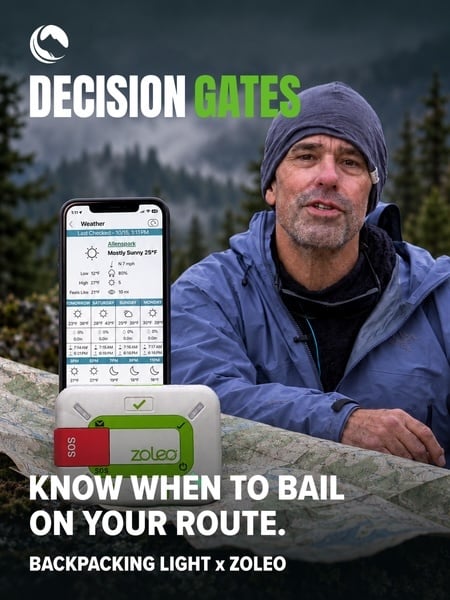 How to Plan with Decision GatesKeep going, change your route, or turn back? Watch how decision gates help structure these choices in our YouTube video.
 © Beartooth Media Group Inc.
 Loading...