Topic

insulated vs. reflective sleep pad

Viewing 25 posts - 1 through 25 (of 27 total)
Paul S BPL Member
PostedApr 8, 2020 at 2:37 pm

I have always used insulated sleeping pads. Original thermarest for many years (3/4 length orange !), and then EXped Synmat 7 UL and Synmat 7 3-d for the last handful of years.

The Expeds are very comfortable (sleep better on them than I do at home!) but I am thinking about moving over to neo air x-lite or x-therm to get more r-value for the weight/packed volume. These pads have no insulation per say, but rather, use layers that reflect heat radiated from your body back at you, and do have air chambers to prevent convection currents inside the pad.

In terms of comfort and warmth, how would you describe the difference between a pad that insulates, and a pad that reflects?

Bruce Tolley BPL Member
PostedApr 8, 2020 at 3:18 pm

@ Paul
The dead air space in the Thermarest NeoAir provides “insulation” by mitigating the movement of the body’s heat by conduction into the ground.

I am not sure how much of the body’s heat radiates out of the sleeping bag downward and can be reflected back.

It would seem to me the purpose of the reflectors and baffles is to mitigate heat loss through convection along the side edges of the NeoAir. In my snow camping experience under a DuoMid, I have found when I toss and turn a lot while sleeping on NeoAir, I get colder and I can feel heat seeping out of the sides of the mat.

Todd T BPL Member
PostedApr 8, 2020 at 5:01 pm

These things don’t “reflect body heat back.”  The reflective surface is inside the pad and doesn’t “see” the sleeper.  Its purpose is to limit heat transfer across the air layer in the pad by limiting radiative transfer from the top of the pad to the bottom.  The top is warmer, basically because of the sleeper’s warm body touching it, so it will radiate heat to the colder bottom.  A surface that is a good reflector is a poor emitter, so heat transfer is lessened.  There may also be some kind of interstitial material or chambers to limit buoyancy effects that increase convective heat transfer, but then that’s basically what regular insulation does.

James Marco BPL Member
PostedApr 8, 2020 at 5:56 pm

I am afraid Todd is unfamiliar with the nature of heat. There are two forms of “heat” that our poor senses interpret the same. The first is low level energy that travels in a straight line. Like any form of EM (electromagetic) energy it conforms too standard physics. A common practice is to quantify these into photons. This is commonly refereed to as IR (InfraRed) radiation. The second form of heat is vibrational energy of molecules or Brownian Motion. This causes conduction through rather gross movement transmitted between atoms.

Usually the human body releases about 7-10% of any heat energy generated as infrared energy. This is also what is registered by an IR night scope. This is what the reflected surface saves in energy loss. Except only the lower half can be reflected…roughly 5% to make things easy. About 80% of this in a NeoAir is reflected back as heat to you. Air has a rough insulation capacity of R1 per inch. Convectional losses are about 2.5 for a NeoAir, give or take. Since there is a baffle,  it is slightly higher. Since about 4% of your heat output is added back as R value through number games. giving about an R 3.1 to 3.2 for a 2.5″ air filled pad with a single mylar reflecting baffle. Follow?


Bruce Tolley BPL Member
PostedApr 8, 2020 at 6:57 pm

@ James

If I follow your steps, the maximum heat a NeoAir could reflect back would be

BodyHEAT *.10*.05*.80 = BodyHeat* 0.004

or .4% of your heat reflected back

Seems like a small number.

PostedApr 8, 2020 at 7:04 pm

The new sleeping pad R value spec. raised the NeoAir XLite’s rating to 4.2.

Some people complain about the NeoAirs suffering edge collapse, making your arms more likely to slip off, reducing their effective width a bit.  Some people don’t like the crinkly noise the NeoAirs make.

Anything is going to suffer greater convective loss if you toss and turn, since the motion effects a pump, stirring up the air, mixing warm with cold.  Different designs will do this to different extents, but I don’t have much comparative experience to share.

If you can, try to borrow a NeoAir for a night.  I’m pretty sure the different temp ratings all feel the same mechanically when you lay on them.  Spend a night on the floor to test the comfort.

PostedApr 8, 2020 at 7:09 pm

Bruce,

The .1 and .05 you have are redundant.  .1 is body heat emitted as IR, .05 is the half of that that points down towards your sleeping pad.

But your point is still valid – much is made of reflective insulation in marketing when it actually represents a very small portion of total heat loss.

PostedApr 8, 2020 at 7:17 pm

Neoairs use a reflective layer to limit radiative heat transfer but the bulk of “insulation” is from the hundreds of small cells or baffles that limit convective heat transfer.

Todd T BPL Member
PostedApr 8, 2020 at 7:26 pm

…the human body releases about 7-10% of any heat energy generated as infrared energy… This is what the reflected surface saves in energy loss.

That’s just not right.  The reflective surface is inside the mat, so whatever radiative heat is being emitted by the sleeper’s body never sees that surface.  Even if the top of the mat was reflective, it wouldn’t help (much) because the radiant barrier would be short-circuited by conduction because the sleeper is touching it.

Roger Caffin BPL Member
PostedApr 8, 2020 at 11:04 pm

@Todd

>> The reflective surface is inside the mat, so whatever radiative heat is being emitted by the sleeper’s body never sees that surface.
Ah … not so fast. It is very likely that the mat fabric is at least partly transparent to IR, in the same way that window glass is transparent to visible light.

>> Even if the top of the mat was reflective, it wouldn’t help (much) because the radiant barrier would be short-circuited by conduction because the sleeper is touching it.
Um … not sure what you mean here, but it certainly sounds wrong as phrased.
And I suspect that the top of the airmat is not reflective in the IR.

Cheers
Roger (PhD, physics)

James Marco BPL Member
PostedApr 9, 2020 at 6:54 am

Basically you would have about the same as a 3W light bulb warming the pad beneath you, Todd. It is not a lot, but significant. It only helps to have one reflecting surface. Increased baffling (such as with the XTherm) usually offsets the radiative warming.

Your physics don’t make much sense to me, sorry. You forget reradiation, absorption, and reflection, but against your body, it is all the same…it keeps you warm. You sense heat from a LOT of different frequencies of IR, convection, etc, the same as you don’t sense heat from UV, only the downstep of the waste heat as it reradiates.


Stephen Seeber BPL Member
PostedApr 9, 2020 at 9:00 am

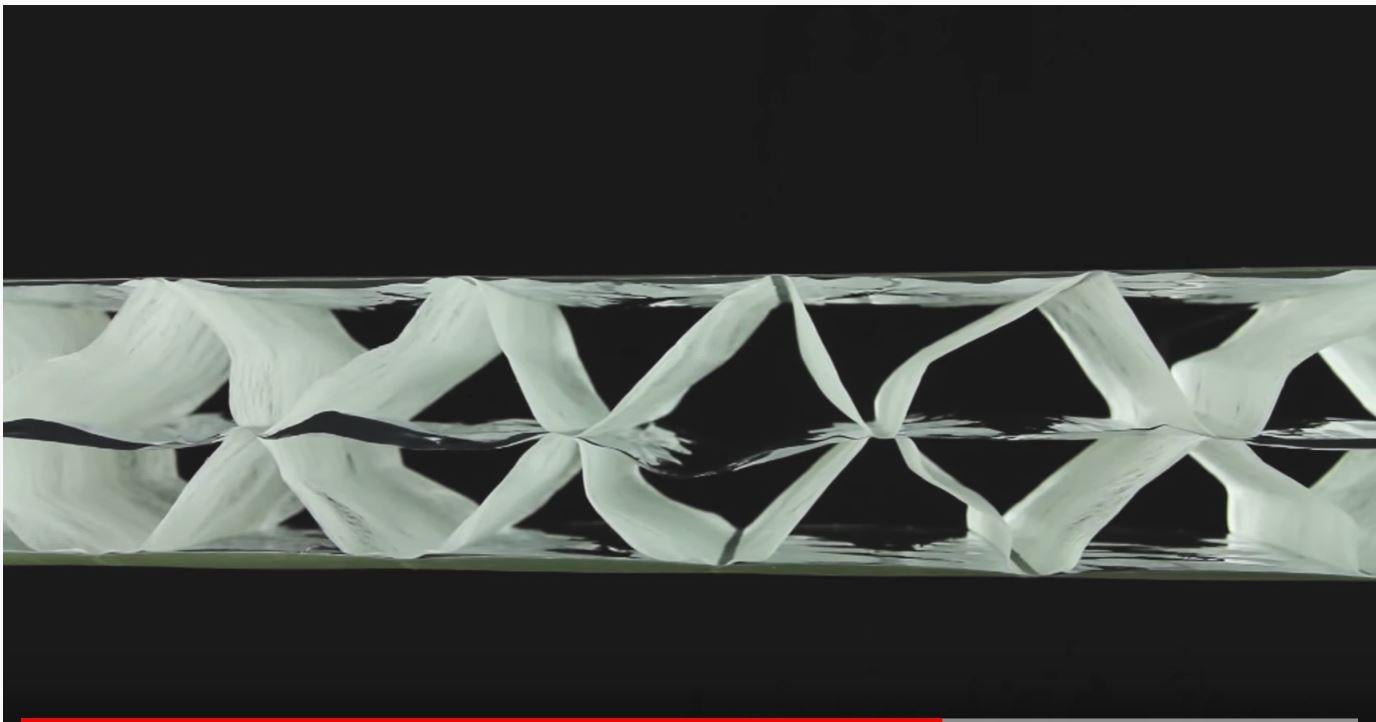
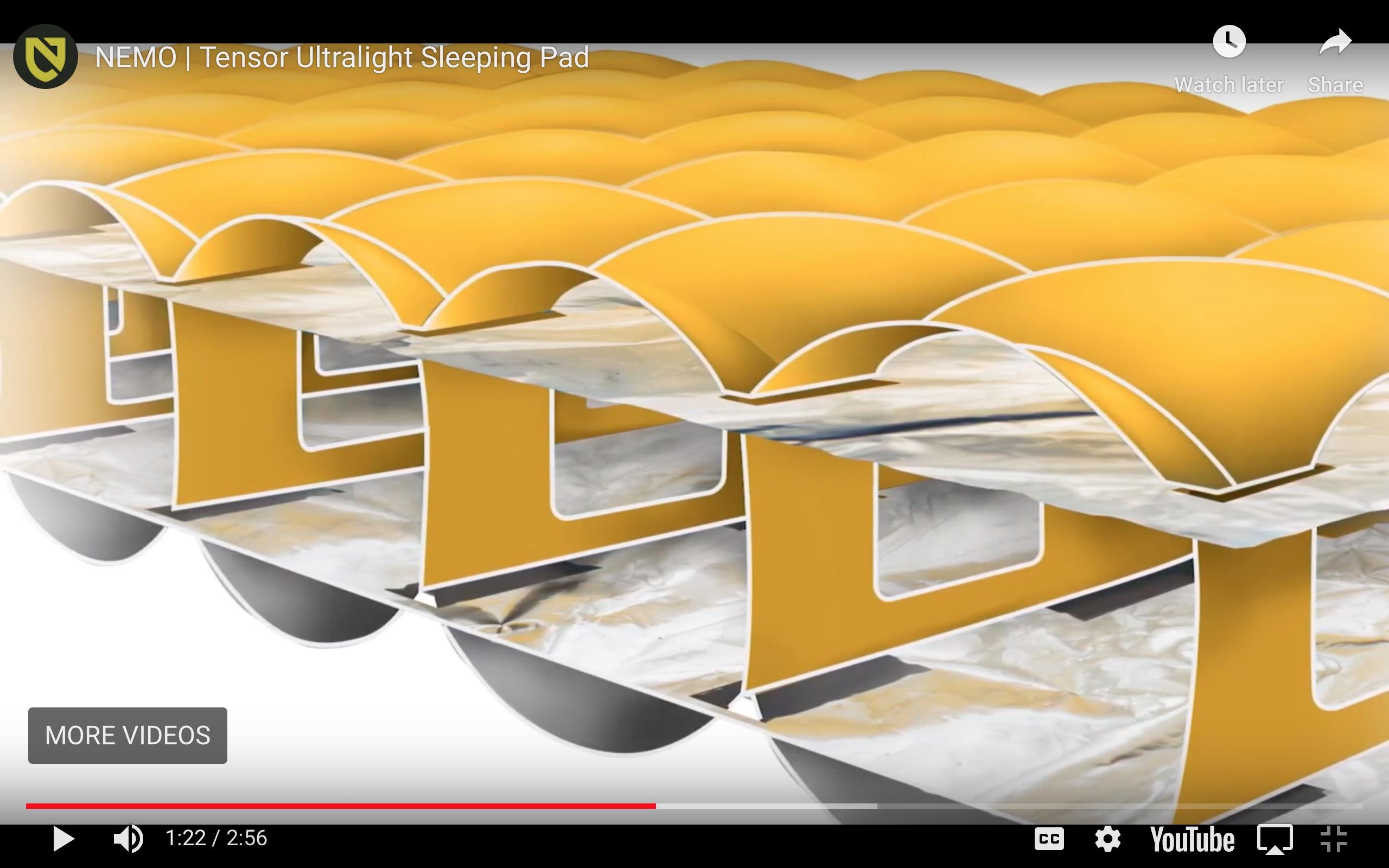
Here is a screen capture from a video showing the interior reflective surfaces from a marketing video produced by Thermarest.


We see what appear to be opposing reflective surfaces. Heat from the user transfers to the top pad fabric layer from the bottom of the sleeping bag and warms the top pad fabric.  The heat transfer from the top layer into the pad will be through convection and radiation. Some conduction will occur at the baffle attachment points.  The configuration of the reflective surface would appear to enable a reduction in radiant transfer.  We don’t know how much.  Just because a fabric coating appears reflective in visible light does not mean it is reflective in long wave infrared wavelengths (8-15 um).  That would have to be established by measurement which is easily accomplished if one cuts open the pad.  Also, the reflectivity of the surfaces may be diminished if dust or moisture accumulates inside the pad.  This is certainly possible since the pad is inflated.  If the material is highly reflective, it will cause the  temperature of the fabric to rise, producing some increase in convective transfer.  However, from the photograph, it certainly appears possible that this structure may act as a radiant barrier and result in increased thermal resistance for the pad.

I posted a paper that discusses thermal impacts of radiant barriers which can be found here: https://backpackinglight.com/forums/topic/evaluation-of-omni-heat-performance/

The construction of this sleeping pad appears more likely than the omni-heat fabric described in the above paper to function as a radiant barrier.


Paul S BPL Member
PostedApr 9, 2020 at 9:10 am

I think the way I worded my original question could have more clear. What I wanted to find out is about peoples subjective experiences of sleeping on a insulated pad (like, exped, for example, with synthetic fiber or down insulation) vs. one of the neo airs (that has no insulating fibers inside the mat). Given the same r-value how would one pad feel (in terms of warmth) compared to the other?

Todd T BPL Member
PostedApr 9, 2020 at 9:11 am

>> Even if the top of the mat was reflective, it wouldn’t help (much) because the radiant barrier would be short-circuited by conduction because the sleeper is touching it.
Um … not sure what you mean here, but it certainly sounds wrong as phrased.
And I suspect that the top of the airmat is not reflective in the IR.

Radiant barriers only work if there’s an air gap (well, the air doesn’t matter…just needs to be a gap) facing the reflective surface.  Think of a wood stove.  They’re typically black or some other special color that emits long-wave radiation well, and you can feel the heat on your face from across the room.  If the stove were instead highly reflective (i.e., low emittance) you wouldn’t feel as much heat.  But walk over and touch your face to the stove and you can bet the heat transfer would not be discernably different regardless of the color.  That’s what I mean by conductance short-circuiting the radiant barrier.  No air gap, no barrier effect.  Same principle applies when your body is mashed against the top of the mattress–any radiant barrier on top of the mat means nothing because conduction takes over.

Jerry Adams BPL Member
PostedApr 9, 2020 at 9:30 am

thermarest neo air is a mattress that does that

inside, there are layer(s) of reflective material that provides reflective surfaces with an air gap.  Also, it reduces internal convection.

With a regular old fashioned air mattress with just one internal volume of air, internal convection reduces the warmth significantly

Jerry Adams BPL Member
PostedApr 9, 2020 at 9:30 am

you can measure the insulation value, like on Roger’s instrument, to see how effective it all is.

PostedApr 9, 2020 at 11:06 am

Paul,

The subjective experience of warmth will be dominated by the listed R value.  It doesn’t matter how the given value is achieved.  All mattresses of any construct with the same R value will more or less be just as warm.

Other subjective aspects of the experience like noise, susceptibility to pumping (cooling if you toss and turn), thickness, surface pattern/texture/stretch – those will all vary from one design to the next and may prove to be the deciding factor.

If you’re willing to change some of those aspects relative to what you’re familiar with, in the interest of the lower weight and bulk of a NeoAir provided it’s just as warm, then all you need to look at is the relative R values.

It might help inform your process to look up the one or two other threads on BPL about the new standard, and how useful (or otherwise) people find R values to be for sleeping pads.

Todd T BPL Member
PostedApr 9, 2020 at 12:22 pm

I think the way I worded my original question could have more clear.

Actually, I think your original question was fine, we just went off on a technical tangent.  I can’t answer your question from experience, but suspect Rene is right–the rated R-value is probably a reasonable indicator of a pad’s warmth, subject to caveats about shape, inflation firmness, movement, upcurling of the edges, yada yada.  Most of those things are probably similar between regular insulation and radiant barriers, though compressing regular insulation reduces its overall R-value (read:  cold spots where hips and shoulders compress the pad), while the barrier benefit of the reflective surface(s) may be less affected (speculation).

Roger Caffin BPL Member
PostedApr 9, 2020 at 3:39 pm

Cutting through all the marketing spin, actual experimental data shows that the dominant heat transfer mechanism inside an airmat is conduction/convection. Radiative heat transfer is quite minor.

Go to our survey of airmats at
https://backpackinglight.com/airmat_sotmr_part1_2011/
and compare the Big Agnes Clearview (basically a pool toy), the Exped Synmat UL 7 and the Exped Downmat 7. They have similar thicknesses, but their claimed R-values are (in the order given) 1, 3.1 & 5.9 .

The Big Agnes (1) is empty, and when you lie on it heat transfer is by conduction into the air inside and then convection due to body movement (even breathing). It is cold.

The Synmat (3.2) has a layer of light synthetic insulation inside it, under the top surface. This insulation prevents the warm air next to your body from circulating, and it does it quite well, although there is some empty air space at the bottom.

The Down airmat (5.9) is filled with down, and there is almost no air movement at all. Needless to say, it is very warm.

The marketing video pic shown by Stephen is mostly just marketing spin, but note the smaller air chambers. They do restrict the air movement, so the mat is warmer than if the mat was empty. The benefits from heat reflection are minor – but they sound good.

Self-inflating foam air mats are not bad, even though they are much thinner. The uncompressed foam does a wonderful job of limiting any air movement, but being thin they can compress right down under your hips and shoulders, to the point of nearly zero thickness. That makes for cold spots, due entirely to convection/conduction.

Cheers

Rex Sanders BPL Member
PostedApr 9, 2020 at 6:36 pm

Subjective experience

I used to own and use a 2015 Nemo pad partly filled with PrimaLoft insulation (Astro Insulated Lite). Now I have a Nemo pad with reflective insulation (Tensor Insulated). Since Nemo didn’t report R-values until recently, and the pads have other differences, I can only give an unfair subjective comparison.

The Tensor Insulated is about the same warmth.

Now that we can compare R-values across makers and pad models, I’d trust that more than one anecdote. The Tensor Insulated is R3.5. Wish I’d waited to buy the warmer Tensor Alpine at R4.8.

Can’t stand the crinkly noise of the NeoAirs. The Tensor is much quieter and tolerable.

HTH.

— Rex

NoCO-Jim BPL Member
PostedApr 10, 2020 at 9:06 am

Yeah Rex, I too bit on a couple of those Astro Insulated Lite pads, rated 15 – 25°F before ASTM F3340-18, and wondered why they slept cold.  R-Value 2.6, post ASTM explains most of the cold sleep.  The amount of “insulation” in the pad is laugable.

Moved on to Thermarest Xtherm (R-Value 6.9), and have been happy ever since.  The NEMO Atsro’s make good rafts in the lake.

Iago Vazquez BPL Member
PostedApr 10, 2020 at 9:18 am

I find the Nemo Tensor Insulated more comfortable than the Xlite both in size regular 20″ width. My arms and shoulders feel better supported. Size large tops.

Chris Bell BPL Member
PostedApr 10, 2020 at 12:43 pm

On regular outings below 0°F my subjective results:

NeoAir Xtherm regular mummy kept me toasty warm to -16°F  But only when absolutely fully inflated.  Which for me was a bit too hard of a bed to sleep on.  By morning I’d want to let out just a bit of air to increase comfort but then the cold was immediately felt.

Nemo Tensor Alpine Ultralight Mountaineering pad.  regular mummy   I gave this a try as the construction of the tensor pads even with the 20 inch wide is for me much more comfortable.  I don’t feel the need to let out air but keep it at full inflation.  I am warm on this to -10°F.  Not on the edge of being cool and not toasty warm.  But I can sleep comfortable all the way to morning, as the temps drop just before sun rise while the trees pop and crack.  Here in northern PA this pad is fine.  We don’t often have the -20°F stretch of days like we used to.

But I have to mention, if not on a multiday outing and have room in the pack I still take the old Therm-a-rest Trail Pro self inflating pad.  Its the flat style self inflating at 2 inches thick.  For some reason this is a no kidding toasty warm pad for me to -10° F.  Often I’ll use a quilt as they seal on the edges better to the flat cloth like surface of this pad.

Rex Sanders BPL Member
PostedApr 10, 2020 at 1:00 pm

Chris makes a good point about inflation and comfort. I’ve inflated my Tensor Insulated as hard as I could on the coldest nights, and it was still a comfortable sleep.

In contrast, most Therm-a-Rest R-values went up in the new ASTM standard because TaR used to inflate to 80% thickness to reflect real world use, while the standard requires full inflation.

— Rex

Viewing 25 posts - 1 through 25 (of 27 total)
Loading...