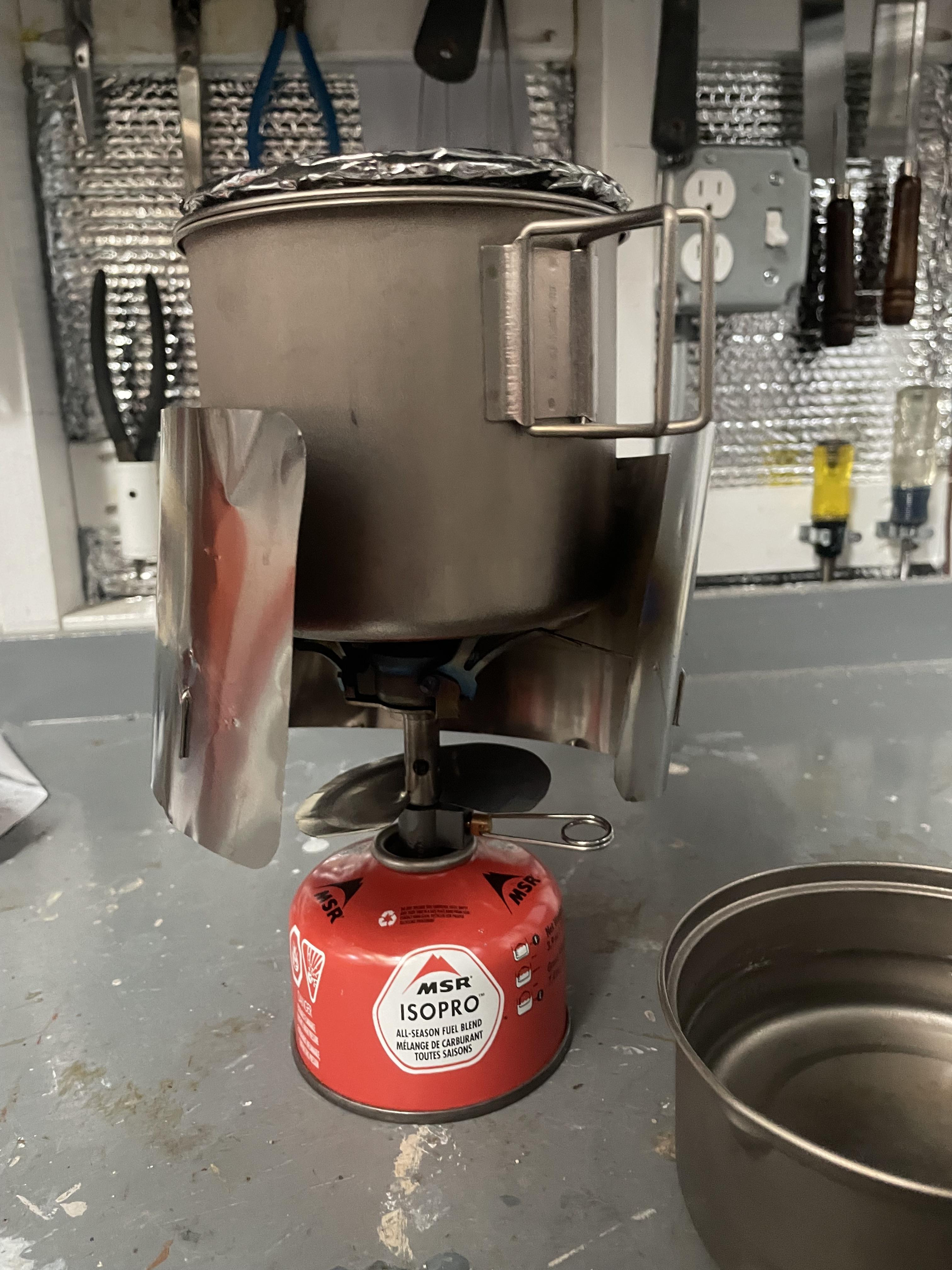
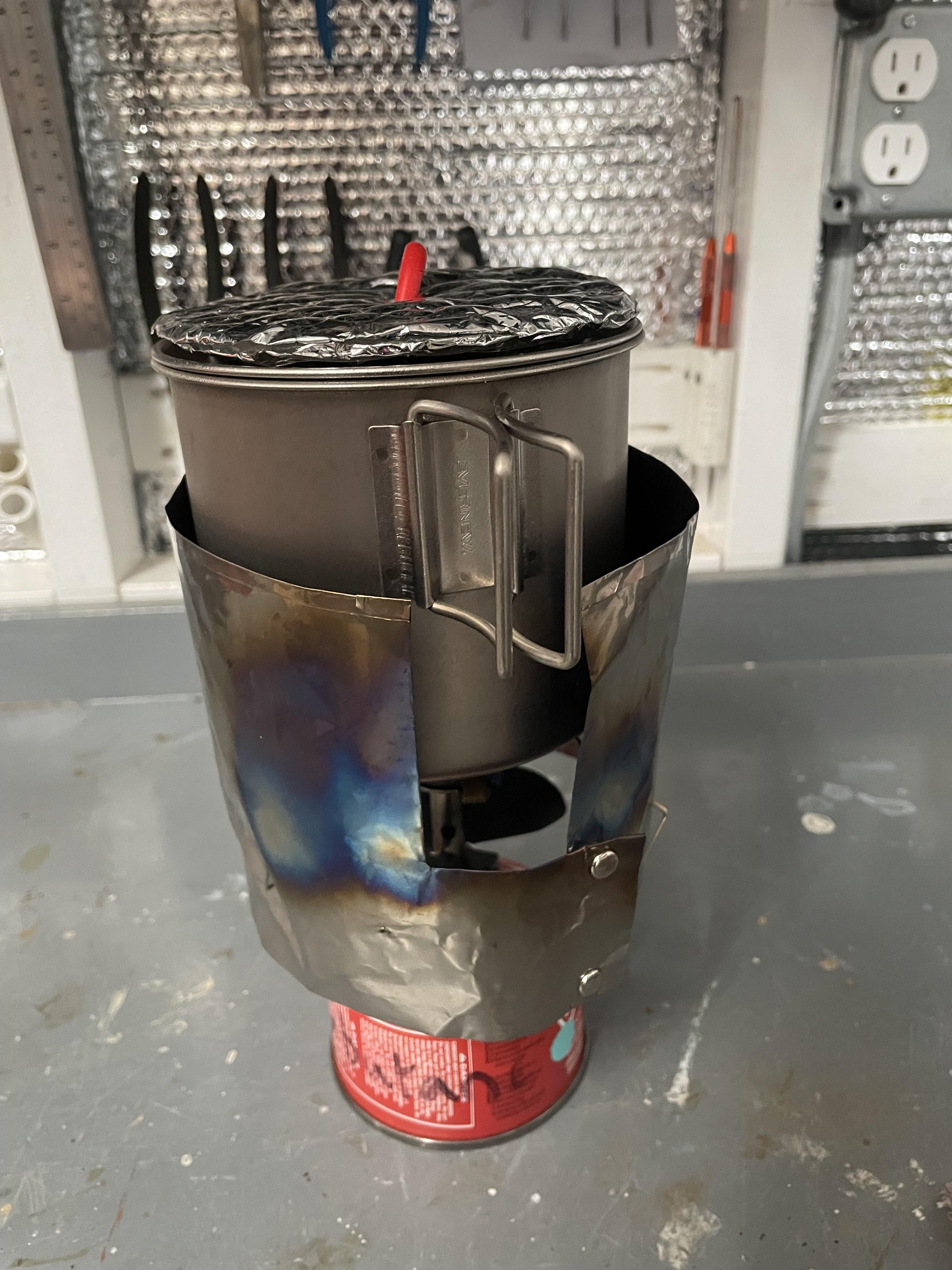
On my last few trips, I’ve had problems with my stove sputtering when cooking at 8,000–8,400 feet. I’m using a Toaks canister stove with a home-made titanium 3/4-wrap windshield and a pie-tin aluminum reflector.
Before my trips, I tested the stove at home (elevation 40 feet) with the windshield and the reflector. It worked flawlessly. The tone was a steady hiss, rather than the roar from the Hornet II that I was previously using.
But on my first trip using a full-wrap windshield, the stove sputtered. The tone changed when I lifted the pot up, and I used more fuel than expected. I put this down to overshielding, possibly blocking the flow of combustion air in or blocking the flow of combustion gases out up and around the pot. I had a 5–8mm gap between the pot and the windshield.
For my next trip, I switched back to my older 3/4 wrap windshield, modifying it to give a 10–20mm gap between the pot and the windshield. See the photo. I boil my tea in the Evernew Kettle and boil my dinner water in the Evernew pot.
I had the same problem, but not as bad as before. The stove didn’t burn steadily at high or low flame and the tone changed a bit when I lifted the pot up. Ambient temperature was about 70°F. I suspected that the gas was contaminated—I’d refilled my 4oz canister from a 16oz eight times. The refills were GSI 70% isobutane, 25% propane, 5% n-butane.
I tested my stove again at home. It worked perfectly, so the fuel couldn’t have been the problem. The ambient temperature was about the same as up in the Sierra on a warm afternoon.
That leaves the altitude and the thinner air—80 kPa at 6,400ft compared with 101 kPa at sea level.
Does anyone have any thoughts on the interaction between stoves, windshields, and altitude?