Well, I’ve got good news and I’ve got bad news. The good news is that you don’t have to worry a lot about selecting which canister is lighter.
The bad news is that no “8 oz” canister that I know of contains more than 227g.
Why do I say you don’t have to worry about which is lightest? Well, unless you have some old ones, they’re pretty much all made by the same manufacturer these days.
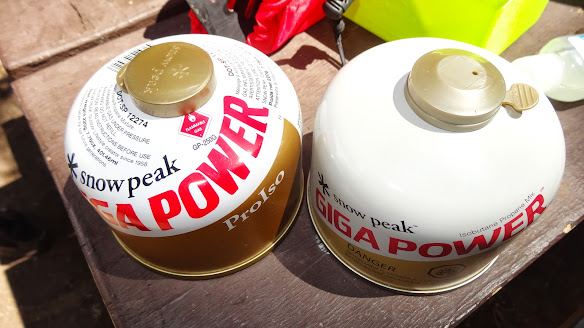
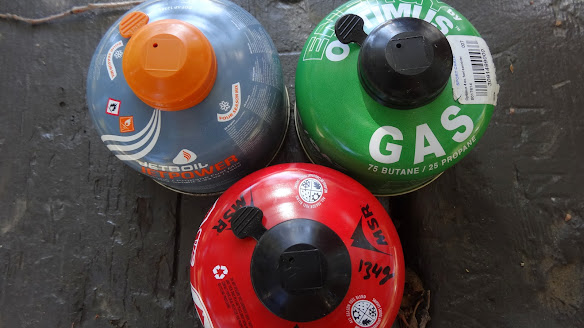
A few years ago, I noticed MSR changed the shape of their canisters, the hue of their red color and their caps instead of flat were more raised and came to a square on top. The following year, Snow Peak Canisters, which had relatively flat caps with “Snow Peak” molded into them became… you guessed it, more raised and came to a square and top, and whereas they had always been labeled “made in Japan”, they now were clearly labeled “made in South Korea”.

Curious, I started looking at a number of different brands. They all had the same caps, and the shapes were all now the same.
I looked at Primus, Optimus, Olicamp, MSR, Jetboil, Brunton, Snow Peak, and Burton. All of those brands now had the same caps and the same canister shape, and all were made in South Korea. The only exception I could find was Coleman which is made in France.
It was pretty clear to me that whereas there had been a diversity of canister caps, countries of origin, and canister shapes, there was now only one. They were all now being made by the same manufacturer.
A little research revealed that the Taeyang Industrial Co. Ltd. of South Korea was the largest manufacturer of gas canisters in the world. Then, I found this on line:
The cap? You guessed it, raised and coming to a square at the top, and unlike many of the major brands who for whatever reason don’t want to let on (and I have asked, directly) who makes their canisters, Kovea prints it right on the side of the canister: “Taeyang Industrial Co. Ltd.”.
So, it doesn’t much matter which canister you choose in terms of empty weight (unless you’ve got some old ones).
The blends still do differ. Which blend you get doesn’t much matter above 50F/10C, but when it gets colder, it does matter. Basically, you want to get a brand that doesn’t have plain butane. Having more propane is great, but if you have a choice between more propane but contains any significant percentage of plain butane vs. less propane but no plain butane (in other words, just isobutane), chose the one with less propane but no plain butane. Currently, Olicamp has the best cold weather blend available that I know about in the US market: 25% propane, 75% isobutane.
HJ