Topic

Fire safe lightweight stoves

Viewing 24 posts - 1 through 24 (of 24 total)
Kyler B BPL Member
PostedJan 31, 2021 at 10:45 pm

I haven’t found much written on this so I want to start a conversation about what are the most forest fire safe UL or LW stove designs around.

Most of the members of this forum are quite competent and I don’t expect are at a major risk of starting forest fires. However I worry about people who are maybe less experienced using their equipment going out and starting forest fires.

I am starting to read that certain areas and parks are banning certain stove types. One stove that I’m seeing parks recommend for being fire safe is the 4 season liquid fuel stove. I believe their reason is because of the positive shut off.


To me the liquid fuel stoves are probably the most unsafe stoves to use in the hands of beginners. I would lean more towards a canister stove or a something like the coldera cone solid fuel version with a flame proof bottom.

What are your thoughts?
Be civil please.

Bob Shuff BPL Member
PostedJan 31, 2021 at 11:10 pm

This has really been a regional issue for regulations.  I live and camp mostly in drought-ridden SoCal.  Fires have been banned as long as I can remember, except in a campsite with a metal fire ring.  It’s often even banned there.  Global warming – whatcha gonna do?

I agree the white gas stoves I think you are referring to are some of the most dangerous.  I worked with scouts for years, and although Philmont still prefers them I would only use them with scouts if forced to.  The priming flare alone says it all.  BSA doesn’t like alcohol stoves, and like you said the positive shutoff is a criteria often cited by land managers

Canisters of course are the preferred stoves by CA officials, and for scouts I prefer the remote stoves as they are more stable.  Scouts these days prefer a “Jetboil” like so many other beginner outdoorsman.  I like the MSR Windburner by far in this class, and MSR now has a larger pot remote version that could serve for patrol-style cooking method.  Any of these seems fine to me for scouts, but most would not be lightweight if you are a BPL member.  If I’m backpacking with a canister stove by regulation, for me it’s the Soto Windmaster with a titanium pot between 650 ml and 1.2L.  I’ll take this any day over something lighter like the BRS.

I often recommend solid fuel (esbit and coghlans) for scouts that want to experiment with lighter weight cook kits, and I carry a couple tabs as backup when I use alcohol stoves on non-scouting trips.  It doesn’t have an off switch, but it won’t spill in clumsy hands and is easy to blow out.  I think it’s also the best BTUs/g and with a cone system should be somewhat wind resistant.

Matthew / BPL Moderator
PostedFeb 1, 2021 at 5:16 am

Just my opinion but I think you nailed it:

”I would lean more towards a canister stove or a something like the Caldera Cone solid fuel version with a flame proof bottom.”

My preference is for a TD cone with Esbit tablets. I feel like this is a very safe setup. I only use a small piece of titanium or stainless foil under mine to protect from a direct fire scar. I wouldn’t be comfortable setting mine up anywhere near combustible materials even with a full titanium ground plate so I don’t bother with a big plate just to keep things simple.

Kyler B BPL Member
PostedFeb 1, 2021 at 6:04 am

Yea I don’t own a cone but am trying an esbit in a half of a disposable roasting tray that fits nicely around my pot and it seems okay.

I will give the nod to the alcohol stoves that use a material to soak up the alcohol so it doesn’t spill also. I made one with carbon felt that was super stable and wouldn’t spill much, if any alcohol if it got tipped over. Still won’t use it in super dry conditions.

looks like trail designs is selling a stove with material inside it now also.

Brad Rogers BPL Member
PostedFeb 1, 2021 at 6:51 am

The Caldera Cone is very stable and seems to me to be about as safe as canister stoves.   One of the main keys is being cognizant of where you place your stove in case it was to tip over, etc.  Cooking on a durable, non flammable surface is the key, that way if you were to have a stove tip for whatever reason, it can’t catch anything else on fire.

HkNewman BPL Member
PostedFeb 1, 2021 at 9:56 am

Canisters are great, just clear a bare area from dried twigs, leaves/pine needles, and forest duff.   After a few years of constant use, each of my canister stoves erupted in flame.  They were easily extinguished via the valve once the flame quickly subsided, but for a few seconds, it was a serious flame.

Looking at merino glove inserts  and just purchased a stove with excellent long-term reviews, so hope for no back country pyro drama.

PostedFeb 1, 2021 at 1:42 pm

A remote fueld canister stove is a lot safer than a canister topped stove.  If you tip a canister topped stove on it’s side, you’re probably going to create a fireball and are not going to be able to reach the shut off valve.  This is a bit worrisome when you use a samll support arm diameter (like the BRS 3000t) and a larger pot (+1 liter) and a tiny fuel canister (4 oz,)

Alcohol stoves safety relies on the skill sets of the user and a majority of the time, they are completely safe.  To further enhance the safety, you should consider using gelled alcohols like Swiss Fire Gel, Hand sanitizer or even Sterno.  One of the big contributers to accidents are spillage during the filling process.  Wicked stove are OK, but gelled alcohols are probably a lot safer.  My 2 cents.

Kyler B BPL Member
PostedFeb 1, 2021 at 4:38 pm

Okay that video has me really worried about alcohol stove users now.

I don’t think I will use mine in the summer months again. Pretty confident using it because I always feel for heat before adding fuel but don’t want to encourage people. Maybe while traveling to exotic places. Or thru hiking remote towns.

Bob Shuff BPL Member
PostedFeb 1, 2021 at 4:58 pm

I want to blame the smoker in the background – and ban them before alcohol stoves.  Although I wonder if alcohol stoves and alcohol consumption aren’t also a contributor in some cases.  I heard once that a majority of snake bites in the US are young men who are consuming alcohol.

Ian BPL Member
PostedFeb 1, 2021 at 5:00 pm

I live in the PNW and have stopped using alcohol stoves altogether.  They can be used safely but for me, the risk to reward isn’t worth it.

Purely opinion but I think paired with a quality pot stand, foil on the ground, and clearing away debris that might catch on fire, solid fuel like esbit is second only to no-cook meals in terms of safety.  The issue is that during fire bans, land management agencies may use language that may prohibit it eg “no charcoal,” “must have a means to turn it off.”  My guess is that many ranger stations aren’t familiar with it to address it specifically, so when I see language that may be interpreted unfavorably to its use, I won’t bring it.

I’ve mostly switched to isobutane.  I don’t think it’s safer than esbit but it’s a lot easier for me to figure out if it’s permissible or not.  Jon’s comment above makes me want to bring my Kovea Spider over other stoves now.  Idester may/may not want to interject his commentary here, but I had an opportunity to kick over a stove when a beetle flew into my ear and aggressively started scrambling towards my ear drum.  Another story for another day…

Fortunately I didn’t set the Blue Mountains on fire with anything other than my screams.

Kyler B BPL Member
PostedFeb 1, 2021 at 5:11 pm

Yea methanol and some other alcohols can appear to burn clear in high light conditions. One of the reasons it’s such a dangerous chemical.

Methanol is also incredibly poisonous. I think 60ml ingested can kill a human. Absorbs very easy through skin. It’s a common chemical for heavy industries and truckers in cold climates. Also the same chemical that makes people go blind when they drink bad moonshine.

PostedFeb 1, 2021 at 5:13 pm

Alcohol stoves can be safe.  Flames can be invisible, that can be mitigated by adding a little salt to produce a yellowish flame.  With respect to the attached video. Yeah, I ‘ve seen it before.  They may have been experienced hikers, however; I thought that they were pretty cavalier about the topic.  Anyone with half a brain would briefly put their hand over the stove to determine if it was still burning. After seeing that video, certain THAT group should not use an alcohol stove.  They would be better off with a JetBoil: no brain, no headache.

That being said, it’s not for everyone.  90% of the time, I use alcohol and or Esbit.  I live in Los Angeles and have seen almost every wildfire in the last 30 years from my house.  The water dropping planes fly over my house.  During extreme droughts, I bring a remote fuel canister stove and would think about using an alcohol stove.    My 2 cents.

Bob Shuff BPL Member
PostedFeb 1, 2021 at 5:39 pm

Unsolicited plug for Flat Cat Gear’s Bobcat windscreen for the Kovea Spider (or their alcohol stove.)  I think it’s great for the wider pots like an Evernew 900.  I see there is an Ocelot windscreen as well now.  Jon’s previous Kovea winscreen still lives in my kit for when I want to take a remote canister stove.  These are top notch and lightweight, with the Bobcat multi-use for canister, alcohol and solid fuels (and the gel too I suppose).  I also recommend the epicurian for solid fuel users.

Iago Vazquez BPL Member
PostedFeb 2, 2021 at 7:16 pm

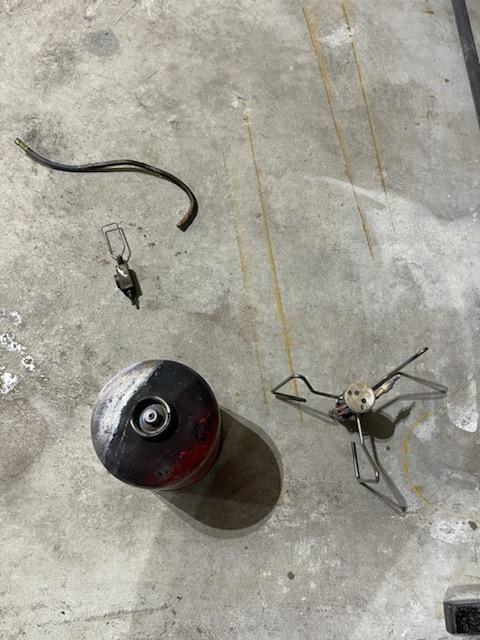
Freakish thing this weekend. Went winter camping with a friend. He brought his Kovea Spider. Purchased new about three years ago. I don’t think it had been used a dozen times. No exaggerating. Camping at about zero F. Forgot thermometer. Using a full MSR canister purchased a couple of days ago. Cooking dinner, the thing went on a sudden fireball from the valve connection reaching out to the stove. Not sure whether it was the valve or canister. My friend shut it off I unscrewed the shut off valve and inspected it. All looked good. I reassembled the stove. Made sure the connection was good. He fires it up and in two seconds the stove and tank valve go in a fireball again. This time larger than the first one. Impossible to reach the valve shut off without burning hands. We consider pouring water and snow on it  We are on snow, so I am not worried about wild fire. I am worried about the tank explosions I keep hearing about and shrapnel taking out someone’s eye or something. So we get away and watch the thing burn. Again, more worried about our safety knowing that the chance of a  wild fire is nil. The “explosion” never happens. Instead it seems the heat creates some fissures in the tanks and burning gas blows out. Took a few minutes to die. When we approach, we noticed the hose came off the valve.

I always felt isobutane was safe and I have been very comfortable using it. Did we miss something? Should we have stopped at the first sign of trouble?

Was it a faulty stove? Faulty tank? Both? Clumsiness on our part?

Do tanks actually explode like what we expect when we see an explosion in the movies or when they go in flames the heat causes fissures but no actual explosion 💥

Iago Vazquez BPL Member
PostedFeb 2, 2021 at 7:38 pm

Thank you for that thread, Ian. So it seems to be an issue with the Spider construction. I had missed or forgotten that thread.

White gas, yes, I expect leaky pumps…

PostedFeb 2, 2021 at 7:47 pm

That sounds like a cracked O-Ring.  That would make a bad seal at the valve.  I had that happen on a new BRS 3000t.

Iago Vazquez BPL Member
PostedFeb 2, 2021 at 7:53 pm

It’s possible, Jon. Although when I disconnected the shutoff valve before I reattached it I gave it a quick look and it seemed fine.

Kyler B BPL Member
PostedFeb 2, 2021 at 7:55 pm

Definitely send that to Kovea! Thanks for sharing!

was it a leak from the valve body/stem or where it actually connected to the canister? I understand if you didn’t happen to catch that while trying to preserve life and limb.

How far was the canister positioned from the flame?

After the first time did you remove the gasket that connects the valve to the canister and inspect? I understand that no one would normally remove it. Finally when you screwed it on with the valve shut you didn’t notice a leak did you?

Iago Vazquez BPL Member
PostedFeb 2, 2021 at 8:10 pm

Dear Kyler,

The flames were sudden and large. I couldn’t really tell where exactly in the shutoff valve connection to the canister they were coming from. The stove also seemed to flare up, but my eyes were focused on the valve as my friend was trying to shut it shut it off.

The canister was away from the flame. The hose was fully extended.

I didn’t remove the gasket. When I unscrew the canister, I inspected both the canister lindal valve threads and also the threads in the stove valve connection. I was looking for anything lodged in there. Everything looked normal. No dirt or anything visible. The O ring was present and seemed fine. With its limited use and age, I wasn’t expecting the O ring to be the cause, so I didn’t give it much thought at the moment not expecting it to be the point of failure. Could it have been somehow damaged? Perhaps. As I said, I was looking for its presence more than anything else.

When I reattached the canister, there were no leaks from the valve. At least nothing appreciable. I gave the stove back to my friend and he lit it a second, final time.

I do think he is reaching out to Kovea.

Viewing 24 posts - 1 through 24 (of 24 total)
Loading...