Topic

Filtration: Electro Adsorption

Viewing 20 posts - 1 through 20 (of 20 total)
PostedSep 11, 2026 at 5:16 pm

Filters: mechanical and electro adsorption

Long story short, I was looking at water filters and stumbled upon Grayl; they offer a limited capacity water filter that removes bacteria and viruses.  They use a filtration methodology called electro adsorption.  Basically, they use a passive charged surface to attract and trap bacteria and viruses.  Since it is a trap, the lifespan is finite and rather low.  Backflushing will get rid of sediments but will do nothing to remove the trapped bacteria or viruses.

A new company called Oassay (no affiliation), has a similar product but it looks like you can buy a replacement filter for $25.  If they would just make an inline filter, this could be an inexpensive and effective drip filtration system for limited water volume (like 500 l).

https://oassay.com/collections/all-products


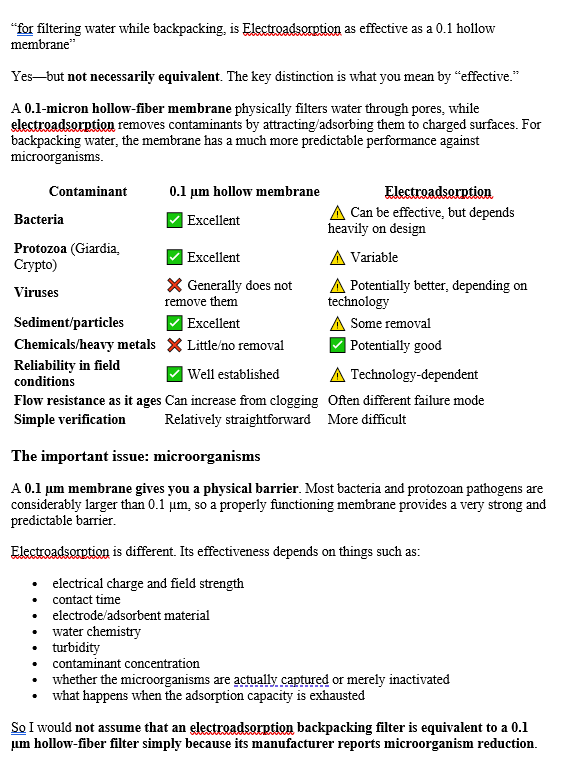
Below is what AI says about comparing mechanical filtration to electro adsorption.   Note: they say while it can be effective, it is highly dependent on the design implementation and lab results.
Drew Smith BPL Member
PostedSep 12, 2026 at 10:18 am

Since there is no actual current in these filters, I assume what they are calling electroadsorption is what biochemists like myself would call ion-exchange filtration. Most bacterial cell walls have a negative charge due to techoic acids and thus will bind to a positively charged surface. I don’t know specifically about protozoans but the carbohydrates found on eukaryotic cell membranes are mostly negatively charged as well. Virus coat proteins generally carry a net charge and so also will be adsorbed by ion-exchange media.

So I’d expect ion-exchange media to have some efficacy in removing pathogens, but I am dubious that it would be as effective as size-based filtration (for bacteria and protozoa) or oxidation/bleaching for bacteria/viruses/protozoa.

I’ll note that the VersaFlow charcoal cartridge, which attaches to their filter cartridge, also contains ion-exchange media, so the Grayl filter is (I think) not a unique product category. Ion-exchange media will remove salts and metals from water, a useful feature for those of us who like desert hiking.

Jerry Adams BPL Member
PostedSep 12, 2026 at 10:54 am

how does the hydroflow compare to sawyer squeeze?

I see the hydroflow costs $23, the squeeze costs $45 plus you get a bunch of useless stuff (bags, plunger,…)

Drew Smith BPL Member
PostedSep 12, 2026 at 11:29 am

@Jerry Adams

I much prefer the Versaflow/Hydroblu to the Sawyer, mainly on the grounds that it backflushes much more easily and effectively. I’ll caveat that criticism by noting that I have not used a Sawyer for about 5 years, maybe they have improved the design.

PostedSep 12, 2026 at 11:38 am

But the Versaflow/Hydroblu ( and Sawyer) doesn’t remove viruses.  That is what make electro adsorption an interesting filter.   While electro adsorption does have some limitations, they do back it up with lab test results.  My 2 cents.

Jerry Adams BPL Member
PostedSep 12, 2026 at 12:07 pm

So, the charcoal cartridge after the hydro flow might be good.

Or a different add on that was electro adsorption

PostedSep 12, 2026 at 12:30 pm

Here is my understanding. Passive Electro Adsorption can bind charged elements to the surface: bacteria and viruses. But to do so, they need to come into close proximity to that surface, hence AI states that this is highly dependent on the fluid path/design of the charged surface.
Traditional carbon filters probably pack a lot of carbon into a vessel and assume that with enough surface area to work. Unless it has data to support removal of viruses I wouldn’t count on it.
From Grayl – Inside the purifier cartridge, non-woven ceramic fibers block and trap microorganisms and particulates with a very high electropositive charge, removing submicron contaminants through electroadsorption. Ultra-powdered activated carbon absorbs chemicals, heavy metals, bad flavors and odors.
The way you produce activated carbon can be quite complex. I used to develop instrumentation for Surface Area Analyzers and we use to test activated carbon that had 2000 square meters per gram of material. You could adjust the surface area as well as the pore size by controlling your manufacturing processes. My speculation is that Grayl figured out how to optimize this for viruses. In their documents, they claim that their filtration is larger than 1 micron, so it is not a mechanical barrier to bacteria.
Bottom line is that you should trust anything until you see the test results and even that deserves some scrutiny. All in all, it is an interesting technology that may one day find a home in the UL market. My 2 cents.

Terran BPL Member
PostedSep 12, 2026 at 12:43 pm

https://hydroblu.com/muv3-nanalum-replacement-water-filter/

The technology used in Nanalum was developed by NASA as a way to reuse waste water on the International Space Station. Nanalum works through electro-absorption and is manufactured with non-woven highly engineered water filter paper which is also impregnated with Granular Activated Carbon (GAC). The Nanalum module has a strong positive electrostatic charge when wet. Like a strong magnet, the positive electrostatic charge of the Nanalum attracts and traps organic contaminants.

PostedSep 12, 2026 at 1:32 pm

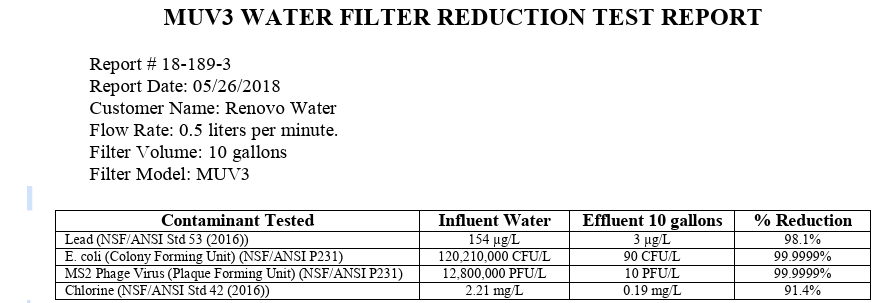
Way cool. Note: they sell regular carbon filters for $7.50 to $10 the electro adsorption filter for $29. The key point is the test results and here they are for the MUV3 Filter. This seems like a very cost-effective solution to virus protection to be.

Now, the MUV3 which filters out viruses only has a rated capacity of 90 gallons. Hydroblue also has various configurations like gravity feed versions and such. So the product that I thought was intriguing actually does exist.

I started exploring this because I am planning a trip to South Africa / Botswana for next year. I was looking for a travel filter to screen out bacteria and viruses.  I think that I have a strong contender here.

Jerry Adams BPL Member
PostedSep 12, 2026 at 2:04 pm

steripen would work.  Take two for reliability and several extra sets of batteries.  A lot of experience with that so more likely to work.

I wonder if that data included the hydro blu in front, then the adsorption filter.  Then, the adsorption filter would last longer.

Another test would be to use a bunch of filters in real life and record how much water was filtered and how clean.  Then test the filters to see if they still work.

It’s nice to see how the filter works when new, but I would wonder how long.

PostedSep 12, 2026 at 3:51 pm

steripen would work. Take two for reliability and several extra sets of batteries. A lot of experience with that so more likely to work.

That is what I am trying to avoid doing.  Too much gear and reliability concerns.  A consumable filter that is passive and effective for a limited volume seems like an ideal approach for my needs.

I wonder if that data included the hydro blu in front, then the adsorption filter. Then, the adsorption filter would last longer.

The way that I understand it, the capcity is defimed by the volume of bacteria/viruses that it can trap and a pre-filter wouldn’t change that.

Another test would be to use a bunch of filters in real life and record how much water was filtered and how clean. Then test the filters to see if they still work.

Not sure how the average person can test this.  It seems to me that this requires a pretty good lab setup.  I may be wrong.


Terran BPL Member
PostedSep 12, 2026 at 4:34 pm

The instructions have the adsorption filter first. Attached to the inlet. The picture on the box has the adsorption filter last . At the mouthpiece.

If viruses are a concern, following instructions may save the other modules from contamination. It may not last as long as if it were last.

I got it for the carbon filter. It makes better tasting water sometimes. I didn’t pay much attention to the third stage until this thread. It’s good to have redundancy, but a little heavy compared to a Sawyer.


Jerry Adams BPL Member
PostedSep 13, 2026 at 7:59 am

“Another test would be to use a bunch of filters in real life and record how much water was filtered and how clean. Then test the filters to see if they still work.
Not sure how the average person can test this.  It seems to me that this requires a pretty good lab setup.  I may be wrong.”

I mean the manufacturer should do that : )

the hollow fiber first would trap bacteria so there would be less stuff going into the adsorption filter so it could trap more virus before filling up

PostedSep 13, 2026 at 9:05 am

the hollow fiber first would trap bacteria so there would be less stuff going into the adsorption filter so it could trap more virus before filling up

True, but the fundemental problem is that you will never know if the filter has reached capacity.  Safer to estimate the 90 gallon limit and replace the filter.  My 2 cents.

Terran BPL Member
PostedSep 13, 2026 at 10:08 am

Safer to estimate the 90 gallon limit and replace the filter.

Absolutely. I was trying to find an answer to Jerry’s question asking if the water was filtered beforehand. Following the instructions, it isn’t, though there is a small pre filter disc inline .


Terran BPL Member
PostedSep 14, 2026 at 8:02 am

I don’t worry about viruses though our standards have dropped a bit. Perhaps in some of the more populated highly contaminated sites.

A hollow fiber filter is usually sufficient. I like a carbon filter for better taste and I guess now for cyanobacteria. The adsorption filter supposedly make them both redundant, but has a short life.

I usually just bring a Sawyer .

PostedSep 14, 2026 at 8:15 am

On a vast majority of backpacking trails, it should not be a problem. I would have some concerns if the trails were near agricultural areas. I ran into this concern when hiking the South West Coast Path in Cornwall. I started looking into virus filtration as I am doing more international travelling these days.

Dan BPL Member
PostedSep 14, 2026 at 12:55 pm

Electroadsorption (sorption based on zeta potential) is not used for critical microorganism removal, e.g. in sterile or viral filtration of pharmaceutical products. It’s not FDA approved.

To the extent that removal of microorganisms is based on size-exclusion in ordinary filtration (and there are exceptions to this), the failure mode of the filter as it reaches capacity involves fouling and reduced flow, but doesn’t generally compromise the retention too much. The log retention value (LRV) may decrease to some extent with fouling, but still stays within specs.

For the sorption process, the retention declines dramatically as the device reaches capacity, but flow doesn’t decline significantly. This makes it less safe and less suitable for field use if the goal is complete removal. It can be very effective for sampling, diagnostics, and sensing technologies.

Viewing 20 posts - 1 through 20 (of 20 total)
Loading...