<p style=”text-align: left;”>I’m taking a winter skills class in March, where we will be camping overnight, and they advise bringing a 0 *F rated bag. I plan on layering my 20*F and 30* F quilts, and have purchased a down hood to go with them.</p>
I know there’s a lot of subjective experience that determines how much R value your sleeping pad should have, but is there any starting point that suggests if it is X degrees, expect to need at least Y R-value? I’m looking at stacking an air mattress with a CCF pad, but would like to know if my plan is workable, or plain laughable. Of course, I’d also like to minimize weight as much as possible.
Topic
Estimate of sleeping pad R-value needed?
Become a member to post in the forums.
- This topic has 10 replies, 8 voices, and was last updated 7 years, 6 months ago by .
The only bit I found helpful there is the one comment of wanting at least R-3 underneath one for sleeping on snow. I have an insulated StS mat with a stated R of 4.4, so that would be enough?
I have difficulty believing that my Thermarest Neoair, which is rated for 3.2, would be sufficient.
EE has a chart with recommended R ratings. E.G. 0 F needs 6 R minimum.
https://support.enlightenedequipment.com/hc/en-us/articles/218688487-How-to-choose-a-sleeping-pad
I have a general rule of 5R or above for temps down to 0F.
It’s a good idea in the winter to carry both an inflatable pad around 4R and a ccf pad like the Ridgerest Solar at 3.5R—then when it hits -10F you can place the Solar on top of the inflatable and get 7.5R—perfect. And if your inflatable dies you can double up the Solar for 6R.
And after long testing on cold nights, I have found I stay warmer with the ccf pad ON TOP of the inflatable and not UNDER the inflatable.
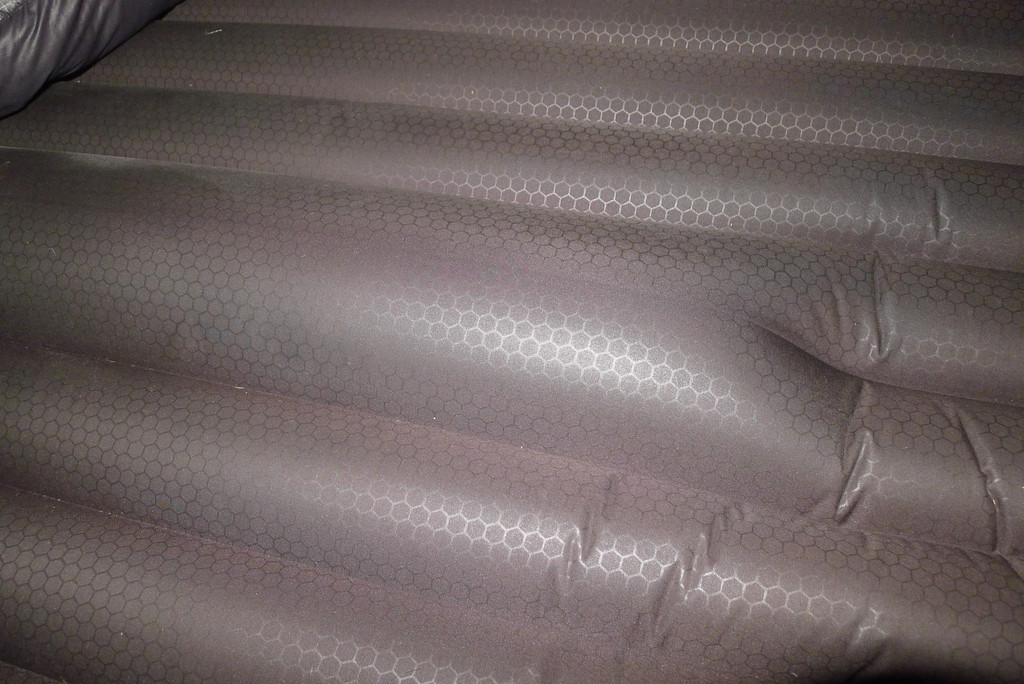
Or you can just get an Exped Downmat at 8R and sleep like a dead possum at -20F—but beware! Expeds have a bad tendency to blow baffle tubes—which happened to me on Day 1 of a 19 day winter trip. See pic—

Somewhere in old BPL threads lies the conclusion that EN bag ratings test their bags using about 1.5” of foam padding. About an R value between R5 & 5.8
And that is under “lab” conditions, with a maniquin lying on its back. If you ever sleep on your side, I’d look at the so-called R values of air mattresses and knock them down by at least 30%
The one big advantage of having the ccf pad on top of an air mattress is it’ll spread out the compression of a side sleeper, making the air mattress perform better. Also, the insulation with the “highest R per inch” should be closest to the heat source, for the greatest efficiency.
just like your strategy with doubling the quilts, mixing a ccf with air is a good idea. And as was said above, R5 is minimum and R7 is a good goal. You could also consider adding a 2nd ccf pad to “sandwich” the air mattress, if you’re concerned about the ground. Also, ccf can handle any ground condensation between the pad and the floor of the tent, if the conditions become ripe for it (on snow, but cool/humid air temp inside the tent.)
I remember reading somewhere that the R-value you need to stay thermally neutral for an average sleep period is around 5. You aren’t experiencing radiative or convective heat loss with a pad on snow or ice. Conductive heat loss is all you deal with. Snow is an excellent insulator. Don’t overthink it. I’ve been on trips that went below negative 20 degrees Fahrenheit and been comfortable with a Neoair (original) and a piece of Ridgerest.
Will you be taking a synthetic jacket? Putting the folded jacket under your hips might do a great deal for warmth and comfort if you are not wearing it to sleep in, or adding a short hip length section for that little extra where it is needed. While putting the CCF on top is perhaps warmer to start with I never do because I am paranoid about punctures, even with something as robust as the S2S. If bulk isn’t a problem the RidgeRest is warmer and before I went to wide pads for safety and comfort I used a 3/4 RR with a full length cheap CCF topped with a LW Thermarest for comfort
I have a Z-rest, and several different air mattresses. I was wondering, in the interest of minimizing weight, is there any point to a short CCF, and full length air mattress? I prefer wide air mattresses, but I’m not seeing any wide CCF available, so I already won’t have as much insulation on the sides as I do in the center.
I do have a synthetic jacket, and depending on conditions, may take it with me. This isn’t until March, so there’s plenty of time. Considering the forecast for the PNW for the winter being warmer and wetter, I may be lucky to have *any* snow to work with, which has been the problem in the past for me trying to get self-arrest and avalanche skills.
Sure is if you use the short CCF on top because that is where the weight can be greatest, hip area followed by shoulders. Can you not still buy thin foam tent sized pads and simply cut one to fit?
Locally we have a chain that sells foam of all sorts cut to size and sold by weight and area. Alternatively you could use what I do for LW summer trips. Go to a Big box hardware store and get some flooring underlay, it is 2mm/ 3mm foam backed by Polycro Share the cost out with mates and it is cheap enough Or do what I did, go to a housing development and scrounge off-cuts from the skips.
For winter tho I am paranoid and bought a RidgeRest Solar which I use under my S2S Comfort plus and put up with the weight because sleep is more important to me and I need the wide mats to sleep well.
I don’t do UL in winter, especially in the death zone
Another possible source: https://www.foambymail.com/neoprene-rubber.html
Become a member to post in the forums.