


Companion forum thread to: Episode 96 | Building Resilience for Backcountry Adversity
Listen Summary In episode 96 of the Backpacking Light podcast we’re going to learn how to build resilience in the backcountry. In this Episode: What’s
Topic
Become a member to post in the forums.
 .
.
Companion forum thread to: Episode 96 | Building Resilience for Backcountry Adversity
Listen Summary In episode 96 of the Backpacking Light podcast we’re going to learn how to build resilience in the backcountry. In this Episode: What’s

I’d love to hear specifically about others’ practices for dealing with challenges when you are feeling mentally/emotionally overwhelmed in the backcountry and are facing a decision that requires fast action.

Resilience
“How do you get to Carnegie Hall?”. The ability to successfully overcome crises situations very often comes from practice / skill development. That is why people get trained in CPR, water safety and other courses. I had an adventure sports trainer teach people about how to repel. He set up situations where the climber would pretend to passed out midway down and the people on the top had to retrieve the person by raising them back up to the top. They would have to brainstorm and execute a recovery method. Afterwards, they would discuss and review the process.
While you emphasis physical, mental and emotional resilience, I suspect knowledge is far more important. That knowledge helps you focus and maintain calm. That is why people offer backpacking/survival courses. Can you image being caught in a snowstorm and were physically, mentally and emotionally strong, but didn’t know how to build a snow cave? Doesn’t training and knowledge act as a calming force to lessen the need for physical, mental, and emotional strength? My 2 cents.

+1 to Jon.
(I could not listen to the entire podcast; it repeatedly crashed. After close to a dozen tries, I got most of the way through the six tips. )
My approach:

Do your best not to get into these situations to begin with. But of course, eventually they will come up.
“I’d love to hear specifically about others’ practices for dealing with challenges when you are feeling mentally/emotionally overwhelmed in the backcountry and are facing a decision that requires fast action.”
This doesn’t have that much to do with physical fitness. Rather, it has to do with
–recognizing the adverse situation
-responding with a slowed down, calm state
-evaluating options
–making a decision and acting
Sure, if a bear is charging the above won’t work. But if water has come flooding into your tent unexpectedly in a near freezing deluge as night is falling, drenching everything but your sleeping bag (ahem, been there) you need to stay calm. In this real life situation, I was ready to hike out in the deluge 12 miles to my car. but my clothes were drenched. Instead, my hiking partner helped me re position my tent out of the sudden stream of water. Once I realized my bag was still dry, I was good.
Usually I unpack my bag first thing after setting up my tent. Suspecting rain was on the way, I didn’t do that as my friends and I went out day hiking. That saved me. My bag was safely stuffed when the trail above overflowed and streamed down into my tent while I was inside. Whew! temps were in the 35% range, the worst. I don’t know what I would have done on my own; my friend helped me manage and all went well enough, except all of us had drenched clothes in the morning and it was still raining like mad. Everyone was hiking out that morning with similar stories. Trinity Alps.
Learn how to fall. Always know where you’re going to land.
Learn how to turn around when conditions are not good. There is a recent death of a hiker attempting a summit in the northeast. He died. The article mentions his mother saying he didn’t like to back out of a hike.
https://apnews.com/article/hiker-death-white-mountains-80b277306cdf4e5c5c29ed897afdbf0a
“Once you get to a certain point, you have to make that choice to continue or turn back,” his mother, Barbara Roma, said. “And he was never really a turning-back kind of kid.”
Getting your trail legs. Knowing when not to turn back. There was a question about being sedentary. I think Ryan mentioned trail running to get in shape. I bought a stationary bike last year. It stares me in the face everyday. At first I only got on it for a short burst. It’s the same thing. You’re legs start to hurt but you power on past it. Soon that gets engrained in your head. I was doing power off stalls over the desert when I was 14. I worked for a tough old gal who trained Air Force pilots during WW2. We flew out of General Pattons old base camp. I did some static line jumps at Lake Elsinore when I was 19. We were in an old Norseman and I saw smoke coming from the cockpit. The motor died and the plane dropped. I finally jumped out around 500’ after 7 others went out. It should be a minimum of 2,000’. It wasn’t. I was looking at trees, fences, and the roadway. I picked my spot, a very small area, turned at the last moment and I came right down the middle. I made 1 jump after that just to get back on the horse, but that was it.
You learn that you’re not going to die, unless you let yourself die. I was never in the military. Many of us are at the age where our friends and parents served in major conflicts A few of the younger guys too. My dad’s buddy lassoed him by the foot, saving his life by dragging him off of Mount Suribachi in Iwo Jima.
You learn from example, then you learn by doing. Develop your skills and have faith in what you’ve learned. Know that others have gone before you. Have confidence because sometimes there is no other choice.
Become a member to post in the forums.
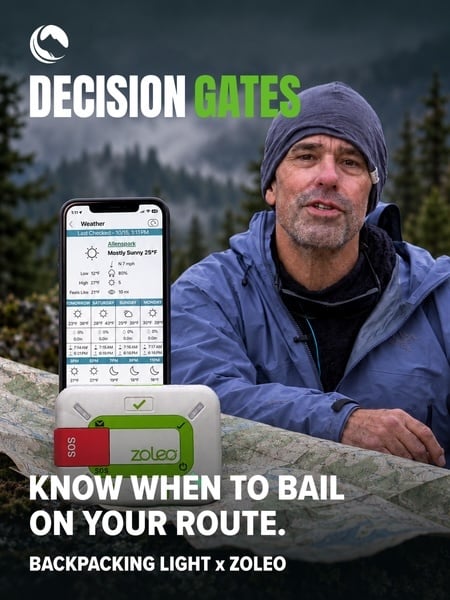 How to Plan with Decision GatesKeep going, change your route, or turn back? Watch how decision gates help structure these choices in our YouTube video.
 © Beartooth Media Group Inc.
 Loading...