Topic

DWR Performance

Viewing 25 posts - 1 through 25 (of 45 total)
Stephen Seeber BPL Member
PostedDec 13, 2019 at 5:04 am

We all know that DWR performance is critical to performance of WPB membranes.  We also expect that the current crop of DWR treatments does not have the longevity of prior products. Regrettably, substitutes are slow to become commercial.  Green Theme Technologies has created a Permanent Water Proofing solution that has been adopted by Marmot and now Outdoor Research.  There are also two external membrane products-Columbia OutDry and Gore Tex Shake Dry.  At this point, the selection of alternatives, particularly in very light weight, packable garments is very limited.  We are generally stuck with DWR for the foreseeable   future.

I am going to set up an AATCC-22 type test and start looking at different retreatment products and hopefully, new garments and fabrics as well to try to determine if performance can be distinguished.  My test device will actually apply water at higher pressure and for longer duration that specified by the AATCC test so I can provide a more demanding test.    This is kind of a difficult project because there is typically no way to know what treatment product is used on any of the fabrics.  However, perhaps we can find that some manufacturer’s products do better than others.

I request that people  post their failure stories along with some information.  The information should include Manufacturer, garment  model, fabric/membrane type, something about usage, such as new, almost new, lots of use, etc., weather conditions that produced failure.  Importantly, maintenance treatment for the garment.  I would like to know the frequency of washing and DRW renewal.  If your renewal process was successful or not and what product was used.

One of the key issues I would like to explore is whether periodic washing and retreatment can provide satisfactory performance.

I will start the ball rolling with the following:
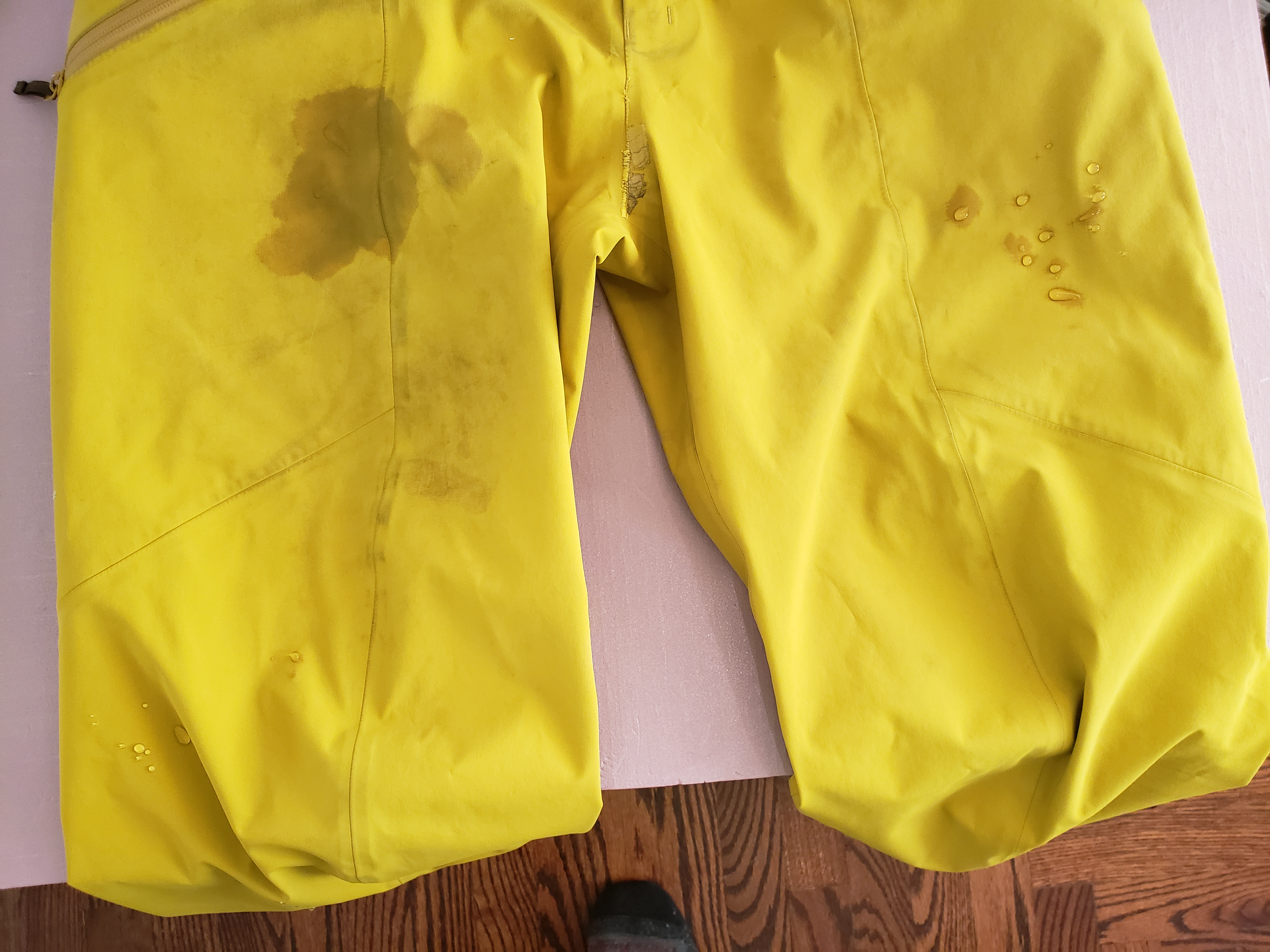
These are Arcteryx Gore Pro pants with extensive use and now in their third winter.  They are very heavily stained.  The stains cannot be washed out despite lots of localized scrubbing.  They have been washed many times and had DWR renewal periodically.   Just before taking the picture I scrubbed the stained area with Techwash using a brush, washed them and reapplied DWR treatment.  I applied water with a dropper.  On the left stain area, the drops immediately wet through.  On the right stain area, with less staining, the drops wet through but more slowly.  The drops on the lower left were applied  to an area with no staining.  No wetting occurred and the drops evaporated.  The pants may have permanently lost some vapor transmission due to poor care.  Here, this does not matter.  If I am warm when wearing them, I open the large rear ventilation zippers.  I know they are still water proof because when I get on the chairlift and sit on a pile of snow, I remain dry.
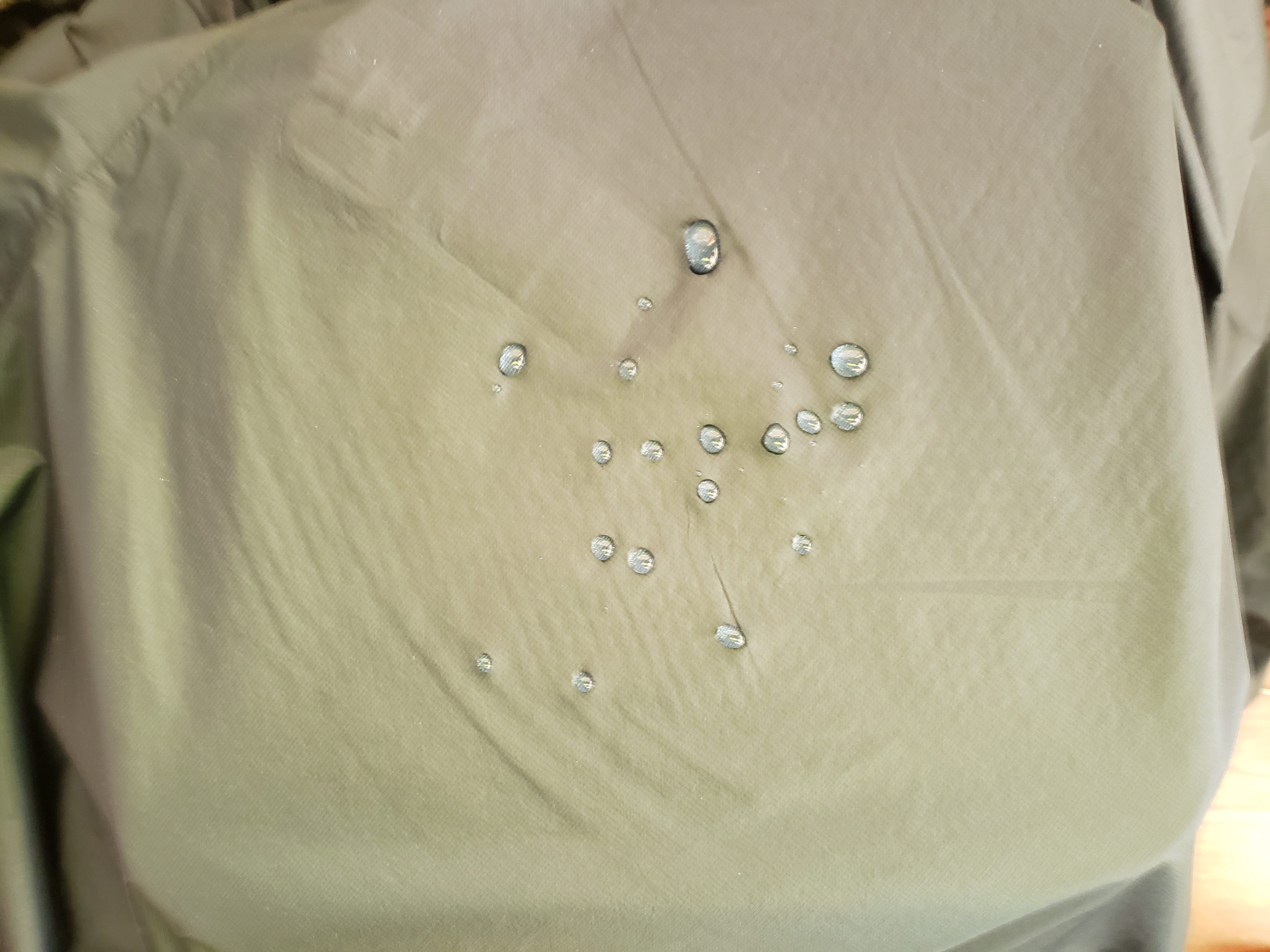
This is a Montbell Versalite.  It is dark blue but I guess my Android phone has a different color sense.  This jacket gets used almost daily.  Because it is a Windstopper membrane and is subject to degradation from skin oils and contaminants, I wash it frequently, particularly if I am sweating.  This jacket was washed and then received a  DWR treatment before taking this picture.  The water drops that were applied remained in place and eventually evaporated.

Once I create my rain shower test, I will retest these under more strenuous conditions and see how they respond to greater pressure and water application duration.

Please respond with details of your failures and perhaps we can all learn something about the state of DWR.



PostedDec 13, 2019 at 2:12 pm

Can you link to a source where OR says they’re using Green Theme’s EMPEL tech?  That’s a new development so far as I’m aware.


What DWR treatments will you be testing?

The ones I’m aware of on the market:

Nikwax TX Direct or the wash-in

Grangers Performance Repel Plus

Gear Aid Revivex Durable Water Repellant

Atsko Permanent Water & Stain Repellant (Green aerosol can)


Stephen Seeber BPL Member
PostedDec 13, 2019 at 2:23 pm

Hi Jeff:

https://www.snewsnet.com/news/green-theme-international-aquavent-watershed-innovation

Sorry, Black Diamond, not OR.  Their Distance windshirt.  Unfortunately, I can’t seem to go back and correct my original post.

First I must create my tester, and then, I will work out a method to test whatever is on the market. I can get.  I want to also test garments to see how they compare.  This little project may drag on a bit but critical is gathering people’s failure experiences as described above.  Perhaps you have one to share.

Steve

Michael E BPL Member
PostedDec 13, 2019 at 5:47 pm

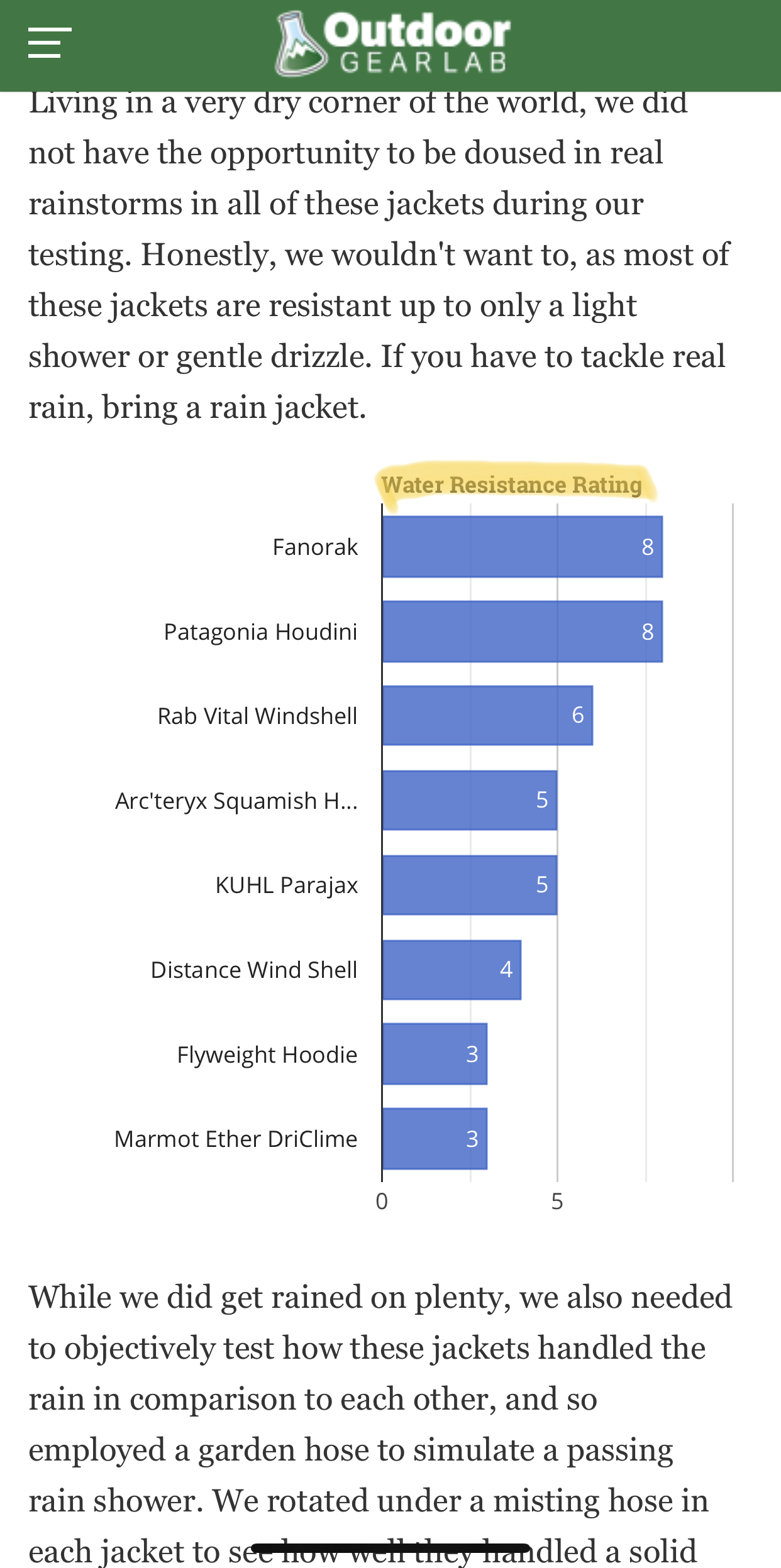
Curious to see how your testing of the BD Distance goes. According to OGL, “Unfortunately, the revolutionary DWR fabric built into the *Distance* significantly underperformed in our testing.”

PostedDec 13, 2019 at 8:05 pm

“Unfortunately I can’t seem to go back and correct my original post.”

YEAH! Many have complained to Ryan for many years about this BPL software defect. So far no fix.
HELLO RYAN!

BTW, thanks for starting this thread. Let’s keep it going with factual updates.

Stephen Seeber BPL Member
PostedDec 13, 2019 at 11:11 pm

Hi Michael:

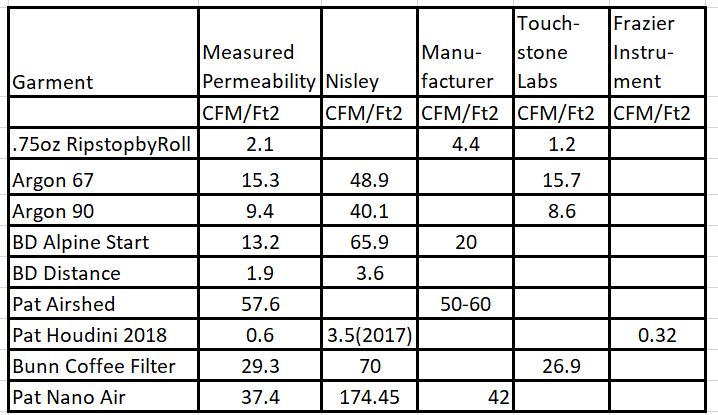
The BD Distance performance is kind of unimpressive by the standard metrics:  Air permeability 1.9 CFM/Ft2, Water Resistance: 251 mm/wc and Breathability at 2400 g/M2/24hr.   Breathability is near the bottom end of windshirts.  Compare this with the Alpine Start:  Air Permeability–13.2 CFM/Ft2, Water Resistance–266,  Breathability  (near the top of windshirts I have tested)–3510 g/M2/24hr.  It is unclear how much the  PWR treatment  of the Distance has to do with its measured performance.  If the PWR is in fact permanent, then that is the advantage is has over other windshirts  and this is what BD stresses in its product description.

Richard Nisley BPL Member
PostedDec 14, 2019 at 2:50 am

3/24/19 – BD Distance Second Look

The reviewer’s use of a hose test to determine moisture ingress is a crude measure of a windshirt’s HH; not DWR sustainability.

Michael E BPL Member
PostedDec 14, 2019 at 6:20 am

Hi Stephen,

Thanks for the Distance info. Yes, I got the Alpine Start mainly for the breathability. Have also found the Schoeller with NanoSphere has fairly good resistance to light rain.

I think that the OGL review was fair inasmuch as they said two months was not an adequate test of DWR durability claims. But BD does also clearly claim that the DWR of the Distance is superior in terms of repelling water:

“Features GTT Revolutionary Breathable Water Protection Technology, an environmentally friendly PFC-free water-repellant finish that is superior in performance compared to any other C-6, C-8, or C-0 DWR. This performance is only exceeded by its durability, as the GTI Technology is permanently hyper-fused to the individual fabric fibers, and there is no need to ever refresh the jacket with an additional spray or wash-in finish. ”

OGL states that, “Despite claims of a superior DWR fabric, our hose test showed that anything more than a light, passing rain will soak this jacket. Fortunately, it dried out completely in a little more than 30 minutes.”

They don’t really explain exactly what the “hose test” entails, but I assume an attempt to simulate different types of rain through adjusting the sprayer? In any event, handling a light passing rain might be all one would expect from a lightweight wind shell. My Tantrum II and Kor Preshell can easily handle that, but there is no promise of unlimited DWR durability.

Tuukka U BPL Member
PostedDec 14, 2019 at 9:54 am

Stephen,

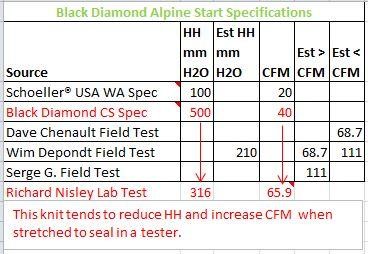
can you clarify your CFM measurement for the Alpine Start? BD claims it comes at 40 CFM and Nisley measured it 67 CFM.

Stephen Seeber BPL Member
PostedDec 14, 2019 at 5:09 pm

HI Michael:

I agree with what you said. Richard Nisley claims the hose test is crude and measures HH not DWR  performance.  As you point out, we do not know how the hose test was done.  As a light shower, the hose test would sort of simulate standard show test methodologies.  If the hose test blasted the garment, then perhaps the HH of the garment, which is pretty low, would be exceeded.  We don’t know.  I don’t think it matters.  OGL makes no claim of performing quantitative tests and we should take their reviews accordingly.


Richard Nisley BPL Member
PostedDec 14, 2019 at 6:57 pm

From HEAR

In contrast,  the classic DWR test measures the shape of small water drops on a slanted fabric surface to determine if they are circular (good DWR = low surface energy = circular droplets = roll off the fabric vs sticking to it)

Michael E BPL Member
PostedDec 14, 2019 at 7:28 pm

Hi Stephen,

I did find more info on the hose test in their overall review of windbreaker jackets:

“While we did get rained on plenty, we also needed to objectively test how these jackets handled the rain in comparison to each other, and so employed a garden hose to simulate a passing rain shower. We rotated under a misting hose in each jacket to see how well they handled a solid dousing. We tested these jackets at the end of each test period, to get an idea of how well their DWR coating had held up over time. The results spanned the range from impressively good to very bad!”

It seems like both the quantitative and non quantitative testing so far does not support the claim of superior water resistance for the Distance. The DWR durability claim is another matter and yet to be tested. As you point out, that durability factor would be the main difference.

I’m curious about something you mentioned earlier. That is, how much of a factor is the DWR itself in terms of measured water resistance performance? What other factors might be at play? Fabric weight, material composition, air permeability? I notice, for example, that my Kor Preshell is less water resistant compared to my Tantrum II. Both are 20 D nylon ripstop, but the Kor Pertex Quantum Air is much more breathable.

Richard Nisley BPL Member
PostedDec 14, 2019 at 8:03 pm

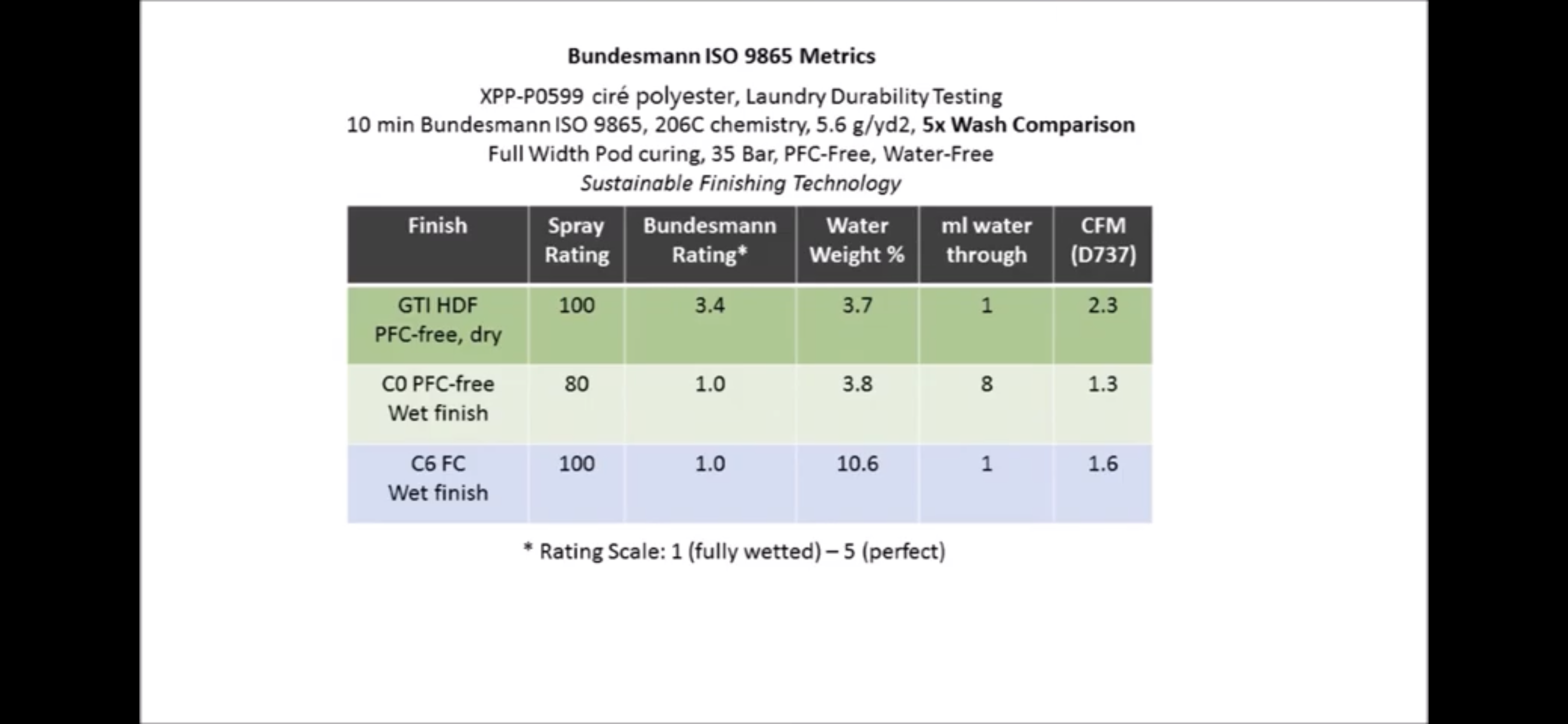
Watch a Bundesmann ISO 9865 test on YouTube to see how DWR is commonly tested. C6 is the DWR used on most current rainwear and C0 is aka NikWax.

Garment movement plus rain drops is simulated in this international standard. See
HERE


Stephen Seeber BPL Member
PostedDec 14, 2019 at 8:54 pm

Hi Tuukka U:

To answer this question, I suggest you first take a look at this thread:

https://backpackinglight.com/forums/topic/87307/page/3/#comments

In this thread Woubeir challenges the magnitude of Richard Nisley’s permeability numbers.  He observes that Nisley’s  data is often far larger than manufacturer’s data.  At one point, Roman Vazhnov asks what instrumentation Nisley uses to obtain his measurements.  Nisley responds:

“My lab equipment’s manufactures and model numbers are proprietary information but, it is similar to the commercial equipment that Gore-Tex scientists used for their air permeable Gore-Tex patent measurements. It is not a DIY tester.”

During my nearly 40 years of owning and operating a testing business, it would be unthinkable for me to withhold instrument identification and calibration data from my clients and, in this case, BPL is Richard Nisley’s client.  I cannot imagine what could be proprietary about what ever it is he uses and how or when it is calibrated.  This type of information is crucial to making an informed judgement as to the validity of his test data.

Ultimately, Nisley reponds to Woubeir:

Take one garment to an independent local lab and measure its air permeability. POOF… no more doubt, perhaps, or maybe. You will experience much less angst knowing for sure (smile).

When I was developing my DIY testers for air permeability, I found I could not match Nisley’s results, and the differences were typically substantial.  I actually sent PMs to Nisley to discuss the discrepancies but never received a response back.

In any case, the calibration process I implemented is described in detail in the various garment reviews I have published on this forum.  I went a step further:  I followed Nisley’s advice to Woubier and had independent lab testing done on 7 fabrics/garments for which Nisley had published test results.  The results of this effort, are seen in the following table:

I have expended considerable effort and funds to establish the reliability of my measurements.  We have no data that would enable us to make a similar statement concerning Richard Nisley’s air permeability measurements.

Now for your specific question:  The Alpine Start I tested was sent to me for testing by a BPL member.  It was a used garment so its performance may differ somewhat from a new garment.  Some discussion about manufacturer’s data may be found on this thread: https://backpackinglight.com/forums/topic/87696/page/3/

Two values are provided:  20 CFM/Ft2 and 40 CFM/Ft2, along with a discussion of units. Beyond this, I have seen no published data on Black Diamond or Schoeller websites.

Stephen Seeber BPL Member
PostedDec 16, 2019 at 12:50 am

Correction to my last post.  The BD Alpine Start I looked at was new from 2018.  I may be receiving some lightly used 2015 and 2016 Alpine Starts to test.  Perhaps the fabric changed.  I have checked my raw data.  I took five readings that ranged from 11.26 to 15.15 with an average of 13.2.  I am curious about this since it is a soft shell.  I will post anything new that comes up if I receive the older garments.

PostedDec 16, 2019 at 2:37 am

This thread got me looking online for info about restrictions placed on DWR treatments.  As Michael E and Richard Nisley have posted above, treatments termed ‘C-6’ and ‘C-8’ have been used for DWR, C-8 being the more water repellent.  But C-8 is being phased out, and C-6 may be also, due to their side effects, which are discussed in an Appalachian Mountain Club article which states that:

“When it comes to your outdoor equipment, first, rest assured you’re not poisoning yourself by wearing PFC-coated rain gear. No evidence suggests that skin contact with DWR is dangerous. The primary source of exposure and environmental contamination comes from the manufacture and disposal of products that contain PFCs.”

https://www.outdoors.org/articles/is-your-waterproof-jacket-toxic

The toxic results of using these compounds in manufacturing will likely redound to limit the reliability of DWR coatings on new gear that we purchase.  There is a lot on the web about substitutes, but nothing fully proven.   And I may think twice before spraying DWR out of a can on anything.

So, will hoard the few Patagonia WPB tops that I have, and treat them reverently to limit dirt and stains and the need for washings, because replacing them with anything nearly as effective may not be possible..  But also note that long before there were restrictions on these compounds, the effectiveness of WPB’s varied all over the walk, as evidenced by the amount of discarded raingear that I need to take to the dump.

As contemplated in a recent BPL thread, maybe the development of new DWR treatments will issue in the development of superlight single wall tents that in all weather are dry and comfortable inside.  Who knows?

Murali C BPL Member
PostedDec 16, 2019 at 4:43 am

I am very impressed with the Columbia Outdry fabric. The Ex Featherweight is light – around 7.5 oz. Agreed it is not superlight 5.5 oz or so like the Zpacks one. But, the Ex Featherweight was around $100 or so. Also, it is not that packable – unless I put it in a stuff sack to limit the space it wants to take up. Limitations I can live with as it doesn’t wet out or have to deal with the uncertainty of a DWR rain jacket.

I used a Ex Reign jacket (heavier one) in PCT-Washington this year and in spite of 4 or 5 days of near constant rain while hiking for 10 hours or so, it did not wet out. Very happy.

Stephen Seeber BPL Member
PostedDec 16, 2019 at 5:48 am

Hi Murali C:

You are pretty enthusiastic about Outdry, which I imagine means you must have experienced prior DWR failures.

So what is the backstory here–the long hikes in the rain where your DWR failed and the jacket wetted out.  What I am looking to document hereis whether failure is inherent to the chemistry of C8 or C6 or, a result of inadequate care of the garment.  Prior to Outdry, did you simply expect to get wet if you were caught in persistent rain?

Steve

Richard Nisley BPL Member
PostedDec 16, 2019 at 6:08 am

This is my response to Stephen’s post starting with “Hi Tuukka U” in this thread.

Tuukka U asked Stephen a simple question

He said, “Stephen,

can you clarify your CFM measurement for the Alpine Start? BD claims it comes at 40 CFM and Nisley measured it 67 CFM.

This resulted in Stephen’s spewing vitriol along the lines that “only he should be relied on for CFM information for the 2014 Black Diamond Start” based on his testing of the 2018 BD Start version. My 2014 lab test plus all the other people who contributed field test information to my post was not valid.

Please reference my 2014 post at https://backpackinglight.com/forums/topic/87696/page/3/#post-2080636  for details beyond the brief excerpt in this post.

One of his major analysis fallacies, other than never having tested the 2014 version, was he was clueless that the material in 2014, significantly changed its CFM based on the tightness on the user or in a test jig. Another of his major analysis fallacies was that both the material manufacture, the jacket manufacture, and many BPL forum members all contributed estimated CFM numbers to the above thread post. Every single source was higher than his “only I can determine truth” 2018 value.

My Air Permeability Test Equipment

I bought my commercial air permeability tester in 2014. It was the same device that Gore-Tex used to test, most if not all, of both their pending and granted air permeable membrane patents though that year. It was a simple decision for me: the pending and granted Gore-Tex patent documents had this machine specifically defined, their associated testing procedures defined, and their actual measurements defined; it was a perfect choice. It was and still is specifically approved for certified air permeability measurements using most international standards: TAPPI T-460, ASTM D-726-58 & D-202-77, APPITA/AS 1301-420, BS 5926, CPPA D-14, ISO 5636/5, SCAN P-19 & P53.
Anyone who has ever read a patent, should recognize a standard phrase, “a person skilled in the art”. This fictional person is considered to have the normal skills and knowledge in a particular technical field, without being a genius. If you have that level of skill, then all of the information about my equipment and methods has been available in detail since 2014.

-Related Reciprocal Questions to Stephen
In what standards is your device incorporated as being accurate enough to be trustworthy?

Why didn’t you fully disclose the design of your CFM tester to the forum. For example, how does it compare to a Frazier Machine in functionality; what is the deviation from the Frazier machine values in the range for common interest (.001 CFM to 100 CFM.}?

My Hydrostatic Head Test Equipment
I bought my commercial hydrostatic head tester in 2014. It was actually manufactured by Gore Labs

I Have No BPL Clients
A contract for services is a contract by which a provider of services agrees to provide a service to a client in exchange for a payment.In my many years on BPL, I have never received any payment, including a paid subscription or any discount. I pay a yearly fee to access the forum as do most. I am in no way obligated


PostedDec 16, 2019 at 1:32 pm

Stephen,

Personal experiences with DWR.

The DWR product we’ve used most is Nikwax because it’s so readily available at the local REI.  However, I’d say my experience with it has been so-so.

I’ve also tried Grangers the Atsko product.  I had quality control issues with the Atsko product.  It came in an aerosol can rather than a pump bottle and both cans had little to no pressure despite feeling full when I got them.  I ended up complaining to their customer service department, but also piercing the cans with a sharp object and draining the product into (there was some initial pressure) into a spray bottle.

I read at least one claim online says this stuff contains C8, but there’s very little information about it online.  After searching, I see that Home Depot carries a 17 oz spray bottle version.

https://www.homedepot.com/p/ATSKO-Permanent-Waterproofing-Water-Guard-Heavy-Duty-Water-and-Stain-Repellent-17-oz-Bottle-66364/207024155

There’s a link next to the product for SDS, but it’s contents are useless.  It’s like they submitted the form with most of the fields blank.

I’m pretty sure I used the Atsko to treat my ~ 7yo eVent rain jacket from Luke’s Ultralight at the beginning of the year.  I say “pretty sure”, because I have the eVent jacket, an OR Helium II, and a Marmot Precip that’s about as old as the eVent jacket.  I’m also responsible for treating my wife and daughter’s rainwear, so I get pretty fuzzy on what product was used on what rainwear items.

I haven’t used the eVent jacket much this year.  My OR Helium II went with me backpacking.   When I wore the eVent jacket on a wet run about 3 weeks ago, I noticed some wetting through across the chest where the hydration pack straps are located.  This was after an hour or exposure, to light rain.

So while I can’t say with certainty that the Atsko product has been performing better than Nikwax, it hasn’t been performing any worse.


PostedDec 16, 2019 at 3:51 pm

Stephen, re: “What I am looking to document hereis whether failure is inherent to the chemistry of C8 or C6 or, a result of inadequate care of the garment.”

Almost 20 years ago, I switched to a Patagonia Specter pull-over, and to an M-10 jacket when they came out a number of years later.   Previously, I always had problems with rain jackets wetting out, totally (unlaminated materials) or to a significant degree with GTX.  After the switch, there has been no wetting out.

So I do not believe that it is just a matter of C-6, or C-8; but rather, quality of manufacture, including manufacture of materials.  As for care of materials, I put on rain gear only when it is raining, and take it off as soon as rain subsides, even if this means putting it in and taking it out of the pack a number of times during the day.  It usually dries out in the tent, but if not, I never pack it away wet.  Patagonia rain gear is expensive even discounted, so I take the best possible care of it, and have never torn it or stained it. While I have been a maniacal bushwhacker, these are just for day hiking explorations; or on longer hikes, detours that last no more than a day.  So the rain gear does not get dragged though thorny briar patches.  Aside from some wrinkling from folding, it looks just as new as the day I bought it.

My hiking style may be relevant also.  I take it easy, and stay on routes with good footing, even when bushwhacking.  And as suggested above, do not head out for a day of bushwhacking when the weather is bad.  Years ago, on a rainy hike intended to go from Mount Washington to Katahdin, I fell and rolled downhill over rocks for about 50 feet coming down into the Great Gulf.  On coming to a halt, could not move one leg, and thought it was broken.  But it was just cramped, and after a few minutes was able to move it and get up to resume the descent.  After that, I have hiked much more carefully, and have enjoyed it a great deal more.

Hope this is helpful.

Murali C BPL Member
PostedDec 16, 2019 at 3:53 pm

Hi Stephen,

I personally have never had any wet out issues with DWR jackets – that’s because I was never caught in day long rain for multiple days. But having heard of such failures in the field, I moved to non-DWR jacket like the Outdry when I went for the PCT-Washington hike where I was preparing for long days of rain. And I was caught in day long rain for multiple days this summer.

When I talked to Joe Valesco at Zpacks, he suggested that one should not use the rain jacket for insulation like many of us do – which can cause premature damage to the DWR. He suggested using a wind jacket instead for insulation and using the rain jacket only when needed. That is one way to prolong the life of the DWR. John Abela is another person who has written extensively about the problems with WPB fabrics and someone who uses the Zpacks jackets or at least reviewed them.

Philip Werner at sectionhiker.com has also commented extensively on this topic.

Also, have heard or read that after marker DWR solutions do not work that great compared to what was done from the factory.

I wish more folks would make ponchos with longer arm sleeves that covers the entire arm. With that and chaps for legs and a cord around your waist to contain the wind, you do not have to deal with DWR failures.


PostedDec 16, 2019 at 5:22 pm

Richard,
I am trying to learn about this technology and appreciate your efforts to educate. I was confused by your statement “…the material in 2014, significantly changed its CFM based on the tightness on the user or in a test jig.” If I’m interpreting what you’re saying correctly, it sounds like you are referring to an increase in CFM based on a tensile preload of the fabric. Is this what you mean? If so, I am confused by that as I can only imagine a lightweight rain jacket as being draped over the body. I can’t imagine there would be a significant deadweight stress. Perhaps the jacket could be slightly preloaded by pulling the bottom downward under a tight pack waist belt, but I don’t think that would be very comfortable or how anyone actually wears the jacket (and the tension would probably relax after walking some distance). I could be wrong, I’ve never thought about it until now. Could you elaborate so that I can gain a better understanding? I appreciate your help on the forum!

Stephen Seeber BPL Member
PostedDec 17, 2019 at 5:10 am

Hi Sam:

That is the kind of history I am looking for.   Thank you.

Hi Murali:

Thanks for the comments and I followed up with your references.


Steve


Viewing 25 posts - 1 through 25 (of 45 total)
Loading...