


Nice, I just happen to have a voucher for their :-)
Topic
Become a member to post in the forums.
 .
.
Nice, I just happen to have a voucher for their :-)

Thanks for the idea of using the Kill-o-watt meter. I’ve never used mine that way, only to see how much something draws and to adjust my generator in the MotorHome. I need to check the ‘fridges. :)
We moved our old fridge to the basement when the house got remodeled, I just leave it open and plugged out, it gets plugged in for Christmas or parties.
I am going to check everyhing that’s always plugged in.
My folks back in the UK installed a geothermal heat pump system several years ago. Unlike solar, it isn’t affected by the “nice weather for ducks” they experience, and they can draw on the energy as they need. They did qualify for a rebate which should help offset the cost over 15 years, although they had to jump through hoops to qualify when the last government changed policy. For every 1p they spend, they get 3p in energy. Previously they were using heating oil, as their rural town wasn’t supplied with natural gas. The initial outlay was considerable, but their savings were earning a pitiful return so they took a long term view. Now they are saving over a thousand pounds on heating bills each year.
If anyone interested in a solar system for their house I would suggest looking into:
http://www.gogreensolar.com/collections/solar-panel-kits
It is a DIY approach, but WAY cheaper than one installed from a solar company. They also have services to produce all the plans you need to get the permit (an extra $475) and a service to get you the IRS rebate and produce the paperwork necessary to connect to the grid ($250).
This what I am looking into. Now if I can just convince my wife that I can install the thing. ;)
I wonder where these panels are made. I hope not China. Chinese made (not Taiwanese) panels because they don’t have good longevity compared to other quality panels
The idea of installing them myself and having an electrician do the hookup to a meter sounds good. “In another life” I did a lot of roofing so I’m no stranger to working on a roof. Plus my house is easy to work on B/C its a one storey house with a low angle pitch to the roof. The savings could be in the $5,000. range for my modest 1,500 sq. ft. home.
BUT, Nevada’s PUC has ruled against rooftop solar owners with much lower (40% lower) kilowatt hour credits for each Kw Hr. produced. In addition non solar homes pay $12.75 per month “net metering fee” to pay for automatic meter reading whereas rooftop solar owners pay $21. per month beginning January 2016. Unlike California, Nevada has seen fit to punish roof top solar owners to benefit NV Energy, a Berkshire-Hathaway company. What’s the saying? “Money talks, everything else walks.”
So I won’t be getting solar PERIOD. I’ll just continue to make my house more energy efficient in other ways, as I have been doing for several years. Insulation, swamp cooler for temps under 100 F., awnings on east and west facing sides, solar screens on all windows, new 15.5 SEER HVAC unit in 2014, reflective paint on the roof sheeting, computer controlled hot water heater, xeriscaped front and back yards, low flow faucets and toilets, etc. My monthly electric bill averages $121./month so that’s fairly reasonable.
My greatest hope is the development of battery technology so anyone with a decent income (say $40,000. + a year) can afford not only solar panels but high tech batteries to store energy for night time use. That means I could then see a path to truly getting off the grid and giving NV Energy a solar finger. ;o)
Yeah, I didn’t figure that you would be able to use it, but sometimes these threads are used for research by others. ;)
I believe these are made in the US, but I am not sure. They have a 25 year 80% output guarantee, which seems to be the industry standard.
If my electric bill was down to a $121 average I probably wouldn’t be looking. I’d love to be down to that AFTER installing a solar system. :)

Well, I live in Bakersfield, CA. I have had solar for two years now. Decided to do it for ecological and economical reasons. I got a loan rather than a lease. Lease is usually bad. I hope to have it paid off in 4.5 years from now. Doubled payments to have no payments when I retire.
I am nervous about PG&E our wonderful power company that made HInkley, CA and Erin Brockovich famous. They keep chipping away at little fees to hinder solar savers. I might have to look into going off the grid with batteries. In the mean time will have to encourage solar companies to fight PG&E abuse.
My Associate Pastor plans on moving to Nevada when he retires and building a home and was planning on putting solar on the home, but recent decisions that you have stated has changed that plan.
I will pray for your fight with your power company.
Blessings for your efforts.
Here is my 7 month update on energy usage. Also here is a link with all of our energy upgrades and I just got a $4,500 rebate check from So Calif Edison for the upgrades. Living in the lower desert our big months for electric consumption are May – Sep, but the tier charge levels change so we should get even bigger dollar savings with our KwH savings this summer. So far in 7 months our KwH consumption is down 34.7% and it should get even better in the summer months. Natural gas consumption is down 59.6% but there won’t be any big gas savings in the summer months.
Our habits have changed some since I retired. We haven’t been camping as much in the past 6 months as in prior years, since I am doing some major remodeling work. Also I am home during the week versus traveling for business in years past. So we have been at home much more during the past few months.
Our 5 year average for electricity was slightly under $190 per month and gas was just under $42 per month ($232 total). I think we may get this down to $90 and $20 ($110 total) without installing solar. Plus we are DINKs, so we aren’t suffering the expense of kids using energy :)

I’ve only been in this house since late January, but so far both my electric and gas bills have been less than $30/mth. I recently had new siding put on, and had them wrap the house in low-e insulation over the house wrap. will be interested to see if that makes much of a difference.

You have to have an air space on at least one side of the low-e layer in order for it to work.
If you just have siding, low-e layer, siding there isn’t much air space
low-e coating on windows work good. Or reflective side of insulation in a wall if there’s an air space next to it.
but low-e layer will reduce air infiltration even if the low-e isn’t doing much. tyvek might be better because it allows water vapor to pass through
(sorry, one trick pony here)
I’ve only been in this house since late January, but so far both my electric and gas bills have been less than $30/mth
Yeah, well you’re single…
;)
Five years ago we spent quite a lot of money converting our house to being solar passive – we also heavily insulated the walls, ceiling and floors, and the new part of the house has polished concrete floors for thermal mass. Of course we also have double-glazing, all LED lighting, ceiling fans etc. At that time we installed 3.2kw of PV, oriented directly north at the right angle for mid-summer sun (NB – I’m in Melbourne so the sun is to the north, not the south). We also installed a charged rainwater system throughout the house, connected to storage of 18,000 litres (as a result our mains water usage is between 30 and 36 litres per day – about 5-6 litres per person per day). Because we were (relatively) early adopters we got the premium feed-in tariff of over 60c a kwH for net feed-in to the grid. Given that for a family of 5 we don’t use much electricity – about 12kwH per day, as near as I can work out – we average a $1,000 per annum surplus on our electricity bill. We use that surplus to pay for our gas (minimal usage except during winter) and water bills. From a financial point of view it’s been excellent. Because the PV is part of the house in my view we don’t need to amortise it – if we ever sell the value of it will be picked up in the value of the house – particularly if the premium feed-in tariff is still operating. In any case, if we did have to amortise it, we’d almost be there. The next step is to install batteries for time-shifting (particularly once we lose the premium feed-in tariff) and with a grid-disconnect so that the next time the grid goes down we’ll still have power.
Become a member to post in the forums.
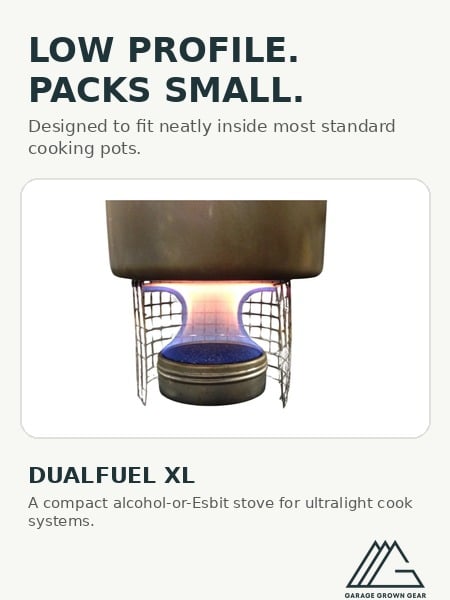 DualFuel XLCompact alcohol-or-Esbit stove with a low-profile design that fits inside most standard cooking pots.
 © Beartooth Media Group Inc.
 Loading...