Topic

DIY – wax based stoves for backpackers

Viewing 17 posts - 1 through 17 (of 17 total)
PostedAug 7, 2019 at 4:18 pm

I have been working on a wax based stove for several years.  The results have been very encouraging as I was able to produce a soot free stove that could boil water in the same time as a good alcohols stove.  In fact, I was planning on writing an article on a DIY wax-based stove for backpackinglight.  In drafting the article, it became apparent to me that the practical risk far outweighs the benefits (at least in my mind).

Here is my rational: for backpackers, the primary purpose of a stove is to boil water.  I know, not rocket science.  There is a phenomenon called Wax Fire that I believe to be a significant issue.

From Wikipedia

A wax fire is created when melted or boiling wax is doused in water. The ensuing reaction creates a large fireball or enlarges the flame of the already existing fire incredibly. Only a small amount of wax and water is needed to create a wax fire.

Chemistry behind the reaction

Following the basic rules of the fire triangle, for a reaction to take place three ingredients are required: oxygen, fuel, and heat. In the case of wax melted down, only the top surface has access to oxygen, so the fire progresses slowly. When water is added to the wax, two things happen. Firstly, the water — being denser than wax — sinks to the bottom of the container. Secondly, as burning wax quickly reaches a temperature of well over 200 degrees C, the water instantly vaporizes. When water changes from a liquid to a gas, there is more than a thousand-fold increase in volume. The water expands violently, and throws the hot wax layer above it into the air as small droplets. The wax now has a much bigger surface area exposed to oxygen so combustion takes place very quickly.

How big of an issue is this?  Well, check out a few of these videos.

https://youtu.be/PSg7dwmATPc

https://youtu.be/lVfagFSxdqw

Since you are vaporizing water, it would only tale a few drops to cause a flare-up.  I would image that if one were not careful, water boiling over the top of a mug would cause a significant problem.  Can a wax stove be designed to minimize flare-ups?  I am sure that it can, however; the added safety features would probably come at a cost of complexity, weight and reliability.  For now, I am abandoning further work on wax-based stove.  My 2 cents.

Jerry Adams BPL Member
PostedAug 7, 2019 at 6:10 pm

That makes sense

If the wax was soaked into a substrate, like cardboard, then this wouldn’t be a risk?

PostedAug 7, 2019 at 7:01 pm

Jerry,

I think that the problem still exist.  The wax has to get into a molten state before you can get the flame to stabilize.  I used carbon felt and saw how the system melted the entire pool of wax.  Think of it this way: molten wax is similar to hot oil.  If they are light and you pour water on them,both of them will flare up into a fireball.  That is why when you have an oil fire in the kitchen you never use water to put it out.  My 2 cents.

MJ H BPL Member
PostedAug 7, 2019 at 11:14 pm

I’m not sure I learned the right lesson, but thanks.

David Thomas BPL Member
PostedAug 8, 2019 at 8:18 am

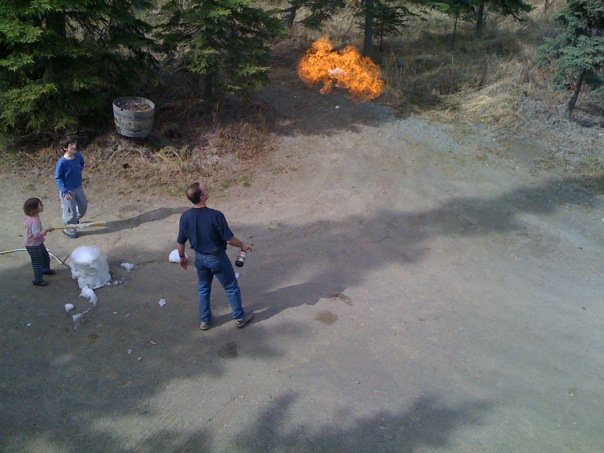
I’m with MJH.  Sounds like a new experiment to do with the kids.  Here we are lighting clouds of methane-filled soap bubbles):

David Thomas BPL Member
PostedAug 8, 2019 at 8:21 am

Jerry:  I’ve tried a variety of wax-soaked cardboard configurations and they worked fine, but were like a candle – a sooty flame.  Jon’s figured out a more clever way to burn wax vapor with enough oxygen to avoid the soot, but I suspect that the wax is therefore a lot hotter.  And more of it is liquid at once.

Jerry Adams BPL Member
PostedAug 8, 2019 at 1:04 pm

ahh…  that makes sense.  wax soaked cardboard does produce soot

PostedAug 9, 2019 at 7:50 am

Jon,

Given your background, it’s very plausible that you’ve achieved your claims, but this still reads a bit funny: I’ve solved a hard problem but I’m not sharing the solution or any proof that I actually have.

People have been cooking over tea candles for ages but this hazard doesn’t appear to be a common problem. Maybe you’re over estimating the actual risk.  Maybe if you share your work, fresh eyes will see elegant safety enhancements.

PostedAug 9, 2019 at 2:21 pm

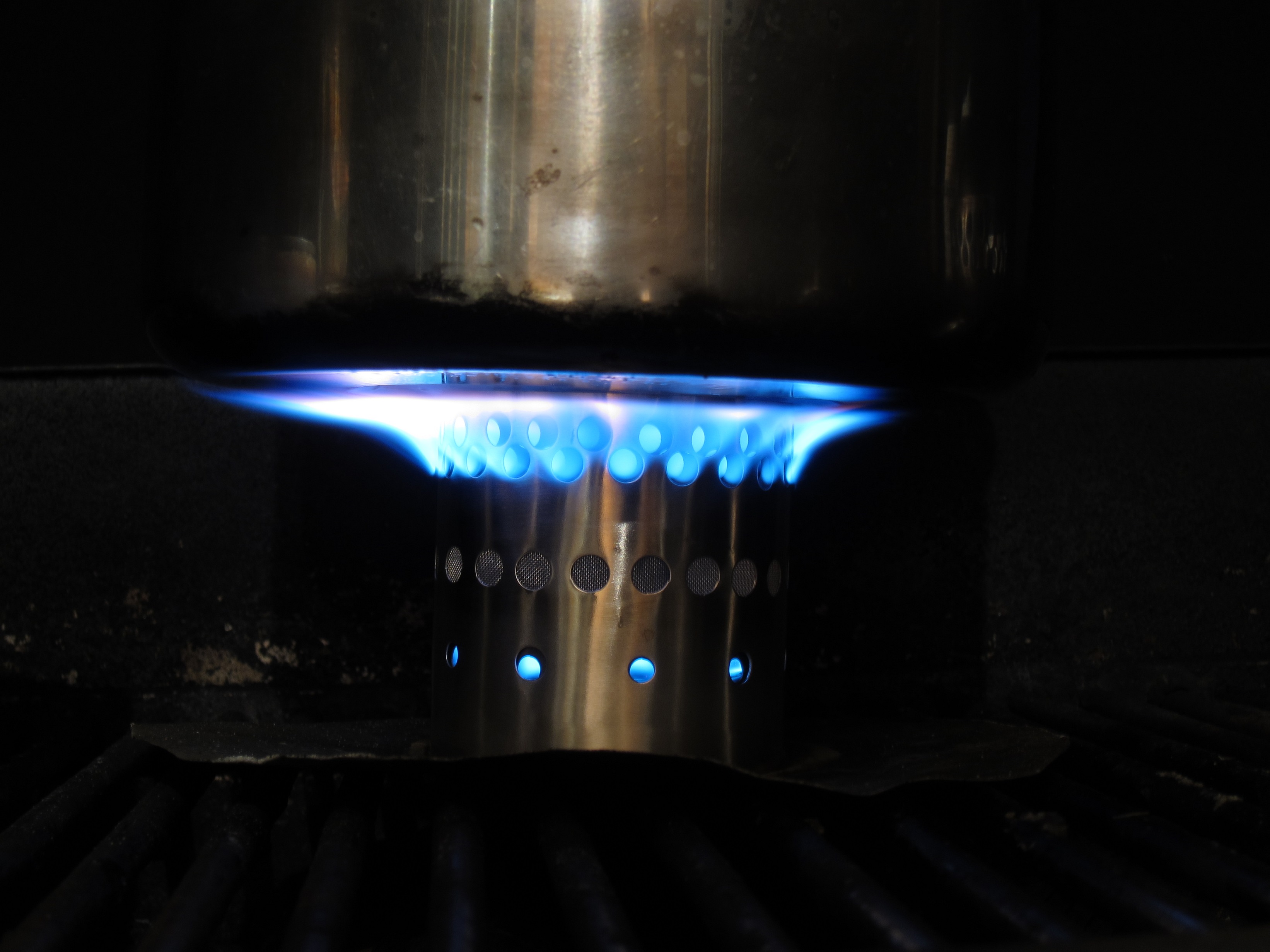
Here is the deal, I have created a wax based stove that burns with a blue flame and is soot free.  I did post some videos on it, but was requested to remove them by Ray Gatt as he thought that they violated his patent (they don’t).  The stove is actually out on loan to Hikin’ Jim and maybe he can chime in on the performance.

As I was writing up the article on wax based stoves, I was listing out the pro’s and con’s of the stove, fire wax is a significant issue.  During the product development process there is a process called failure modes , effects and critical analysis (FMECA).  Basically what is the worst thing that can happen to your product.  In this case, a flare up due to water accidently dripping into flaming wax is a significant event.  Releasing the DIY plan as is opens up the risk of injury to level that I thought was unacceptable.  Particularly in the curretn digital age, once information is out there it can spread quickly. 19/20 people may be perfectly safe, but that 1/20 can cause some serious damage.  If you have doubts, go look at those videos that I posted of Wax Fire.

Is it solvable? absolutely.  That being said, a wax based stove still has only a niche application.  There are only so many hours in a day and I am not sure that this is worth the effort at this time.  My 2 cents.

JCH BPL Member
PostedAug 9, 2019 at 4:53 pm

I support Jon for taking an educated and ethical decision, as well as decided CYA.  Anyone is free to disagree with that decision…I do not.  Intelligently done Jon.

David Thomas BPL Member
PostedAug 9, 2019 at 8:38 pm

I concur.  I’ve long pondered the results of accidentally spilling boiling hot water (or Ramen noodles) onto a butane-mix canister and while I can imagine it going badly, it would be a rare constellation of conditions for a canister to rupture.  There’d be poor heat transfer on the top of the canister (since there’s only butane gas on the other side), the butane is typically a bit cool when in use, very hot water cools quickly by evaporation, and the canisters do take a pretty high temperature before exploding as Roger has tested.

But a few drops of water from a pot, pot filling, a big raindrop(?) or certainly a trickle of rain off your parka hood or tent/tarp over you into that molten wax that’s far above 100C?  That seems a lot more likely and has very dramatic results.

Thanks Jon, for the heads up.  I play with melted wax at times, albeit usually just barely above its melting point, and I’ll be more careful in the future.

PostedAug 9, 2019 at 11:23 pm

Niche application:I dream for wax stove since 2 years for  canadian artic  plane fuel/gas law restriction.


David Thomas BPL Member
PostedAug 10, 2019 at 11:41 pm

Jean-Francois:  PM me – I’ve come up with some solutions for Adak which, unlike many Alaskan towns accessible by bush plane, is only served by 737s out of Anchorage so everything has to get past TSA.

Roger Caffin BPL Member
PostedJan 12, 2025 at 12:03 am

Our first candle stove was published here in 2007. it had a simple open flame. Prospects were not good, mainly due to oxygen limits. It was sooty – very.

Jon’s version in August 2019 looks much better! Proper blue flames even. I would love to see a proper article with drawings here at BPL.

Could there be a hazard with a spill of water? Yes, I guess so. But if you have ever seen what happens when there is leak between stove and canister, that is far worse! Yeah, been there, seen that. Everything is a potential hazard.

Go for it Jon for an article. If I can help, let me know.

Cheers

Viewing 17 posts - 1 through 17 (of 17 total)
Loading...