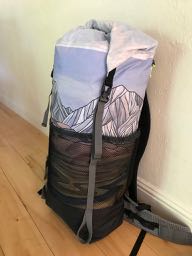
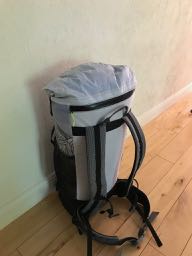
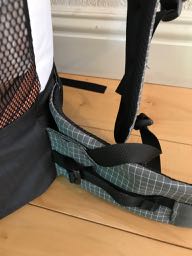
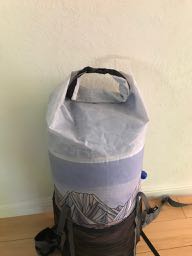
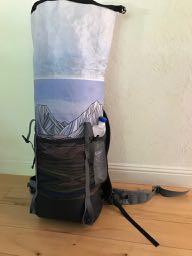
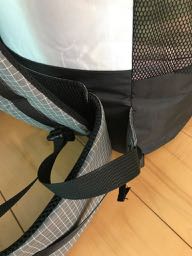
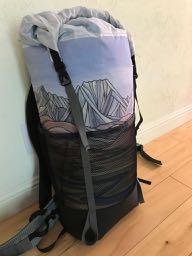
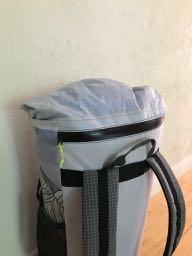
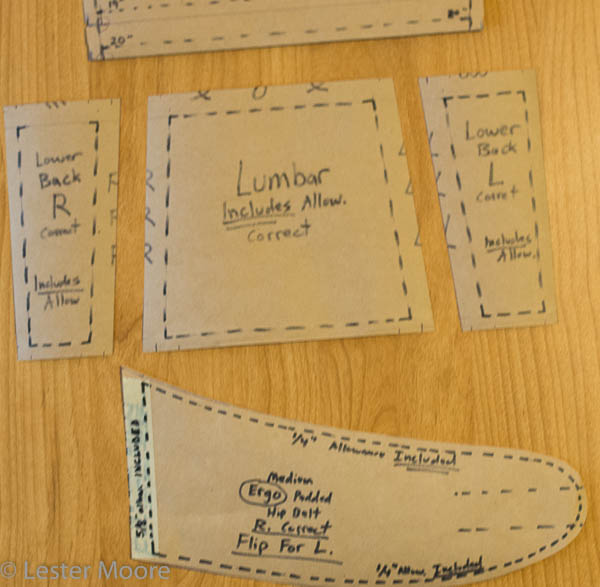
The Lower Back L and Lower Back R panel are single layer. the Lumbar panel may be either single layer fabric, or double layer (fabric on inside and spacer mesh outside) with foam between both layers. Each hip belt wing gets sewn into the seam that attaches the appropriate Lower Back panel (R or L) to the Lumbar panel – these seams are marked “R R R” and “L L L” vertically where the patterns join. After sewing these seams with hip belt wings untrained into them, the allowances are folded flat inward and a row of top stitches added to each side (pseudo flat felled), then bar tacks are added to the back panel where the top and bottom corners of each wing attach.
You make a good point on the pull force being in line with the bar tacks (vertical) rather than being outward. Most of the pack’s weight should result in a vertical force vector where the hip belt attaches. In theory, hip belt attachment seams should disperse this force somewhat, even though the seams are inline with the force (vertical). But since the force is vertical rather than horizontally (outward), the top stitch part of the “flat felled” seam really isn’t providing any additional force distribution – most of the stress will be on the first primary stitch line only.
However, there is some component of force exerted outward (horizontally) as one tightens the hip belt around one’s waist. Although this horizontal force is minimized or eliminated by cinching down the “load lifter” straps that you have installed between the hip belt wings and the outer edges of the backpack.