The desire to hike in nature is a key interest of this website, and our ability to do so is currently challenged, whether it is access to local hikes or permit station closures. I think this has been a useful conversation and I commend everyone for avoiding the current societal tendency to politicize or demonize others about a range of concerns about which reasonable people may disagree. In this case the general issues include public policy informed by health concerns; who has the authority to make the rules; does one need to respect the rules; access to public places; and whether one chooses to take part in enforcing or encouraging others to observe the rules, whatever they may be.
In considering for myself how to think about and act in the situation at Runyon Canyon I offer examples of two public amenities:
Public Pools. When I enter the pool there are a list of rules that everyone is asked to follow. They range from clear public safety rules, like interdictions against using the pool while experiencing active diarrhea, to management issues, like where you leave your things or how you circle-swim safely or share the lanes efficiently. I have not seen anyone challenge rules about diarrhea, but in almost every other respect I have seen conflict amongst swimmers and clear defiance of authority. One man had to be escorted out of the pool by the police as he did not think the pool had the right to tell him to not swim in the fast lane. Some people are clearly just crazy. When I experience inappropriate behavior, I now mostly avoid confrontation and if necessary ask a pool official to officiate. However, if someone is clearly a novice to swimming or new to our pool, I try to approach them in a friendly way, not assume malice, avoid anger and treat them respect, and it usually works out fine, but it took me many years to master this skill! I think the key analogies to Runyon are that the pool is a shared public amenity that is available to everyone so long as they accept the authority of the pool officials; that to enter the pool commits one to a social contract of benevolently-controlled behavior; and, well, if you pee in the pool, you ruin it for everyone. Shared public amenity- governed by rules of a recognized authority- public health concerns- social contract- socially responsible behavior.
Wilderness Rules. There are places in nature where to walk and camp requires the use of a bear canister. This rule was made to both protect the bears from the need to transport or worse euthanize them when they discover people food, and also to protect people from bears who begin to associate people with food. There are other regulations to protect nature, and they often include the use of mandated campsites and established fire rings. So if I go to the mandated campsite, and ten feet away Jim and Jane Doe think it is clever idea to sleep next to their unprotected food, I don’t think that is acceptable, there is no authority present to officiate, and I may decide to discuss the issue with them. Similar to the pool, the campsite is a shared public amenity- governed by rules of a recognized authority- with public safety concerns as well as wilderness management concerns- social contract- socially responsible behavior. There are limits to my ability to enforce the rules, and once again it is important to treat others with some respect. I have several times pointed out that the food garbage next to a tent presents the same issues as packaged food, and the newbies just never thought about it that way and are usually thankful for the exchange. Many of us actually know how to protect food just fine without canisters, but we understand that the making of public policy must not assume universal knowledge or proficiency. As for my behavior, I have to decide how I want to manage my own fear or frustration over a situation, and how much I am willing to engage a potential confrontation. I tend to get more irked by behavior that does damage as opposed to general rudeness.
Back to Runyon Canyon. This is the first pandemic most of us have ever experienced, but I think most of the access and use issues of this specific place are basically the same as the pool and the wilderness. The City of Los Angeles has mandated the “Safe At Home” policy to use face coverings and social distancing protocols, and as an additional sub-layer of authority, the park went beyond to pay guards to inform people at the gate about social distancing and to check for face coverings. A series of signs and marking were set up within the park, and the park even designated that the trail in question be one-way only. Additionally, I am in the older at-risk age category, and the group I encountered was not making the slightest effort to provide me with a safe path through their big party. So it is the same: Shared public amenity- governed by rules of a recognized authority- public health concerns- social contract- socially responsible behavior. More than other less congested local trails, Runyon Canyon is very much a popular an urban park, not any kind of wilderness, and I believe that in that specific place I had a right to expect face masks and social distancing in my close presence.
Generally speaking through these times I have enjoyed a sense of camaraderie and respect with my fellow neighbor walkers and shoppers, so the behavior at the park was a surprise to me. I probably should have not bothered to say anything as I tried to pass through this group. I did not speak with anger, and was respectful in just stating my viewpoint. Hopefully at least one person went home thinking just a little bit more about society and their place in it. In the meantime, I need to train a lot more for the summer, but even if Runyon stays open, which at this point may be in doubt, I think I will need to hike elsewhere.
Unfortunately, I fear that the virus will in various ways impact everyone’s access to nature for some time to come.


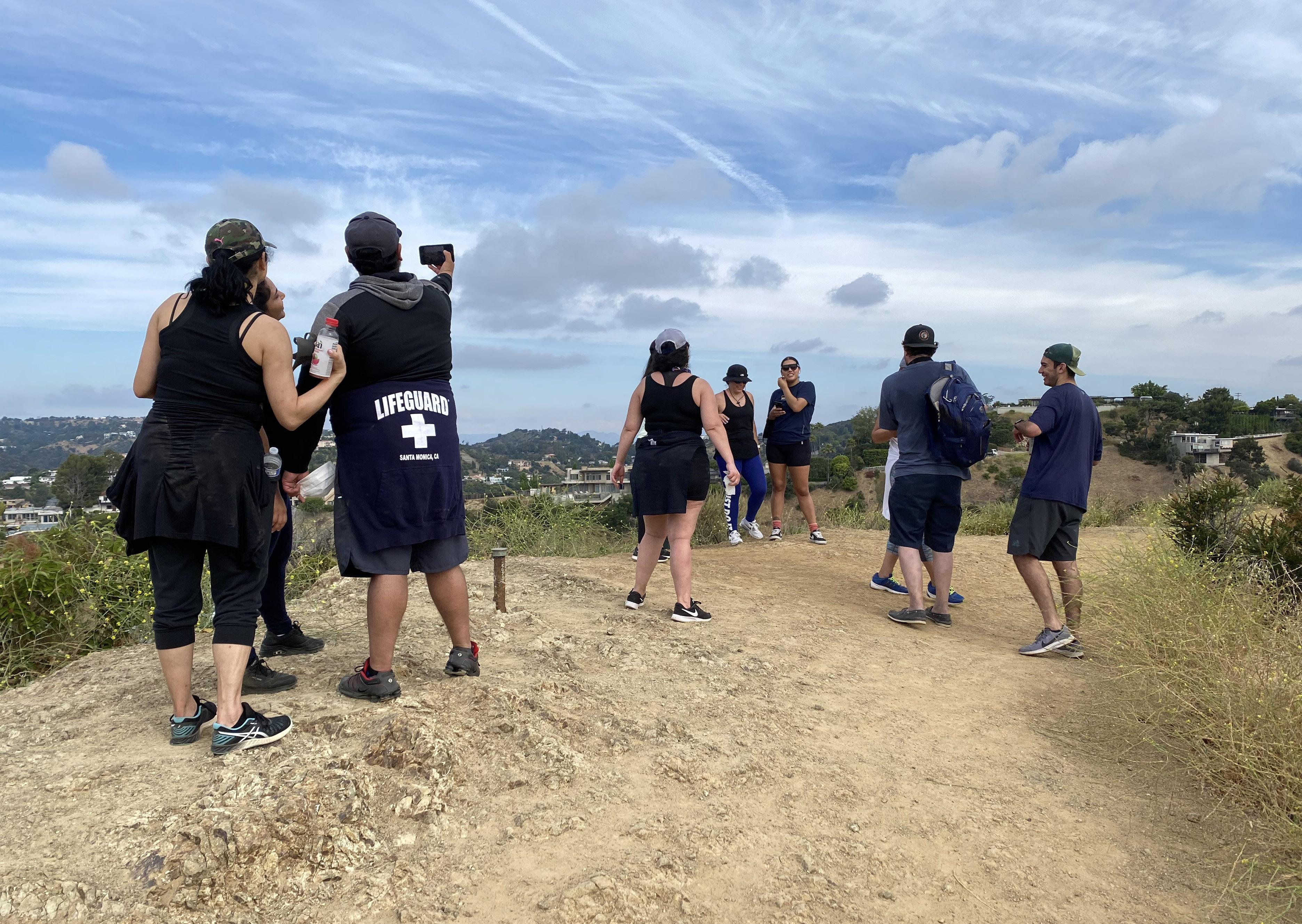 Runyon Canyon, one of Los Angeles’s famed local urban hikes, was finally re-opened this week with social distance measures, including mandatory face masks, some trails still closed, one-way trails and marked-off roads. Near the top of the West Trail I had to walk past this group with no masks, no distancing, group selfies, etc. I announced “Hey guys, one-half of Los Angeles is out of work now, and a tremendous number of those people are undocumented workers who have no access to any social services and are worried about how they are going to feed their kids tonight. Don’t you think we could all wear masks to help end this horrible situation?