Topic

By The Numbers Quickie: White and Black Garments Solar Gain Comparison

Viewing 12 posts - 1 through 12 (of 12 total)
Stephen Seeber BPL Member
PostedJun 13, 2026 at 4:04 pm

A member asked a question on my latest article. I am posting this little piece I published in 2019 to help with my response. I could not find it on the site, so here it is again.  I think it is pretty useful when selecting colors for your outer layer.
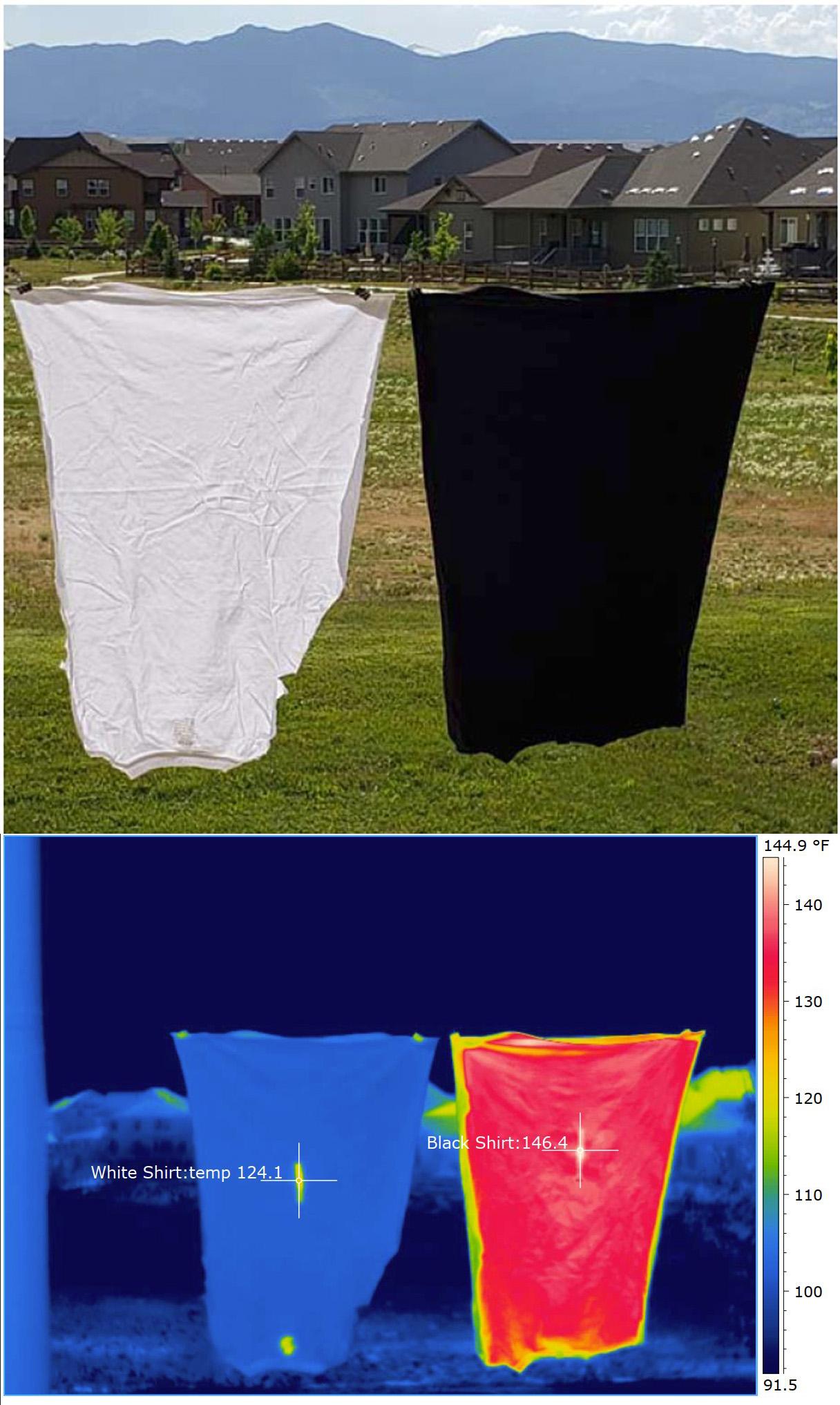
White and black T-shirts were cut in half and hung to
face directly into the sun. A piece of electrical tape is
adhered to each shirt to ensure very high emissivity at
the measurement point. A thermal imager is used to
capture temperatures on the side of the shirt away
from the sun.

The ambient temperature is 93oF. Winds were calm.

Solar gain raises the temperature of the white shirt by
31.1oF. The temperature of the black shirt is increased
by 53.4oF. Wearing light colored clothes in the sun will
substantially reduce the heat load the body must
control during outdoor activities.

Why the difference? Most of the sun’s heat is
contained in the near infrared spectrum. A portion of
the heat is contained in the visible light
spectrum. When sunlight hits the shirts, the white shirt
reflects a portion of the visible light. It absorbs the
unreflected visible light and all of the heat in the near
infrared wavelength. The absorbed energy is
converted to heat. When sunlight hits the black shirt,
nearly all incident energy is absorbed and turned into heat,
and almost nothing is reflected away. Therefore, the black shirt
becomes hotter than the white shirt.

I try to wear a white outer layer during sunny summer hikes. Especially at elevation.


Jen BPL Member
PostedJun 13, 2026 at 7:24 pm

I’d always thought that dark or brightly pigmented clothing provided more UV protection, but this review article suggests that it’s a bit more complicated than that (there’s a “regular clothing” section if you scroll a bit). Apparently quantity/intensity of dye also plays a role…?

Stephen Seeber BPL Member
PostedJun 14, 2026 at 10:04 am

Hi Terran: In principle, dark colors will have lower UV transmission. These were pretty thick cotton, so who knows? I have used UV Intensity Cards from Amazon that allow cheap,useful and simple comparisons of clothing performance. If the sun comes out today, I can see if I can measure anything through these shirts with a card.

Terran BPL Member
PostedJun 14, 2026 at 6:38 pm

Thanks Stephen.

Thinking that thickness and weave would effect UV exposure as well as color. With a thin breathable fabric for a sun shirt, color is more critical. There becomes a compromise between UV exposure and accumulated heat.

Stephen Seeber BPL Member
PostedJun 15, 2026 at 9:26 am

Terran: Those things are all true.  Further, for sunburn, you don’t want to measure just UVA or UVB.  The measurements must be taken using the Diffey erythemal action spectrum. This weights spectral components by their probability of producing sunburn. So, the cards have limited use. I may purchase an instrument that can do this, as it is a subject in which I have some interest. Stay tuned.

Terran BPL Member
PostedJun 16, 2026 at 10:41 am

Down another rabbit hole? Way cool. I think it would be very helpful information. Another variable might be how a fabric preforms when soaked in sweat. Very much appreciated.

Stephen Seeber BPL Member
PostedJun 16, 2026 at 4:59 pm

What I hope to measure is the fractional reduction of UVA and UVB according to the erythemal action spectrum. This spectrum is weighted to the wavelengths most likely to result in skin damage. I hope to figure our how the warnings about color type, fabric thickness, etc. impact likely skin damage. We shall see.  So yeah, another rabbit hole.

Terran BPL Member
PostedJun 17, 2026 at 7:03 am

What role does distance play? I believe light will defuse when passing through fabric, the light waves will weaken. A bellows style shirt seems to work well in this regard. The light energy either bounces off, is absorbed, or is confused as it passes through. As the distance from the fabric grows like in a tent, does the light energy reconstitute?

Stephen Seeber BPL Member
PostedJun 17, 2026 at 8:53 am

Hi Terran: Let’s not get ahead of ourselves. The new instrument will arrive on Monday and then I will go about adapting it to my envisioned task. Then, I will start testing fabrics and see if what I want to do seems feasible.  After that, let the discussion begin.

Terran BPL Member
PostedJun 17, 2026 at 11:56 am

Chasing rabbits…looking forward to your observations.

Brad W BPL Member
PostedJun 17, 2026 at 12:09 pm

I bough a UV card from Amazon to measure a newly purchased OR Echo’s UV blocking ability compared to an older-2-3 year old heavily used but in good repair Echo. The problem with the UV card is they react very vast and trying to capture the cards measurement as soon as the shirt is removed is difficult.  I would love to see someone with real equipment test this.

Viewing 12 posts - 1 through 12 (of 12 total)
Loading...