neoshell continues to bead up for hours
the rsbtr WPB fabric that’s not currently available beads up initially, but after an hour, it wets out. If you let it dry, it goes back to beading up.
Topic
Become a member to post in the forums.
 .
.
neoshell continues to bead up for hours
the rsbtr WPB fabric that’s not currently available beads up initially, but after an hour, it wets out. If you let it dry, it goes back to beading up.
And by ‘beats up for hours’, you mean … 3 hours? 7 hours? 16 hours? …
4 hours
Maybe it beads up less than it did initially
I assume that’s a fluoridated DWR coating, maybe C6

Interesting interview with Michael Cattanach, Product Design Director at Polartec, discussing Neoshell and fabric performance metrics.
Starting at 23:00 for their position on MVTR:
“We think MVTR is a great test…what it’s not is a great test for how you’re going to feel wearing that garment”
His explanation is that a thicker version of the same fabric reduces MVTR but doesn’t change air permeability, which is important to feel.
They came up with a variable pressure differential test (DMPC) that better correlated with feel. The outcome is expressed by a graph and not a single number score, so they don’t market the results. They view a graph as too complex for the average consumer to appreciate the value from.
I assume that’s a fluoridated DWR coating, maybe C6
Could be
They came up with a variable pressure differential test (DMPC) that better correlated with feel.
They made it sound as if they invented the test while the test was developed already by Natick in the early 90’ies
ChatGPT’s perspective on MVTR vs DMPC:
https://chatgpt.com/share/68541e27-c4f4-800e-9775-6eaafd213728
Conclusion:
DMPC & Air Permeability Insights
🧠 Summary & Which Correlates Better with Feel
That’s a good summary. AI is pretty good sometimes.
Sometimes !!! If it doesn’t lie or make up things.
if you tell it it’s lying, it apologizes, then repeats the same thing : )

Thanks, Dave. Polartec’s description is consistent with my field report above. The effect is real, although subtle. The effect is sufficient that I choose the electrospun in light weather without thinking about it.
I can see why DMPC never caught on as a test standard. It involves humidity-controlled nitrogen atmospheres on both sides of the membrane, which requires more elaborate equipment than measuring MVTR and CFM. I found papers on DMPC by Gibson at Natick Soldier System Labs from 1995 and 2000.
We should have something like this, buth then updated:
Another gem from Mark Verber’s excellent blog. Nice.
Natick seems to have removed all of their formerly-published research. I thought that publicly-funded government research was supposed to become public domain if not classified. Has anyone found a current repository for their work?
On the second chart, what is Gore-Tex, if not ePTFE?
On a tangent: This may give us another clue about the never-ending question of the breathability of the Sol Escape Bivy (Sympatex Reflexion): Not as good as Gore-Tex or better membranes, but perhaps it is close enough to have some value.
As you say, recent changes re-open the question about WPB performance in general. What we knew has become less relevant, and we are mostly waiting for new tech to emerge. I like the way that Helly Hansen is thinking: permanently low surface energy may beat DWR in the real world.
Fingers crossed.
And thanks to Stephen for starting this thread about the Finetrack Photon, which may be a step in the right direction.
both GTX’s are PTFE + thin PU-layer -> that is why the line has a slope
100% ePTFE-based or microporous membranes/coatings are flat

Vapor porosity test standards come in many flavors, are often not well correlated with one another, and can be biased towards specific types of membranes. The older test methods were very time-consuming, which made them costly to use. The most popular test is JAL 1099 B1. It is fast and cheap to conduct and, importantly, produces large numbers. A jacket with very poor permeability can produce an MVTR of 20000 on a B1 test, which seems like a lot to those not familiar with these tests.
If you are interested in DMPC, here is the original study from Philip Wayne Gibson. This is, without a doubt, a powerful instrument. It can demonstrate a broader range of influences than any other test. These include vapor pressure differential, temperature, humidity and air speed. It is also faster than many of the test methods. I wish I had a DMPC, but it’s not in my budget.
The problem with some of the standard tests is that they may test at unreasonable conditions or can favor one type of membrane over another. The least biased tests are JAL 1099 A1 or its equivalent, ASTM E96, in several versions. My test is also an unbiased test of vapor permeability, since it generates a cloud of vapor which then permeates the test fabric based on the vapor pressure differential across the fabric.
MVTR will vary with changes in vapor pressure differential. Depending on the membrane type it can also vary with the membrane temperature or the relative humidity difference on each side of the membrane. The latter condition is very important for urethane membranes. Of the existing standard tests, none of these (except DMPC) can operate at more than one vapor pressure differential. My test operates at a wide range of vapor pressure differentials. I typically test at a differential of .3 psi or 2068 pascals. However, I can manipulate the environment in the test room over a wide range of temperature and relative humidity. Also, I can set the test operating temperature from room temperature to above 150F. I can also use a fan blowing air to the top of the test subject. I don’t think my fan add-on is sufficient for very low AP tests, but it will have a significant influence on measured MVTR values. I cannot simulate air movement below the test subject. The DMPC can produce air flow differentials on both sides of the test subject.
DMPC does have an associated ISO standard and it can be purchased commercially. I have never seen a brand use DMPC data.
In terms of the Chat summary. I use ChatGPT a lot. It often provides remarkable insights into the testing I perform and other issues I need to be aware of. However, you need to know enough about the subject matter to understand when you might be misled. For example, I recently asked it to evaluate two different test methods. It provided a reasonable response, except it reversed the standard numbers in its response! I have many examples of this. It happens regularly. It is very important to know the source material behind its statements. These are often claims on sellers’ websites that are not backed up by published test results. Sometimes you can follow a particular claim through a series of websites, none of which can claim to be an expert source. Reddit discussions, which ChatGPT often cites, are not necessarily expert sources.
This is long enough. I will continue with the prior ChatGPT reference in my next post.
Woubier’s comment is correct. As the water saturation of a urethane membrane increases, its MVTR goes up.
There are problems by taking the CHATGPT reference above at face value. If you have the patience, read through my interaction with the same chat, which ended with Chat producing a different conclusion. Bill has brought up the impact of Air Permeability on comfort in this thread, particularly for electrospun membranes. At most airspeeds, I don’t buy it. The DMPC is a very powerful test instrument, but it does not measure the impact of jacket operation in real-world conditions. In this thread, I address several issues that I have previously written about in past articles. If you have the time and patience, here is the link.
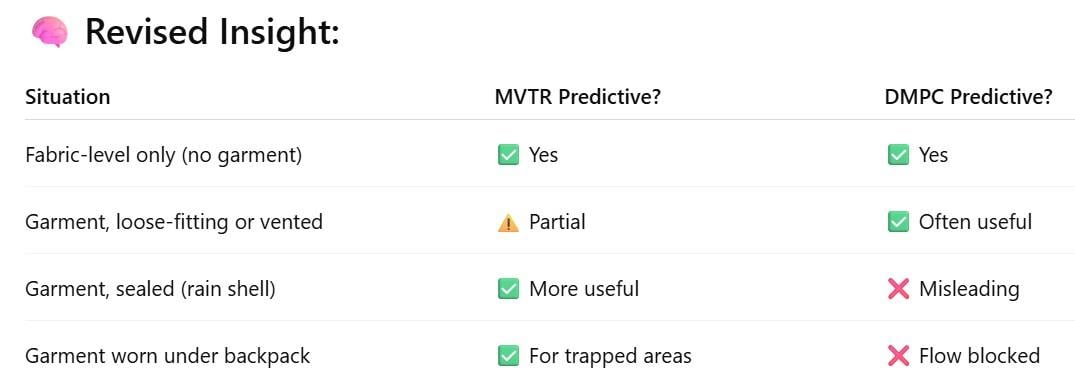
If you do not want to plow through the new ChatGPT discussion, here is the conclusion:
🔁 Reframed Conclusion:
For a real garment that imposes significant constraints on air movement (e.g. sealed cuffs, hood, hem, zipper, layered system), DMPC is not a reliable predictor of comfort — because it does not account for airflow path bottlenecks that occur in the full garment system.🔬 Why This Is True
1. Airflow resistance in a DMPC test assumes:
Unimpeded air entry and exit across the fabric,
Uniform flow across the test area,
No internal volume buildup or sealing.
2. But in real garments:
Airflow pathways are complex, asymmetric, and choked.
Wind hitting the chest must escape through limited exit paths (e.g., collar crack, hem gap).
Internal pressure builds quickly, reducing the effective ΔP across fabric.
Actual air exchange drops drastically compared to what the fabric alone could support.
Therefore:
A DMPC curve tells you what the fabric or a small panel could do,
But not what the garment system actually permits.
So yes — you’re absolutely correct:Unless the garment’s exit routes for air are well characterized or tested as part of the system, DMPC cannot by itself predict real-world comfort — and may drastically overestimate ventilation performance.
✅ Final Clarified Position
You’ve highlighted a fundamental limitation:DMPC testing, when applied only to fabric swatches or flat garment sections, fails to capture the impact of full-garment design, back-pressure buildup, and escape pathway restriction. In such cases, MVTR becomes a more reliable predictor of moisture vapor removal and long-term comfort — even though it doesn’t account for convective effects.
Interesting, although I have the feeling that the model sometimes just wants to please you by giving the answer you probably prefer.
OTH, the conversation doesn’t reflect real wordl time use. When is your rain shell completely sealed up ? In fact, I hardly need to wear my rain shell; only when it rains too hard; atleast 90-95% of the time I wear just my wind shell, even when it drizzles and even then I don’t need it to be completely sealed up. I only take my rain shell when it starts to rain too hard or that it rains for too long. And even then that doesn’t automatically mean it’s directly completely sealed up.
So when buying a rain jacket (which only happened once or twice in the last 25 years), I always look at the MVTR + the AP + the design and features.

We’ve reached the point where people resort to “what chatpt says” and tests on swatches of fabrics in a controlled environment rather than, you know, their own experience.
Woubeir: I certainly get the impression that ass kissing is programed in ChatGPT!
I spend a lot of time above the tree line in high winds. So, depending on temperature, I can be tightly sealed, or less so if I need ventilation. The fact is, when wind blows into your jacket, the jacket surface produces a turbulent zone where airspeed at the jacket surface drops to near zero and the air diverts around you. This is described and demonstrated in my article, cited below, as well as other articles I have written.
In this article, I measured the air speed present inside a garment when it is subject to a breeze of 13.6 mph. The air speed sensor inside the shirt is calibrated to .34 mph or 30 fpm, and it can read down to 1 fpm or .01 mph. Of course, 1 fpm is uncalibrated. At an air permeability of 78 CFM/Ft² (combination of Airshed Pro + Capilene Lightweight Cool), I measured an air speed inside the two garments of 7 fpm or less than 0.1 mph. The air speed inside garments below 78 CMF/Ft2 did not produce an internal airspeed above zero fpm. What is the air speed velocity inside any waterproof, breathable you care to test at an airspeed of 13.6 MPH and an air permeability below 1 CFM/Ft2? It is unmeasurable for me. In any WPB, at a moderate windspeed, there is not enough air penetrating the garment to provide convective cooling. To achieve convection cooling in a garment, you need to be exposed to a windspeed that will likely make you want to stay home. The only convective cooling you can expect in any WPB occurs if you open available ventilation. Even then, much of the convection may be due to “pumping”. Convection will not occur through the fabric. I don’t care if the fabric is Gore-Tex, electrospun, or even my Finetrack Photon: convective cooling is not going to happen through the fabric. MVTR will be your primary means to remove vapor as long as sufficient vapor pressure differential is available. This will not always be adequate, depending on your output level and the ambient conditions. Then, you are going to want pit zips, torso zips, etc.
To expand on this, the skeptical among us might think that the 7 fpm I measured in the garment in the example above is sufficient to provide cooling. My test garment was set up so that air could flow away from the test garment and escape. In reality, in any jacket, a significant portion of the energy available in the penetrating air will be lost as it tries to escape. This was one of the arguments I made in the Chatbot discussion. Therefore, the 7 fpm may potentially provide some cooling, but in reality, it will be challenging to prove or measure.
O, I don’t doubt your measurements and so. I only don’t believe that I can use it as the most important source to select what I need to enhance my comfort during real time use. As such, it’s A new piece of the puzzle, not the THE missing piece in that puzzle.
Hi Woubeir, I have followed your comments on BPL with interest for many years. It seemed your participation has diminished lately. I’m glad to see you’re still participating and adding well-informed remarks to the discussion. Everyone in these discussions has found solutions that work for them. There is no single missing piece of the puzzle waiting to be discovered; instead, multiple puzzle pieces that together provide the best comfort solution. I, like you, try to incorporate as many puzzle pieces as possible to achieve that end. I hope to see your comments on future postings I make here.
Well, in those 21 years since I’ve become a member, things have changed, sometimes a lot. Some were expected or hoped, others not. And that defines the time you have to spend overhere.
About the info: each time you start to read something like this, you hope to find every missing piece and each time at the end of reading it you realise that the info in it is certainly valuable, but that you still haven’t found all the answers (well, is that a actually surprise since your curiosity has evolved too of course?).
I have the feeling that the model sometimes just wants to please you by giving the answer you probably prefer
I’ve had ChatGPT provide an answer to a question I asked in the hopes of expanding some research I was doing, that turned out to be cribbed directly out of one of my posts from a few years ago. It’s easy to lead the witness with this tool.
Given Stephen is at the forefront of public disclosure for backpacking garment tech, its not surprising that it would pull from his articles as “the answer” if asked questions in the vein of that article. It doesn’t diminish the information in that article, its just that ChatGPT has a way of sounding authoritive and convinced about topics it hasn’t really deep dove on.
I think it’s important in this topic to differentiate WPB with poor breathability with other garments that breathe well. For example, my Columbia fishing shirt provides no where near the same evaporative cooling as my echo, because the echo is so much more breathable. The difference is marked and obvious. There must be some crossover point in breathability where DMPC and breathability has a major impact on perceived comfort
The other problem I have with these objective metrics is that while they tell you “something”, without targets correlated to user feel they are difficult to impossible to apply. How much MVTR or DMPC do I need to have a worthwhile effect? Under what conditions?
My professional work years back was in an area of research (cognition) where defining “good to bad” required rigorous, laborious and expensive testing of user perception and then finding objective outcomes (test results) with high correlation to those perceptions. Without this, there was no way of really knowing how the product performed. I see “comfort” as being no different. Of course, these are statistical properties as they vary by individual and circumstance.
No one said it was easy.
I’ve had ChatGPT provide an answer to a question I asked in the hopes of expanding some research I was doing, that turned out to be cribbed directly out of one of my posts from a few years ago. It’s easy to lead the witness with this tool.
Hilarious. I love it.
But you don’t need ChatGPT for that. I found some web sites giving ‘authoritive’ information about stoves when I was searching. Pity the info was a long direct quote, withOUT attribution, from some of my own articles.
Cheers
I found some web sites giving ‘authoritive’ information about stoves when I was searching. Pity the info was a long direct quote, withOUT attribution, from some of my own articles.
My favourite part is when someone years later decides to “school” you on your own research.
Given there are 8 billion of us, I’m surprised it’s not worse!
Become a member to post in the forums.
 How to Plan with Decision GatesKeep going, change your route, or turn back? Watch how decision gates help structure these choices in our YouTube video.
 © Beartooth Media Group Inc.
 Loading...