About 12 years ago I switched from conventional vibram-sole boots to boots with foot-shaped toe boxes (Treksta & Altra) to avoid sore and blistered toes. The changed worked, no more toe issues! However, I noticed that the boots (4 different ones tried) had a tendency to slip on a trail littered with pebbles. They had a tendency to roll like trying to walk on ball bearings. A common feature of all 4 pairs was the absence of a prominent heel. A month ago I had a slip which resulted in a spiral-fractured fibula and a severely sprained ankle. If I can avoid that in the future by switching to boots with a prominent heel, I want to do it. Does anyone know if the boots without heels, think zero lift, have the tendency to slip on pebbles (like ball bearings), while boots with heels not so much?
Topic
Boot Heels: Do they prevent slips?
Become a member to post in the forums.
- This topic has 35 replies, 20 voices, and was last updated 2 years, 2 months ago by .
I wonder if it is depth of tread that is causing this? I have Columbia newton ridge boots, I think. They are more flat like a sneaker but aggressive tread, they do not slide easy. They also have a pretty wide toe box.
I was wearing Altra Olympus 5 mid-height boots when I was injured. The tread depth of those is 1/4″ to 3/16″, depending on the location. I selected the Olympus 5 because they are very grippy on wet rock.
DG on top of hard rock or ground. I don’t think heels make much difference. A good sticky Vibram sole , trekking poles. I’m more nimble in shoes. I get a better footing than with boots. My ankles bend and my foot lands flatter on the ground and I can catch my balance better.
In my case the footing was pebbles on dirt, i.e. nothing for Vibram to stick to. My thought is a more prominent heel would dig into dirt and pebbles (think calf roping). I was using trekking poles. When I stepped forward on my right boot, it slipped forward like it was on ice. The left boot held firm, and I ended up sitting on the inside of my left boot with a twist of the lower leg and ankle. I might have avoided the fall when I was younger. At 73 I’ve lost some agility.
I’d think a heel would help a little, but maybe only a little. Good cleats would seem to be more important, and a stiffer boot (which often has a bit of a heel) usually has better cleats than a floppy trail runner.
The Olympus 5 is fairly stiff, but it doesn’t have a heel. I guess the issue is the size of the pebbles relative to the size of cleats in the sole. If the pebbles are marble-size, then they will be larger than any normal cleat, whereas a prominent heel could be 1/2″…
I think that loose ground and pebbles are always going to present a slipping hazard. Aggressive treads might help. All boots are different, and if you think that your traction was better in previous boots, maybe there is a different way to address the problems you had with your toes.
Also, you mentioned that your agility/balance may be declining with age, I think that’s an idea that would be worth pursuing.
…”a more prominent heel would dig into dirt and pebbles.”
I had the same thought when reading your first post. I’m not sure if it’s true. To me, it makes good intuitive sense. Keens have a very wide toe box and heels.
I had a similar injury when I slipped coming down wet granite–slick rock!–and went down. Broken fibula and a bad sprain. Not fun.
p.s. as every backpacker knows, Dylan wrote about hiking in foggy, cold rainy weather at high altitudes:
Take me on a trip upon your magic swirling ship
My senses have been stripped
My hands can’t feel to grip
My toes too numb to step
Wait only for my boot heels to be wandering
I’m ready to go anywhere, I’m ready for to fade
Into my own parade
Cast your dancing spell my way, I promise to go under it
the cat erased a much nicer version of this.
Meindle USA .. light soft boots with heels.
https://meindlusa.com/collections/mens-collection/products/comfort-fit-light-hiker
i have worn out many many pairs of these.
My suspicion is that there is a another difference at work here; the sharpness and hardness of the rear edge of the sole. I have doubts about a traction advantage due to a prominent heel, but i do feel that my old back in the day vibram soled boots would dig in more with that relatively hard, relatively sharp rear edge than the soft, rounded rear edge of my trail runners do. This may be accentuated by the rear “spoiler” found on some shoes , like my various Altra Lone Peaks. Either that or it was the extra pound plus of swing weight on each foot helping making for a harder impact!
yes, just what Paul said. the structural stiffness of the shank, which is such a bother when it comes to covering ground, may very well work in ones favor during a downhill slip.
on Keens, they do have some sweet toe room, that’s for sure, but in my op, rather indifferent grip .. and with that sort of grip, ya never know when it’s going to turn a dime on you. i bought my mom a 1990 Honda Civic, and the OEM tires were that way too. one could just be motoring along, hit xyz amount of water, along with some specific temperature and,… weeee, sliding thru the turn we’d go. yeah .. right into the other lane too. Michelin’s solved that issue, and she lived to die of natural causes. i miss her. well, not so much her driving, which was hideous, but the entire Mom part … an exceptional woman. thanks Dad.
Hiking with an old Navajo years ago. As he surefootedly hiked in leather soled penny loafers on steep downhills, he constantly harped at me. “Downhill, your weight is always on your toes. Weight on your heals and I will have to carry you out with a broken leg.”
“Downhill, your weight is always on your toes. Weight on your heals and I will have to carry you out with a broken leg.”
I don’t know about that.
Hum. Back in the day when I wore boots (OK, way back), I always found that ‘digging my heels in’ was a good way to handle very steep and loose slopes.
Cheers
<p style=”text-align: left;”>I prefer a heel when crossing on wet rocks and through boulder fields, using the front heel edge at the instep for a more secure hold on a rock edge.</p>
The in-step on my mids and runners have a fair amount of wear and cuts on the instep when I retire them.
I’ve gotten so used to walking this way over 50 years of hiking and backpacking, when I did buy a pair of runners with no heel ridge, I went down a number of times and just used them to walk the dog and mow the law.
Thanks for the significant input. I started this thread simply because I didn’t “remember” slips, mostly with no fall or injury, until I changed to boots with no heels. Of course, my memory could be (is likely) faulty, so I wondered what others in this community have experienced. The comments about the benefit of a stiff heel/shank combination, remind me of hiking steep downhill on soft soil, digging in the heel with each step to control the descent.
The Altra Olympus 5 have a soft lip at the back of the heel. It skids on dirt (or hard snow )where a stiff vertical heel would dig in. Might also skid gravel as one adds weight — no experience, so can’t be sure.
The lip also changes one’s gait in ordinary walking. I removed a lip once from a pair of shoes, which seemed to vastly improve them. Separate matter from the height/thickness of the heel.
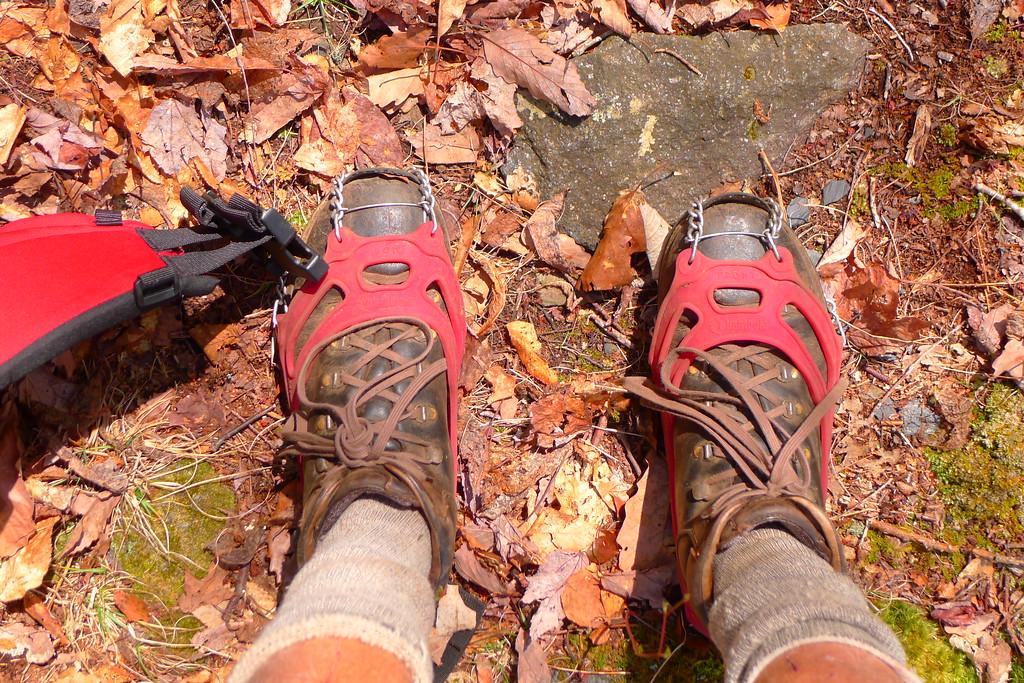
After I hit 70 I started carrying microspikes on all my trips and use them on bare ground if a trail is steep enough to require them. Golfers use cleats, football players use cleats, track and field uses cleats—why not backpackers? The days of the deeply lugged soled hiking boot are over (can find them anymore) hence the cleats.

Tipi, Thanks for the suggestion. I recently acquired a pair of microspikes. In my particular fall, the slope was so gentle that I don’t believe I would have used them, unless I simply use them all the time. I also like your comment about the absence of deeply lugged boot soles. That lack goes along with the absence of prominent heel structures.
All, in the beginnings of research for new boots, I have found a few reviews where customers complain that a boot is “slippery” on a dirt trail with loose material. Has anyone else seen such reports? Is there a common feature of these slippery boots.
Peter—I think the overwhelming onslaught of “running shoes” i.e. tennis shoes, has resulted in alot more slips when backpacking. I sometimes follow behind backpackers in trail runners and get to see how often they slip in mud on trails. This was rarely the case in the 1970s with lugged boots.
I think as we get older we’re not as sure footed. You have to revaluate your gait. I get numbness in my feet so I don’t sense the ground like I did before and I’m slower to correct myself. A softer sole will help, lugs will help, but mostly, it’s how you walk and what you’re used to wearing. Transforming to zero drop is going to change your step.
Walking is a controlled fall. Learn how to fall correctly.
Terran, Aging is certainly a huge factor leading to slips. I am 74. I still have good strength and endurance thanks to a lifetime of workouts that include weight training and low-impact aerobic exercises, like the elliptical. At the same time, there is no way that I have the agility and quickness as when I was younger. Backpacking technology made it possible to reduce my carry-weight for a 1-week trip from 40+ pounds to 25 pounds. That’s enough so that weight is not really a factor for me. Treking poles add additional safety and provide props for a lightweight tent. What’s the right choice for footwear? It’s not clear to me that what works best for a backpacker in the 20-50 age group also applies to the 70+ age group.
Terran brings up a good point—Age. When I was young I fell often on backpacking trips and didn’t think much about it since my body could handle the fall. Then when I hit my 60s I “started to stop falling” because I spent more time studying the ground below me and practicing careful boot placement. Now in my 70s I still carry heavy packs but go slow and use spikes when necessary. It’s all about Endurance when going uphill and Concentration when going downhill.
Become a member to post in the forums.