Topic
Backpacking Chairs: A Comprehensive Guide to the Science of Seated Recovery, Ultralight Chair Design, and Market Landscape
Forum Posting
A Membership is required to post in the forums. Login or become a member to post in the member forums!
Home › Forums › Campfire › Editor’s Roundtable › Backpacking Chairs: A Comprehensive Guide to the Science of Seated Recovery, Ultralight Chair Design, and Market Landscape
- This topic has 17 replies, 15 voices, and was last updated 6 months ago by
Buckeye Davis.
-
AuthorPosts
-
Jul 2, 2025 at 9:44 pm #3837546
Companion forum thread to: Backpacking Chairs: A Comprehensive Guide to the Science of Seated Recovery, Ultralight Chair Design, and Market Landscape
In ultralight backpacking, chairs are often dismissed as luxury. This guide reframes them as recovery tools — exploring their impact on performance, biomechanics, and thermal management. From sit pads to suspended seats, we analyze the design tradeoffs and field use cases that shape the modern camp seating landscape.
Jul 3, 2025 at 7:21 am #3837570I didn’t check all the sources listing but the science here is pretty questionable with small studies in disanalogous scenarios (standing vs sitting in occupational low back pain for example) and not the gold standard of large randomized control trials. It should be noted that much of the world doesn’t sit in chairs. This is very much a cultural activity. It might be argued that westerners bodies are adapted to chairs and it has some benefit in that environment but that’s an assumption. I work in healthcare I’m not aware of any scenario in which providers or physical therapists have recommended chairs over some other alternative. I could imagine various alternatives like lying down, ultralight hammocks, sitting on the ground, sitting on your side etc. I’m cool with people liking and wanting to bring chairs and finding benefits from them, but the arguments made here from the medical side are more speculative than something firm.
Jul 3, 2025 at 8:52 am #3837572I suggest that elevated seating may offer specific utility in mitigating spinal and muscular fatigue compared to unsupported or constrained postures on the ground (excluding lying down).
By promoting more neutral alignment and reducing muscular demand, such seating may aid recovery, particularly in fatigued hikers. Sustained isometric postures – like unsupported ground sitting – can contribute to localized stiffness and fatigue, which may delay movement readiness. While research on backcountry seating is limited, literature from occupational and exercise science indicates that posture and support affect muscle recovery and comfort. These insights support the idea that elevated, supported seating can be a useful recovery tool in certain backpacking contexts.
The context I’m presenting here is limited to using brief periods of seated recovery in a hiking context, and what we can do to maximize offloading when lying down isn’t a practical option.
Jul 3, 2025 at 12:03 pm #3837583I’m a little surprised to see the critique of the effort to quantify the usefulness of a lightweight chair. While I don’t know that the effort is successful, but I really appreciate the effort. Even more than the studies, I appreciate Ryan’s effort to articulate in his commentary things that I’ve thought about previously but have never made the congestive effort to articulate for myself. This has mad it easier to think through the tradeoffs between comfort and weight on any given trip. One thing that I LOVE about hiking anywhere is being able to just sit and look and think and do cognitive work that is difficult in the everyday world. If I don’t have a chair, I find that time is invariably cut short because of discomfort. But if I have a chair, I can sit as long as I need. While I don’t use the word “meditate” because I don’t have a method to this thinking that I like to do in the wilderness, it is, for all intents meditation. I appreciate Ryan’s unpacking of these sedentary mental activities and their benefits to the physical activities preceding and following.
Jul 3, 2025 at 2:24 pm #3837587I don’t need quantitative studies performed over thousands of hours over random individuals to tell me that sitting on the ground or a rock or a fallen tree trunk after eight hours of backpacking isn’t restful. It’s not. And so I’ve taken to stretching out flat in my tent and reading just after a hard hike. BUT: I need to be up and about and taking in the views well into the star studded night. I can’t be trapped in my tent.
Allowing my muscles and spine and posture to relax is truly important. Recovery from a strenuous hike that involves various postures: sitting, standing, sleeping–are all crucial.
I think Ryan is onto something important.
“it must be noted that much of the world doesn’t sit on chairs…” Really? Most of the the world sits on the ground? Hmm, I doubt that.
Jul 3, 2025 at 3:32 pm #3837588Thanks for the writeup Ryan!
“it must be noted that much of the world doesn’t sit on chairs…”
I say.. If you like sitting on a chair, then bring a chair! If you like sitting on the ground, then sit on the ground. But don’t let your ego sit on a chair while you miserably sit in the dirt…
Jul 3, 2025 at 5:44 pm #3837599Every piece of gear needs to earn its way into your backpack because of multiple practical uses. The Helinox Ground Chair has done so by doing 3 jobs I use every time I’m on the trail. 1) It’s a very solid chair. 2) Its a great tray to easily pile up dinner and move to a better vista of that nights stream, river, lake, ledge, etc. 3) Its a tent chair, here’s the instructions (setup the chair, tip it over backwards so the chair back is now laying on the ground, sit on the ground on the chair back, slide backward putting your back against the chair bottom which is now vertical up in the air). This bit of chair jujitsu allows you to sit comfortably in a low built tent to read at night or survive a day of thunder storms. These 3-in-1 practical uses make the case by themselves, leaving therorised performance gains a bonus.
Jul 3, 2025 at 10:23 pm #3837601So that’s why I keep falling to the side when I get up from my REI Flexlite Air. I’m not going to replace it, since I know I can take a nap after lunch in it.
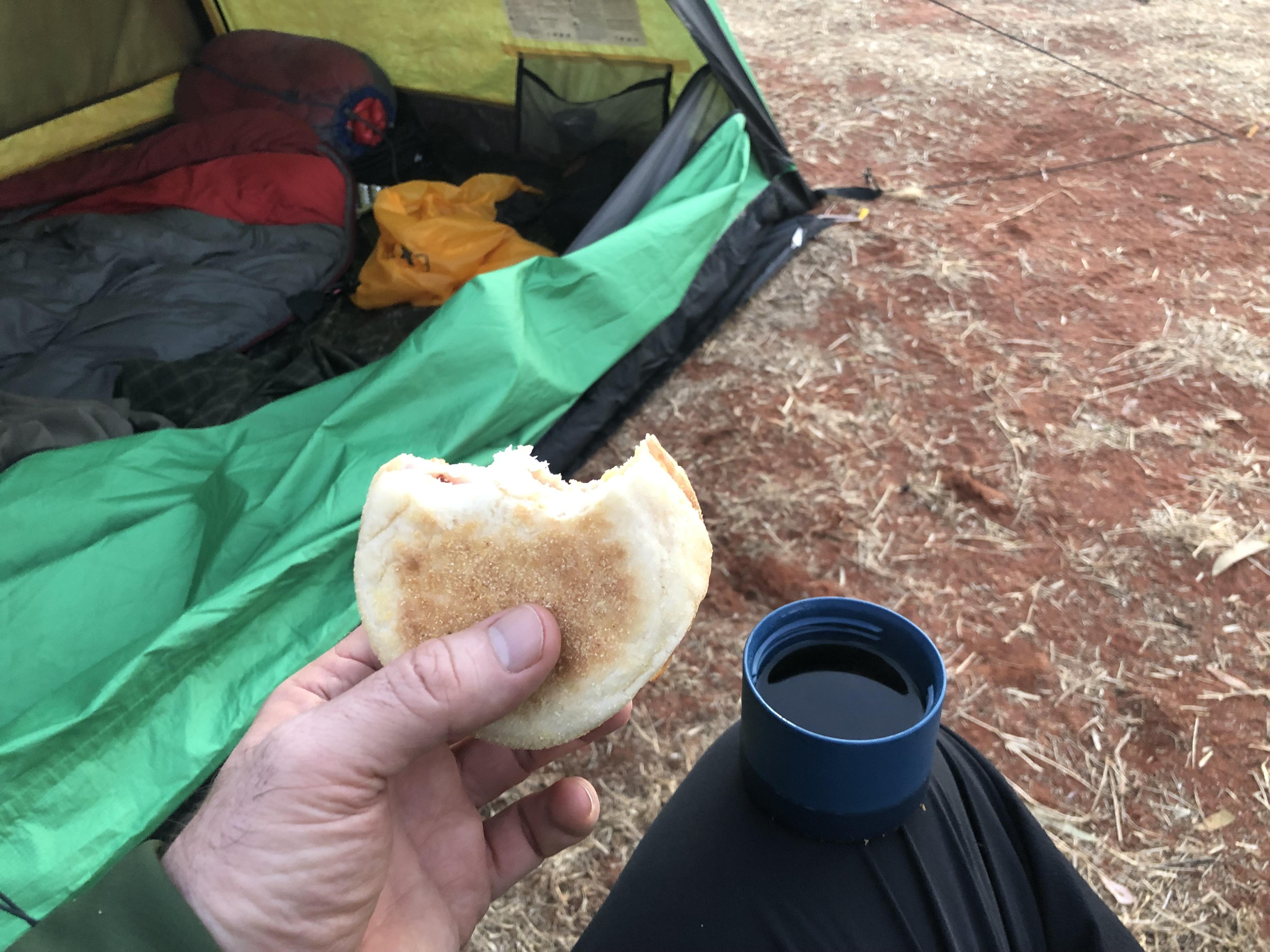
Jul 3, 2025 at 11:38 pm #3837603The other benefit worth consideration is cleanliness. Sitting on a beach/rock/fallen tree even with a sit pad usually ends up with getting mud or charcoal on clothes, sand in zippers etc. Fine stuff like Central Australian sand is very difficult to get out even with machine washing, and can’t be good for your Gore-Tex etc. This is a Mountain Designs (cut-price Helinox clone) about 800gm, Yulara campground, Northern Territory. You can sit in luxury for breakfast (muffin and tea) without getting sand on your cup/Thermos lid, gets you out of the cold tent into the scenic sunrise, more comfy than eating lying down. Any crumbs fall on the sand so no ants attracted into the tent!
Dirt on the chair legs stays in the chair bag till you get home, dirt on your pants ends up on your sleeping bag, in the tent etc. That kills your fabrics/zips quicker. I won’t bother with a chair if I know there’s a tent platform (ergonomic enough without a seat back) for a comfy enough spot on a sit pad.
Moving the chair to follow the sun is also great if you have finished walking and just want to sit and read the Kobo, but the tent platforms are often shaded because they place them off the ridge line.

Jul 7, 2025 at 5:17 pm #3837729Ryan
Thanks for mentioning the DCF ground sheets for the major four legged chairs on the market. I broke a Chair Zero several years ago when I set it up on soft soil and the legs sunk into the ground, cracking a hub apart. There are other options to solve the problem like tennis balls or larger 3d printed feet but the DCF ground sheet is very weight competitive and I just ordered one after learning about it in your article.
Jul 7, 2025 at 10:54 pm #3837748I’m too lazy to read the article, sorry. But I am not willing to carry any extra weight, and a chair will be extra until my body is no longer capable of sitting on the ground. I try to sit on the floor a lot, with the dog, just to read, or in yoga. The more time I spend on the ground or the floor, the easier backpacking is because my hips are looser, and my lower back less uncomfortable without support. Just as I try to train for hiking, I try to train for sitting comfortably without a chair. Training works! (barring disability anyway)
Jul 8, 2025 at 5:18 am #3837751I do CrossFit 2x a week and go rock climbing 1x a week at the gym. At age 54, sitting in a chair is 100x better than sitting on the ground for all the reasons Ryan Jordan cited.
Jul 9, 2025 at 6:51 am #3837790I have been thinking about AK’s suggestion above that one can train for sitting on the ground, my own recent experiences, and the article presented above. I suggest there is space for all of those to coexist.
I believe AK is correct. My own experiences what she has said about becoming comfortable on the ground. I started practicing yoga casually a year ago and that has changed the ways I sit, lay, and touch the ground. In February I moved to a new place which has lovely polished concrete floors. I wasn’t sure if the move was going to be temporary or permanent so I was sitting on the floor, my bed, one of many pads, or a Helinox/Alite. After a month in my new studio, I was visiting a friend’s house and we sat on a sofa and I groaned audibly in pleasure when I sat on his sofa. I sit on a hard round metal art room stool at work so this really was my first time sitting on something soft in a month. I purchased a small sofa a couple of days later and my body feels better because of it. I continue to spend time on the floor but I’m also on the sofa.
So if you practice yoga and sit on the ground a lot it gets better. Also, Ryan is correct that sitting on a comfortable seat is important part of our recovery process.
Based on my own experience of yoga/floor time I encourage others to try that out and see if you can enhance your comfort on hard surfaces whether that is at home or in the field on a trip where you want to stay light.
Jul 9, 2025 at 7:26 am #3837792I have found that doing squats with 10 pound dumbbells makes it easier to get down and back up. Also cross streams and put my pants on in the morning.
That is insane that anyone would carry a chair backpacking. From my perspective. But a lot of people love them. I should try taking a chair just to see.
Jul 9, 2025 at 7:38 am #3837794I have found that doing squats with 10 pound dumbbells makes it easier to get down and back up.
I have a 240lb 1 rep max back squat, and a 210lb 1 rep max front squat. I still dislike sitting on the ground at the end of a long day of hiking. I’m going to Iceland in 7 days to backpack the Laugavegeur trail with friends and we’re bringing tents to avoid sleeping with 20 other snoring people in bunks in the mountain huts. There’s a whole lot of absolutely nothing to lean against, and at Hrafntinusker, I’ve even read that sharp bits of obsidian can be found on the ground waiting to slice up your backpack. Cool. Guess who’s taking an REI FlexLite Air chair with a DCF ground sheet/wrap? (This guy)
There are definitely times when I’ll leave the luxury of a chair behind. For example, if I’m required to carry a bear canister, that becomes my stool even though it’s not as comfortable as a chair. I wouldn’t be opposed to acquiring the MountainSmith Slingback chair just to have something to lean back against.
Jul 9, 2025 at 1:55 pm #3837820Everyone’s needs are different, so other factors need to be considered.
The Helinox chair zero is a torture rack for me because it locks my hips into one specific position causing lower back pain to flare in 30 minutes. I’m much more comfortable on the ground because it allows me to shift pressure points. I’m pretty flexible, which helps.
I bought a Helinox ground chair but never carried it once. I sometimes carry a 9 oz hammock set up (not to sleep in) that’s far more restorative than even a home chair.
The decision is always whether the benefit outweighs the extra load, and the usual answer for me is yes, for 9 oz. It’s also a great way to wash and air out feet and cook dinner while watching the sun go down.
I’d be hesitant to carry much more weight than that.
Jul 14, 2025 at 6:14 am #3838005I was expecting to read through this thread and have a laugh at some strong opinions, and there is some of that. Did not expect to learn much, but I did.
The idea of training for ground sitting is a neat concept. Sitting cross legged can be hard for me if I don’t do it often, but when I make a habit of doing so, it helps stretch out my IT bands to keep my knees lined up and it gets my whole spine back in a good strong flexy state. I wouldn’t call cross-legged restful, but I wouldn’t call myself bendy, and thats something I can address with quick results if motivated by the idea of more comfortable hiking.
Also the hammock idea somehow evaded me. I have lots of hammocks, even a very small custom hammock that is under 4oz including suspension. I slept in it while bike touring but never thought to stash it for long day packs. That could really make my day.
Thanks BPL people. You have once again changed the way I experience miles.
Jul 25, 2025 at 12:38 pm #3838633And think of all the amazing naps you could have, Stefan!
-
AuthorPosts
- You must be logged in to reply to this topic.
Forum Posting
A Membership is required to post in the forums. Login or become a member to post in the member forums!
Our FORUMS are Moderated
Backpacking Light forum posts are moderated and here to foster helpful and positive discussions about lightweight backpacking. Please be mindful of our values and boundaries and review our Community Guidelines prior to posting.