Topic

Are Asymmetrical Mids OK? A Mechanical Engineer's Answer…

Viewing 15 posts - 1 through 15 (of 15 total)
PostedApr 13, 2016 at 10:30 pm

Quick Background: I’m about to make a mid shelter in which me and my wife can sleep on the same side of the support pole. This enables us to share a bag, a bug shelter, and warmth. MLD addresses this issue in the Duomid XL by offsetting the pole position and creating an asymmetrical mid geometry. HMG addresses this issue by making HUGE shelters. I wanted to know what would happen to the stresses of the wall if I angled the pole so the bottom was offset, but the top was not, so the shelter could remain symmetrical. So I calculated the forces of the wall if a 100N wind force was applied to the top of the pole. Its not perfect, but basically, I concluded that there is no MAJOR reason to not just change the angle of the pole, as opposed to creating an asymmetric shelter.

Here Are My Calculations

Thoughts? Am I missing something major?

TLDR: I nerded out on statics trying to design a mid and would like some input…

rmeurant BPL Member
PostedApr 14, 2016 at 5:25 am

An architectural theorist’s answer – use the Locus Gear DPTE approach I.e. Use two poles with an adaptor at the apex, and a symmetrical ‘mid. Frees up all the inner space, and you can cuddle to your heart’s content.

Ron Bell / MLD BPL Member
PostedApr 14, 2016 at 7:34 am

The major plus of the DuoMid XL design over a symmetrical  design in a mid-to-large size 2P Mid is not the strength but that it offers a dry sleeping area for two behind the pole after entry/exit in the rain with the slop area for wet shoes/ gear/ etc in front of the pole.     That is not the case with a symmetrical 2p Mid with an end entry door design.   (I usually offset the single pole in the Solo and DuoMid  toward the door  for more sleep space when using them solo.)

PostedApr 14, 2016 at 7:43 am

Thanks for the input, guys. The other limit of the inverted V pole setup is height, as it requires serious pole extenders to get what I consider a nice height (~5ft). Sounds like a non-vertical mid-pole biased towards the door in my symmetrical myog 8×8 mid will do the trick. The zipper isn’t going all the way to the top, so hopefully not too much weather will come down into the sleeping area during entry/exit. Time to get sewing…

Jerry Adams BPL Member
PostedApr 14, 2016 at 9:26 am

Interesting from many levels

Is this more of an engineering project or do you want a tent you can use?  Some practical considerations aren’t so interesting from engineering point of view.  Like if the zipper goes up more rain won’t fall below.

You must be a millennial.  I didn’t know you guys knew what paper and pencil were : )

To simplify, Cosine of an angle close to zero ~= one, Angling it a bit doesn’t reduce strength much.

One pole is better than two:

They get a little longer because that angle gets further from zero so the cosine starts getting smaller than one.  And then you need a bigger diameter pole.  If a pole is twice as long, for example, you need a much bigger diameter tubing for the pole.  There’s some sort of power relationship or something.

And if you have two poles, they need to be more than half the diameter each.  So the total weight will be more.  Again, there’s some sort of power relationship with strength as a function of diameter of tubing.  Twice the diameter tubing is much more than twice as strong.  (or rigid or whatever…)

I made an asymmetric mid that I’ve used for years.  On the side of the pole I sleep on, the floor is 9 feet x 4 feet.  On the other side is a triangle that extends about 3 feet.  Saves a little weight.

Maybe if you did two people, you could make the side people sleep on 6 feet wide.

The zipper is on the triangle side.  When I open the door, half of that triangle floor area is exposed to rain.  That’s sort of my porch.  The other half of the triangle is covered so I store stuff there.

I like the peak to be 60 inches tall.  Then I can sit up during rainy periods.  I like the zipper to go almost all the way to the top.  Leave it unzipped when it’s not rainy or windy for better ventilation.  Taller peak adds weight though, cancels out any savings from being asymmetrical.  Almost all commercial mids are shorter (to save weight?)

When you sew panels together, you want to sew sides that are on the bias together, and sides that are angled to the bias together, because it stretches differently.  Regular mid this just happens automatically.  A little more difficult with asymetric.  You just have to correctly layout the two panels that make the triangle side.

Pitching a regular mid is fairly easy.  Stake the four corners.  You just have to be square.  Put in the pole.  Done.  Except when the four corners aren’t in a plane you have to finagle with guyline length a bit to compensate.  Or the pitch is funky – wrinkles and ridges aren’t taut.

Asymmetric mid is harder to figure out, but then maybe easier.  Stake the two far corners of the rectangle side.  Put in the pole.  Stake the farthest corner of the triangle.  You have only three corners so they’ll be in a plane.  Then stake the 4th and 5th corners.  If the farthest corner is close to the ground, then when you unzip, the shape of the tent won’t change and you can easily zip back.

I don’t know if any of that makes any sense.  Probably more than you wanted but you said mechanical engineer.

PostedApr 14, 2016 at 10:13 am

Thanks for the info, Jerry. To answer your question, this is a sewing project for a shelter that I will very much be using. I just wanted to nerd out on some engineering and refresh my statics. I like the triangle porch area idea! I’m planning on making a symmetrical 8×8 mid that is about 60 inches high, and ideally, I’d like this shelter to have a “shrinking” capability where I can reef in two opposing walls to make it a 5×8 shelter for use in smaller footprint areas. I think I will just offset the pole at the bottom, and have the top hit the exact center of the mid. I plan on lashing together two hiking poles to do this, so diameter considerations are kind of a non issue. I believe the pole property you are referring to is the “area moment of inertia”, which determines the stiffness of a beam, and in the case of a thin tube approximately equals pi*thickness*radius^3. Okay, too much engineering. Thanks again for all the help!

Jerry Adams BPL Member
PostedApr 14, 2016 at 11:20 am

good idea

if you tried to make asymmetric, you would likely have to iterate.

I still use the same square mid I made first

I have iterated through several variations of asymmetric, and it’s currently a bit of a hack and I really need to re-make it with new fabric

David Thomas BPL Member
PostedApr 14, 2016 at 2:22 pm

Academically, I’m a ChemEng, occupationally an EnvEng.  But I dabble in backyard tree houses, climbing walls, roller coasters, zip lines and bungie jumps.

The pole has to be a little longer if you set it to the side (duh), but the forces are still along its axis (if there was any net lateral force at the top of the pole, it would move until there wasn’t).  Tension of the tent fabric on the pole side will be greater than on the non-pole side.  So you can’t have equal tautness on each side of the tent.  That’s maybe not a problem, but the non-pole side may flap in the wind a little more.  And you need more substantial staking on the pole side.

It seems to solve a problem – wanting a large uninterrupted area – with minimal extra weight: just a few more inches of pole length.  Another possible application would be with an in-tent wood stove.  Those can really eat into the usable space, so getting the pole out of the way could help.  And maybe the pole could serve as a one-picket picket fence between sleepers and the wood stove?  A reminder to stop rolling over in that direction.

Matt Dirksen BPL Member
PostedApr 14, 2016 at 4:05 pm

I wouldn’t underestimate the added resistance required at the ground anchored pole end.

When using an UltaMid 4 in 30-50mph winds the other week, I witnessed the pole tip get hammered straight down into the (arguably soft) soil by several inches. If I had set the pole at any kind of angle to the center, I could imagine it would have easily slipped out of the ground during those winds. Regardless, I still believe your design should work under normal circumstances.

Let us know how it goes!


PostedApr 14, 2016 at 4:10 pm

Good point, there will definitely be some additional forces going on in this setup… I was actually more worried about the stakes pulling out than the pole being driven down/slipping, but I’ll keep an eye out! Will keep everyone posted, just need to a few dozen hours of work time…

PostedApr 14, 2016 at 5:02 pm

Jerry’s tent is a version of the Royce tent — a rectangle plus a triangular vestibule. It seems like the added triangle makes a nice addition for very little weight. The idea is in Horace Kephart’s 1921 book, Camping and Woodcraft. The forces on the center pole of a pyramid can be high in a storm. A friend was on Mt. Rainier during a storm in a Black Diamond pyramid;  the pole started to buckle and they reinforced with ice axes.

This thread has more info:

https://backpackinglight.com/forums/topic/60461/

I made a spread sheet to calculate the weights of Royce tents and half pyramids of various geometries.  The extra fabric to make the half pyramid into a Royce is almost negligible.

PostedApr 14, 2016 at 6:40 pm

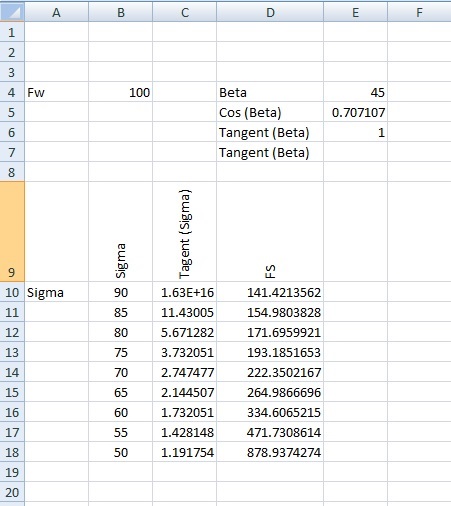
Math seems right but I am not sure about the interpretations.  Ran the numbers assuming that the angle of the tent wall was set at 45 degree and that the pole started at a vertical position (90 degrees) and calculated the stress as the pole took on more of an angle.


Reality check: if the tent pole is vertical then the Fs(x axis) would need to balance the Fw so 100N and then the magnitude of the vector would need to be 100N/cos(45)=141.  Check.  As the tent pole angles out to 45 degrees, Fs should approach infinity. Check.


I may be wrong, but the angle should have a significant impact on the fabric stress.  My 2 cents.


David Thomas BPL Member
PostedApr 15, 2016 at 1:43 am

Good point about ground penetration by the pole.  In some campsites, a simple rock under the pole would solve that.  In other sites, a beer-bottle cap or small-diameter jar lid (salad dressing?) would treble to sextuple the surface area supporting the pole.

Agreed, Jon: If the pole is parallel to one side of the tent, there is no limit to the stress on the fabric nor the compression on the pole.  The pole has to be somewhat in the interior of the tent.  Otherwise, any tension on the non-pole side will pull the pole and in that direction.

Jerry Adams BPL Member
PostedApr 15, 2016 at 8:14 am

I have this little circle of 1/4 inch plywood with a hole part way through for the pole to inset.  It was the remains of a hole saw.  maybe 3 inches in diameter. I painted it red after almost losing it.  I have several more blanks at home.  (I have this problem throwing junk away).  Maybe weighs 1/4 ounce.

I’ve used rocks or a piece of wood but it can slip off, but that works pretty good.

Nick Otis BPL Member
PostedApr 15, 2016 at 3:38 pm

Not an engineer–just my roommates all were in college! Pretty cool to integrate your profession with your hobby here. Interesting thread to read. I’m especially interested in how the ‘shrinking footprint’ part of your design comes out cause then you can get the best of both worlds. Nothing to add here but encouragement.

Viewing 15 posts - 1 through 15 (of 15 total)
Loading...