Topic

Advice switching from Tarp Tent Notch to Bivy + ???

Viewing 17 posts - 1 through 17 (of 17 total)
Phong D BPL Member
PostedApr 20, 2019 at 6:59 am

Hello, in 2016 I did about 700 miles on the PCT most of it was in the Tarp Tent notch.  I liked the Notch, but I didn’t like how it handled the wind.  The double apex causes a loud bang when wind causes one pole to move.  When the poles snaps back into place it makes a sound like the snapping of a whip.  People next to me thought it was thunder!  Its probably because I made it as taut as I can, but I just like trying to keep it from flapping.

Eventually I switched to a Nemo Hornet which is a Fly Creek style tent.  I was surprised at how fragile it was..the materials are extra then and tore on the first night (I made the floor too tight and there was a rock).  I got it replaced for free at REI and have been gentler on it and it’s treated me well.  It’s much quieter in the wind than the Notch, but the materials are very thin to try to make up for the heavier pole design.  It was also much warmer than the Notch, as it was easier to get the fly down low to cover more of the mesh.  I hate to admit it, but I liked that fact that it adds a lot of warmth as opposed to the more open design of the Notch.

So my perfect dream setup would be something fairly warm…but also stable in the wind.  I also like the idea sleeping “outside” on nice days.  I did that a few times on the PCT and it was very rewarding.  So…I made my own lightweight bivy.  It has a mesh face so its not for rain, it would need something on top of it.  Its very warm compared to either my tarp tent or the Nemo Hornet.  My question is this: I want to put shaped tarp on top of it, but am worried about how shaped tarps can handle storms.  Do shaped tarps handle wind better than a Nemo Hornet or equivalent (like the Fly Creek)?  What about the Tarp Tent notch?  Its noisy in storms but I’m thinking about safety now.  My option would be to take my bivy for most nights and ALSO carry another “something” for rain and storms.  Because the bivy is so light (sub 1 pound) I dont mind carrying another 2 pounds if it means its safe in weather.

So here it is:

  1. Bivy + Tarp Tent Notch
  2. Bivy + Nemo Hornet
  3. Bivy + Something else

What is best for bad weather?  PS I know the Tarp Tent guys sometimes are on this forum…I love the Notch just looking for good advice!

Thanks!


James Marco BPL Member
PostedApr 20, 2019 at 1:29 pm

It depends on the conditions. You like it warm. That is hard with any solo shelter and still have enough room & ventilation for low condensation. Tarptent works well when it is warm, like summer conditions. The Nemo is a bit warmer, and the mesh covers/hides the condensation pretty well, but the three pole design makes it heavy and there is no way to re-purpose the poles as something useful, therefore it’s heavy. Even modern Tarptents are heavy (discounting the expensive DCF/cuben Notch/Aeon, something you DON’T want until you finalize your shelter requirements.) Any enclosed roof will be fairly water resistant. Looking at the old 18oz Squall design, you find that the tarp, mesh and floor were outgrowths of need, not convenience. Nemo started off heavy with airbeams. While they dropped the airbeams, they remain heavy…more “comfort oriented” than “need” driven.
As far as bad weather goes, you really have to define what you mean. I have ridden out 40mph with some very high gusts in wind storms with a simple tarp, but there was no rain. I just needed to get out of the wind to cook, and be comfortable setting stuff down without the wind getting it. Rainstorms of 1-2in/hr have completely flooded the surrounding area with water, while I remained dry under my tarp. Both together was more of a problem, but I managed to keep my bag dry…never needed a bivy, though I had one 30 years ago. Snow caused the tarp to bow down to a couple inches from my face, again, not a problem to simply push the snow off, roll over and go back to sleep. Spindrift was a problem, though. You learn to brush it off before it accumulates, bank up around the perimiter and the front, if you can. No floor means I can cook, dig a kitty hole, or even spill some water without a problem in bad weather. At night, bugs/reptiles aren’t very active in the ADK’s. (It averages about 50F even in July and August.) A simple 17oz shaped tarp in a rather large size works for me, nearly perfectly, for the ADKs.

I am a believer in UL packing for Fall, Summer and Spring conditions. Late Fall and early Spring I often carry an extra couple layers of insulation. A good wool sweater, rather loose knitted and thick at about a pound (15oz actually) and a set of mid weight merino wool long johns (at about 14oz.) This puts me at ~11pounds for my base kit which is about a pound more than UL. But, it also rains one out of three days, so I expect my shirt and sweater to get wet(though not soaked) even through my rain gear. Water(rain,) wet rotten snow, melting fresh snow, slippery trails, steep climbs, stream crossings, bushwhacks and blowdowns are my biggest concerns while out. Cooking/sleeping are easy in comparison.

Soo, given my requirements, a shaped tarp and a ground cloth, along with rather careful site selection, work the best for me for three season conditions. There are a few lean-tos in the ADKs, so I will use these shelters when I can. But, my shaped tarp is adequate when no shelter is available. I don’t use a bivy. A couple times I have used my tarp as a bivy, just rolling up in it eating jerky and nuts. I stayed mostly dry, but really it is my last choice. Sometimes, in heavy wind storms, I have to pitch it very low and literally crawl my way into it. When I sit, I push it up with my head, and it tends to buffet my head a bit. But, I can still manage to cook, eat and sleep. Full belly, warm bed…bliss…

PostedApr 20, 2019 at 1:33 pm

Wind makes everything suck, especially that PCT wind. But I think your best choice is to try a shaped tarp with your bivy and if you don’t like the tarp, stick with your Nemo Hornet. I don’t think you really need a bivy at all to sleep out under the stars.

Lester Moore BPL Member
PostedApr 20, 2019 at 5:55 pm

Your option number 3 would save you the most weight and give you a shelter that complements your bivy the best. A shaped tarp plus bivy is a versatile combination that works well for 3-seasons and even later with good site selection. As mentioned above, site selection and shelter orientation are a little more important with a tarp than a free standing tent. That said, shaped tarps like the Deschutes (or similar Hexamid) do a pretty good job with moderate winds when oriented correctly.

In summer, leave the bivy at home and use a 3 ounce STS Nano Pyramid mosquito net. If it’s wet weather, you can bring the bivy for warmth and added splash protection. And if it’s shoulder season and cold, you can add a long johns and a down parka to your sleep system, or a 3 ounce VBL, or for the ultimate in added warmth add a 50F synthetic over-quilt for 12-14 ounces.

Phong D BPL Member
PostedApr 20, 2019 at 6:14 pm

Hey James, Diane, I’ll add more info to what hiking I do.  Being in California, I hike sections of the PCT and JMT most of the time.  I frequent this area in late may to early fall, so I mostly avoid the bad weather shoulder season.  In winter I am mostly in the Joshua Tree desert, so basically I almost never encounter heavy snow.  So I’m basically a fair weather camper.  Bad weather to me means being above the tree line and caught in a late may storm or early fall storm.

I should make it more clear, but in terms of warmth, I think my bivy design is warm enough that I actually don’t need the shelter to provide any extra warmth.  Condensation is not a problem where I camp, most of the time its the opposite.  The bivy adds the right amount of humidity and warmth.

The tarp or that “something else” would be just for the random late may early fall storm that might occur above the tree line.

I think I will just have to try out a shaped tarp but the one I am looking at is so expensive…lol…I guess you can say that about any nice gear.  I am thinking of trying one of the cuben mids…but wanted to do some research before dropping 500+ dollars!  My wife will kill me…but its my birthday in a few days so maybe I can get away with it!


Phong D BPL Member
PostedApr 20, 2019 at 6:15 pm

whats a VBL? But thanks for the advice everyone.  Just looked up the STS Nano Pyramid mosquito net.  That looks like just the ticket.  Thanks!

Bruce Tolley BPL Member
PostedApr 20, 2019 at 7:02 pm

For three season backpacking below the tree line in the Sierra Nevada, check out the Grace, Cricket and Patrol tarps in silnylon from Mountain Laurel Designs.

If you are camping above the tree line, a Pyramid type (sometimes called just Mid) shaped tarp will be more wind worthy.

The advantage of a tarp is that you then can adapt your sleep system to your personal preferences and conditions: no bivy, mosquito net bivy, regular bivy with waterproof bottom and water resistant top. Not to mention, you can chose to just sleep under the stars when the weather looks good.

Cheers

Phong D BPL Member
PostedApr 20, 2019 at 7:15 pm

Between the Cricket/Patrol and the Pyramid type, I might have to just buy one for a while.  I’m guessing the Pyramid is my best bet?  I think something like a Doumid would work for my gear…any experience in using something this size in the Sierra’s?  Do they fit relatively easily?

Bruce Tolley BPL Member
PostedApr 20, 2019 at 8:30 pm

I own both a Grace tarp and a MLD Duomid.  If you wanted to make just one investment for all seasons and accept the weight penalty of the Mid, the Duomid would be a good choice. I use my Grace tarp for spring and summer and the Duomid for Winter snow camping.

Any tarp or mid takes up a bit more room when pitching and bit more effort to get the stakes into the ground. One advantage to the Mid is that is takes fewer guylines since you have all four corners pulling down on the center pole. One disadvantage of the Mid is when the pole is in the center, for the first two or three nights you have to remember not to knock it down in the middle of the night.

Does a Mid fit easily?.  The Duomid footprint is 5.5 by 9 feet so it takes up more room that the space- constrained, lightweight tents you named above. But on the inside, you have room for all your gear and with the door open, you could even cook in vestibule area.  Some tall people have reported preferences for Solomid and Solomid XL but I have no experience with those tents. I am 6 ft 2 inches tall and except for one night I was sleeping on a slight slope, I tossed and turned and rolled into the side of the Duomid, have found it long enough.

PostedApr 20, 2019 at 8:44 pm

The double apex causes a loud bang when wind causes one pole to move.  When the poles snaps back into place it makes a sound like the snapping of a whip.

I have neither seen nor ever heard of this before. Can you send a photo of your setup because something is off.  Thanks.


-H

(info@tarptent.com)

Phong D BPL Member
PostedApr 20, 2019 at 9:19 pm

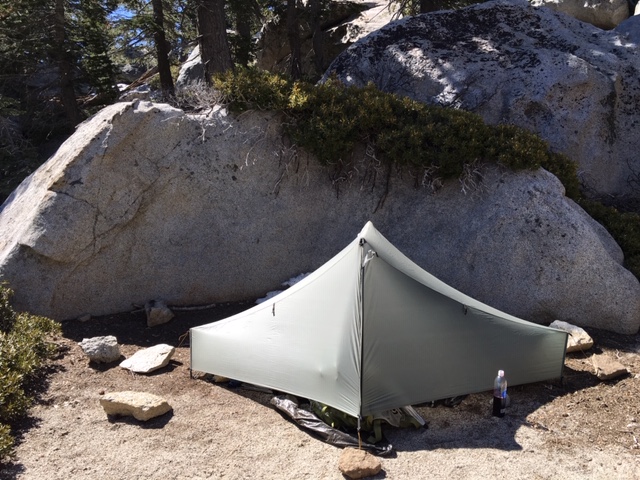
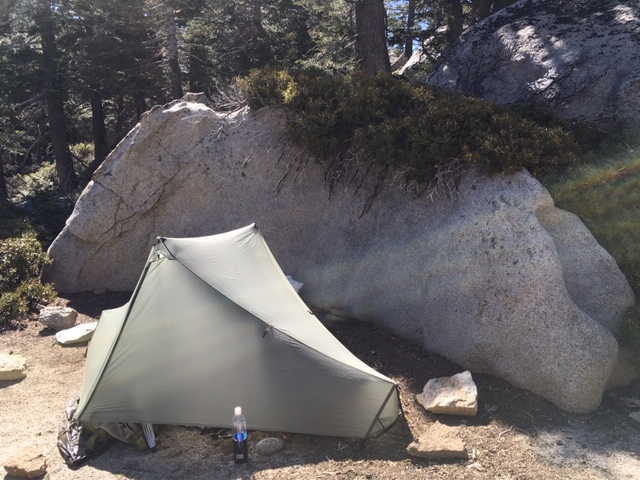
Hi Henry. These images are typical of how I setup the tent. I do tend to pull it very tight. The sound I hear is like the sound when a person snaps a blanket in the air…kind of like snap.

What happened was that a wind blew through, and I think somehow it caught the tent at the right moment and maybe it just all tensioned out at the same time, creating that sound. Maybe it would actually happen in any tent? I’m not sure, I’ve only heard the pop one time. It does however flap a bit more than Nemo, but I think its give and take…the nemo just seemed quieter…the tarptent build way stronger. Since I’m unusually noise sensitive maybe tarp like structures dont work for me?

Matthew / BPL Moderator
PostedApr 20, 2019 at 9:50 pm

Off-topic but the silnylon Notch may be the most attractive tent design I’ve ever seen. Those two photos really show it off nicely. I love how the catenary curves come up to tension so gracefully. The school I used to teach at had a fashion design program and I brought my Notch in one day and set it up in the grass. The fashion students loved it and sketched/photographed it from different angles.

The previous respondents have far more experience than I do but I enjoy the combination of a breathable bivy (MLD Superlight or Borah equivalent) with a either a Mid or cat-cut tarp. I enjoy the simplicity of the bivy in nicer conditions while providing a bug-proof home for the night

My vote for the conditions you mention would be a Mid over a Grace/Patrol/Cricket if you are going to be above treeline. On trips that are less exposed the other three provide a nice reduction in weight and packed volume.

Phong D BPL Member
PostedApr 20, 2019 at 10:01 pm

Yes, the notch looks badA$$! On the PCT I’m sure I’ve sold a bunch of them. If only it could do everything well I wouldn’t need more tents!

Thanks for all the advice. I am going to try my bivy setup with a pyramid of some kind.

Brad Rogers BPL Member
PostedApr 20, 2019 at 10:03 pm

Am correct in that you are not using the Notch with trekking poles and instead using it with flimsier  CF or Aluminum poles ?  I’ve seen trekking poles bend in large mids, but would be surprised one would bend in a smaller shelter like the Notch.  I’ve never heard the complaint you bring up.

My suggestion if you use trekking poles anyways might be a Duomid or Solomid XL with a Solo inner net (solid).  If you don’t use trekking poles, perhaps a Tarptent Moment (with a solid inner)or Hilleberg Enan?

PostedApr 20, 2019 at 11:06 pm

What happened was that a wind blew through, and I think somehow it caught the tent at the right moment and maybe it just all tensioned out at the same time, creating that sound.


I highly recommend adding some apex guylines and stake them separately if possible. Doing that will completely lock the ridgeline.

-H


Phong D BPL Member
PostedApr 21, 2019 at 8:19 am

Hi Henry

You probably nailed it.  I forgot that was an option but I bet that works.


thanks for chiming in!

PostedApr 21, 2019 at 9:35 am

This reminds me of when many years ago a mate and I arrived at a refuge on a ridge. A very expose place but my mate was eager to try out his spinnaker tarp so he set it up. Later on the wind came up so he opted to sleep in the refuge but by then, amused by the time someone took to set up their tent,at I placed my Contrail right on the most exposed spot, just for fun because the other tents were all around that  spot but further down by shrubs and boulders.

As it got dark my mate had to go out to take down his tarp because he had complaints about the noise it made.

Pulling down my Contrail  the next morning , I was told that it wasn’t the sort of tent made for that kind of weather. Oddly I had a good night sleep not worried about others complaining about my loud snoring.

Viewing 17 posts - 1 through 17 (of 17 total)
Loading...