Topic

wearing dark colors in the hot sun?

  • This topic is empty.
Viewing 25 posts - 1 through 25 (of 29 total)
PostedFeb 4, 2015 at 5:25 pm

This is kind of a dumb question, and definitely a frivolous one, so please bear with me :).

I know that it's not wise to wear black in the hot sun, as it will absorb sunlight and make you hotter.

I am in the process of buying some hiking pants. I really, really, really don't want the typical khaki/tan hiker-looking pants; sorry if I sound shallow ;). But a lot of brands seem to be offering a charcoal grey color this year, which I love.

Is dark grey too close to black, and will I end up roasting on my summer hike and regretting not buying the standard light khaki colored items? I don't hate khaki that much, if it means being uncomfortable :).

For example:

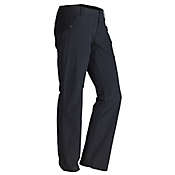
ExOfficio Nomad Roll Up Pant, slate grey

or

Marmot Ginny Pant, Dark Steel

HkNewman BPL Member
PostedFeb 4, 2015 at 6:06 pm

The darker the color, the more sun they tend to absorb. Depends on the solar irradiation of the area you are planning to hike + the season – in southern NM in the hot Memorial Day sun, I couldn't stand the sun heating brown suede on a light hiking shoe during a break and switched to light beige (almost white) mesh on a Moab the next year … been doing that since 2002.

Just to add I've had a black polo shirt bleached flecked gray over a summer; maybe pants wouldn't be quite as bad.

Ed: add

Jenny A BPL Member
PostedFeb 4, 2015 at 6:19 pm

If you got a pair of zip-offs or convertibles, that would give you more options if you start to get too warm.

PostedFeb 4, 2015 at 6:41 pm

Thanks Jenny, HK.

HK, Gah…my shoes are dk brown suede! I didn't even consider those. I started out with light beige, but when I switched sizes, they only had dk brown available. I actually liked the color better and never even thought about the heat! Maybe I need to try to exchange those again too!

David Thomas BPL Member
PostedFeb 4, 2015 at 7:33 pm

White absorbs less heat but emits less heat, too.

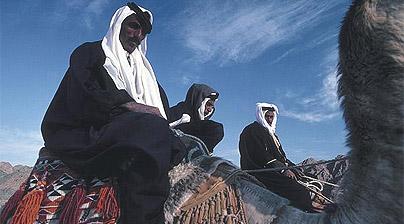
Black absorbs more heat, but it emits more heat back to the environment:

Bedouin in black

Generally, local people seem to use black with more insulation under it, and white in thinner garments like the ones we typically wear in hot weather.

The biggest things for me are: a good shade hat, an umbrella (cooler than a hat), and clothes or a neck bandana that I can wet with water and cool myself off from the outside. I find it less tiring to apply water from a stream to my neck than to sweat it out.

HkNewman BPL Member
PostedFeb 4, 2015 at 7:41 pm

It was a break on an exposed Gila mesa where I could feel the solar heat up my old Vasque lightweights everywhere light mesh wasn't. The ample toe-guard, and brown fuzzy suede. Switched my desert lightweights (w/aftermarket insole) to tan low Merrill Moab's and then the last 3 pr have been off-white/"beluga blue" Moab's which quickly become light beige/gray.

Ralph Burgess BPL Member
PostedFeb 4, 2015 at 7:47 pm

"White absorbs less heat but emits less heat, too.
Black absorbs more heat, but it emits more heat back to the environment:"

I don't think so.

Most of the sun's radiation – black body at 5800K – is in the visible spectrum. "Color" therefore shows (pretty much) what proportion of the sun's radiation is absorbed. Black is what we see when all the sun's radiation is absorbed, white is what we see when all the sun's radiation is reflected.

However, humans are at a much lower temperature than 5800K. We do not emit in the visible spectrum. When we emit heat back the environment it's at much lower energy – infrared. Visible color is not correlated with infrared emissivity – so, other things being equal, black and white clothing both emit similar amounts or infrared radiation back to environment.

Ralph Burgess BPL Member
PostedFeb 4, 2015 at 8:02 pm

"Generally, local people seem to use black"
I think the idea that people in hot countries wear black is something of an urban legend. Some may do, but it's not generally true.

There was a paper that got quite a lot of publicity, it's quite readable, here:
http://faculty.weber.edu/jcavitt/OrnithologyMaterials/Coatcolorinanimals.pdf

It looks at heat absorption in animals with deep plumage or fur. The paper has been misrepresented in the press as an unqualified "black is cooler". What the authors actually found is that with a thin covering, white is always cooler. However, with deep covering such as feathers or long fur, things get more complicated. Since black absorbs more, long black feathers will absorb more at the tips, so solar radiation will not penetrate so easily through towards the skin. if there is no airflow, the radiation absorbed at the tips just gets conducted inwards and is still ultimately absorbed by the skin, so black is still hotter. However, when there is good airflow, the radiation absorbed in the tips may be removed by the airflow before it reaches the skin. So, in a breeze, black may be cooler. But note this is conduction/convection, it has nothing to do with black having better emissivity in infrared – it does not.

The authors are quite modest about these preliminary findings – they state quite clearly that they definitely don't fully understand a complex situation.

Anyway… If you're wearing normal clothing, it's still clear that white is cooler.

If you're wearing very loose clothing with good airflow that simulates feathers – well, then maybe go for black. MAYBE this is what's happening with the loose fitting garments of some desert dwellers… but I have never seen any analysis of this (nor, as I say, is it at all clear that desert dwellers predominantly wear black anyway).

Ralph Burgess BPL Member
PostedFeb 4, 2015 at 8:12 pm

She's got some huge temperature gradients going on there.
Hypothermic in head and butt, heat stroke around the boob and thigh areas.

Lori P BPL Member
PostedFeb 4, 2015 at 8:22 pm

I use gray pants, light or dark, and do fine. No real noticeable difference from the tan/bone colored pants I used to have (and wore out). The breathability of the fabric has more to do with it, IMO. I don't get black pants but have black shirts – it's not really a big deal unless it's 80+ degrees and full sun.

EndoftheTrail BPL Member
PostedFeb 4, 2015 at 8:40 pm

"No, black doesn't make you hot at all."

Kidding aside… black, I don't know — but my travel pants are charcoal gray and I've worn them to both hot/dry and hot/humid places plenty of times and for months at a stretch. Not a problem.

Nathan F BPL Member
PostedFeb 4, 2015 at 8:59 pm

I've hiked in black Montane terra pants and black merino tops throughout the eastern us and south america. This has never presented a problem. Dark clothes look better, stay clean longer, and are preferable for international travel that might include time spent in urban areas as well as on the trail. Again, no perceivable difference in comfort even in hot climates, for me at least.

PostedFeb 4, 2015 at 9:18 pm

I would never choose anything darker than a mid-gray Black? Forget it, at least for warm weather hiking. I notice a HUGE difference vs. light tan clothing. I imagine that this is less an issue in the eastern US, where the intensity of the sun is less acute, but in the southern Rockies, the lighter the better, and preferably loose-fitting.

David Thomas BPL Member
PostedFeb 4, 2015 at 10:59 pm

Ralph,

I agree with what you said, paraphrasing, "black is black in the visible range, white is white in the visible range, but their behavior radiating heat in the infrared is unknown and likely close to each other". I did experiments on pot colors and posted it on BPL. Short story: Black, white, and red are black, white and red in the visible range. But black, white and red are all black in the energetic range of IR (burner and flame temperatures). Whereas shiny metal is a very good mirror of visible and of IR.

I didn't say it explicitly, but I agree we should wear light colors in our thin, western-type clothes. If you're in many layers to insulate you from the heat and from outer layers of clothes while providing air flow and evaporative cooling close to your body, well, heck, I don't know about that, because I've only ever worn that much clothing at -40F, not when I was in 122F or 117F. But my understanding is that black garments in Arabia are part of a thick assemble of clothes.

A variation of your feathers example: umbrellas in India. Black blocks the sun better – it gives you a better spot of shade. On a clear, dry day (less IR from atmospheric water vapor), I suspect you want the umbrella to be pretty high so you get your spot of shade without a hot, reradiating object being so close to you.

Ralph Burgess BPL Member
PostedFeb 4, 2015 at 11:48 pm

Indian umbrellas are interesting, I didn't know that. As you say, it sounds analogous to black feathers. If you have to use cheap thin fabric, the only way to make it opaque is to make it absorb – so choose black rather than white. The absorption raises the temperature of the black umbrella. But, unlike clothing, a large air gap insulates your body from the hot umbrella.

Presumably the ideal umbrella material, if you can afford it, is a shiny mirror-like surface that's completely reflective and completely opaque in the visible spectrum. That's what wealthy BPLers would choose.

Re IR emissivity – you've probably seen this, but compare this to your data:
http://www.scigiene.com/pdfs/428_InfraredThermometerEmissivitytablesrev.pdf
For paints, for example – visible color makes almost no difference at all. But finishes that we perceive as "shiny" or metallic tends to have very low IR absorption & emissivity. Hence emergency blankets.

Lori P BPL Member
PostedFeb 5, 2015 at 6:40 am

"Presumably the ideal umbrella material, if you can afford it, is a shiny mirror-like surface that's completely reflective and completely opaque in the visible spectrum. That's what wealthy BPLers would choose."

Like the Chrome Dome that saved me from melting in exposed full sun at 110f?

I'm not wealthy. It was forty bucks on sale…. And I love mine, and have been offered lots of money for it on the trail.

Ralph Burgess BPL Member
PostedFeb 5, 2015 at 7:22 am

You are Warren Buffett to an Indian umbrella manufacturer… $40 is more than a week's income to the average Indian.

(And if you "compare at $80", that would be more than 2 weeks' income.)

Gary Dunckel BPL Member
PostedFeb 5, 2015 at 8:10 am

When I lived in Saudi Arabia for 5 years back in the '80's, I came to have two rules–wear light colors (tan, yellow, or light gray), and stay out of the direct sun at all times. The Saudi men all wore white, while the women all wore black. I could understand the white, but that black? I also noticed that wearing darker colored pants didn't matter much, but it was essential to have light colored, loose-fitting shirts on my torso. And a light tan or gray wide-brimmed hat. And yes, stand in the shade whenever possible. Direct sun at 120*-130* F is relentless.

Jerry Adams BPL Member
PostedFeb 5, 2015 at 8:13 am

For most of the year when it's cool, I wear darker colors. Sometimes I'll be a bit cold and find some sunlight to stand in and warm up. Or if something's damp it'll dry out.

When it's hot, I'll wear lighter color. Especially shirt. Need long sleeves to provide sun protection.

Valerie E BPL Member
PostedFeb 5, 2015 at 9:30 am

I live in Southern Arizona, where it's (almost) always WAAAAAAYYY too hot (today's high is 82F; it's FEBRUARY fergawdsakes!!).

I, too, hate the whole paramilitary hiker clothing look (shout-out to Mountain Hardwear, for offering some fashionable choices made with tech fabrics).

I have lots of medium-dark gray hiking pants, and they're fine. Frankly, when it's 105F and sunny, it doesn't really matter what colour your pants are — you're gonna be hot. And at the really high temperatures, I'm wearing shorts, anyway (often black ones; yep, for fashion reasons).

I do agree, however, with David about the umbrella (I use a Chromedome), and with Gary that it's the colour of my shirt that seems to matter most.

I have no quarrel with you wanting to feel a bit pretty out there! ;^)

Viewing 25 posts - 1 through 25 (of 29 total)
Loading...