Topic

How many ponchos to make a quilt top?

  • This topic is empty.
Viewing 25 posts - 1 through 25 (of 41 total)
Nick Smolinske BPL Member
PostedJan 7, 2015 at 7:20 pm

So I have this long-running issue with cowboy camping in the desert in winter. I go on a *lot* of trips where I don't bring a tent. No bugs, no rain, no big deal. But sometimes dew can be really annoying, and I'm tired of dealing with a wet down bag in the morning, especially if I won't be getting sun until 2 in the afternoon (I'm looking at you, Grand Canyon).

So I had a thought – my summer quilt (5 oz apex) gets me down to 40 F when I sleep with my winter layers on. And it packs down to about half the size of my down bag (it's a bulky/overly roomy Sierra Designs 650-fill). So I think that rather than spend a lot of money on a better down bag, I might just go back to synthetic and make a quilt with twice as much insulation (maybe layer 6 oz and 4 oz apex from OWF. Or just two layers of 6 oz . . .). Even with that much insulation, I think it will still be about 10 oz lighter than my winter down bag.

Then I had another thought – why not buy a couple DriDucks ponchos to use as the top material for the quilt? That would add some extra water shedding ability. The question is, how many would I need? I'd guess 2 would be enough but maybe 3, just to be safe? And does anyone know the weight per square yard of propore?

IIRC my summer quilt is 72 inches tall and 54 inches wide at the torso.

PostedJan 7, 2015 at 10:01 pm

What might be more useful in your situation considering the conditions, is to block more of the IR radiation from radiating into the open sky/space, which is what is causing a lot of that dew/condensation wet out.

A simple Heat Sheet rigged above you and your quilt would solve that pretty well though course wouldn't be a good idea in windy weather since it's a fragile material. This of course can be reversed and used as excellent solar block in the daytime if need be.

I would not use propore as a quilt material myself. It's just too fragile, and sewing it is problematic. You can tape it though. Ime, tyvek tape works extremely well with propore material.

If you want extra water shedding, create your own super DWR. Take a fairly breathable nylon, and treat the outside with thinned silicone adhesive (not caulk). I've done this with a number of fabrics so far, i use a foam brush and then go over with a smooth microfiber cloth. But first, heat the fabric you will be treating, nice and hot in the dryer and treat in a warm to hot place.

Once the fumes from the paint thinner, which you used to thin the silicone adhesive, has dissipated and it seems more dried, then put in the dryer again to further cure said treatment.

This DWR will should last a very long time, and will strongly repel water. For extra measure, you can treat both sides of the fabric, just make sure your slurry is thin enough because you don't want to overly fill in/block the fabric's interstices which can reduce the breathability too much.

PostedJan 7, 2015 at 10:54 pm

Justin, I've read several of your posts suggesting that you can create your own EPIC-like coating by applying silicone adhesive to fabrics. I don't think that's correct. If you paint on silicone adhesive, with or without diluting it with a solvent, all you're doing is creating a solid coating of silicone on one side of the fabric. This is very different from EPIC.

In the EPIC fabric, the individual fibers are encapsulated and the interstitial spaces are either left open or with a very thin and controlled layer of silicon polymer between the fibers. The EPIC process requires strict control over the viscosity of the silicon polymer/solvent mixture, as well as steps to stretch the fabric substrate and induce shear thinning in the silicon polymer layer to make sure that the fibers are individually encapsulated instead of creating a monolithic layer blocking all fabric pores.

I think all you're doing by painting on silicone adhesive is making a solid layer of silicone on one side of the fabric. Similar to silnylon but without the complete impregnation. This makes the fabric waterproof but completely non-breathable. I guess you could call this a super-DWR, but I think it's a lot closer to simply being a vapor barrier liner. It certainly won't be air permeable like EPIC.

Please read for yourself about the EPIC process in their primary patent: https://www.google.com/patents/US6129978

Nextec has some 50+ patents on silicon polymer coatings for fabrics, most of which are linked to that patent as well, if you want to learn about exactly what they are doing.

PostedJan 7, 2015 at 11:11 pm

"I think all you're doing by painting on silicone adhesive is making a solid layer of silicone on one side of the fabric. Similar to silnylon but without the complete impregnation. *****This makes the fabric waterproof but completely non-breathable.****"

I have done this currently with 3 different fabrics (maxima ESD–treated on both sides, 1.1 ripstop nylon, and a polyester windshirt fabric–two windshirts of this material actually) , as well as beefed up the Deluge DWR on two houdini's.

In NONE of the cases have the fabrics become completely non breathable. In all cases, i can still suck and even blow air through some. The areas of the Houdini treated (shoulder, etc) though are the least breathable now.

It depends on how tightly woven the fabric is before hand and how thick of a coating you apply. Would i do it with M50 or M55, no, they are not breathable enough to begin with, too tightly woven. The interstices would become too small and blocked and would fall under the above issue you cited.

But the fabrics i did it on, all it did was greatly improve water repellency, and decrease breathability some–and in most of these cases, this was an ***improvement****.

Yes, i occasionally talk very theoretically and conceptually about things, but i also talk plenty from experience, and when i concretely recommend something directly to an individual here, it's because i've experience with it and have done and tested it myself.

If you want, i can create a column water pressure tester some time and take video footage of the difference between the silicone adhesive treated maxima ESD fabric compared to the non treated. Or, rather i would prefer to send out some samples to someone with testing equipment and know how already in place.

Nick Smolinske BPL Member
PostedJan 8, 2015 at 6:51 am

What might be more useful in your situation considering the conditions, is to block more of the IR radiation from radiating into the open sky/space, which is what is causing a lot of that dew/condensation wet out.

That sounds like it could be useful, and what I've started to do a lot is rig my mid up with the doors open, so that it acts a little more like a tarp. The issue with doing that all the time, or rigging something up all the time, is more philosophical than practical – I really love laying my bedroll out in the desert with nothing above me. Rigging anything to block IR would just ruin the experience for me . . . I'd rather suck it up and deal with the dew.

So with that said . . . I found a screaming deal on driducks on Ebay. So I'm going to try this anyway; I figure I can always just cut the top layer out of the quilt and sew a new one on later. In the worst case I'll add a "don't try this" note to the collective MYOG consciousness.

I'm also going to try heat-sealing test strips of propore using an iron – the ad copy on the driducks says that it has welded seams. If that doesn't work I might try contact cement or 9485PC transfer tape. This won't help around the edges where I'm sewing between propore and taffeta, but to put the to piece together it should work.

PostedJan 8, 2015 at 8:28 am

Justin, please excuse my skepticism, but I'd love to see a micrograph of that fabric… I have a high-power microscope, but no objective camera, so I don't have a good way to take a magnified image so it might not be very interesting for you to send a fabric sample. But perhaps Richard would be willing to take some images?

Nick, sorry to hijack your thread. Have you considered making a bivy with a Propore top instead of integrating it into the quilt? That way you can take it on or off without modifying the quilt.

Jerry Adams BPL Member
PostedJan 8, 2015 at 8:36 am

That seems weird to buy several Driducks to get the required amount of that fabric. Too bad you can't just buy the fabric.

I have same problem – like to cowboy camp but sometimes dew is a problem.

I have M50 cover – 0.7 oz/yd2 from thru-hiker. More water resistant than other light fabrics. The dew never seems to get through to down.

Above about 2.5 oz/yd2, synthetic is just too bulky and heavy. Down is better. I have a 5 oz/yd2 quilt that I used to use – just need a little extra space in pack and have to replace it more often.

If you just had a space blanket on top of you, I think dew would be almost eliminated, but it's not breathable so you'de get wet inside. Maybe poke holes in the space blanket.

Nick Smolinske BPL Member
PostedJan 8, 2015 at 10:39 am

Lots of good insight here.

I thought about making a separate bivy. It would certainly add versatility. But it seems like that would have more issues with condensation, because it wouldn't have as many venting options. It'll be interesting to see how well it works with the quilt.

A bivy is also heavier because I'm adding the bivy floor and a top layer of quilt fabric. But if I do decide to go the bivy route I definitely like the idea of propore as the top material.

Jerry – I have a 5oz apex quilt already that I feel barely takes up any space in my pack at all. Maybe I'm just used to that bulky sierra designs bag. 10 oz of apex, on the other hand, is definitely to the point where down would be better. Maybe I'll split the difference and do two layers of 4 oz apex.

And I already ordered the driducks, but thanks for the info about Milesgear – good to know for the future. At least the ponchos were really cheap. I don't think I ended up spending much more money. It might even come out cheaper than $5/yd. I just have more seams to deal with this way.

Ryan Smith BPL Member
PostedJan 8, 2015 at 10:45 am

+1 to Paul's post. I think Dave used to also make a propore emergency bivy that didn't have a closure like a normal bivy, just a drawstring or something similar. That may work for you too.

Beyond that, you could also try Tyvek 1443r. Lighter than propore and also breathes pretty well. Can also be purchased by the yard.

Edit: Nick and I posted at the same time.

Ryan

PostedJan 8, 2015 at 1:21 pm

It should be pointed out that the propore fabric that Dave uses is heavier, burlier than dri ducks material, and so would be more durable. When addressing propore before, i was more so referencing to dri ducks the material that Nick mentioned wanting to use.

PostedJan 8, 2015 at 1:48 pm

"Justin, please excuse my skepticism, but I'd love to see a micrograph of that fabric…"

Hmm, well at this point i'm not sure what you are skeptical of? Your original contention was that adding silicone adhesive to a fabric would make it waterproof and non breathable. Neither is even close to being true for the 4 fabrics i've treated (well, close'ish for the Houdini fabric, the areas treated are now very highly water resistant and not very breathable).

Rather than put some pressure on someone like Richard whom is probably a busy person, to test/photograph this material, i will just create another thread on MYOG outlining the steps i took and the conditions and folks can test it for themselves if they want too–it's easy to do and relatively cheap. It's pretty easy to tell when a fabric increases it's water repellency, especially a nylon, or decreases the breathability but is still breathable–doesn't take a rocket scientist to note these obvious changes ;)

Since it seems you are calling into question my basic integrity/honesty and intelligence, perhaps we should make this more interesting. Perhaps a hundred dollar bet that you're off and i'm correct about this? Again, with the understanding that the original degree of breathablity is a higher one (>40 CFM). Some fabrics, like M50 and M55 are so tightly woven, that yes, the process i've come up with would likely render these non breathable and waterproof. Up for it?

I've been careful in the past to call these silicone adhesive treated fabrics EPIC like most of the time, because i'm not claiming that it's the same degree of quality or specific specs/controlled application that Nextec likely has as compared to the DIY projects i've done. I would be surprised if the coating i put on is as uniform as are the coatings as typical for true EPIC fabric, however, once you use a thicker coating of something, you don't have too worry too much if one part of the coating is a little thicker or thinner than another. After all, EPIC is not meant to be fully waterproof and neither are the fabrics that i've treated nor do i want them to be.

See yah on my other MYOG thread.

Richard Nisley BPL Member
PostedJan 8, 2015 at 2:19 pm

Andrew and Justin,

I will micrograph one sample set with and without the coating if Justin PMs me a request.

PostedJan 8, 2015 at 2:36 pm

Would you also be willing to do some HH testing of a treated sample verse an untreated sample? I can send you a treated and untreated sample of fabric. If so, how large should the pieces be? I'll also p.m. you.

PostedJan 8, 2015 at 2:46 pm

Justin, my skepticism is that you can apply enough silicone to coat the fibers without filling the interstitial spaces between the fibers by a simple application of thinned silicone adhesive and some wiping with microfiber. Especially considering it is a well-accepted technique to do exactly that to re-waterproof fabrics that have aged or to turn fabrics into VBL layers (Skurka painted a spare set of shell jacket and pants with silicone adhesive to turn them into VBL on his Alaska-Yukon Expedition.)

My suspicion is that with the fabric samples you've referenced that are still breathable, that you have in fact added little silicone to the fabric and therefore there are sections of fibers that are untreated or lightly treated. That's not what I would call EPIC which is a sophisticated process that completely encapsulates the fibers. Perhaps I don't understand your process, so I would be very interested to hear in detail your process and would encourage you to send a sample to Richard as a micrograph would show exactly what your coating has or has not done.

I don't question your integrity but places like BPL are mainly useful because of the high quality of information presented here and just like in an academic setting peer review of ideas and techniques improves the overall quality of the forums. Hopefully we will both learn something as a result of the exchange.

Andrew

PostedJan 8, 2015 at 3:44 pm

To clarify my idea a little bit…

EPIC according to the Nextec patent:

"A porous web comprising a three dimensional structure of a plurality of structural elements with interstitial spaces therebetween; most of said structural elements are encapsulated by a cured, liquid silicone polymer composition; and most of the interstitial spaces are open."

In contrast to standard silicone coatings (the prior art):

"Prior art fluorochemical and silicone fabric treatment evidently can protect only that side of the fabric upon which they are disposed. Such treatments significantly alter the hand, or tactile feel, of the treated side. Prior silicone fabric coatings typically degrade the tactile finish, or hand, of the fabric and give the coated fabric side a rubberized finish which is not appealing for many fabric uses, particularly garments. […] These surface coatings impart various characteristics to the surface of a web, but do not substantially impregnate the web fibers. Such coatings remain on the surface and do not provide a film over the individual internal fibers and/or yarn bundles of the web. In addition, such coatings on the web surface tend to wash away quickly. […] Such a treated web is substantially devoid of its original tactile and visual properties, and instead has the characteristic rubbery properties of a cured silicone polymer."

I think what you are doing is partially coating the surface with a water-impermeable layer. Covering 50% of the area of a fabric with silicone will of course reduce the air permeability by 50% and will increase the water resistance by 50%… but I would argue this is fundamentally different from an EPIC coating.

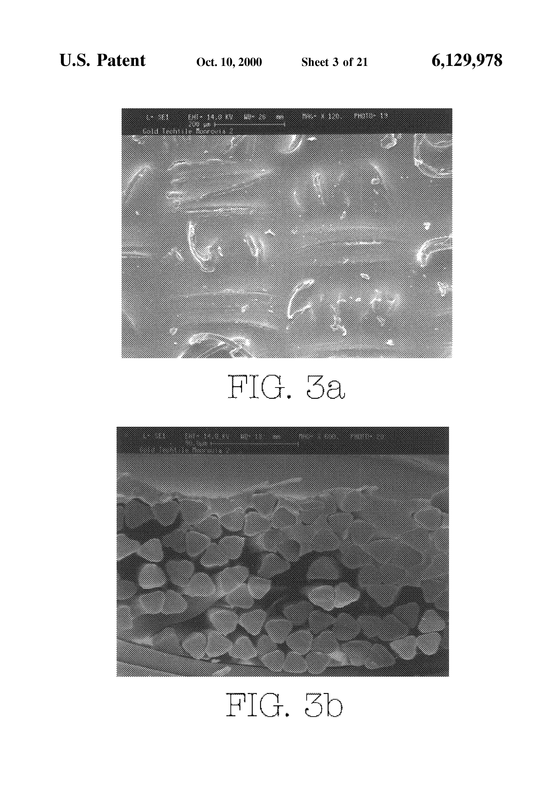
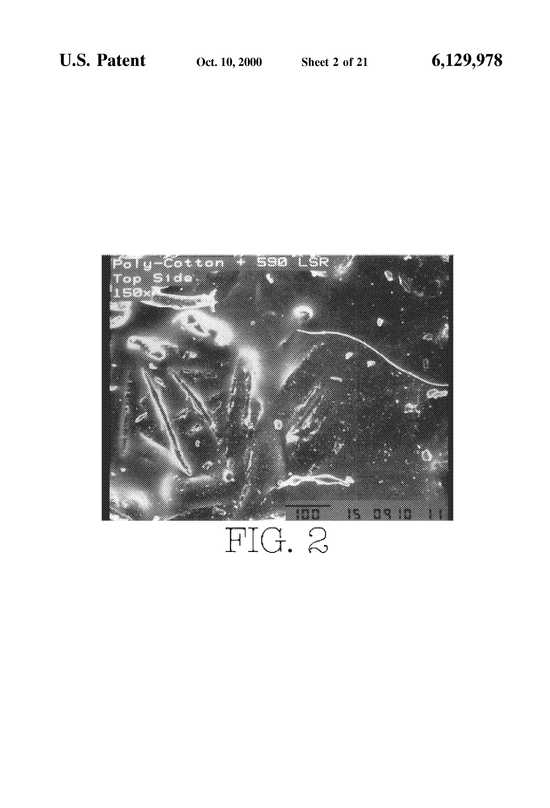
The patent has a few good micrographs which compare an EPIC coating to a monolithic silicon polymer layer:

EPIC treatment (top figure: 120x magnification of EPIC sample, bottom figure: cross section of same sample)
1

Monolithic silicone coating
2

The EPIC layer is much thinner, encapsulates the fibers and (again quoting from the patent here): "Since either filled, plugged, almost filled interstices, or open cells in the region of an internal layer remain transmissive of air in cured webs made by this invention, the webs are characteristically air permeable or breathable."

Edited to fix images.

Richard Nisley BPL Member
PostedJan 8, 2015 at 5:18 pm

Justin,

Yes, I will also test the HH of the before and after sample. Both samples should be ~1' square.

PostedJan 8, 2015 at 8:07 pm

Andrew F…. Sigh…

I don't doubt that Nextec's process of silicone application is more refined, more uniform, and probably at the very least a bit better quality than my own. Let's keep on track for the moment and put this all into context before getting wrapped up in the esoteric's and minutiae of just how deep the layer of silicone goes in my treatment verse official EPIC.

This was one of your original statements, and one i took strong exception to, you wrote, "I think all you're doing by painting on silicone adhesive is making a solid layer of silicone on one side of the fabric. Similar to silnylon but without the complete impregnation. This makes the fabric waterproof but completely non-breathable."

I addressed the above because of how inaccurate and armchair presupposing it was and that's being polite.

Now let's go back to the genesis of this debate. I recommended to Nick S. to create his own super DWR by applying silicone adhesive in a certain manner to a fabric that is fairly breathable to begin with. I call it a super DWR mainly because unlike other DWR's, it does not wear off fast like other DWR's. My informed guess is that this is simply because the coating is much thicker than other DWR type coatings, not any inherent superiority of silicone verse these other substances. As Roger has pointed out, silicone is not the best material for DWR to begin with, because it's soft, doesn't bond well to other materials, etc.

All that may be true, but when the coating is so much thicker than other DWR's, ti i..i..i mmme is on it's side, oh yes it is.

This is why i recommended this DIY treatment to Nick verse getting a typical DWR treated fabric. Getting real EPIC fabric is just a good option and probably better, but also more expensive and limits the choices of fabric and weight. My process being superior in some way over EPIC was never a claim or issue originally, but you turned it into this AFTER i pointed out your original presupposing was so far off the mark as to be laughable.

Btw, making silnylon or similar equivalent is certainly possible with the method i use, but again, you would want/need an inherently more tightly woven fabric to begin with, and apply a more silicone heavy slurry. But when you have only one part silicone adhesive to 10 parts paint thinner, but it's blended up with a hand held blender, and then the fabric is stretched (and was heated) as you strongly rub it in AND you treat two sides, guess what, if the interstices are large enough to begin (eg a more inherently breathable material), the silicone will in a liquid form, get down into the fibers more. Maybe the fibers aren't 100% covered, but certainly they will be more than 50% covered on average.

Now, you take a more tightly woven fabric, a less thinned silicone–say 1 part silicone adhesive to 5 parts paint thinner, and you more so paint both sides, the silicone is going to tend to sit more on the surface and more so fill in the interstices , and one can create a silnylon like material. It's largely a matter of density, both density of fiber to volume ratio and density or thickness of coating.

Again, none of this is rocket science and neither Nextec nor EPIC is magic nor some kind of state of the art, super advanced tech. They had to come up with a process that would allow them to treat large amounts of fabric, quickly, easily, and more cheaply and THAT'S WHAT THEIR R&D LARGELY WENT INTO, MOST EFFICIENT MANUFACTURING PROCESSES, and that some hack like myself came along and roughly and somewhat crudely approximated their tech/end result using more primitive means, is really not all that unusual or unheard of in the DIY/MYOG world.

I also approximated Polygiene's silver chloride treatment, so what, it was easy to hack once i figured out certain key information. If i was into computers (i'm not), i would probably be a talented literal hacker. Being poor your whole life can have a way of making you more resourceful than someone else whom can go out and buy whatever strikes their fancy, or had everything handed to them when growing up. I didn't, and i can't, so instead i figure out how to re-create it.

The credit for the great ideas to begin with goes to Nextec, Polygiene, etc. and whomever originally conceived of them.

PostedJan 8, 2015 at 8:43 pm

Justin,

I'd rather be hiking than arguing on the internet, so I'll keep this short.

Here is my original statement:

"I think all you're doing by painting on silicone adhesive is making a solid layer of silicone on one side of the fabric. Similar to silnylon but without the complete impregnation. This makes the fabric waterproof but completely non-breathable. I guess you could call this a super-DWR, but I think it's a lot closer to simply being a vapor barrier liner. It certainly won't be air permeable like EPIC."

My point was that, I believe your coating with silicone adhesive simply blocks parts of the surface of the fabric, reducing breathability and increasing water resistance in the same way that partially wrapping yourself in a plastic bag would. Yes, your final product has some breathability – probably because your coating doesn't cover 100% of the surface. A plastic bag with holes has breathability as well. I don't know how you applied the coating, so I can't be sure. However, this is fundamentally different than EPIC, and is fundamentally different than almost all other commercial DWR finishes (which are primarily fluorocarbon based and are not monolithic coatings at all). Like I said in the above quote, I believe you've created a partial VBL, not a "super-DWR" or some proxy of EPIC or other waterproof-breathable membranes/coatings.

I hope you found the patent interesting. I learned a few things reading it.

PostedJan 8, 2015 at 9:41 pm

Oh, i think if we are both fully honest with ourselves, we might admit we enjoy a good debate and mental sparring on occasion. At least i do, and considering it's past midnight here and with a "feel like" temp of 10 degrees outside, and i have to work tomorrow, don't think i will be doing much hiking in the present. I do plan to go out this weekend for an overnighter.

Anyways, in any case, i am sending a piece of both untreated maxima ESD fabric (sourced originally from DIY gear supply) and silicone adhesive treated maxima ESD fabric to Richard for it to be tested for differences in HH levels and to be micro-photographed.

This fabric btw, has been treated on both sides, and i can still suck and blow air through all areas of same. You'll just have to take my word on that, unless Richard is willing to also test the CFM of the samples. However, one can extrapolate in an approximate sense, that if the HH is not too high, <1000mm, and the micrographs show regular easily visible pore sizes, that indeed the material is still functionally breathable. Which means, no matter how you cut it, you have added a DWR to the fabric. Whether or not it is truly a super DWR, meaning very durable, would have to be tested by aging processes. I'm confident that it would last longer than wax, fluorocarbon, and silicone spray DWR's.

There is a general inverse relationship between degree of porosity and water repellency, especially in single layer fabrics, though type of DWR and type of weave can also affect HH readings i think.

Just for shites and giggles, i'm going to try to guess the HH of the treated Maxima sample i'm sending to Richard. I'm going to guess it's around 730mm of hh.

PostedJan 8, 2015 at 10:18 pm

Very good Justin. I hope you can make it out this weekend; I'm trying to scrape together an overnighter too.

Since you threw your hat in the ring, I will too for accountability purposes. I predict a hydrostatic head of close to zero and micrographs showing a mostly complete thick silicone coating, but with significant voids.

Nick, sorry again for derailing your thread. As a consolation prize, PM me your address and I'll send you a free piece of Tyvek 1443R big enough for the top of a bivy.

Nick Smolinske BPL Member
PostedJan 9, 2015 at 7:25 am

Nick, sorry again for derailing your thread. As a consolation prize, PM me your address and I'll send you a free piece of Tyvek 1443R big enough for the top of a bivy.

No big deal – I got the insight I needed anyway, now it's just time to make the thing. And ponder Tyvek versus Propore, I suppose – thanks! Maybe I'll sleep in my garage with my summer quilt and try both laid on top of me for comparison. :)

Dave @ Oware BPL Member
PostedJan 9, 2015 at 8:59 am

Add some tiny tie outs/buttons/clips/velcro on your quilt and on your driducks poncho. tie the poncho over the quilt. Then it can be replaced, left off, used as a poncho or tarp etc. Then if it doesn't work you still have a good quilt without the fragile fabric or you can try the sil treatment next, or other possibilities.

If the tie outs were centered on the quilt you could even tie up the side hems or the center ridgeline of the poncho for air flow/air space to try different configurations.

Then let us know how it works!

Viewing 25 posts - 1 through 25 (of 41 total)
Loading...