


Bob Shaver, thank you for your fiction.
Twenty years, huh?
I have a friend who is 85 and who is still going strong. Obviously he has slowed down suitably for his age. Another friend was 83 when he ran his last ultra-marathon.
–B.G.–
Topic
Become a member to post in the forums.
Bob Shaver, thank you for your fiction.
Twenty years, huh?
I have a friend who is 85 and who is still going strong. Obviously he has slowed down suitably for his age. Another friend was 83 when he ran his last ultra-marathon.
–B.G.–
> Everyone has about 20 years of active running in them, and then they are done running.
Amusing idea. Got any published research to support it? Personal anecdotes will not suffice to prove this.
I started running long distance at high school. Represented the school. I am still running at 69, trying to keep up with my wife. (She's the real runner in the family.) A single negative example can disprove a theory.
However, I will agree that if you overload juvenile cartilage and connective tissue, you may do some long term damage. This may be the source of some of your 20 year theory. Also, that's why I insist that young kids should not carry packs of more than 25% of their body weight, to protect their spines.
Cheers
When I was a kid, I started running in the seventh grade. Up to the ninth grade, we were not allowed to run longer than a half-mile. I asked the track coach about running on the team, and I told him I had been running 1.5 mile distances, so he didn't think that was good. From the tenth grade, we were allowed to run the cross-country distances, usually two miles. I think they were trying to protect us from too much hard running at a young age.
–B.G.–
Bones and soft tissues will grow and remodel themselves in response to applied load. A moderate amount of impact training can be good for bones – they'll feel the stress and will become stronger as a result. In this sense, running can be good, so long as it's not over-done. If you stop running, your bones won't feel the stress, and they'll become weaker (which is an easier state to maintain).
These articles are missing the technical details and theory of growth and remodeling, but they get the concept mostly right:
For bones: http://en.wikipedia.org/wiki/Wolff%27s_law
For soft tissues: http://en.wikipedia.org/wiki/Davis%27_law
If you have not read about Edward Payson Weston, I highly recommend you read "The Last Great Walk", by Wayne Curtis. He was a professional walker in the 1880's and in 1909, at the age of 70, walked from New York City to San Francisco in 100 days, averaging 40 miles per day.

I would rather walk or ride my bike all day than run for 15 minutes. When I feel like running, I sit down until the feeling passes :)
proceed (to run) at your own risk. If personal anecdotes don't mean squat, why do you relate your personal anecdote?
I only run if I don't think I can "take on" what is chasing me. Unfortunately this implies I may have run more the older I get. Out in the woods I just need to outrun one other hiker so it may pay to travel in groups with at least one person slower than you.

Formal running and training for me began 50 years ago, coaching runners 40 years ago. As I have aged I am slower, a little stiffer and slower to recover and adapt to training. I've switched to Hokas but the running continues. I currently am averaging an hour a day. By summer I hope to be closer to a 90 minute average. I retire this spring at 65 and hopefully the CT is in my future this summer. It has always been easier for me to run than walk. We all have to choose a path to aerobic fitness that works for us. Declarations of what is good or bad have little meaning beyond our own circumstance. Bike, hike, swim, whatever works. For me, I can't imagine not being able to run.

Somewhere in the middle, the extremes meet…
I think running, with the caveats of in moderation (no marathons, etc) and on certain terrain, can be and is as a trend, healthy and good for many bodies.
Moderation is very important, and terrain too. I started to run again after a hiatus, but i refuse to run on asphalt, concrete, etc. I run on natural surfaces, particularly grass/dirt and to a lesser extent gravel on dirt.
Then there is the matter of one's diet and the rest of one's health and lifestyle choices.
Regular exercise does create some cushion or leeway to abuse the body somewhat and get more away with it than a sedentary lifestyle, but a great healthy diet, relatively clean/healthy environment (air, water, house pollution, etc, etc), and a calm, positive, etc. attitude and approach to life and others GO A LONG WAY in improving the health of the body. With those three plus regular exercise in cahoots, the body can heal and maintain very well unless unusually strong/persistent genetic factors is a huge variable.
Problem is, people get so wrapped up in such specific areas and don't look at things from a holistic perspective of an overall, interconnected, interrelated system. Balance, it's all about balance. Many ignore some facet and focus over much on others.
Personally, i need to work more on the exercise part of the balancing act. I'm too sedentary. Been improving this, but not enough so far.
Study after longitudinal study after longitudinal study has shown absolutely NO relationship between running and the development of any form of arthritis.
This from a 1989 epidemiological study in the Journal of Rheumatology: "No conclusive evidence exists that running causes osteoarthritis; research trends suggest that running may slow the functional aspects of musculoskeletal aging"
Another meta-analysis of all the literature published until 2010 also comes to the same hard conclusion.
So no, running doesn't hurt you. Bad posture, a desk job, being overweight, having many other injuries…these things have known correlations with osteoarthritis. But running does not.
Running DOES improve bone density, cardiovascular health, and muscle tone.

"Running DOES improve bone density, cardiovascular health, and muscle tone."
And, one hopes, my dating chances….

Why is everyone about running? Maybe the theory is that running will help with the backpacking. For some, obviously not. But if it works for you, of course.
My not so SUL backpacking continued until retirement from a career of full time office work. The first summer trek after that one of my pups got sick. We were extracted by a couple who just happened to be named Two Saints (phonetic). The next summer I was doing fine, but after ten days, with no warning, one knee started making funny noises like a rusty gate. As pain arrived and increased daily, the decision to halt another ten days later was a sad but obvious one.
The partial recovery of the knee and return to UL BP took some minor surgery, various medicinals, and 2-3 years of intense daily physical therapy. The heart surgery was still yet to come. That took 3 years to get over, although day hiking and ultra-careful BP continued during that time.
The point is that we are all different, and each must develop their own ways to proceed. But it's a struggle devoutly to be wished, because I'm still trekking, and enjoying it more than ever. Thank you, BPL and posters for all the tips.
" And, one hopes, my dating chances…. "
well, that's what i was thinking too. that way, when they bolt … we can run the to ground.
Thank you Jen!
Hi Bob
> proceed (to run) at your own risk.
OF COURSE. I am responsible for my own actions.
> If personal anecdotes don't mean squat, why do you relate your personal anecdote?
Wrong interpretation.
Maybe the simplest example is the story of the black swans.
All the swans in the UK are white. A theory developed in the UK that 'all swans are white'. This theory was 'supported' every time someone saw another white swan – in the UK. But all that support is NOT proof of the theory.
When early settlers reached Australia they saw black swans. But the 'experts' in the UK rejected the reports because 'all swans are white' – therefore the reports must be wrong, therefore the theory still held.
Chuckle.
You can adduce all the supporting anecdotes you like in favour of your theory – but they mean almost nothing to a scientist. However, just ONE contradicting anecdote is sufficient to render the theory suspect. Granted, many non-scientists (and some scientists) would prefer to retain their theory and reject the contradicting anecdote.
In science terms, it is called the 'null hypothesis'.
Cheers
"Everyone has about 20 years of active running in them, and then they are done running. If you are light in weight, you might get more years of running. If you are heavy, fewer years. At that time, they get back problems, knee problems, hip problems, whatever. If you start running at 20, around age 40-50 you will have issues with diminished connective tissue in feet, knees, hips or back. If you start running at age 50, you've still got 20 years."
I don't think it is quite that cut and dried, Bob. There is so much variability in body type and other genetically determined physical factors that help determine how long a person will be able to run, not to mention the type, volume, and intensity of the running they do, that a universal theory will not accurately predict all, or even most, outcomes. I happen to fit into your theoretical framework, but I have been around many, many runners of widely varying abilities who do not. I suppose we could dissect my experience, but I'm not sure it would prove anything so I'll leave it here.
Edited: What I would say is that both running and hiking with a pack are effective ways to condition oneself for backpacking. In my case, I transitioned from running to hiking with a pack out of necessity, and have found both to achieve my goal. That said, running took me to a level of fitness I could never have attained by hiking with a pack, even allowing for the age differential.
Jambeaux, , As mentioned a few times in this thread and which I highly recommend is that you consider a hammock/ tarp combination. Check out the Hammock Forums, http://www.hammockforums.net, if you have not already as it provides great information on the world of hammocking. I initially purchased a Grand Trunk light weight (cheap and which I still love) hammock to give it a go and am now a dedicated 'hammock camper'. Easy ingress and egress(no kneeling), ease with setup ( no kneeling), and easy on the bones in various sleeping positions. A good nights sleep is crucial for rejuvenation. After years of hard work and play my 40 something year old bones sometimes feel well advanced in years. Hammocks are the way to go IMHO.

Agriculture is less than 5000 years old. Modern humans have been around for at least 60,000 years.
What did hunter-gatherers do every day? Think about it. ANSWER: They walked for hours and hours. That is how we evolved. Sure, our ancestors ran, but probably only when they needed to.
Tom, you came closer to the truth than anyone else on the issue of running, it depends on the individual. For me, I find that steep mountain hikes provide the most demanding cardio. And I don't get the jarring knee and shin pain like I do with running. That's why I'm addicted to mountains.
Just a few sites or citations for research that suggest that endurance running (persistence hunting) was very much a part of hunter gatherer life as well as their anatomy and physiology. It's a topic very much in the mainstream of current anthropological research.
http://www.fas.harvard.edu/~skeleton/pdfs/2007c.pdf
http://jeb.biologists.org/content/212/5/713.abstract
http://www.nature.com/nature/journal/v432/n7015/full/nature03052.html
Pickering, Travis Rayne; Bunn, Henry (October 2007). "The endurance running hypothesis and hunting and scavenging in savanna-woodlands". Journal of Human Evolution (53,4).
Gerald, funny you should mention hammocks. I was at REI just the other day checking them out. I met a guy there that was very knowledgeable about them. There was one thing in particular about hammocks that I didn't go over with him so I'll ask you. Here in FL where I live it's snake and bug city most of the year so a tent with a floor and a bug nest was always mandatory. How is that handled in the hammock world?
Jambeaux
You can buy hammocks with an integrated bug net (like the Warbonnet Blackbird), and you can also get full bug netting enclosures for hammocks that don't have integrated bug nets.
Don't shop at REI. To Google, and look up warbonnet blackbird, Clark hammocks, Hennessey hammocks, and the Dangerbird hammock. Also, Jacks R Better bridge hammock. There are others as well.
The REI near me has Hennessey hammocks.
"Here in FL where I live it's snake and bug city most of the year so a tent with a floor and a bug nest was always mandatory. How is that handled in the hammock world?"
In Florida, the snakes prefer to hammock singly and not with the bugs.
–B.G.–
Become a member to post in the forums.
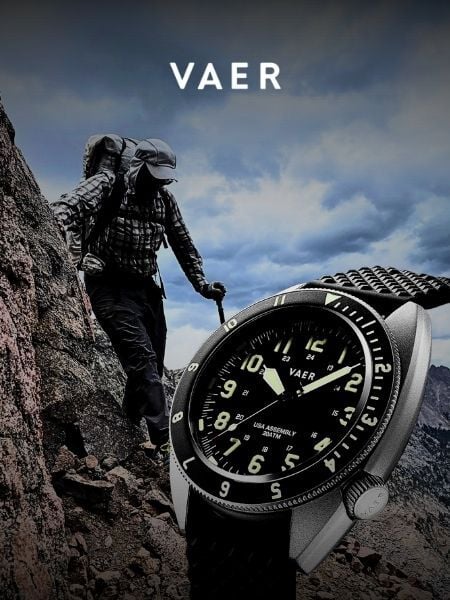 Vaer C4 Tactical Field SolarDurable timepiece for wilderness users - 20ATM (200m) water resistance, 120-click bezel, 316L SS casing, sapphire glass, solar-powered, Epson VS-42 Japanese movement, C3 Lume, USA assembly.
 © Beartooth Media Group Inc.
 Loading...